PUBLISHER: Mordor Intelligence | PRODUCT CODE: 2124878

PUBLISHER: Mordor Intelligence | PRODUCT CODE: 2124878
Induced Pluripotent Stem Cells - Market Share Analysis, Industry Trends & Statistics, Growth Forecasts (2026 - 2031)
According to Mordor Intelligence, the induced pluripotent stem cells market size is projected to expand from USD 2.37 billion in 2025 and USD 2.59 billion in 2026 to USD 4.14 billion by 2031, registering a CAGR of 9.83% between 2026 to 2031.
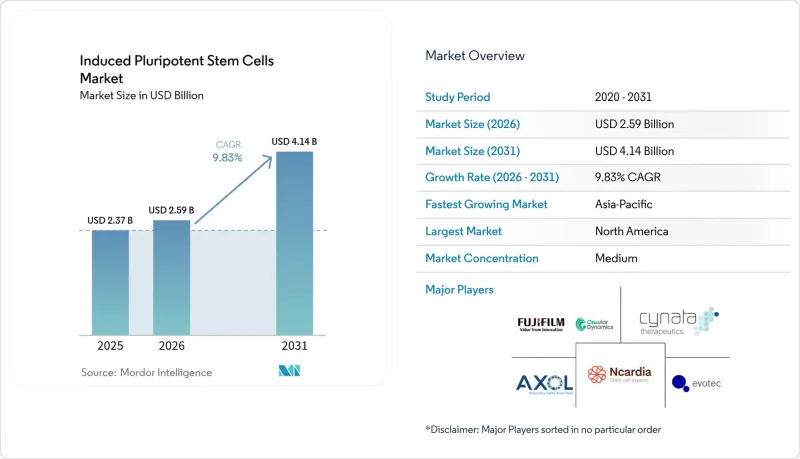
This report is Segmented by Derived Cell Type (Cardiomyocytes, Neurons, Hepatocytes, Fibroblasts, Keratinocytes, Others), Application (Drug Discovery, Disease Modeling, Toxicity Testing, Regenerative Medicine, Cell Therapy, and More), End User (Academic Institutes, and More), and Geography (North America, Europe, Asia-Pacific, MEA, South America). Market Forecasts are in Value (USD).
Global Induced Pluripotent Stem Cells Market Trends and Insights
Surge in iPSC-Enabled Drug Discovery and Toxicity Testing Demand
Pharmaceutical sponsors are switching from animal models to iPSC-derived cardiomyocytes and hepatocytes that flag human-specific toxicities, cutting Phase II failure rates by up to 35 percentage points. FUJIFILM Cellular Dynamics showed that iCell hepatocytes detected hidden liver liabilities in eight compounds that had cleared rodent screens, leading FDA reviewers to accept iPSC data in investigational new drug files in 2024. Takeda integrated these assays into 40% of its early pipeline by 2025, trimming preclinical timelines by six months and saving roughly USD 30 million per asset. Contract research organizations such as Charles River and Eurofins now charge USD 4,500 per compound for full iPSC toxicity panels, less than half the 2023 rate, broadening adoption among small biotechs. Growing regulatory acceptance under the U.S. 21st Century Cures Act and the EU's 3Rs principles further institutionalizes the practice.
Expanding Clinical Pipeline of iPSC-Derived Cell Therapies
Seventeen iPSC-based therapeutics were in Phase I or II worldwide by mid-2025, led by BlueRock Therapeutics' bemdaneprocel for Parkinson's disease, which delivered a 40% improvement on the Unified Parkinson's Disease Rating Scale at twelve months. Heartseed's HS-001 cardiac patch posted a 15% rise in left ventricular ejection fraction without serious adverse events, advancing toward Japan's conditional approval pathway that can cut three years from a typical launch schedule. Fate Therapeutics' FT596 off-the-shelf CAR-NK cells achieved 60% complete responses in B-cell lymphoma, outperforming autologous CAR-T benchmarks by 15 points. Century Therapeutics secured FDA clearance for CNTY-101 gamma-delta T cells for solid tumors, expanding the addressable oncology base. Collectively, these milestones sustain investor confidence in the induced pluripotent stem cells market.
High Cost and Process Complexity for Large-Scale GMP Production
ISO 13485 facilities, 30-day differentiation runs, and whole-genome release testing push batch costs to as high as USD 150,000, pricing many academic spin-outs out of the market. Media costs often exceed USD 2,000 per liter, and yield variability can reach 50%, hampering the reliable cost of goods. CDMOs charge up to USD 5 million for Phase I clinical material, a hurdle for seed-stage ventures. Cryopreservation losses of 30% force manufacturers to oversize production runs, inflating inventory overhead. Although automation cuts labor by 80%, setting up a 500-liter GMP suite still requires more than USD 10 million in capital, delaying scale-out in the induced pluripotent stem cells market.
Other drivers and restraints analyzed in the detailed report include:
- Robust Public and Private Funding Across U.S., EU, and Japan
- Advances in Non-Integrating Reprogramming and CRISPR Editing
- Fragmented Global Regulatory and Standardization Requirements
For complete list of drivers and restraints, kindly check the Table Of Contents.
Segment Analysis
Cardiomyocytes accounted for 28.02% of the induced pluripotent stem cells market share in 2025, supported by pharmaceutical use in cardiotoxicity screening and by regenerative medicine trials such as Heartseed's HS-001 patch. Parallel progress in ventricular-patch trials could open therapeutic revenue streams as early as 2027.
Neurons remain the fastest-growing sub-segment at a forecast 10.06% CAGR. Pharmaceutical interest in Parkinson's and ALS models, combined with academic consortia scaling patient-derived lines, underpins sustained demand. BlueRock's Phase II data and Axol's 50-line isogenic panel validate commercial potential beyond research reagents. Growing neurodegenerative disease burden reinforces the long-run contribution of neurons to the induced pluripotent stem cells market.
Complete Report Scope:
- By Derived Cell Type
- Cardiomyocytes
- Neurons
- Hepatocytes
- Fibroblasts
- Keratinocytes
- Other Cell Types
- By Application
- Drug Discovery and Development
- Disease Modeling
- Toxicity Testing
- Regenerative Medicine
- Cell Therapy
- Tissue Engineering
- Other Applications
- By End User
- Academic and Research Institutes
- Pharmaceutical and Biotechnology Companies
- Contract Research Organizations
- Hospitals and Specialty Clinics
- Other End Users
- By Geography
- North America
- United States
- Canada
- Mexico
- Europe
- Germany
- United Kingdom
- France
- Italy
- Spain
- Rest of Europe
- Asia-Pacific
- China
- Japan
- India
- Australia
- South Korea
- Rest of Asia-Pacific
- Middle East & Africa
- GCC
- South Africa
- Rest of Middle East & Africa
- South America
- Brazil
- Argentina
- Rest of South America
- North America
Geography Analysis
North America contributed 38.91% of 2025 turnover, reflecting FDA clarity, NIH and CIRM grant programs, and a dense venture-capital ecosystem. Canada's STEMCELL Technologies supplies culture media to 70% of academic users worldwide, reinforcing the region's critical input position. Mexico's new Lonza facility signals movement of contract manufacturing into cost-advantaged locales.
Asia-Pacific is projected to grow at 11.67% CAGR through 2031, the fastest among all regions. Japan's conditional approval pathway shortens launch timelines by up to five years, drawing global companies to partner or relocate trials. China's USD 1.2 billion provincial funds and WuXi bioreactor build-out create the largest single new manufacturing corridor for the induced pluripotent stem cells market. India, South Korea, and Australia collectively add momentum through coordinated government grants and translational trials.
Germany, France, and the United Kingdom dominate clinical trial counts, while harmonized MHRA guidance in 2024 streamlined cross-border submissions. Israel and Brazil spearhead Middle East & Africa and South America adoption respectively, lifting those combined regions to an 8% contribution and illustrating global diffusion of the induced pluripotent stem cells market.
- Applied StemCell Inc.
- Axol Bioscience
- BlueRock Therapeutics
- Cellino Biotech
- Century Therapeutics Inc.
- Cynata Therapeutics Ltd.
- Evotec
- Fate Therapeutics Inc.
- FUJIFILM Cellular Dynamics Inc.
- Hitachi
- Lonza Group
- Merck
- Ncardia BV
- Pluristyx Inc.
- REPROCELL Inc.
- Stem Cell Technologies
- Takara Bio
- Thermo Fisher Scientific
- Ushio Inc.
Additional Benefits:
- The market estimate (ME) sheet in Excel format
- 3 months of analyst support
TABLE OF CONTENTS
1 Introduction
- 1.1 Study Assumptions & Market Definition
- 1.2 Scope of the Study
2 Research Methodology
3 Executive Summary
4 Market Landscape
- 4.1 Market Overview
- 4.2 Market Drivers
- 4.2.1 Surge In IPCS-Enabled Drug Discovery & Toxicity Testing Demand
- 4.2.2 Expanding Clinical Pipeline of Ipsc-Derived Cell Therapies
- 4.2.3 Robust Public & Private Funding Across U.S., EU & Japan
- 4.2.4 Advances In Non-Integrating Reprogramming & CRISPR Editing
- 4.2.5 Adoption of Closed-System Automated GMP Bioreactors
- 4.2.6 Emerging Industrial Uses (Cultured Meat, iPS-Platelets)
- 4.3 Market Restraints
- 4.3.1 High Cost & Process-Complexity for Large-Scale GMP Production
- 4.3.2 Fragmented Global Regulatory & Standardization Requirements
- 4.3.3 Genetic Instability / Tumorigenicity Safety Concerns
- 4.3.4 Concentrated Patent Ownership Driving Royalty Pressure
- 4.4 Regulatory Landscape
- 4.5 Technological Outlook
- 4.6 Porter's Five Forces Analysis
- 4.6.1 Threat of New Entrants
- 4.6.2 Bargaining Power of Buyers
- 4.6.3 Bargaining Power of Suppliers
- 4.6.4 Threat of Substitute Products
- 4.6.5 Intensity of Competitive Rivalry
5 Market Size & Growth Forecasts
- 5.1 By Derived Cell Type
- 5.1.1 Cardiomyocytes
- 5.1.2 Neurons
- 5.1.3 Hepatocytes
- 5.1.4 Fibroblasts
- 5.1.5 Keratinocytes
- 5.1.6 Other Cell Types
- 5.2 By Application
- 5.2.1 Drug Discovery and Development
- 5.2.2 Disease Modeling
- 5.2.3 Toxicity Testing
- 5.2.4 Regenerative Medicine
- 5.2.5 Cell Therapy
- 5.2.6 Tissue Engineering
- 5.2.7 Other Applications
- 5.3 By End User
- 5.3.1 Academic and Research Institutes
- 5.3.2 Pharmaceutical and Biotechnology Companies
- 5.3.3 Contract Research Organizations
- 5.3.4 Hospitals and Specialty Clinics
- 5.3.5 Other End Users
- 5.4 By Geography
- 5.4.1 North America
- 5.4.1.1 United States
- 5.4.1.2 Canada
- 5.4.1.3 Mexico
- 5.4.2 Europe
- 5.4.2.1 Germany
- 5.4.2.2 United Kingdom
- 5.4.2.3 France
- 5.4.2.4 Italy
- 5.4.2.5 Spain
- 5.4.2.6 Rest of Europe
- 5.4.3 Asia-Pacific
- 5.4.3.1 China
- 5.4.3.2 Japan
- 5.4.3.3 India
- 5.4.3.4 Australia
- 5.4.3.5 South Korea
- 5.4.3.6 Rest of Asia-Pacific
- 5.4.4 Middle East & Africa
- 5.4.4.1 GCC
- 5.4.4.2 South Africa
- 5.4.4.3 Rest of Middle East & Africa
- 5.4.5 South America
- 5.4.5.1 Brazil
- 5.4.5.2 Argentina
- 5.4.5.3 Rest of South America
- 5.4.1 North America
6 Competitive Landscape
- 6.1 Market Concentration
- 6.2 Market Share Analysis
- 6.3 Company Profiles (includes Global Level Overview, Market Level Overview, Core Segments, Financials as Available, Strategic Information, Market Rank/Share for Key Companies, Products & Services, and Recent Developments)
- 6.3.1 Applied StemCell Inc.
- 6.3.2 Axol Bioscience Ltd.
- 6.3.3 BlueRock Therapeutics
- 6.3.4 Cellino Biotech
- 6.3.5 Century Therapeutics Inc.
- 6.3.6 Cynata Therapeutics Ltd.
- 6.3.7 Evotec SE
- 6.3.8 Fate Therapeutics Inc.
- 6.3.9 FUJIFILM Cellular Dynamics Inc.
- 6.3.10 Hitachi Ltd.
- 6.3.11 Lonza Group AG
- 6.3.12 Merck KGaA
- 6.3.13 Ncardia BV
- 6.3.14 Pluristyx Inc.
- 6.3.15 REPROCELL Inc.
- 6.3.16 Stemcell Technologies Inc.
- 6.3.17 Takara Bio Inc.
- 6.3.18 Thermo Fisher Scientific Inc.
- 6.3.19 Ushio Inc.
7 Market Opportunities & Future Outlook
- 7.1 White-space & Unmet-Need Assessment

