PUBLISHER: Mordor Intelligence | PRODUCT CODE: 2124888

PUBLISHER: Mordor Intelligence | PRODUCT CODE: 2124888
Hospital Linen Supply And Management Services - Market Share Analysis, Industry Trends & Statistics, Growth Forecasts (2026 - 2031)
According to Mordor Intelligence, the hospital linen supply and management services market size is projected to expand from USD 12.43 billion in 2025 and USD 13.41 billion in 2026 to USD 20.09 billion by 2031, registering a CAGR of 8.42% between 2026 to 2031.
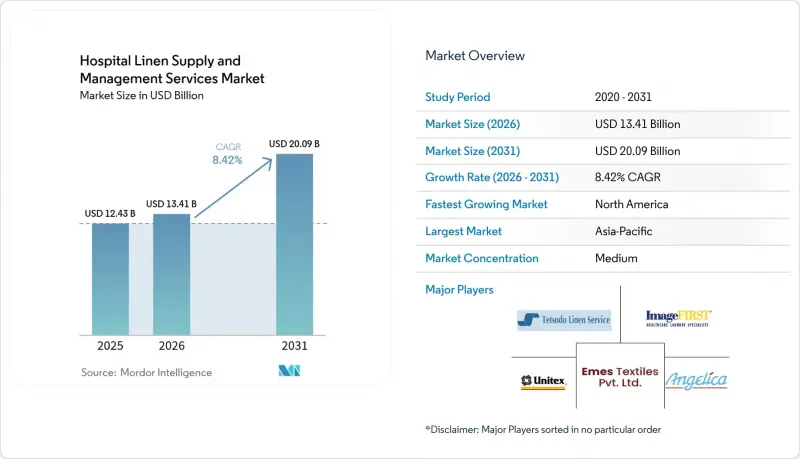
This report is Segmented by Product (Bed Sheets & Pillow Cover, Patient Gowns & Apparel, and More), Material (Woven Cotton & Blends, Non-Woven Disposables, Others), End User (Hospitals, Specialty Clinics & ASCs, Long-Term Care & Rehab Centers), and Geography (North America, Europe, Asia-Pacific, Middle East & Africa, South America). Market Forecasts are Provided in Value (USD).
Global Hospital Linen Supply And Management Services Market Trends and Insights
Rising Hospitalization Rates Amplified by Aging Population
The number of people aged 75 and older will rise by 49.9% in the United States by 2037, a cohort that consumes 2.5 times as many inpatient days as younger adults, driving bed occupancy toward 85%. Each occupied bed produces 9-12 pounds of soiled textiles a day. Longer stays tied to chronic diseases increase linen-change frequency, forcing hospitals either to add on-premises laundries costing USD 2 million per 100 beds or to pivot to HLAC-accredited vendors. China's 60+ population will exceed 300 million by 2030, mirroring the same demand trajectory. As demographic pressure builds, the hospital linen supply and management services market is poised for structural, volume-driven growth.
Stringent Infection Control Regulations Mandating Hygienic Linens
CDC guidelines require 160 °F for 25 minutes or EPA-registered chemistries during laundering, while the Joint Commission obliges quarterly microbial testing and HLAC accreditation for suppliers.These mandates drive capital investment into tunnel washers, ozone injection, and ISO 15797 quality protocols. Antimicrobial textiles infused with copper or silver reduce MRSA and C. difficile transmission by up to 40% and are gaining FDA clearance. Higher up-front linen costs are offset by fewer hospital-acquired infections, aligning economic incentives with regulatory compliance and fueling premium-product demand within the hospital linen supply and management services market.
High Initial Capital Required for On-Premise Laundry Automation
A 100-bed hospital needs USD 2-3 million for tunnel washers, dryers, and finishing lines, plus 5,000 square feet of utility-heavy space. Sub-500-bed facilities cannot amortize these costs, so outsourced providers scale faster, thereby widening the addressable market for hospital linen supply and management services.
Other drivers and restraints analyzed in the detailed report include:
- Cost Optimization Push Driving Outsourcing of Linen Services
- Expansion of Healthcare Infrastructure in Emerging Economies
- Fluctuating Cotton Prices Affecting Linen Procurement Costs
For complete list of drivers and restraints, kindly check the Table Of Contents.
Segment Analysis
Bed Sheets & Pillow Covers delivered 44.12% of 2025 revenue, underpinned by three sheet changes per occupied bed weekly. Patient Gowns & Apparel, however, will grow at 9.20% CAGR, the fastest pace in the hospital linen supply and management services market, as antimicrobial fabrics command premium pricing and hospitals prioritize patient dignity. Surgical Drapes & Wrappers show a structural move toward disposable polypropylene in trauma and cardiac theaters.
Commodity towels and blankets rise mainly with new-bed additions, but the growth edge lies in procedure-specific packs for orthopedic and ophthalmic ASCs that fetch USD 15-25 per kit. Vendors with FDA-cleared antimicrobial portfolios improve margins and enhance stickiness in the hospital linen supply and management services market.
Complete Report Scope:
- By Product
- Bed Sheets & Pillow Cover
- Patient Gowns & Apparel
- Towels & Bath Linens
- Surgical Drapes & Wrappers
- Blankets
- Others
- By Material
- Woven Cotton & Blends
- Non-Woven Disposables
- Others
- By End User
- Hospitals
- Large Hospitals (>500 beds)
- Medium Hospitals (100-499 beds)
- Small Hospitals (<100 beds)
- Specialty Clinics & ASCs
- Long-Term Care & Rehab Centers
- Hospitals
- By Geography
- North America
- United States
- Canada
- Mexico
- Europe
- Germany
- United Kingdom
- France
- Italy
- Spain
- Rest of Europe
- Asia-Pacific
- China
- Japan
- India
- Australia
- South Korea
- Rest of Asia-Pacific
- Middle East & Africa
- GCC
- South Africa
- Rest of Middle East & Africa
- South America
- Brazil
- Argentina
- Rest of South America
- North America
Geography Analysis
North America accounted for 41.05% of 2025 revenue, driven by mature outsourcing penetration above 60% and strict HLAC compliance. Private-equity deals such as PureStar's 2026 acquisition of Emerald Textiles consolidate regional operators into multistate networks. Canada's single-payer system standardizes linen protocols across provinces, while Mexico's medical-tourism corridor raises quality benchmarks.
Asia-Pacific, forecast at 10.97% CAGR, will become the fastest-growing region as China's healthcare spending heads for USD 1.8 trillion by 2030 and India deploys 3 million new beds. Centralized laundry hubs near mega-hospitals in Shanghai and Delhi capture scale advantages, accelerating the diffusion of RFID and ozone technologies in the hospital linen supply and management services market.
Europe faces slower unit growth but leads on sustainability mandates. Elis SA's 440 plants across 29 countries capture multi-country contracts by offering traceable, low-impact wash chemistry. The Middle East & Africa benefits from USD 159 billion in GCC healthcare spending, with Saudi Arabia privatizing 290 hospitals by 2030 and generating greenfield contracts under long-term PPP models. South America's fragmented provider base outsources linen to mitigate currency shocks and tariff costs, though equipment import duties constrain the pace of modernization.
- Alsco Inc.
- Angelica Corporation
- Aramark
- Crothall Healthcare (Compass Group)
- Crown Health Care Laundry Services
- Emes Textiles
- Emerald Textiles
- Elis SA
- Healthcare Linen Services Group
- HCSC Industrial Laundry
- ImageFIRST
- Medline Industries (Linen Services)
- Mission Linen Supply
- Rentokil Initial plc (Initial Medical)
- Stalbridge Linen Services
- Synergy Health (STERIS)
- Tetsudo Linen Supply Co., Ltd.
- Unitex Textile Rental Services
- Cintas Corporation
Additional Benefits:
- The market estimate (ME) sheet in Excel format
- 3 months of analyst support
TABLE OF CONTENTS
1 Introduction
- 1.1 Study Assumptions & Market Definition
- 1.2 Scope of the Study
2 Research Methodology
3 Executive Summary
4 Market Landscape
- 4.1 Market Overview
- 4.2 Market Drivers
- 4.2.1 Rising Hospitalization Rates Amplified by Aging Population
- 4.2.2 Stringent Infection Control Regulations Mandating Hygienic Linens
- 4.2.3 Cost Optimization Push Driving Outsourcing of Linen Services
- 4.2.4 Expansion of Healthcare Infrastructure in Emerging Economies
- 4.2.5 Adoption of RFID-Enabled Tracking Increasing Service Efficiency
- 4.2.6 Circular Economy Initiatives Favoring Reusable Linen Programs
- 4.3 Market Restraints
- 4.3.1 High Initial Capital Required for On-Premise Laundry Automation
- 4.3.2 Fluctuating Cotton Prices Affecting Linen Procurement Costs
- 4.3.3 Shortage of Skilled Laundry Workforce in Urban Hospitals
- 4.3.4 Environmental Concerns Over Water & Energy Use Prompting Scrutiny
- 4.4 Regulatory Landscape
- 4.5 Technological Outlook
- 4.6 Porter's Five Forces Analysis
- 4.6.1 Threat of New Entrants
- 4.6.2 Bargaining Power of Buyers
- 4.6.3 Bargaining Power of Suppliers
- 4.6.4 Threat of Substitute Products
- 4.6.5 Intensity of Competitive Rivalry
5 Market Size & Growth Forecasts
- 5.1 By Product
- 5.1.1 Bed Sheets & Pillow Cover
- 5.1.2 Patient Gowns & Apparel
- 5.1.3 Towels & Bath Linens
- 5.1.4 Surgical Drapes & Wrappers
- 5.1.5 Blankets
- 5.1.6 Others
- 5.2 By Material
- 5.2.1 Woven Cotton & Blends
- 5.2.2 Non-Woven Disposables
- 5.2.3 Others
- 5.3 By End User
- 5.3.1 Hospitals
- 5.3.1.1 Large Hospitals (>500 beds)
- 5.3.1.2 Medium Hospitals (100-499 beds)
- 5.3.1.3 Small Hospitals (<100 beds)
- 5.3.2 Specialty Clinics & ASCs
- 5.3.3 Long-Term Care & Rehab Centers
- 5.3.1 Hospitals
- 5.4 By Geography
- 5.4.1 North America
- 5.4.1.1 United States
- 5.4.1.2 Canada
- 5.4.1.3 Mexico
- 5.4.2 Europe
- 5.4.2.1 Germany
- 5.4.2.2 United Kingdom
- 5.4.2.3 France
- 5.4.2.4 Italy
- 5.4.2.5 Spain
- 5.4.2.6 Rest of Europe
- 5.4.3 Asia-Pacific
- 5.4.3.1 China
- 5.4.3.2 Japan
- 5.4.3.3 India
- 5.4.3.4 Australia
- 5.4.3.5 South Korea
- 5.4.3.6 Rest of Asia-Pacific
- 5.4.4 Middle East & Africa
- 5.4.4.1 GCC
- 5.4.4.2 South Africa
- 5.4.4.3 Rest of Middle East & Africa
- 5.4.5 South America
- 5.4.5.1 Brazil
- 5.4.5.2 Argentina
- 5.4.5.3 Rest of South America
- 5.4.1 North America
6 Competitive Landscape
- 6.1 Market Concentration
- 6.2 Market Share Analysis
- 6.3 Company Profiles (includes Global Level Overview, Market Level Overview, Core Segments, Financials as Available, Strategic Information, Market Rank/Share for Key Companies, Products & Services, and Recent Developments)
- 6.3.1 Alsco Inc.
- 6.3.2 Angelica Corporation
- 6.3.3 Aramark Corporation
- 6.3.4 Crothall Healthcare (Compass Group)
- 6.3.5 Crown Health Care Laundry Services
- 6.3.6 Emes Textiles Pvt. Ltd
- 6.3.7 Emerald Textiles
- 6.3.8 Elis SA
- 6.3.9 Healthcare Linen Services Group
- 6.3.10 HCSC Industrial Laundry
- 6.3.11 ImageFIRST
- 6.3.12 Medline Industries (Linen Services)
- 6.3.13 Mission Linen Supply
- 6.3.14 Rentokil Initial plc (Initial Medical)
- 6.3.15 Stalbridge Linen Services
- 6.3.16 Synergy Health (STERIS)
- 6.3.17 Tetsudo Linen Supply Co., Ltd.
- 6.3.18 Unitex Textile Rental Services, Inc.
- 6.3.19 Cintas Corporation
7 Market Opportunities & Future Outlook
- 7.1 White-space & Unmet-Need Assessment

