PUBLISHER: Mordor Intelligence | PRODUCT CODE: 2124897

PUBLISHER: Mordor Intelligence | PRODUCT CODE: 2124897
Vaccine Contract Manufacturing - Market Share Analysis, Industry Trends & Statistics, Growth Forecasts (2026 - 2031)
According to Mordor Intelligence, the vaccine contract manufacturing market size in 2026 is estimated at USD 4.33 billion, growing from 2025 value of USD 3.90 billion with 2031 projections showing USD 7.31 billion, growing at 11.05% CAGR over 2026-2031.
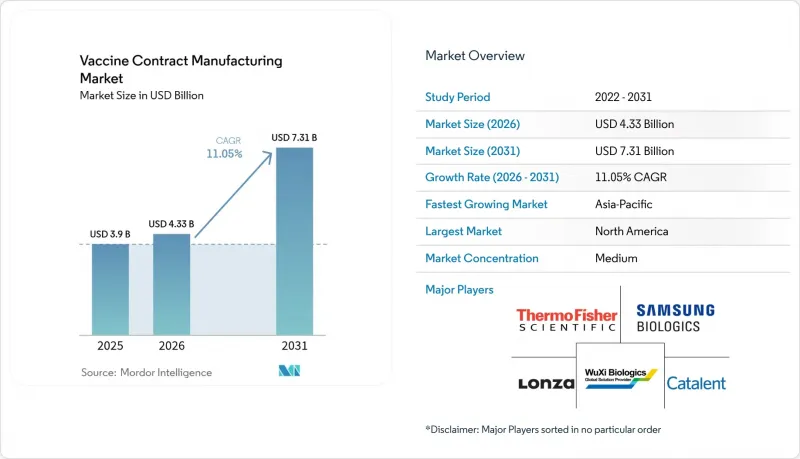
This report is Segmented by Vaccine Type (Inactivated, Live-Attenuated, RNA, and More), Process (Downstream {Analytical & QC, and More} and Upstream {Bacterial, Mammalian, and More), Scale of Operations (Preclinical, Clinical, and More), End User (Human and Veterinary), and Geography (North America, Europe, Asia-Pacific, and More). The Market Sizes and Forecasts are Provided in Terms of Value (USD).
Global Vaccine Contract Manufacturing Market Trends and Insights
Advancements In Single-Use and Modular Facilities
Single-use bioreactors and prefabricated cleanrooms cut green-field build times from seven years to under two, letting sponsors align capital outlay with demand surges. Wacker Chemie's EUR 102 million (USD 119 million) modular mRNA plant shows how standardized blocks can be lifted into multiple jurisdictions without lengthy redesigns, giving the vaccine contract manufacturing market elasticity for pathogen shifts. Capital-light developers gain access to late-phase capacity, while regulators now treat modular suites as equivalent to traditional spaces, trimming validation cycles and smoothing global dossier filings.
Government Immunization Initiatives and Funding Pools
Public buyers now couple purchase budgets with local-capacity targets. Gavi's USD 1.2 billion African Vaccine Manufacturing Accelerator ties grant disbursement to in-country output, and the U.S. Project NextGen steers USD 5 billion of next-generation COVID-19 spending to domestic partners, giving the vaccine contract manufacturing market multi-year volume visibility.
Escalating Biologics-Grade Raw-Material Costs
More than half of lab suppliers raised catalog prices by end-2023, with chromatography resin inflation outpacing general inputs. This eroded CDMO margins locked into fixed-price master service agreements. Limited lipid vendors intensified cost swings for RNA vaccines, and smaller plants lacked hedging scale.
Other drivers and restraints analyzed in the detailed report include:
- Expansion Of Global Pediatric Vaccine Schedules
- CDMO Platform Bundling For mRNA And Viral-Vector Tech
- Cold-Chain Gaps in Emerging Markets
For complete list of drivers and restraints, kindly check the Table Of Contents.
Segment Analysis
The vaccine contract manufacturing market continues to be led by inactivated products, which secured a 33.02% share in 2025 due to decades-long safety data and established demand from public programs. However, RNA vaccines are posting the strongest expansion at 18.07% CAGR, propelled by adaptable sequence design and shorter pre-clinical timelines. Live-attenuated candidates still serve pediatric clusters where durable mucosal immunity is essential, but growth remains slower as regulators favor non-replicating vectors for new pathogens.
CDMOs run parallel stainless and single-use lines, allowing high-balance-sheet clients to keep legacy volume steady while ramping RNA batches without cross-contamination risk. Adjuvant-ready subunit shots gain traction for elderly and immunocompromised cohorts, supported by new saponin and toll-like receptor agonists that boost titers at lower antigen load. Toxoid volumes plateau, limited to booster campaigns in markets with established herd immunity, yet remain critical for manufacturers seeking steady baseline utilization. The diverging technology mix pushes the vaccine contract manufacturing market to invest in capex-flexible suites that can shift between inactivated and genetic platforms with minimal downtime.
Downstream steps captured 57.62% of 2025 revenue, making purification and fill-finish the most lucrative node in the vaccine contract manufacturing market. Purity specs tightened post-COVID-19, compelling CDMOs to install high-capacity chromatography skids and single-use depth filters that cut changeover hours. In contrast, upstream runs are scaling through fed-batch intensification and microbial continuous modes, trimming the cost of goods but driving more load into downstream bottlenecks.
Between 2026 and 2031, upstream activities are projected to grow at 14.82% CAGR, spurred by improved insect-cell systems for multivalent proteins. To prevent idle stainless systems, plants adopt hybrid seeds-stainless seed trains feeding single-use production bioreactors, balancing speed and depreciation costs. Analytical quality control weaves through each node, now embracing at-line spectroscopy for in-process release. Fill-finish services fetch premium fees because regulators see syringe integrity and particulate inspection as final risk barriers. Vetter's EUR 1.5 billion dual-site build illustrates the defensive moat around sterile capacity in the vaccine contract manufacturing market.
Complete Report Scope:
- By Vaccine Type
- Inactivated Vaccines
- Live-attenuated Vaccines
- RNA Vaccines
- Subunit Vaccines
- Toxoid-based Vaccines
- By Process
- Downstream
- Analytical & QC Studies
- Fill & Finish
- Packaging
- Other Downstream Processes
- Upstream
- Bacterial Expression Systems
- Baculovirus / Insect Expression Systems
- Mammalian Expression Systems
- Yeast Expression Systems
- Other Upstream Processes
- Downstream
- By Scale of Operations
- Preclinical
- Clinical
- Commercial
- By End User
- Human
- Veterinary
- Geography
- North America
- United States
- Canada
- Mexico
- Europe
- Germany
- United Kingdom
- France
- Italy
- Spain
- Rest of Europe
- Asia Pacific
- China
- Japan
- India
- South Korea
- Australia
- Rest of Asia Pacific
- Middle East & Africa
- GCC
- South Africa
- Rest of Middle East & Africa
- South America
- Brazil
- Argentina
- Rest of South America
- North America
Geography Analysis
North America contributed 46.21% of vaccine contract manufacturing market revenue in 2025 on the back of sizable public incentives and rapid permitting pathways for green-field bioprocess sites. Merck's USD 1 billion Durham facility integrates 3D-printed components and generative-AI inspection, setting new benchmarks for cycle-time metrics. Canada augments regional depth, with Moderna's 100-million-dose Laval plant expected online by 2025, underscoring commitment to reshoring supply.
Asia Pacific is the fastest-growing territory, posting an 11.68% CAGR, as China's biopharma sales hit CNY 650.6 billion in 2023 and India leverages volume efficiencies built on decades of UNICEF procurement. Samsung Biologics' USD 1.4 billion long-term contract shows multinational trust in Korean quality frameworks, while Indonesia and Thailand roll out tax holidays to lure green-field RNA suites. The region's skill base widens as universities funnel chemical engineers into GMP apprenticeships, narrowing historical gaps in validation and documentation.
Europe remains a strategic pillar, supported by cohesive EMA guidance and cross-border batch release recognition. Germany's EUR 600 million pledge to Gavi signals alignment of industrial policy with global health goals, keeping EU plants central to UNICEF tenders. Eastern European states pitch lower labor costs while adopting EU quality codes, drawing second-tier CDMOs seeking cost arbitrage without customs delays. The Middle East & Africa and South America represent smaller shares today but showcase ambitious build programs like the African Vaccine Manufacturing Accelerator. These initiatives could shift the vaccine contract manufacturing market geography by 2030 as technology transfer agreements mature. Infrastructure gaps persist, especially in ultra-cold warehousing, yet funding streams earmark upgrades that dovetail with regional disease-burden priorities.
- Ajinomoto Bio-Pharma Services
- Catalent
- Batavia Biosciences
- CJ CheilJedang (Batavia Biosciences)
- Curia Global
- Emergent Bio Solutions
- FUJIFILM
- CordenPharma
- IDT Biologika
- Lonza Group
- Recipharm
- Richter-Helm BioLogics
- Samsung Group
- Thermo Fisher Scientific
- Wuxi Biologics
- Serum Institute of India
- SK bioscience
- Bavarian Nordic
- BioNTech Manufacturing Services
- Sanofi Pasteur (Valneva JV)
Additional Benefits:
- The market estimate (ME) sheet in Excel format
- 3 months of analyst support
TABLE OF CONTENTS
1 Introduction
- 1.1 Study Assumptions & Market Definition
- 1.2 Scope of the Study
2 Research Methodology
3 Executive Summary
4 Market Landscape
- 4.1 Market Overview
- 4.2 Market Drivers
- 4.2.1 Advancements In Single-Use And Modular Facilities
- 4.2.2 Government Immunization Initiatives And Funding Pools
- 4.2.3 Expansion Of Global Pediatric Vaccine Schedules
- 4.2.4 CDMO Platform Bundling For mRNA And Viral-Vector Tech
- 4.2.5 Near-Shoring Mandates From Pandemic-Era Supply-Chain Reviews
- 4.2.6 Rapid Adoption Of Digital Quality-By-Design Analytics
- 4.3 Market Restraints
- 4.3.1 Escalating Biologics-Grade Raw-Material Costs
- 4.3.2 Cold-Chain Gaps In Emerging Markets
- 4.3.3 Regulatory Lag In Tech-Transfer Validation
- 4.3.4 Post-COVID Idle Capacity Creating Price Pressure
- 4.4 Supply-Chain Analysis
- 4.5 Regulatory Landscape
- 4.6 Technological Outlook
- 4.7 Porter's Five Forces Analysis
- 4.7.1 Threat of New Entrants
- 4.7.2 Bargaining Power of Buyers
- 4.7.3 Bargaining Power of Suppliers
- 4.7.4 Threat of Substitutes
- 4.7.5 Competitive Rivalry
5 Market Size & Growth Forecasts (Value)
- 5.1 By Vaccine Type
- 5.1.1 Inactivated Vaccines
- 5.1.2 Live-attenuated Vaccines
- 5.1.3 RNA Vaccines
- 5.1.4 Subunit Vaccines
- 5.1.5 Toxoid-based Vaccines
- 5.2 By Process
- 5.2.1 Downstream
- 5.2.1.1 Analytical & QC Studies
- 5.2.1.2 Fill & Finish
- 5.2.1.3 Packaging
- 5.2.1.4 Other Downstream Processes
- 5.2.2 Upstream
- 5.2.2.1 Bacterial Expression Systems
- 5.2.2.2 Baculovirus / Insect Expression Systems
- 5.2.2.3 Mammalian Expression Systems
- 5.2.2.4 Yeast Expression Systems
- 5.2.2.5 Other Upstream Processes
- 5.2.1 Downstream
- 5.3 By Scale of Operations
- 5.3.1 Preclinical
- 5.3.2 Clinical
- 5.3.3 Commercial
- 5.4 By End User
- 5.4.1 Human
- 5.4.2 Veterinary
- 5.5 Geography
- 5.5.1 North America
- 5.5.1.1 United States
- 5.5.1.2 Canada
- 5.5.1.3 Mexico
- 5.5.2 Europe
- 5.5.2.1 Germany
- 5.5.2.2 United Kingdom
- 5.5.2.3 France
- 5.5.2.4 Italy
- 5.5.2.5 Spain
- 5.5.2.6 Rest of Europe
- 5.5.3 Asia Pacific
- 5.5.3.1 China
- 5.5.3.2 Japan
- 5.5.3.3 India
- 5.5.3.4 South Korea
- 5.5.3.5 Australia
- 5.5.3.6 Rest of Asia Pacific
- 5.5.4 Middle East & Africa
- 5.5.4.1 GCC
- 5.5.4.2 South Africa
- 5.5.4.3 Rest of Middle East & Africa
- 5.5.5 South America
- 5.5.5.1 Brazil
- 5.5.5.2 Argentina
- 5.5.5.3 Rest of South America
- 5.5.1 North America
6 Competitive Landscape
- 6.1 Market Concentration
- 6.2 Market Share Analysis
- 6.3 Company Profiles (includes Global level Overview, Market level overview, Core Segments, Financials as available, Strategic Information, Market Rank/Share for key companies, Products & Services, and Recent Developments)
- 6.3.1 Ajinomoto Bio-Pharma Services
- 6.3.2 Catalent
- 6.3.3 Batavia Biosciences
- 6.3.4 CJ CheilJedang (Batavia Biosciences)
- 6.3.5 Curia Global
- 6.3.6 Emergent BioSolutions
- 6.3.7 Fujifilm Diosynth Biotechnologies
- 6.3.8 CordenPharma
- 6.3.9 IDT Biologika
- 6.3.10 Lonza
- 6.3.11 Recipharm
- 6.3.12 Richter-Helm BioLogics
- 6.3.13 Samsung Biologics
- 6.3.14 Thermo Fisher Scientific
- 6.3.15 WuXi Biologics
- 6.3.16 Serum Institute of India
- 6.3.17 SK bioscience
- 6.3.18 Bavarian Nordic
- 6.3.19 BioNTech Manufacturing Services
- 6.3.20 Sanofi Pasteur (Valneva JV)
7 Market Opportunities & Future Outlook
- 7.1 White-space & Unmet-need Assessment

