PUBLISHER: Mordor Intelligence | PRODUCT CODE: 2124921

PUBLISHER: Mordor Intelligence | PRODUCT CODE: 2124921
Computer And Peripherals Standard Logic IC - Market Share Analysis, Industry Trends & Statistics, Growth Forecasts (2026 - 2031)
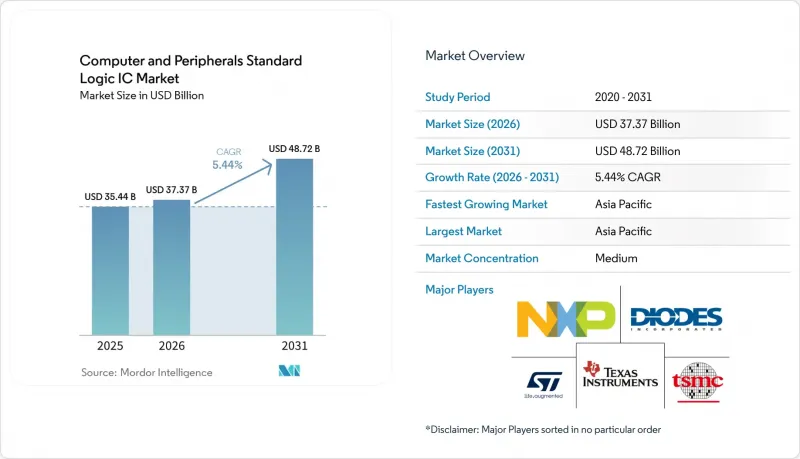
According to Mordor Intelligence, the computer and Peripherals Standard Logic IC market size is expected to grow from USD 35.44 billion in 2025 to USD 37.37 billion in 2026 and is forecast to reach USD 48.72 billion by 2031 at 5.44% CAGR over 2026-2031.
This report is Segmented by Logic Family (Transistor-Transistor Logic (TTL / LS / ALS), and More), Function Type (Gates/Inverters, Flip-Flops/Latches, and More), Package Type (Through-Hole DIP / CDIP, SOIC/TSSOP, and More), End-Use Device (Personal Computers and Laptops, Printers, Scanners and MFPs, and More), and Geography. The Market Forecasts are Provided in Terms of Value (USD).
Global Computer And Peripherals Standard Logic IC Market Trends and Insights
Surging demand for low-voltage LVC logic in ultra-thin peripherals
Ultra-thin peripherals favor 1.65 V-5.5 V 74LVC/AUP devices that deliver nanosecond switching while fitting strict thermal envelopes, propelling a 6.73% CAGR through 2030. USB4 and Thunderbolt 5 hubs exemplify this shift by requiring 40 Gbps-plus signaling in compact enclosures. Distributed low-voltage logic architectures outperform monolithic alternatives on power and heat, sustaining demand across global design centers and APAC assembly bases.
AI-assisted auto-routing increasing configurable multi-gate IC volume
Machine-learning PCB tools evaluate thousands of topologies in minutes and frequently choose uncommon gate combinations, driving a 23% rise in demand for configurable multi-gate devices. Vendors supplying broad parametric libraries and rapid samples win sockets as design cycles compress.
Design-in inertia toward SoC integration of discrete logic
Advanced SoCs now embed programmable logic blocks that replicate common 74-series functions, cutting discrete content in high-volume devices despite rising overall electronics complexity. Yet functions needing galvanic isolation or high-voltage switching still rely on stand-alone ICs, tempering but not eliminating the substitution threat.
Other drivers and restraints analyzed in the detailed report include:
- Mainstream USB-C/Thunderbolt hub upgrade cycles
- Rising attach rate of wireless keyboards and mice using low-power buffers
- Lengthening automotive-grade qualification queues (AEC-Q100)
For complete list of drivers and restraints, kindly check the Table Of Contents.
Segment Analysis
2025 results showed high-speed 74HC/HCT devices occupying 30.62% revenue. Low-voltage 74LVC/AUP families, benefiting from energy-sensitive edge nodes, are forecast to add 6.51% CAGR, driving the Computer and Peripherals Standard Logic IC market size in this category to outpace legacy TTL lines. Mixed-voltage designs combine multiple CMOS families to balance cost and timing, a pattern accelerated by AI-guided CAD that lowers design effort.
The migration toward heterogeneous voltage domains preserves discrete demand where SoC pins cannot satisfy isolation or noise immunity. ECL/MECL retains niche roles in jitter-sensitive acquisition systems, whereas 4000-series CMOS fulfills wide-voltage industrial needs. Continued package shrinkage ensures the Computer and Peripherals Standard Logic IC market retains family diversity rather than converging on a single dominant architecture.
Gates and inverters held a 25.98% share in 2025, reflecting their universality. Signal switches and level translators will lead segment expansion with a 6.74% CAGR to 2031 as multi-voltage SoCs interface with mixed-signal peripherals, raising the Computer and Peripherals Standard Logic IC market share for these devices. Multiplexers and decoders support multi-display docks, while buffers maintain integrity on high-speed differential pairs.
Design teams increasingly prefer translator ICs with adaptive threshold tracking, trimming board spins caused by supply-rail migrations. The shift signals demand growth rooted in interface management rather than raw gate count, sustaining value even as transistor integration climbs.
Complete Report Scope:
- By Logic Family
- Transistor-Transistor Logic (TTL / LS / ALS)
- High-Speed CMOS (74HC / HCT)
- Low-Voltage CMOS (74LVC / AUP)
- Advanced High-Speed CMOS (74AC / ACT)
- Wide-Voltage 4000-Series CMOS
- ECL / MECL and Other Bipolar Logic
- By Function Type
- Gates and Inverters
- Flip-Flops and Latches
- Counters and Dividers
- Shift Registers
- Buffers / Drivers / Transceivers
- Multiplexers / Decoders and Encoders
- Comparators and Arithmetic Logic
- Signal Switches and Level Translators
- By Package Type
- Through-Hole DIP / CDIP
- SOIC / TSSOP
- SOT-23 / SOT-353 and Other Micro-Packages
- QFN / XSON / DFN
- WLCSP / Wafer-Level Chip-Scale
- BGA / LGA
- By End-Use Device
- Personal Computers and Laptops
- Printers, Scanners and MFPs
- External Storage and Docking Stations
- Gaming Consoles and Accessories
- Networking Peripherals (Routers, Hubs)
- POS Terminals and Kiosks
- Industrial PCs and Rugged Peripherals
- By Geography
- North America
- United States
- Canada
- Mexico
- South America
- Brazil
- Argentina
- Colombia
- Rest of South America
- Europe
- United Kingdom
- Germany
- France
- Italy
- Spain
- Rest of Europe
- Asia-Pacific
- China
- Japan
- South Korea
- India
- Rest of Asia-Pacific
- Middle East and Africa
- Middle East
- Saudi Arabia
- United Arab Emirates
- Rest of Middle East
- Africa
- South Africa
- Egypt
- Rest of Africa
- Middle East
- North America
Geography Analysis
Asia-Pacific led with 50.72% Computer and Peripherals Standard Logic IC market share in 2025 and is forecast to rise at an 8.45% CAGR, underpinned by integrated foundry-to-assembly ecosystems in China, Taiwan, and South Korea. Japan's automotive-centric tier-1s sustain demand for extended-temperature families, while Taiwan extends leadership through panel-level packaging clusters.
North America delivered a growing CAGR outlook as design houses in the United States push AI-centric peripherals that require configurable multi-gate logic. Canada and Mexico leverage proximity to U.S. OEMs for board-level assembly, anchoring regional demand despite limited wafer capacity.
Europe posted a growing CAGR trajectory driven by automotive electrification and industrial automation. Germany's Tier-1 suppliers qualify AEC-Q100 devices, France supports aerospace variants, and Italy attracts panel-level packaging investment that diversifies supply beyond Asia. Emerging regions in Latin America, the Middle East, and Africa collectively formed a small part of the 2024 revenue, with infrastructure-driven networking peripherals stimulating future uptake.
- Texas Instruments Incorporated
- Nexperia B.V.
- onsemi Corporation
- STMicroelectronics N.V.
- Toshiba Electronic Devices and Storage Corporation
- ROHM Co., Ltd.
- Diodes Incorporated
- Microchip Technology Inc.
- Infineon Technologies AG
- Renesas Electronics Corporation
- Maxim Integrated (Analog Devices, Inc.)
- Vishay Intertechnology, Inc.
- Lattice Semiconductor Corporation
- Skyworks Solutions, Inc.
- Taiwan Semiconductor Manufacturing Co., Ltd. (Foundry Perspective)
- Teledyne e2v Semiconductor
- Samsung Electronics Co., Ltd. (System LSI)
- NXP Semiconductors N.V.
- Broadcom Inc.
- Analog Devices, Inc.
Additional Benefits:
- The market estimate (ME) sheet in Excel format
- 3 months of analyst support
TABLE OF CONTENTS
1 INTRODUCTION
- 1.1 Study Assumptions and Market Definition
- 1.2 Scope of the Study
2 RESEARCH METHODOLOGY
3 EXECUTIVE SUMMARY
4 MARKET LANDSCAPE
- 4.1 Market Overview
- 4.2 Market Drivers
- 4.2.1 Surging demand for low-voltage LVC logic in ultra-thin peripherals
- 4.2.2 Shift-left PCB design workflows boosting single-gate (1G) logic ASPs
- 4.2.3 AI-assisted auto-routing increasing volume of configurable multi-gate ICs
- 4.2.4 Mainstream upgrade cycles for USB-C/Thunderbolt hubs
- 4.2.5 Rising attach-rate of wireless keyboards and mice using low-power buffers
- 4.2.6 Cost-down programs in ODM printers favouring 74HC/HCT drop-ins
- 4.3 Market Restraints
- 4.3.1 Design-in inertia toward SoC integration of discrete logic
- 4.3.2 Lengthening automotive-grade qualification queues (AEC-Q100)
- 4.3.3 Volatility in 200 mm foundry capacity for legacy logic nodes
- 4.3.4 Counterfeit 74-series influx in secondary channels
- 4.4 Industry Supply Chain Analysis
- 4.5 Regulatory Landscape
- 4.6 Technological Outlook
- 4.7 Porter's Five Forces Analysis
- 4.7.1 Bargaining Power of Suppliers
- 4.7.2 Bargaining Power of Buyers
- 4.7.3 Threat of New Entrants
- 4.7.4 Threat of Substitutes
- 4.7.5 Degree of Competition
- 4.8 Assessment of Macroeconomic Impact
5 MARKET SIZE AND GROWTH FORECASTS (VALUE)
- 5.1 By Logic Family
- 5.1.1 Transistor-Transistor Logic (TTL / LS / ALS)
- 5.1.2 High-Speed CMOS (74HC / HCT)
- 5.1.3 Low-Voltage CMOS (74LVC / AUP)
- 5.1.4 Advanced High-Speed CMOS (74AC / ACT)
- 5.1.5 Wide-Voltage 4000-Series CMOS
- 5.1.6 ECL / MECL and Other Bipolar Logic
- 5.2 By Function Type
- 5.2.1 Gates and Inverters
- 5.2.2 Flip-Flops and Latches
- 5.2.3 Counters and Dividers
- 5.2.4 Shift Registers
- 5.2.5 Buffers / Drivers / Transceivers
- 5.2.6 Multiplexers / Decoders and Encoders
- 5.2.7 Comparators and Arithmetic Logic
- 5.2.8 Signal Switches and Level Translators
- 5.3 By Package Type
- 5.3.1 Through-Hole DIP / CDIP
- 5.3.2 SOIC / TSSOP
- 5.3.3 SOT-23 / SOT-353 and Other Micro-Packages
- 5.3.4 QFN / XSON / DFN
- 5.3.5 WLCSP / Wafer-Level Chip-Scale
- 5.3.6 BGA / LGA
- 5.4 By End-Use Device
- 5.4.1 Personal Computers and Laptops
- 5.4.2 Printers, Scanners and MFPs
- 5.4.3 External Storage and Docking Stations
- 5.4.4 Gaming Consoles and Accessories
- 5.4.5 Networking Peripherals (Routers, Hubs)
- 5.4.6 POS Terminals and Kiosks
- 5.4.7 Industrial PCs and Rugged Peripherals
- 5.5 By Geography
- 5.5.1 North America
- 5.5.1.1 United States
- 5.5.1.2 Canada
- 5.5.1.3 Mexico
- 5.5.2 South America
- 5.5.2.1 Brazil
- 5.5.2.2 Argentina
- 5.5.2.3 Colombia
- 5.5.2.4 Rest of South America
- 5.5.3 Europe
- 5.5.3.1 United Kingdom
- 5.5.3.2 Germany
- 5.5.3.3 France
- 5.5.3.4 Italy
- 5.5.3.5 Spain
- 5.5.3.6 Rest of Europe
- 5.5.4 Asia-Pacific
- 5.5.4.1 China
- 5.5.4.2 Japan
- 5.5.4.3 South Korea
- 5.5.4.4 India
- 5.5.4.5 Rest of Asia-Pacific
- 5.5.5 Middle East and Africa
- 5.5.5.1 Middle East
- 5.5.5.1.1 Saudi Arabia
- 5.5.5.1.2 United Arab Emirates
- 5.5.5.1.3 Rest of Middle East
- 5.5.5.2 Africa
- 5.5.5.2.1 South Africa
- 5.5.5.2.2 Egypt
- 5.5.5.2.3 Rest of Africa
- 5.5.5.1 Middle East
- 5.5.1 North America
6 COMPETITIVE LANDSCAPE
- 6.1 Market Concentration
- 6.2 Strategic Moves
- 6.3 Market Share Analysis
- 6.4 Company Profiles (includes Global level Overview, Market level overview, Core Segments, Financials as available, Strategic Information, Market Rank/Share for key companies, Products and Services, and Recent Developments)
- 6.4.1 Texas Instruments Incorporated
- 6.4.2 Nexperia B.V.
- 6.4.3 onsemi Corporation
- 6.4.4 STMicroelectronics N.V.
- 6.4.5 Toshiba Electronic Devices and Storage Corporation
- 6.4.6 ROHM Co., Ltd.
- 6.4.7 Diodes Incorporated
- 6.4.8 Microchip Technology Inc.
- 6.4.9 Infineon Technologies AG
- 6.4.10 Renesas Electronics Corporation
- 6.4.11 Maxim Integrated (Analog Devices, Inc.)
- 6.4.12 Vishay Intertechnology, Inc.
- 6.4.13 Lattice Semiconductor Corporation
- 6.4.14 Skyworks Solutions, Inc.
- 6.4.15 Taiwan Semiconductor Manufacturing Co., Ltd. (Foundry Perspective)
- 6.4.16 Teledyne e2v Semiconductor
- 6.4.17 Samsung Electronics Co., Ltd. (System LSI)
- 6.4.18 NXP Semiconductors N.V.
- 6.4.19 Broadcom Inc.
- 6.4.20 Analog Devices, Inc.
7 MARKET OPPORTUNITIES AND FUTURE OUTLOOK
- 7.1 White-Space and Unmet-Need Assessment

