PUBLISHER: Mordor Intelligence | PRODUCT CODE: 2124926

PUBLISHER: Mordor Intelligence | PRODUCT CODE: 2124926
Europe Computer Monitor - Market Share Analysis, Industry Trends & Statistics, Growth Forecasts (2026 - 2031)
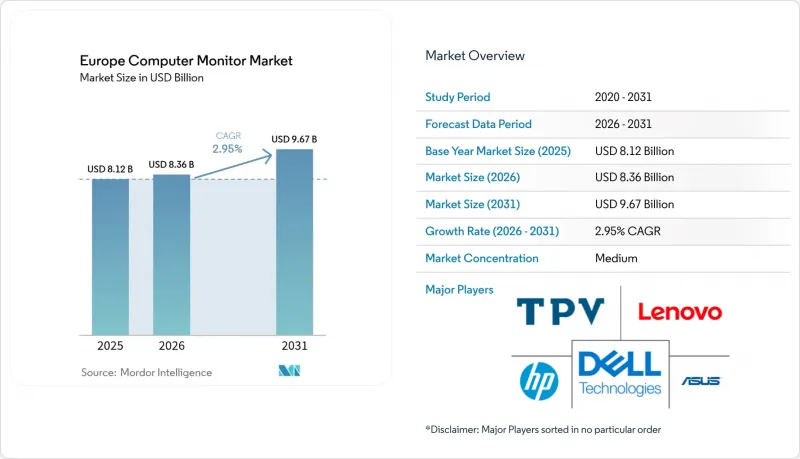
According to Mordor Intelligence, the european computer monitor market size in 2026 is estimated at USD 8.36 billion, growing from 2025 value of USD 8.12 billion with 2031 projections showing USD 9.67 billion, growing at 2.95% CAGR over 2026-2031.
This report is Segmented by Screen Resolution (1366X768, 1920X1080 FHD, and More), Panel Technology (IPS LCD, VA LCD, and More), Screen Size (<=21. 5", 22"-24. 5", and More), Refresh Rate (<=75Hz, 76-144Hz, and >=165Hz), End-User (Consumer, Corporate and Commercial, and More), Sales Channel (Offline and Online), and Country. The Market Forecasts are Provided in Terms of Value (USD).
Europe Computer Monitor Market Trends and Insights
Persistent Hybrid-Work Monitor Refresh Cycles
Hybrid work adoption keeps offices and homes equally important. Dual-screen setups are now standard, and procurement teams in Germany and the Netherlands increasingly enforce EU Green Public Procurement criteria that reward energy-efficient models. EIZO's Class A FlexScan releases illustrate how vendors secure contracts by offering lower lifetime energy costs. Rather than large one-time roll-outs, companies are staging staggered upgrades that blend central-office orders with employee stipend-funded home purchases, sustaining a rolling demand curve for the European computer monitor market.
Rapid Uptake of High-Refresh Gaming Monitors
Esports venue expansion and mainstream gaming enthusiasm are moving refresh-rate expectations from 144 Hz toward 240 Hz and beyond. Spain shows the steepest ascent, driven by new gaming cafes that specify tournament-grade displays. Partnerships such as AGON by AOC with Red Bull Esports illustrate the direct link between sponsor visibility and monitor specification upgrades. Portable high-refresh units from ViewSonic also enjoy traction among players who attend both home and LAN events, reinforcing demand diversity within the European computer monitor market.
Panel Supply-Chain Tightness and Price Inflation
LCD capacity reductions coincide with OLED ramp-ups, leaving a production gap that inflates glass and DDIC costs. Lead times for mainstream panels stretch to 16-20 weeks, forcing brands to favor high-margin models and sacrificing entry-level assortment breadth. The imbalance is set to persist until at least 2028, restraining unit growth in price-sensitive bands of the European computer monitor market.
Other drivers and restraints analyzed in the detailed report include:
- Corporate Demand for Energy-Efficient Displays
- Transition Toward UHD and WQHD Resolutions
- EU Right-to-Repair Slowing Replacement Cycles
For complete list of drivers and restraints, kindly check the Table Of Contents.
Segment Analysis
Full HD held 45.12% of the European computer monitor market share in 2025, underscoring its continued role as the default specification for cost-conscious buyers. Yet the 4 K UHD tier is advancing at a 4.55% CAGR, signaling robust appetite among creative professionals, medical institutions, and high-end gamers who equate pixel density with productivity and visual fidelity. OLED and Mini-LED innovations allow 4 K panels to achieve HDR brightness and accurate color gamuts, removing previous performance barriers. The result is a multi-layered pricing ladder in which UHD screens capture premium margins while FHD volumes absorb budget demand, collectively stabilizing the European computer monitor market.
WQHD serves as the mid-market bridge, favored by esports players who need higher sharpness without the GPU burden of 4 K rendering. Manufacturers leverage this zone to upsell existing owners through incremental refresh-rate boosts and curvature options. Legacy resolutions below 1080p shrink annually as offices retire aging assets, while specialty formats cater to medical carts and industrial control rooms. Looking ahead, the European computer monitor industry expects resolution mix shifts to be gradual, restrained by IT budget approvals and emerging regulations that prioritize energy efficiency over sheer pixel count.
IPS LCD captured 39.25% share in 2025, prized for viewing-angle stability and an entrenched supply ecosystem. OLED, projected at a 4.62% CAGR, disrupts the premium stripe by delivering infinite contrast and near-instant response times, critical features for competitive gaming and cinematic content creation. Samsung's QD-OLED collaborations with Dell illustrate how panel innovation translates into channel differentiation. VA and TN remain cost-effective for curved and entry-level gaming SKUs, yet the pricing gap narrows as OLED yields climb.
Mini-LED backlit IPS acts as an interim solution, offering zone dimming that brings HDR-level brightness without full emitter changeovers. This hybrid path helps vendors meet evolving EU power standards, since local dimming reduces average luminance draw. In parallel, manufacturers hedge supply disruptions by diversifying panel sourcing, balancing mature LCD lines with exploratory OLED capacity to protect the European computer monitor market continuity.
Complete Report Scope:
- By Screen Resolution
- 1366 X 768
- 1920 X 1080 (FHD)
- 2560 X 1440 (QHD)
- 3840 X 2160 (4K UHD)
- Other Resolutions
- By Panel Technology
- IPS LCD
- VA LCD
- TN LCD
- OLED
- Mini-LED
- By Screen Size (Diagonal)
- <= 21.5"
- 22"-24.5"
- 25"-27"
- >= 28"
- By Refresh Rate
- <= 75 Hz
- 76-144 Hz
- >= 165 Hz
- By End-User
- Consumer
- Corporate and Commercial
- Gaming Cafes and Esports Venues
- Creative and Media Professionals
- Healthcare and Diagnostics
- Other End-Users
- By Sales Channel
- Offline (Retail and Distribution)
- Online (E-commerce and DTC)
- By Country
- Germany
- United Kingdom
- France
- Italy
- Spain
- Belgium
- Netherlands
- Rest of Europe
List of Companies Covered in this Report:
- Dell Technologies Inc.
- HP Inc.
- Lenovo Group Limited
- TPV Technology Limited (AOC and Philips)
- ASUSTeK Computer Inc.
- Samsung Electronics Co., Ltd.
- LG Electronics Inc.
- Acer Inc.
- BenQ Corporation
- ViewSonic Corporation
- Micro-Star International Co., Ltd. (MSI)
- EIZO Corporation
- iiyama International B.V.
- Hannspree Europe GmbH
- Gigabyte Technology Co., Ltd.
- AOPEN Inc.
- AGON by AOC
- Medion AG
- Belinea (S and T AG)
- Wortmann AG (Terra)
- NEC Display Solutions Europe GmbH
- MMD-Monitors and Displays Nederland B.V.
Additional Benefits:
- The market estimate (ME) sheet in Excel format
- 3 months of analyst support
TABLE OF CONTENTS
1 INTRODUCTION
- 1.1 Study Assumptions and Market Definitions
- 1.2 Scope of the Study
2 RESEARCH METHODOLOGY
3 EXECUTIVE SUMMARY
4 MARKET LANDSCAPE
- 4.1 Market Overview
- 4.2 Market Drivers
- 4.2.1 Persistent hybrid-work monitor refresh cycles
- 4.2.2 Rapid uptake of high-refresh gaming monitors
- 4.2.3 Corporate demand for energy-efficient displays
- 4.2.4 Transition toward UHD and WQHD resolutions
- 4.2.5 EU ecolabel rules accelerating panel innovation
- 4.2.6 Expansion of tele-health imaging monitors
- 4.3 Market Restraints
- 4.3.1 Panel supply-chain tightness and price inflation
- 4.3.2 Component shortages raising ASPs
- 4.3.3 EU right-to-repair slowing replacement cycles
- 4.3.4 Laptop-first workforce preference
- 4.4 Industry Value Chain Analysis
- 4.5 Regulatory Landscape
- 4.6 Technological Outlook
- 4.7 Impact of Macroeconomic Factors
- 4.8 Porter's Five Forces Analysis
- 4.8.1 Bargaining Power of Suppliers
- 4.8.2 Bargaining Power of Buyers
- 4.8.3 Threat of New Entrants
- 4.8.4 Threat of Substitutes
- 4.8.5 Competitive Rivalry
5 MARKET SIZE AND GROWTH FORECASTS (VALUES)
- 5.1 By Screen Resolution
- 5.1.1 1366 X 768
- 5.1.2 1920 X 1080 (FHD)
- 5.1.3 2560 X 1440 (QHD)
- 5.1.4 3840 X 2160 (4K UHD)
- 5.1.5 Other Resolutions
- 5.2 By Panel Technology
- 5.2.1 IPS LCD
- 5.2.2 VA LCD
- 5.2.3 TN LCD
- 5.2.4 OLED
- 5.2.5 Mini-LED
- 5.3 By Screen Size (Diagonal)
- 5.3.1 <= 21.5"
- 5.3.2 22"-24.5"
- 5.3.3 25"-27"
- 5.3.4 >= 28"
- 5.4 By Refresh Rate
- 5.4.1 <= 75 Hz
- 5.4.2 76-144 Hz
- 5.4.3 >= 165 Hz
- 5.5 By End-User
- 5.5.1 Consumer
- 5.5.2 Corporate and Commercial
- 5.5.3 Gaming Cafes and Esports Venues
- 5.5.4 Creative and Media Professionals
- 5.5.5 Healthcare and Diagnostics
- 5.5.6 Other End-Users
- 5.6 By Sales Channel
- 5.6.1 Offline (Retail and Distribution)
- 5.6.2 Online (E-commerce and DTC)
- 5.7 By Country
- 5.7.1 Germany
- 5.7.2 United Kingdom
- 5.7.3 France
- 5.7.4 Italy
- 5.7.5 Spain
- 5.7.6 Belgium
- 5.7.7 Netherlands
- 5.7.8 Rest of Europe
6 COMPETITIVE LANDSCAPE
- 6.1 Market Concentration
- 6.2 Strategic Moves
- 6.3 Market Share Analysis
- 6.4 Company Profiles (includes Global level Overview, Market level overview, Core Segments, Financials as available, Strategic Information, Market Rank/Share for key companies, Products and Services, and Recent Developments)
- 6.4.1 Dell Technologies Inc.
- 6.4.2 HP Inc.
- 6.4.3 Lenovo Group Limited
- 6.4.4 TPV Technology Limited (AOC and Philips)
- 6.4.5 ASUSTeK Computer Inc.
- 6.4.6 Samsung Electronics Co., Ltd.
- 6.4.7 LG Electronics Inc.
- 6.4.8 Acer Inc.
- 6.4.9 BenQ Corporation
- 6.4.10 ViewSonic Corporation
- 6.4.11 Micro-Star International Co., Ltd. (MSI)
- 6.4.12 EIZO Corporation
- 6.4.13 iiyama International B.V.
- 6.4.14 Hannspree Europe GmbH
- 6.4.15 Gigabyte Technology Co., Ltd.
- 6.4.16 AOPEN Inc.
- 6.4.17 AGON by AOC
- 6.4.18 Medion AG
- 6.4.19 Belinea (S and T AG)
- 6.4.20 Wortmann AG (Terra)
- 6.4.21 NEC Display Solutions Europe GmbH
- 6.4.22 MMD-Monitors and Displays Nederland B.V.
7 MARKET OPPORTUNITIES AND FUTURE OUTLOOK
- 7.1 White-space and Unmet-need Assessment

