PUBLISHER: Mordor Intelligence | PRODUCT CODE: 2124927

PUBLISHER: Mordor Intelligence | PRODUCT CODE: 2124927
Global Leak Detection Solutions - Market Share Analysis, Industry Trends & Statistics, Growth Forecasts (2026 - 2031)
According to Mordor Intelligence, the leak detection solutions market size was valued at USD 4.58 billion in 2025 and estimated to grow from USD 4.83 billion in 2026 to reach USD 6.33 billion by 2031, at a CAGR of 5.53% during the forecast period (2026-2031).
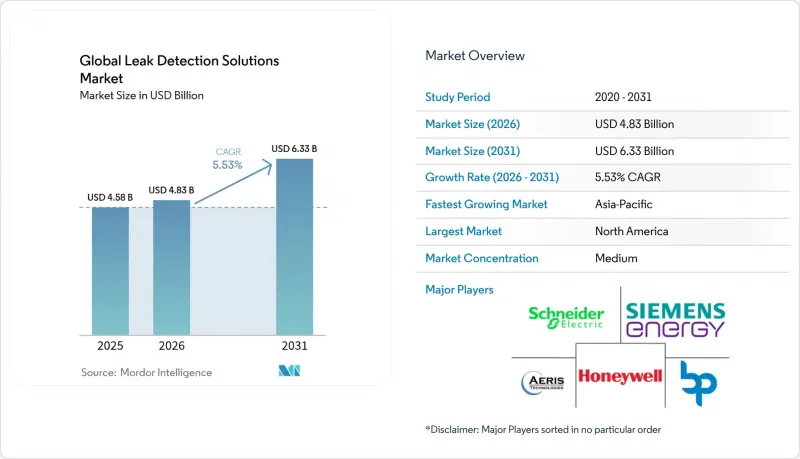
This report is Segmented by Technology (Acoustic/Ultrasonic, Pressure Analysis, and More), End-User Industry (Oil and Gas, Chemical, Water Treatment, and More), Component (Hardware, Software, and Services), Deployment Mode (Fixed/Stationary, Portable/Handheld, and More), Pipeline Stage (Upstream, Midstream, and More), and Geography (North America, South America, Europe, Asia-Pacific, and Middle East and Africa).
Global Leak Detection Solutions Market Trends and Insights
Stringent fugitive-methane regulations drive market transformation
The Inflation Reduction Act's methane surcharge, which started at USD 900 per metric ton in 2024 and climbs to USD 1,500 by 2026, re-shaped project economics by making continuous monitoring cheaper than paying fees. Complementary "Super Emitter" protocols allowed third parties to trigger operator response on leaks above 100 kg/hr, accelerating the adoption of fixed sensors and satellite data feeds. Operators substituted legacy Method 21 surveys with optical gas imaging and fiber-optic arrays to avoid downtime, lifting order volumes for high-resolution camera packages.
Rapid expansion of hydrogen and CCUS pipeline projects
Hydrogen molecules are smaller and more diffusive than methane, demanding detectors that spot leaks below 1 ppm; Raman analyzers demonstrated such sensitivity at several-meter stand-off distances. The U.S. Department of Energy earmarked USD 25 million for hydrogen-specific detection R&D in 2025. India's state operators, including GAIL, evaluated dedicated hydrogen trunklines, creating follow-on demand for specialized sensors.
High CAPEX for fiber-optic and LiDAR deployments in brown-field pipelines
Distributed fiber-optic sensing costs USD 50,000-100,000 per kilometer, and retrofits often require trenching or rack modifications that disrupt throughput. LiDAR heads suitable for hazardous zones were priced between USD 200,000 and USD 500,000, restricting adoption when crude prices softened. Operators in lower-margin basins thus favored portable ultrasonic detectors despite narrower coverage.
Other drivers and restraints analyzed in the detailed report include:
- AI-enabled predictive analytics lower false positives
- Satellite constellations enable global emissions transparency
- Scarcity of skilled thermography and acoustics technicians in emerging markets
For complete list of drivers and restraints, kindly check the Table Of Contents.
Segment Analysis
Acoustic and ultrasonic systems held 26.74% of 2025 revenues, making them the largest single technology cohort in the leak detection solutions market. Piezo-electric sensors delivered instantaneous alerts within a 40 m radius and required no calibration, a value proposition that suited onshore gathering lines. Laser absorption and LiDAR platforms, while still smaller in absolute sales, expanded at an 8.41% CAGR, buoyed by regulatory recognition of quantified emission measurement protocols.
Thermal imagers moved from handheld to cloud-connected variants that streamed radiometric data for predictive analytics, broadening appeal among refinery operators. Fiber-optic distributed sensing gained contracts along subsea tiebacks where maintenance access was limited. Analytical modeling showed sub-1% localization error for acoustic-emission-based storage-tank monitoring, validating acoustic dominance in fixed assets.
The oil and gas sector captured 60.35% of 2025 revenue, reflecting statutory leak fees and the high-consequence nature of hydrocarbon releases. Nevertheless, water treatment utilities logged the quickest expansion at 5.76% CAGR, spurred by aging mains and drought-linked loss-reduction mandates. Utilities deployed AI classifiers that achieved 98.3% accuracy on leak/no-leak differentiation in potable networks. Chemical and power-generation operators adopted clamp-on flowmeters following corporate net-zero policies, while hydrogen developers demanded Raman-based detectors to satisfy safety case requirements.
Complete Report Scope:
- By Technology
- Acoustic / Ultrasonic
- Pressure Analysis
- Thermal Imaging
- Fiber Optic
- Laser Absorption and LiDAR
- Vapor Sensing
- E-RTTM
- Other Technologies
- By End-User Industry
- Oil and Gas
- Chemical
- Water Treatment
- Power Generation
- Other End-Users
- By Component
- Hardware
- Software
- Services
- By Deployment Mode
- Fixed / Stationary
- Portable / Handheld
- Drone-Mounted / Aerial
- By Pipeline Stage
- Upstream
- Midstream
- Downstream
- By Geography
- North America
- United States
- Canada
- Mexico
- South America
- Brazil
- Argentina
- Rest of South America
- Europe
- Germany
- United Kingdom
- France
- Italy
- Russia
- Rest of Europe
- Asia-Pacific
- China
- Japan
- India
- South Korea
- Australia
- Rest of Asia-Pacific
- Middle East and Africa
- Middle East
- Saudi Arabia
- United Arab Emirates
- Turkey
- Rest of Middle East
- Africa
- South Africa
- Nigeria
- Rest of Africa
- Middle East
- North America
Geography Analysis
North America retained 37.70% of global revenue in 2025 owing to methane-fee statutes, enhanced pipeline safety regulations, and the rollout of satellite verification programs such as MethaneSAT that scrutinized shale basins. Canada's hydrogen roadmap further boosted orders for specialized leak sensors, while Mexico's cross-border pipeline build created incremental demand for midstream monitoring solutions. The leak detection solutions market size in the region is forecast to advance steadily as refiners digitize aging assets.
Asia-Pacific recorded a 7.62% CAGR through 2031. India commissioned a USD 1.3 billion, 2,800 km LPG pipeline in 2025 and earmarked USD 5 billion for new gas corridors, lifting hardware imports, and local assembly. Japan signed bilateral pacts to curb methane leakage and funded R&D on drone-based inspections for municipal sewer lines. China expanded L-band SAR combined with ground-penetrating radar to detect water-line failures beneath urban arteries, accelerating municipal orders.
Europe maintained momentum as the EU tightened corporate sustainability reporting and methane-intensity disclosure. Operators integrated fiber-optic strings along North Sea interconnectors and invested in LiDAR-equipped helicopters to monitor distribution grids. The Middle East and Africa lagged in skilled labor, but rising CCUS hubs in the Gulf and new crude export pipelines in East Africa unlocked contracts for turnkey leak detection packages. Regional utilities leveraged technology transfer agreements to bridge capability gaps.
- Honeywell International Inc.
- Aeris Technologies Inc.
- Bridger Photonics Inc.
- Schneider Electric SE
- Siemens Energy AG
- Xylem Inc.
- Krohne Messtechnik GmbH
- PSI Software AG
- Teledyne FLIR LLC
- ClampOn AS
- PermAlert (Division of Tremco Incorporated)
- OptaSense Ltd. (a Luna Innovations company)
- Physical Sciences Inc.
- Veeder-Root Company
- Atmos International Limited
- Emerson Electric Co.
- Baker Hughes Company - Avitas Systems
- Perma-Pipe International Holdings Inc.
- Sensit Technologies LLC
- Pentair plc
- Synodon Inc.
- INGU Solutions Inc.
- New Cosmos Electric Co. Ltd.
- Pressure Pipe Inspection Company (PPIC)
- Enagas S.A.
- TTK SAS
Additional Benefits:
- The market estimate (ME) sheet in Excel format
- 3 months of analyst support
TABLE OF CONTENTS
1 INTRODUCTION
- 1.1 Study Assumptions and Market Definition
- 1.2 Scope of the Study
2 RESEARCH METHODOLOGY
3 EXECUTIVE SUMMARY
4 MARKET LANDSCAPE
- 4.1 Market Overview
- 4.2 Market Drivers
- 4.2.1 Stringent fugitive-methane regulations (e.g., U.S. Inflation Reduction Act)
- 4.2.2 Rapid expansion of hydrogen and CCUS pipeline projects
- 4.2.3 AI-enabled predictive analytics lowers false positives
- 4.2.4 Adoption of leak-detection-as-a-service (LDaaS) business models
- 4.2.5 Satellite constellations providing high-resolution emissions data
- 4.2.6 Mandatory ESG reporting driving proactive leak management
- 4.3 Market Restraints
- 4.3.1 High CAPEX for fiber-optic and LiDAR deployments in brown-field pipelines
- 4.3.2 Scarcity of skilled thermography and acoustics technicians in emerging markets
- 4.3.3 Cyber-security vulnerabilities in cloud-linked LD systems
- 4.3.4 False alarms in multiphase flow conditions reducing operator confidence
- 4.4 Value Chain Analysis
- 4.5 Regulatory Landscape
- 4.6 Technological Outlook
- 4.7 Porter's Five Forces Analysis
- 4.7.1 Threat of New Entrants
- 4.7.2 Bargaining Power of Consumers
- 4.7.3 Bargaining Power of Suppliers
- 4.7.4 Threat of Substitute Products
- 4.7.5 Intensity of Competitive Rivalry
- 4.8 Impact of Macroeconomic Factors
5 MARKET SIZE AND GROWTH FORECASTS (VALUE)
- 5.1 By Technology
- 5.1.1 Acoustic / Ultrasonic
- 5.1.2 Pressure Analysis
- 5.1.3 Thermal Imaging
- 5.1.4 Fiber Optic
- 5.1.5 Laser Absorption and LiDAR
- 5.1.6 Vapor Sensing
- 5.1.7 E-RTTM
- 5.1.8 Other Technologies
- 5.2 By End-User Industry
- 5.2.1 Oil and Gas
- 5.2.2 Chemical
- 5.2.3 Water Treatment
- 5.2.4 Power Generation
- 5.2.5 Other End-Users
- 5.3 By Component
- 5.3.1 Hardware
- 5.3.2 Software
- 5.3.3 Services
- 5.4 By Deployment Mode
- 5.4.1 Fixed / Stationary
- 5.4.2 Portable / Handheld
- 5.4.3 Drone-Mounted / Aerial
- 5.5 By Pipeline Stage
- 5.5.1 Upstream
- 5.5.2 Midstream
- 5.5.3 Downstream
- 5.6 By Geography
- 5.6.1 North America
- 5.6.1.1 United States
- 5.6.1.2 Canada
- 5.6.1.3 Mexico
- 5.6.2 South America
- 5.6.2.1 Brazil
- 5.6.2.2 Argentina
- 5.6.2.3 Rest of South America
- 5.6.3 Europe
- 5.6.3.1 Germany
- 5.6.3.2 United Kingdom
- 5.6.3.3 France
- 5.6.3.4 Italy
- 5.6.3.5 Russia
- 5.6.3.6 Rest of Europe
- 5.6.4 Asia-Pacific
- 5.6.4.1 China
- 5.6.4.2 Japan
- 5.6.4.3 India
- 5.6.4.4 South Korea
- 5.6.4.5 Australia
- 5.6.4.6 Rest of Asia-Pacific
- 5.6.5 Middle East and Africa
- 5.6.5.1 Middle East
- 5.6.5.1.1 Saudi Arabia
- 5.6.5.1.2 United Arab Emirates
- 5.6.5.1.3 Turkey
- 5.6.5.1.4 Rest of Middle East
- 5.6.5.2 Africa
- 5.6.5.2.1 South Africa
- 5.6.5.2.2 Nigeria
- 5.6.5.2.3 Rest of Africa
- 5.6.5.1 Middle East
- 5.6.1 North America
6 COMPETITIVE LANDSCAPE
- 6.1 Market Concentration
- 6.2 Strategic Moves
- 6.3 Market Share Analysis
- 6.4 Company Profiles (includes Global level Overview, Market level overview, Core Segments, Financials as available, Strategic Information, Market Rank/Share for key companies, Products and Services, and Recent Developments)
- 6.4.1 Honeywell International Inc.
- 6.4.2 Aeris Technologies Inc.
- 6.4.3 Bridger Photonics Inc.
- 6.4.4 Schneider Electric SE
- 6.4.5 Siemens Energy AG
- 6.4.6 Xylem Inc.
- 6.4.7 Krohne Messtechnik GmbH
- 6.4.8 PSI Software AG
- 6.4.9 Teledyne FLIR LLC
- 6.4.10 ClampOn AS
- 6.4.11 PermAlert (Division of Tremco Incorporated)
- 6.4.12 OptaSense Ltd. (a Luna Innovations company)
- 6.4.13 Physical Sciences Inc.
- 6.4.14 Veeder-Root Company
- 6.4.15 Atmos International Limited
- 6.4.16 Emerson Electric Co.
- 6.4.17 Baker Hughes Company - Avitas Systems
- 6.4.18 Perma-Pipe International Holdings Inc.
- 6.4.19 Sensit Technologies LLC
- 6.4.20 Pentair plc
- 6.4.21 Synodon Inc.
- 6.4.22 INGU Solutions Inc.
- 6.4.23 New Cosmos Electric Co. Ltd.
- 6.4.24 Pressure Pipe Inspection Company (PPIC)
- 6.4.25 Enagas S.A.
- 6.4.26 TTK SAS
7 MARKET OPPORTUNITIES AND FUTURE OUTLOOK
- 7.1 White-space and Unmet-Need Assessment

