PUBLISHER: Mordor Intelligence | PRODUCT CODE: 2124934

PUBLISHER: Mordor Intelligence | PRODUCT CODE: 2124934
North America And Europe Vending Machine - Market Share Analysis, Industry Trends & Statistics, Growth Forecasts (2026 - 2031)
According to Mordor Intelligence, the North America and Europe vending machine market size is expected to grow from USD 15.36 billion in 2025 to USD 16.67 billion in 2026 and is forecast to reach USD 25.14 billion by 2031 at 8.55% CAGR over 2026-2031.
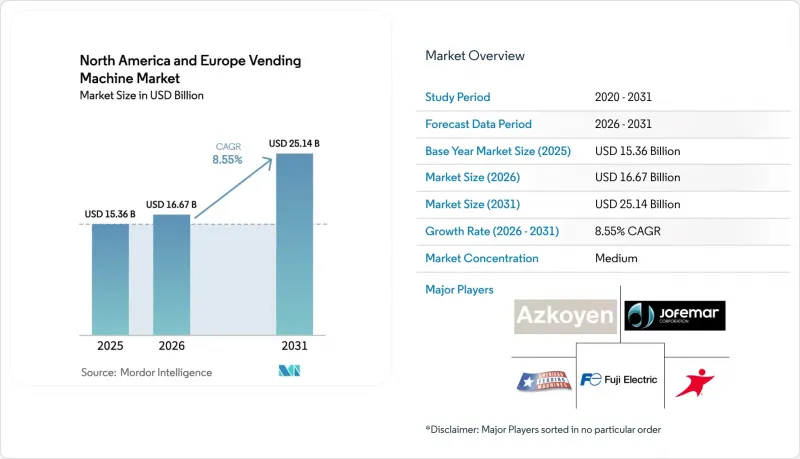
This report is Segmented by Type (Beverage, Food and Snacks, and More), Location (Institutional Settings, Transportation Facilities, and More), Payment Mode (Cash, Cashless - Card, and More), Technology (Non-Smart Standalone, and More), End-Use Industry (Corporate Workspaces, Education, Healthcare, and More), and Geography. The Market Forecasts are Provided in Terms of Value (USD).
North America And Europe Vending Machine Market Trends and Insights
Cashless Micro-Payments Integration Accelerating Unit Economics
Vending operators that fitted contactless readers and mobile-wallet acceptance achieved a 77% cashless share in 2024, reducing coin-handling costs and enabling dynamic pricing that lifted average ticket values by up to 18%. Germany illustrates the economics: SECO and BDTA began retrofitting 200,000 tobacco units with girocard terminals, eliminating cash-collection routes that previously absorbed 25% of operating costs.
Rising Demand for Contact-Free Retail Experiences
Touchless interfaces introduced during the pandemic are now standard in busy venues. QR-code ordering and voice-activated modules reduce surface-contact complaints and align with hygiene protocols in healthcare and food-service settings.
Escalating Cyber-Security and Data-Privacy Threats
The EU Cyber Resilience Act obliges vending operators to patch vulnerabilities within 14 days or face fines up to 2.5% of global revenue, raising compliance outlays by USD 800-1,200 per legacy unit.
Other drivers and restraints analyzed in the detailed report include:
- Expansion of Fresh-Food Vending in Transport Hubs
- AI-Powered Planogram Optimisation and Dynamic Pricing
- High Capital Cost of Retrofit for Connectivity
For complete list of drivers and restraints, kindly check the Table Of Contents.
Segment Analysis
Sales of beverage machines still anchor the North America and Europe vending machine market, holding 45.78% revenue share in 2025. However, food and snack machines are forecast to grow 9.02% annually, reflecting the superior gross margins of chef-prepared meals. A single Farmer's Fridge unit at Chicago O'Hare generated USD 120,000 in 2024 triple the take of a standard snack vendor. Cold-chain investments are therefore rising, spurred by FDA temperature-logging mandates and EU refrigerant rules that favor energy-efficient propane systems.
Natural-refrigerant compressors add 30-40% to equipment cost yet reduce electricity use by 20%, enabling price premiums on perishable SKUs. Beverage vending continues to benefit from supplier-funded placements and tolerant temperature bands, enabling incumbents to defend share through exclusive pour rights and promotional pricing. Personal-care merchandising remains below 5% but is gaining traction in hospitals and dormitories, where round-the-clock access to hygiene items offsets emergency-supply trips.
Offices delivered 36.72% of 2025 installations, but hybrid work diminished weekday footfall and pressured per-machine turnover. In contrast, airports and metro stations are projected to grow at an annual rate of 8.31%, aided by municipal efforts to diversify non-fare revenue. Metro de Madrid's EUR 7.7 million contract for 145 combo ticket-and-snack units underscores the commercial potential, each machine occupies only 4 sq ft and is expected to earn USD 35,000 yearly, split evenly with the transit authority.
Institutional venues such as schools and hospitals provide stable demand but impose nutritional or hygiene restrictions that lengthen assortment cycles. Leisure settings exhibit high per-event revenue yet volatile throughput, compelling operators to balance machine density with route efficiency. Closed-campus systems simplify settlement but tie operators into exclusive contracts, limiting SKU experimentation.
Complete Report Scope:
- By Type
- Beverage
- Food and Snacks
- Personal-Care and Hygiene
- Other Type
- By Location
- Office and Commercial Buildings
- Institutional Settings
- Transportation Facilities
- Leisure and Entertainment Venues
- By Payment Mode
- Cash
- Cashless - Card
- Cashless - Mobile Wallet / QR
- Closed-Loop Systems (Campus/Stored-Value)
- By Technology
- Smart/Connected (IoT-Enabled)
- Non-Smart (Standalone)
- By End-Use Industry
- Corporate Workspaces
- Education
- Healthcare
- Travel and Hospitality
- Manufacturing and Distribution Centres
- By Geography
- North America
- United States
- Canada
- Europe
- United Kingdom
- Germany
- France
- Italy
- Spain
- Russia
- Rest of Europe
- North America
List of Companies Covered in this Report:
- American Vending Machines Inc.
- Fuji Electric Co., Ltd.
- Azkoyen Vending Systems, S.A.
- Aramark Corporation
- Jofemar Corporation
- Compass Group PLC
- Evoca Group S.p.A.
- Crane Merchandising Systems Inc.
- Automated Merchandising Systems Inc.
- Sanden Holdings Corporation
- Selecta Group B.V.
- Bulk Vending Systems Ltd.
- Continental Vending Inc.
- FAS International S.p.A.
- N&W Global Vending S.p.A.
- Westomatic Vending Services Ltd.
- Azkoyen Group S.A.
- Bianchi Vending Group S.p.A.
- Vengo Labs Inc.
- Bianchi Industry S.p.A.
- FAS International S.p.A.
Additional Benefits:
- The market estimate (ME) sheet in Excel format
- 3 months of analyst support
TABLE OF CONTENTS
1 INTRODUCTION
- 1.1 Study Assumptions and Market Definition
- 1.2 Scope of the Study
2 RESEARCH METHODOLOGY
3 EXECUTIVE SUMMARY
4 MARKET LANDSCAPE
- 4.1 Market Overview
- 4.2 Market Drivers
- 4.2.1 Cash-less Micro-Payments Integration Accelerating Unit Economics
- 4.2.2 Rising Demand for Contact-Free Retail Experiences
- 4.2.3 Expansion of Fresh-Food Vending in Transport Hubs
- 4.2.4 AI-Powered Planogram Optimisation and Dynamic Pricing
- 4.2.5 Workplace Well-Being Initiatives Driving Healthy-Snack Offerings
- 4.2.6 Government Incentives for Energy-Efficient Refrigeration
- 4.3 Market Restraints
- 4.3.1 Escalating Cyber-security and Data-Privacy Threats
- 4.3.2 High Capital Cost of Retrofit for Connectivity
- 4.3.3 Stringent EU Waste-Reduction Regulations on Single-Use Packaging
- 4.3.4 Persistent Vandalism and Physical Theft Risks
- 4.4 Industry Value Chain Analysis
- 4.5 Regulatory Landscape
- 4.6 Technological Outlook
- 4.7 Porter's Five Forces Analysis
- 4.7.1 Bargaining Power of Suppliers
- 4.7.2 Bargaining Power of Buyers
- 4.7.3 Threat of New Entrants
- 4.7.4 Threat of Substitutes
- 4.7.5 Intensity of Competitive Rivalry
- 4.8 Impact of Macroeconomic Factors on the Market
- 4.9 Unique Vending Machines Across the Countries
5 MARKET SIZE AND GROWTH FORECASTS (VALUE)
- 5.1 By Type
- 5.1.1 Beverage
- 5.1.2 Food and Snacks
- 5.1.3 Personal-Care and Hygiene
- 5.1.4 Other Type
- 5.2 By Location
- 5.2.1 Office and Commercial Buildings
- 5.2.2 Institutional Settings
- 5.2.3 Transportation Facilities
- 5.2.4 Leisure and Entertainment Venues
- 5.3 By Payment Mode
- 5.3.1 Cash
- 5.3.2 Cashless - Card
- 5.3.3 Cashless - Mobile Wallet / QR
- 5.3.4 Closed-Loop Systems (Campus/Stored-Value)
- 5.4 By Technology
- 5.4.1 Smart/Connected (IoT-Enabled)
- 5.4.2 Non-Smart (Standalone)
- 5.5 By End-Use Industry
- 5.5.1 Corporate Workspaces
- 5.5.2 Education
- 5.5.3 Healthcare
- 5.5.4 Travel and Hospitality
- 5.5.5 Manufacturing and Distribution Centres
- 5.6 By Geography
- 5.6.1 North America
- 5.6.1.1 United States
- 5.6.1.2 Canada
- 5.6.2 Europe
- 5.6.2.1 United Kingdom
- 5.6.2.2 Germany
- 5.6.2.3 France
- 5.6.2.4 Italy
- 5.6.2.5 Spain
- 5.6.2.6 Russia
- 5.6.2.7 Rest of Europe
- 5.6.1 North America
6 COMPETITIVE LANDSCAPE
- 6.1 Strategic Moves
- 6.2 Market Share Analysis
- 6.3 Company Profiles (includes Global Level Overview, Market Level Overview, Core Segments, Financials as available, Strategic Information, Market Rank/Share for key companies, Products and Services, and Recent Developments)
- 6.3.1 American Vending Machines Inc.
- 6.3.2 Fuji Electric Co., Ltd.
- 6.3.3 Azkoyen Vending Systems, S.A.
- 6.3.4 Aramark Corporation
- 6.3.5 Jofemar Corporation
- 6.3.6 Compass Group PLC
- 6.3.7 Evoca Group S.p.A.
- 6.3.8 Crane Merchandising Systems Inc.
- 6.3.9 Automated Merchandising Systems Inc.
- 6.3.10 Sanden Holdings Corporation
- 6.3.11 Selecta Group B.V.
- 6.3.12 Bulk Vending Systems Ltd.
- 6.3.13 Continental Vending Inc.
- 6.3.14 FAS International S.p.A.
- 6.3.15 N&W Global Vending S.p.A.
- 6.3.16 Westomatic Vending Services Ltd.
- 6.3.17 Azkoyen Group S.A.
- 6.3.18 Bianchi Vending Group S.p.A.
- 6.3.19 Vengo Labs Inc.
- 6.3.20 Bianchi Industry S.p.A.
- 6.3.21 FAS International S.p.A.
7 MARKET OPPORTUNITIES AND FUTURE OUTLOOK
- 7.1 White-Space and Unmet-Need Assessment

