PUBLISHER: Mordor Intelligence | PRODUCT CODE: 2124938

PUBLISHER: Mordor Intelligence | PRODUCT CODE: 2124938
System Integration - Market Share Analysis, Industry Trends & Statistics, Growth Forecasts (2026 - 2031)
According to Mordor Intelligence, the system integration market size was valued at USD 46.91 billion in 2025 and estimated to grow from USD 49.62 billion in 2026 to reach USD 65.71 billion by 2031, at a CAGR of 5.78% during the forecast period (2026-2031).
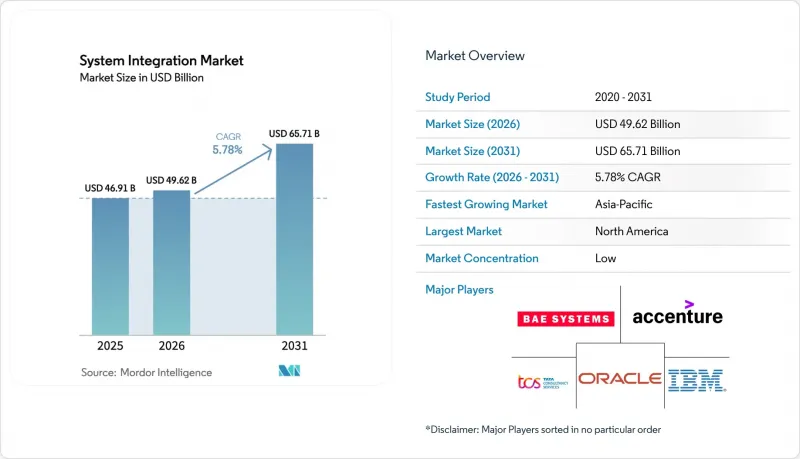
This report is Segmented by Service Type (Infrastructure Integration, Consulting and Advisory, and More), Deployment Mode (On-Premise, and Cloud), End-User Industry (Manufacturing, Automotive, and More), Integration Type (Device/IoT Integration, and More), Organization Size (Large Enterprises, and Small and Medium Enterprises), and Geography. The Market Forecasts are Provided in Terms of Value (USD).
Global System Integration Market Trends and Insights
Shift to Hybrid-Multi-Cloud Integration Architectures
Enterprises now distribute workloads across three or more hyperscalers alongside retained on-premise estates, a pattern confirmed by a 2025 survey that found multi-cloud usage rising to 72% of large firms. Integration platforms that translate divergent APIs, identity models, and data-sovereignty constraints have therefore become strategic control planes. Financial institutions split customer data onto sovereign clouds while offloading analytics to global providers, multiplying integration touchpoints. The European Central Bank's 2024 outsourcing guidelines require exit strategies and interoperability, further accelerating orchestration spending. Architects are pivoting toward event-driven designs and service meshes that abstract infrastructure, enabling near-real-time data fabrics across hybrid landscapes.
5G and Edge-Computing Roll-Outs Demanding Low-Latency Orchestration
Standalone 5G networks push compute to the edge, where millisecond latency budgets prohibit round-trips to central data centers. Global 5G subscriptions hit 1.9 billion in mid-2025, with network slicing creating dedicated industrial lanes. Manufacturing plants deploy edge gateways that preprocess sensor data before syncing it with enterprise resource planning systems in the cloud. Telecom operators are re-platforming operations-support systems to expose 5G core APIs, driving demand for carrier-grade middleware. ITU's IMT-2020 standards, finalized in 2024, codify ultra-reliable low-latency communication benchmarks that integration vendors must now meet. Edge-to-cloud orchestration is therefore essential for monetizing 5G investments rather than treating it as a discretionary upgrade.
Escalating Talent Shortage of Integration Architects
LinkedIn recorded a 34% year-over-year increase in open integration-architect roles in 2025, yet the median time-to-fill still exceeded 60 days. Signing bonuses and equity grants inflate project budgets, while sector-specific knowledge demands narrow the candidate pool further. Offshore staffing mitigates costs in many IT domains but provides limited relief for hybrid-integration work that requires time-zone alignment with on-premises teams. Enterprises are experimenting with low-code tools to stretch scarce talent, though such platforms falter in deeply customized legacy estates. The shortage is expected to persist through 2028, capping the attainable speed of market expansion.
Other drivers and restraints analyzed in the detailed report include:
- Rapid IT-OT Convergence in Smart Manufacturing
- Cyber-Security Compliance Mandates
- Cost Overruns from Technical Debt in Legacy Estates
For complete list of drivers and restraints, kindly check the Table Of Contents.
Segment Analysis
Infrastructure integration accounted for 45.61% of the system integration market share in 2025, underscoring the need to orchestrate servers, storage, and networks across hybrid estates. Financial institutions and government agencies still depend on tightly controlled on-premise hubs, so revenue from cabling, virtualization, and resiliency engineering remains steady. Providers now bundle monitoring, patching, and capacity planning into outcome-based contracts, lengthening engagement tenures and smoothing revenue flow.
Application and software integration, meanwhile, is expanding at a 6.33% CAGR through 2031 as enterprises favor API-first models that decouple mobile apps and analytics from back-end cores. The pivot blurs the lines between the infrastructure and application layers because the same orchestration engines manage both Kubernetes clusters and gateway endpoints. IBM's USD 4.6 billion acquisition of Apptio in 2023 highlighted demand for cost-governance tools that rationalize integration budgets. Vendors that can package infrastructure provisioning with application connectivity into a single managed service are capturing a growing share of the system integration market.
On-premises installations accounted for 59.16% of 2025 revenue, reflecting data-sovereignty rules and the substantial installed base of middleware supporting regulated workloads. Even as they modernize edge nodes, banks and public agencies are extending capital investment cycles by favoring physical control over mission-critical integration hubs. This approach reflects their preference for maintaining direct oversight and security of critical infrastructure, ensuring reliability and minimizing potential risks associated with external dependencies.
Cloud-based integration platforms are growing at a 6.16% CAGR to 2031 as subscription pricing, auto-scaling, and continuous updates prove attractive to mid-market firms. MuleSoft reported that 64% of its new deployments were cloud-native in 2025, up from 48% two years earlier. The European Union Data Act, effective September 2025, grants enterprises data-portability rights, lowering switching costs and encouraging experimentation. Hybrid control-plane patterns, where data stays on-premises but orchestration logic runs in the cloud, now anchor many proofs of concept and expand the overall system integration market.
Complete Report Scope:
- By Service Type
- Infrastructure Integration
- Application and Software Integration
- Consulting and Advisory
- By Deployment Mode
- On-Premise
- Cloud
- By End-User Industry
- IT and Telecom
- BFSI
- Healthcare and Life Sciences
- Manufacturing
- Government and Utilities
- Energy and Oil and Gas
- Retail and E-Commerce
- Aerospace and Defense
- Automotive
- Other End-User Industries
- By Integration Type
- Data Integration
- Process / Workflow Integration
- Application / API Integration
- Device / IoT Integration
- By Organization Size
- Large Enterprises
- Small and Medium Enterprises
- By Geography
- North America
- United States
- Canada
- Mexico
- South America
- Brazil
- Argentina
- Rest of South America
- Europe
- United Kingdom
- Germany
- France
- Italy
- Rest of Europe
- Asia Pacific
- China
- Japan
- India
- South Korea
- Rest of Asia Pacific
- Middle East and Africa
- Middle East
- United Arab Emirates
- Saudi Arabia
- Rest of Middle East
- Africa
- South Africa
- Egypt
- Rest of Africa
- Middle East
- North America
Geography Analysis
In 2025, North America commanded a dominant 38.91% share of the system integration market, driven by federal zero-trust mandates and a push for banking modernization. The U.S. Office of Management and Budget emphasizes identity-centric controls, relying on detailed policy enforcement across hybrid environments. Meanwhile, Canadian companies are aligning their privacy frameworks with those of their cross-border counterparts.
Asia-Pacific is projected to grow at a 6.83% CAGR through 2031, the fastest among regions. China's New Infrastructure program funds 5G, the industrial internet, and data-center builds, all of which require robust orchestration. India's Unified Payments Interface processed 11.4 billion transactions in December 2025, showcasing the scale of real-time integration workloads. Japan and South Korea accelerate smart-factory and autonomous-vehicle ecosystems, each adding edge-to-cloud complexity.
Europe contributes steady growth driven by the Digital Operational Resilience Act and NIS2, which together enforce documentation, incident reporting, and third-party risk testing. Germany spearheads IT-OT convergence in automotive and machinery, France expands open-banking APIs, and the United Kingdom navigates post-Brexit divergence that elevates cross-border orchestration costs. South America, the Middle East, and Africa remain smaller slices, yet smart-city and energy-grid projects in Brazil, the United Arab Emirates, and Saudi Arabia steadily expand the global system integration market.
- Accenture plc
- IBM Corporation
- Tata Consultancy Services Limited
- Oracle Corporation
- BAE Systems plc
- Wipro Limited
- Cognizant Technology Solutions Corporation
- Deloitte Touche Tohmatsu Limited
- Infosys Limited
- MDS Systems Integration
- Capgemini SE
- Tech Mahindra Limited
- Siemens AG
- Fujitsu Limited
- CGI Inc.
- DXC Technology Company
- Cisco Systems, Inc.
- HCL Technologies Limited
- Hitachi Vantara LLC
- Atos SE
- SAP SE
- NEC Corporation
- NTT DATA Corporation
- EPAM Systems, Inc.
- MuleSoft LLC
- Red Hat, Inc.
Additional Benefits:
- The market estimate (ME) sheet in Excel format
- 3 months of analyst support
TABLE OF CONTENTS
1 INTRODUCTION
- 1.1 Study Assumptions and Market Definition
- 1.2 Scope of the Study
2 RESEARCH METHODOLOGY
3 EXECUTIVE SUMMARY
4 MARKET LANDSCAPE
- 4.1 Market Overview
- 4.2 Market Drivers
- 4.2.1 Shift to Hybrid-Multi-Cloud Integration Architectures
- 4.2.2 5G and Edge-Computing Roll-Outs Demanding Low-Latency Orchestration
- 4.2.3 Rapid IT-OT Convergence in Smart Manufacturing
- 4.2.4 Cyber-Security Compliance Mandates (e.g., NIS2, CISA SBOM)
- 4.2.5 Under-Sea Cable Upgrades Forcing Carrier-Grade Software Re-Platforming
- 4.2.6 AI-Driven "Integration-Platform-as-Code" Reducing Time-to-Value
- 4.3 Market Restraints
- 4.3.1 Escalating Talent Shortage of Integration Architects
- 4.3.2 Cost Overruns from Technical Debt in Legacy Estates
- 4.3.3 Vendor-Lock-In Risk with Hyperscaler Integration Services
- 4.3.4 Rising Scope-3 ESG Reporting Burden Delaying Capex
- 4.4 Industry Value Chain Analysis
- 4.5 Regulatory Landscape
- 4.6 Technological Outlook
- 4.7 Impact of Macroeconomic Factors on the Market
- 4.8 Porter's Five Forces Analysis
- 4.8.1 Bargaining Power of Suppliers
- 4.8.2 Bargaining Power of Buyers/Consumers
- 4.8.3 Threat of New Entrants
- 4.8.4 Threat of Substitutes
- 4.8.5 Intensity of Competitive Rivalry
5 MARKET SIZE AND GROWTH FORECASTS (VALUE)
- 5.1 By Service Type
- 5.1.1 Infrastructure Integration
- 5.1.2 Application and Software Integration
- 5.1.3 Consulting and Advisory
- 5.2 By Deployment Mode
- 5.2.1 On-Premise
- 5.2.2 Cloud
- 5.3 By End-User Industry
- 5.3.1 IT and Telecom
- 5.3.2 BFSI
- 5.3.3 Healthcare and Life Sciences
- 5.3.4 Manufacturing
- 5.3.5 Government and Utilities
- 5.3.6 Energy and Oil and Gas
- 5.3.7 Retail and E-Commerce
- 5.3.8 Aerospace and Defense
- 5.3.9 Automotive
- 5.3.10 Other End-User Industries
- 5.4 By Integration Type
- 5.4.1 Data Integration
- 5.4.2 Process / Workflow Integration
- 5.4.3 Application / API Integration
- 5.4.4 Device / IoT Integration
- 5.5 By Organization Size
- 5.5.1 Large Enterprises
- 5.5.2 Small and Medium Enterprises
- 5.6 By Geography
- 5.6.1 North America
- 5.6.1.1 United States
- 5.6.1.2 Canada
- 5.6.1.3 Mexico
- 5.6.2 South America
- 5.6.2.1 Brazil
- 5.6.2.2 Argentina
- 5.6.2.3 Rest of South America
- 5.6.3 Europe
- 5.6.3.1 United Kingdom
- 5.6.3.2 Germany
- 5.6.3.3 France
- 5.6.3.4 Italy
- 5.6.3.5 Rest of Europe
- 5.6.4 Asia Pacific
- 5.6.4.1 China
- 5.6.4.2 Japan
- 5.6.4.3 India
- 5.6.4.4 South Korea
- 5.6.4.5 Rest of Asia Pacific
- 5.6.5 Middle East and Africa
- 5.6.5.1 Middle East
- 5.6.5.1.1 United Arab Emirates
- 5.6.5.1.2 Saudi Arabia
- 5.6.5.1.3 Rest of Middle East
- 5.6.5.2 Africa
- 5.6.5.2.1 South Africa
- 5.6.5.2.2 Egypt
- 5.6.5.2.3 Rest of Africa
- 5.6.5.1 Middle East
- 5.6.1 North America
6 COMPETITIVE LANDSCAPE
- 6.1 Market Concentration
- 6.2 Strategic Moves
- 6.3 Market Share Analysis
- 6.4 Company Profiles (includes Global Level Overview, Market Level Overview, Core Segments, Financials as available, Strategic Information, Market Rank/Share, Products and Services, Recent Developments)
- 6.4.1 Accenture plc
- 6.4.2 IBM Corporation
- 6.4.3 Tata Consultancy Services Limited
- 6.4.4 Oracle Corporation
- 6.4.5 BAE Systems plc
- 6.4.6 Wipro Limited
- 6.4.7 Cognizant Technology Solutions Corporation
- 6.4.8 Deloitte Touche Tohmatsu Limited
- 6.4.9 Infosys Limited
- 6.4.10 MDS Systems Integration
- 6.4.11 Capgemini SE
- 6.4.12 Tech Mahindra Limited
- 6.4.13 Siemens AG
- 6.4.14 Fujitsu Limited
- 6.4.15 CGI Inc.
- 6.4.16 DXC Technology Company
- 6.4.17 Cisco Systems, Inc.
- 6.4.18 HCL Technologies Limited
- 6.4.19 Hitachi Vantara LLC
- 6.4.20 Atos SE
- 6.4.21 SAP SE
- 6.4.22 NEC Corporation
- 6.4.23 NTT DATA Corporation
- 6.4.24 EPAM Systems, Inc.
- 6.4.25 MuleSoft LLC
- 6.4.26 Red Hat, Inc.
7 MARKET OPPORTUNITIES AND FUTURE OUTLOOK
- 7.1 White-Space and Unmet-Need Assessment

