PUBLISHER: Mordor Intelligence | PRODUCT CODE: 2124946

PUBLISHER: Mordor Intelligence | PRODUCT CODE: 2124946
Middle East Smart Card - Market Share Analysis, Industry Trends & Statistics, Growth Forecasts (2026 - 2031)
According to Mordor Intelligence, the Middle East smart card market size is expected to grow from USD 1.07 billion in 2025 to USD 1.16 billion in 2026 and is forecast to reach USD 1.77 billion by 2031 at 8.79% CAGR over 2026-2031.
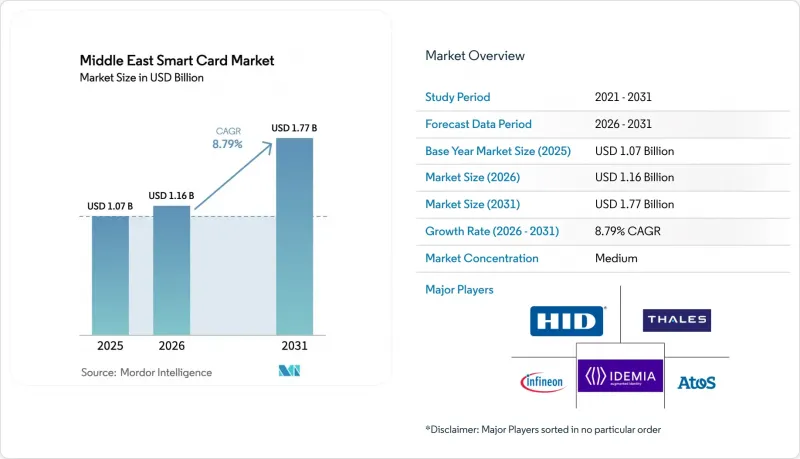
This report is Segmented by Interface Type (Contact-Based, Contactless, Dual-Interface), Chip Type (Memory Smart Cards, Microcontroller Smart Cards, and More), Function/Application (Payment and Banking, Identification and Authentication, and More), End-User Vertical (BFSI, IT and Telecommunication, Government, and More), and by Country. The Market Forecasts are Provided in Terms of Value (USD).
Middle East Smart Card Market Trends and Insights
National e-ID & e-Passport Roll-outs across GCC
GCC governments have made biometric civil ID a centrepiece of digital public-service delivery. The UAE will decommission physical Emirates ID cards by late 2025, transitioning to face- and fingerprint-verified digital credentials that remain accessible through secure mobile wallets. Oman already maintains 100% population coverage with multi-application smart IDs supplied by Thales. Kuwait's MY KUWAIT ID app embeds additional verification layers that strengthen access to more than 70 e-government services. Such programmes elevate unit volumes and drive the Middle East smart card market as ministries demand interoperable solutions capable of cross-border authentication.
Vision-2030-Led Cashless Payment Mandates in Saudi Arabia & UAE
Saudi Arabia's Mada network expansion and Dubai's target of 90% cashless transactions by 2026 institutionalise card-based payments across retail, transport, and government service payments. Simultaneously, the Central Bank of the UAE will introduce the Digital Dirham in late 2025, embedding tokenisation and smart-contract capabilities that must interface seamlessly with advanced card hardware. Cash-on-delivery usage in MENA halved from 41% in 2020 to 20% in 2023, underscoring behavioural shifts favouring contactless card infrastructure.
Interoperability Gaps between GCC & Levant Card Standards
While GCCNET unifies ATM clearing, card certification protocols remain fragmented across neighbouring markets, forcing issuers to carry multiple product SKUs and slowing cross-border service harmonisation. Lebanon's adoption of alternate biometric standards for border control exemplifies the technical divergence that elevates certification cost and complexity.
Other drivers and restraints analyzed in the detailed report include:
- Mass-Transit Smart-Ticketing for Mega-Projects
- 5G SIM Replacement Cycle Boosting High-End Micro-controller Cards
- Mobile-Wallet Cannibalisation in Affluent Gulf States
For complete list of drivers and restraints, kindly check the Table Of Contents.
Segment Analysis
Contact-based credentials remain dominant due to legacy bank and e-ID programmes, yet the contactless wave is unmistakable. In 2025, contactless cards represented 48.00% issuance and are advancing at 9.41% CAGR. The Middle East smart card market size for contactless platforms is forecast to add USD 258.6 million between 2026 and 2031 as transit operators and retailers retrofit NFC readers. Dual-interface cards mitigate migration risk by embedding both modes and already account for 19.00% of new volumes.
Transit agencies favour contactless because it speeds passenger flow and supports multi-modal integration. Retail chains deploy tap-to-pay because it aligns with regional social-distancing preferences adopted during the pandemic. Meanwhile, biometric overlays-such as palm-vein or facial match-are beginning to secure high-value contactless limits, reinforcing confidence in frictionless payment. These factors ensure the contactless segment will overtake contact-based share well before 2031, cementing its status as the long-term growth engine of the Middle East smart card market.
Microcontroller units currently dominate with a share of 65.28% in 2025 due to established certification pedigree and broad application across payments, telecom, and ID. Nevertheless, SoC architectures are growing fastest at 11.06% CAGR because they consolidate CPU, secure element, and wireless interface in one die, reducing BOM and footprint. The Middle East smart card market size for SoC platforms is poised to reach USD 223.4 million by 2031.
Regional sovereign investment in semiconductor design hubs-exemplified by Saudi Arabia's SAR 1 billion (USD 266 million) National Semiconductor Hub-signals a future shift toward domestic IP and packaging capacity. European technology leaders respond by localising value chains; IDEMIA invested EUR 20 million (USD 21.6 million) in capacity that guarantees European source traceability while serving GCC data-protection mandates. Infineon's SECORA Pay Green exemplifies the parallel sustainability imperative, cutting virgin plastic and CO2 by 60%
Complete Report Scope:
- By Interface Type
- Contact-Based
- Contactless
- Dual-Interface
- By Chip Type
- Memory Smart Cards
- Micro-controller Smart Cards
- System-on-Chip and Others
- By Function / Application
- Payment and Banking
- Identification and Authentication
- SIM and Telecommunications
- Transit and Ticketing
- Healthcare
- IoT and Other Niche Uses
- By End-User Vertical
- BFSI
- IT and Telecommunications
- Government and Public Sector
- Transportation and Logistics
- Healthcare
- Retail and Loyalty
- Others
- By Country
- United Arab Emirates
- Saudi Arabia
- Qatar
- Kuwait
- Oman
- Bahrain
- Israel
- Rest of Middle-East
List of Companies Covered in this Report:
- Thales Group
- IDEMIA
- Eviden (Atos Group)
- Giesecke + Devrient GmbH
- NXP Semiconductors N.V.
- Infineon Technologies AG
- HID Global Corporation
- Secura Key
- Eastcompeace Smart Card Co. Ltd.
- CPI Card Group Inc.
- Watchdata Technologies Pte Ltd.
- Muehlbauer Group
- Mastercard Inc.
- Visa Inc.
- Samsung Electronics Co. Ltd.
- Cardz Group ME LLC
- OT-Morpho (Gemalto)
- Zwipe AS
Additional Benefits:
- The market estimate (ME) sheet in Excel format
- 3 months of analyst support
TABLE OF CONTENTS
1 INTRODUCTION
- 1.1 Study Assumptions and Market Definition
- 1.2 Scope of the Study
2 RESEARCH METHODOLOGY
3 EXECUTIVE SUMMARY
4 MARKET LANDSCAPE
- 4.1 Market Overview
- 4.2 Market Drivers
- 4.2.1 National e-ID and e-Passport Roll-outs across GCC
- 4.2.2 Vision-2030 led Cashless Payment Mandates in Saudi Arabia and UAE
- 4.2.3 Mass-Transit Smart-Ticketing for Mega-Projects
- 4.2.4 5G SIM Replacement Cycle Boosting High-End Micro-controller Cards
- 4.2.5 Smart Hajj/Umrah ID Initiatives Driving High-Volume Issuance Peaks
- 4.3 Market Restraints
- 4.3.1 Inter-operability Gaps between GCC and Levant Card Standards
- 4.3.2 Grey-Market Counterfeit Card Inflows Undermining Security Trust
- 4.3.3 Imported IC Shortages due to Global Export Controls and Logistics
- 4.3.4 Mobile-Wallet Cannibalisation in Affluent Gulf States
- 4.4 Value / Supply-Chain Analysis
- 4.5 Regulatory Landscape
- 4.6 Technological Outlook (NFC, Biometric, Metal and Eco Materials)
- 4.7 Porter's Five Forces Analysis
- 4.7.1 Bargaining Power of Suppliers
- 4.7.2 Bargaining Power of Buyers
- 4.7.3 Threat of New Entrants
- 4.7.4 Threat of Substitutes
- 4.7.5 Intensity of Competitive Rivalry
5 MARKET SIZE AND GROWTH FORECASTS (VALUE)
- 5.1 By Interface Type
- 5.1.1 Contact-Based
- 5.1.2 Contactless
- 5.1.3 Dual-Interface
- 5.2 By Chip Type
- 5.2.1 Memory Smart Cards
- 5.2.2 Micro-controller Smart Cards
- 5.2.3 System-on-Chip and Others
- 5.3 By Function / Application
- 5.3.1 Payment and Banking
- 5.3.2 Identification and Authentication
- 5.3.3 SIM and Telecommunications
- 5.3.4 Transit and Ticketing
- 5.3.5 Healthcare
- 5.3.6 IoT and Other Niche Uses
- 5.4 By End-User Vertical
- 5.4.1 BFSI
- 5.4.2 IT and Telecommunications
- 5.4.3 Government and Public Sector
- 5.4.4 Transportation and Logistics
- 5.4.5 Healthcare
- 5.4.6 Retail and Loyalty
- 5.4.7 Others
- 5.5 By Country
- 5.5.1 United Arab Emirates
- 5.5.2 Saudi Arabia
- 5.5.3 Qatar
- 5.5.4 Kuwait
- 5.5.5 Oman
- 5.5.6 Bahrain
- 5.5.7 Israel
- 5.5.8 Rest of Middle-East
6 COMPETITIVE LANDSCAPE
- 6.1 Market Concentration
- 6.2 Strategic Moves
- 6.3 Market Share Analysis
- 6.4 Company Profiles {(includes Global level Overview, Market level overview, Core Segments, Financials as available, Strategic Information, Market Rank/Share for key companies, Products and Services, and Recent Developments)}
- 6.4.1 Thales Group
- 6.4.2 IDEMIA
- 6.4.3 Eviden (Atos Group)
- 6.4.4 Giesecke + Devrient GmbH
- 6.4.5 NXP Semiconductors N.V.
- 6.4.6 Infineon Technologies AG
- 6.4.7 HID Global Corporation
- 6.4.8 Secura Key
- 6.4.9 Eastcompeace Smart Card Co. Ltd.
- 6.4.10 CPI Card Group Inc.
- 6.4.11 Watchdata Technologies Pte Ltd.
- 6.4.12 Muehlbauer Group
- 6.4.13 Mastercard Inc.
- 6.4.14 Visa Inc.
- 6.4.15 Samsung Electronics Co. Ltd.
- 6.4.16 Cardz Group ME LLC
- 6.4.17 OT-Morpho (Gemalto)
- 6.4.18 Zwipe AS
7 MARKET OPPORTUNITIES AND FUTURE OUTLOOK
- 7.1 White-space and Unmet-Need Assessment

