PUBLISHER: Mordor Intelligence | PRODUCT CODE: 2124948

PUBLISHER: Mordor Intelligence | PRODUCT CODE: 2124948
Wi-Fi Chipset - Market Share Analysis, Industry Trends & Statistics, Growth Forecasts (2026 - 2031)
According to Mordor Intelligence, the wi-Fi chipset market size is expected to grow from USD 21.90 billion in 2025 to USD 23.24 billion in 2026 and is forecast to reach USD 31.27 billion by 2031 at 6.12% CAGR over 2026-2031.
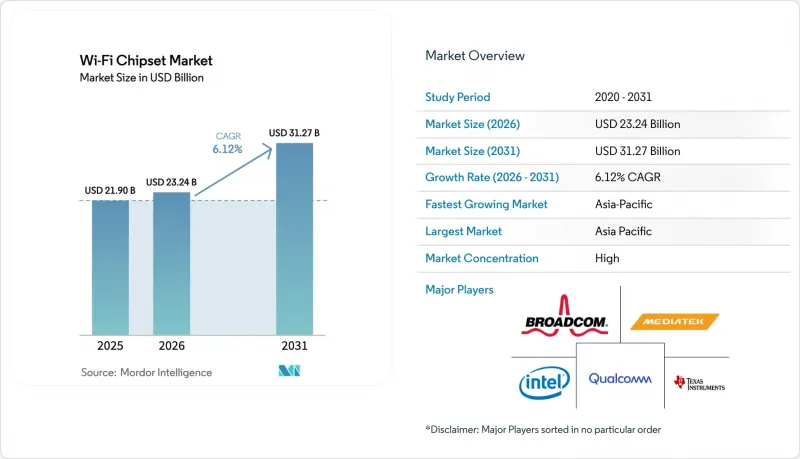
This report is Segmented by Standard (Wi-Fi 4, Wi-Fi 5, Wi-Fi 6 and 6E, and More), MIMO Configuration (MU-MIMO, SU-MIMO), Device Application (Smartphones, Tablets, Desktops, Laptops, Wi-Fi Router and Broadband Gateway, and More), End-User (Residential, Enterprise, Industrial, Automotive, and More), and Geography (North America, South America, and More). The Market Forecasts are Provided in Terms of Value (USD).
Global Wi-Fi Chipset Market Trends and Insights
Rapid Adoption of Wi-Fi 6/6E in Enterprise Networks
Corporate campus upgrades began moving from pilot to full-scale rollouts in 2024, pushed by the 1,200 MHz of 6 GHz spectrum released by the FCC. Added channels permit larger 320 MHz widths that quintuple throughput versus Wi-Fi 5, giving IT teams capacity headroom for 8K media streams and latency-sensitive collaboration tools. More than 400 Wi-Fi 6E-certified devices had reached commercial availability by 2024, and enterprise-class access points formed the fastest-growing certification subcategory. Facilities teams report lower troubleshooting tickets as clean 6 GHz channels avoid interference created by legacy devices operating at 2.4 GHz and 5 GHz. Vendors position Wi-Fi 6E hardware as future-proof investments that accept software upgrades to Wi-Fi 7 when spectrum becomes available. Procurement cycles are shortened to under 15 months in verticals such as healthcare and finance, where always-on wireless is now an operational prerequisite.
Growth in Smart-Home Devices and Residential Mesh Networking
Household device density surpassed 30 connected endpoints in many urban dwellings during 2024, and forecasts suggest averages above 50 by 2028. That surge forces service providers to redesign gateways around tri-radio chipsets capable of dedicating 6 GHz backhaul links between mesh nodes. Wi-Fi 6E gateways thus prevent 4K streaming boxes from crowding thermostats and security cameras that still operate on 2.4 GHz. Beamforming and seamless handoff software within new chipsets sustain consistent throughput as occupants roam from room to room, addressing a top driver of support calls. Mature power-save modes extend battery life for low-duty-cycle sensors, trimming truck-roll costs for internet service providers. Broadcom quantified a double-digit drop in field-support incidents after deploying 6 GHz-enabled gateways across select North American fiber footprints.
Network Security Threats and Complex Management
Transitioning to WPA3 hardens Wi-Fi networks, yet mixed-generation device fleets create compatibility gaps that slow enterprise upgrades. Multi-Link Operation in Wi-Fi 7 multiplies policy sets because each frequency link demands synchronized encryption credentials. IT administrators, therefore, invest in automated policy engines that escalate costs and lengthen deployment timetables. The influx of unmanaged IoT devices widens attack surfaces, prompting stricter network segmentation and zero-trust architectures that strain limited staff resources. Automated Frequency Coordination databases required for outdoor 6 GHz channels further complicate change-management workflows, pushing some organizations to slow rollouts until vendor tooling matures.
Other drivers and restraints analyzed in the detailed report include:
- Integration of Wi-Fi HaLow for Low-Power Industrial IoT
- Regulatory Opening of 6-7 GHz Spectrum Accelerating Wi-Fi 7
- Semiconductor Fabrication Capacity Constraints (< 6 nm)
For complete list of drivers and restraints, kindly check the Table Of Contents.
Segment Analysis
Wi-Fi 6 and Wi-Fi 6E together commanded 41.27% revenue share in 2025 as the preferred upgrade path for enterprise campus refresh projects. The segment benefits from backward compatibility and certified client ecosystems, anchoring the Wi-Fi chipset market through the mid-term horizon. The Others category, dominated by Wi-Fi 7 designs, is set to record the fastest 6.72% CAGR as chipmakers finalize 320 MHz channel architectures that multiply spectral efficiency. Apple's flagship smartphones and laptop platforms are scheduled to integrate tri-band Wi-Fi 7 radios in 2025, which typically triggers accelerated LAN infrastructure investment by corporations aligning device and access-point capabilities. Filogic-based Wi-Fi 7 gateways demonstrated 4X higher uplink throughput in operator lab tests, underscoring differentiation over Wi-Fi 6E predecessors.
Growing demand for virtual reality, cloud gaming, and ultra-high-definition streaming elevates throughput expectations beyond the ceiling of Wi-Fi 6E. Early adopters place strategic orders for access points that feature Automatic Frequency Coordination clients to satisfy 6 GHz incumbent protections in outdoor venues. Market education campaigns from chipset vendors emphasize latency reduction in the single-millisecond range, critical for bidirectional XR use cases. As the Wi-Fi chipset market transitions, component suppliers that offer modular reference designs accelerate customer time-to-market and lock in design wins across CPE, PC, and smartphone verticals.
MU-MIMO solutions generated 60.65% of 2025 sales and registered a 6.61% CAGR through 2031. Eight-stream access points push simultaneous downlink and uplink data to dozens of devices, a capability vital for lecture halls and transportation hubs that often peak above 500 concurrent users. Advances in beamforming algorithms embedded inside Wi-Fi 6E and Wi-Fi 7 PHY layers sustain signal integrity even in reflective indoor environments. The Wi-Fi chipset market size attached to MU-MIMO implementations benefits from premium ASPs for high-end enterprise gear.
SU-MIMO chipsets remain in entry-level gateways and price-sensitive IoT nodes where single-threaded communication remains sufficient. Yet as IoT density rises, even consumer access points are migrating to four-stream MU-MIMO designs to minimize airtime contention. Component vendors embed AI acceleration blocks that analyze client telemetry and dynamically allocate spatial streams, assuring predictable application performance for videoconferencing apps that dominate residential upstream traffic.
Complete Report Scope:
- By Standard
- Wi-Fi 4
- Wi-Fi 5 (802.11ac)
- Wi-Fi 6 and 6E (802.11ax)
- Wi-Fi 7 (802.11be)
- Other Standards (Wi-Fi 8, Older)
- By MIMO Configuration
- MU-MIMO
- SU-MIMO
- By Device Application
- Smartphones
- Tablets
- Desktops
- Laptops
- Wi-Fi Router and Broadband Gateway
- TV
- IoTs
- Infotainment Systems (Automotive)
- Other Device Applications (Drones, Gaming Devices)
- By End-User
- Residential (Consumer Electronics)
- Enterprise (Networking)
- Industrial
- Automotive
- Government and Public
- Medical
- Other End-Users (Education, Commercial)
- By Geography
- North America
- United States
- Canada
- Mexico
- South America
- Brazil
- Argentina
- Rest of South America
- Europe
- Germany
- United Kingdom
- France
- Russia
- Rest of Europe
- Asia-Pacific
- China
- Japan
- India
- South Korea
- South-East Asia
- Rest of Asia-Pacific
- Middle East and Africa
- Middle East
- Saudi Arabia
- United Arab Emirates
- Rest of Middle East
- Africa
- South Africa
- Egypt
- Rest of Africa
- Middle East
- North America
Geography Analysis
Asia-Pacific generated 43.05% of Wi-Fi chipset market shipments in 2025, with China, Japan, and South Korea anchoring both manufacturing and consumption. Government fiber investments across Tier-2 and Tier-3 Chinese cities stimulate demand for tri-radio gateways, although current limitations on indoor 6 GHz operation delay full-scale Wi-Fi 6E adoption. Japan's regulatory green light for 6 GHz WLAN in 2024 sparked local OEM activity around Wi-Fi 7 routers that support 320 MHz channels, while Korean operators deploy carrier-grade Wi-Fi 6E access points inside 5G-enabled smart-city corridors. India's surge in internet subscribers and the establishment of a Wi-Fi design center in Chennai illustrate the region's evolving role as both an engineering hub and a high-volume consumer.
North America maintains a leadership role in enterprise deployments, leveraging the FCC's early opening of the entire 6 GHz band. Hybrid work patterns keep demand strong for access points with dynamic channel allocation features. Service providers bundle managed Wi-Fi 7 gateways into gigabit fiber packages to reduce customer churn and differentiate beyond speed tiers. The Wi-Fi chipset market benefits from robust private-sector funding that underwrites rapid generation transitions when total cost-of-ownership models justify productivity gains. Europe experiences accelerated Wi-Fi 7 adoption among broadband operators preparing for 8 Gbps multi-gig services. CEPT's efforts to authorize the upper 6 GHz band would double available channels and foster symmetrical gigabit performance across densely populated metro areas. Meanwhile, South America and the Middle East, and Africa deliver emerging-market growth as cost-reduced Wi-Fi 6 chipsets migrate into mass-market smartphones and fixed-wireless gateways that bridge rural connectivity gaps. Spectrum allocation diversity across these regions complicates global SKU alignment, but standards-based certifications minimize interoperability risk for multinational OEMs.
- Qualcomm Technologies Inc.
- Broadcom Inc.
- MediaTek Inc.
- Intel Corporation
- Texas Instruments Incorporated
- STMicroelectronics N.V.
- Samsung Electronics Co., Ltd.
- NXP Semiconductors N.V.
- ON Semiconductor Corporation
- Espressif Systems
- Beken Corporation
- Infineon Technologies AG
- Renesas Electronics Corporation
- Nordic Semiconductor ASA
- Silicon Laboratories Inc.
- MaxLinear, Inc.
- UNISOC (Shanghai) Technologies Co., Ltd.
- Realtek Semiconductor Corporation
- Skyworks Solutions Inc.
- Qorvo Inc.
- Analog Devices Inc.
- Murata Manufacturing Co., Ltd.
- Marvell Technology, Inc.
- ASR Microelectronics Co., Ltd.
Additional Benefits:
- The market estimate (ME) sheet in Excel format
- 3 months of analyst support
TABLE OF CONTENTS
1 INTRODUCTION
- 1.1 Study Assumptions and Market Definition
- 1.2 Scope of the Study
2 RESEARCH METHODOLOGY
3 EXECUTIVE SUMMARY
4 MARKET LANDSCAPE
- 4.1 Market Overview
- 4.2 Market Drivers
- 4.2.1 Proliferation of public Wi-Fi hotspots and IoT connections
- 4.2.2 Rising internet penetration and demand for high-speed connectivity
- 4.2.3 Rapid adoption of Wi-Fi 6/6E in enterprise networks
- 4.2.4 Growth in smart-home devices and residential mesh networking
- 4.2.5 Integration of Wi-Fi HaLow for low-power industrial IoT
- 4.2.6 Regulatory opening of 6-7 GHz spectrum accelerating Wi-Fi 7
- 4.3 Market Restraints
- 4.3.1 Network security threats and complex management
- 4.3.2 Competition from cellular 5G/LPWAN alternatives in IoT
- 4.3.3 Semiconductor fabrication capacity constraints (<6 nm)
- 4.3.4 Fragmented regional spectrum regulations for Wi-Fi 7
- 4.4 Impact of Macroeconomic Factors on the Market
- 4.5 Evolution of Wi-Fi
- 4.6 Industry Supply Chain Analysis
- 4.7 Regulatory Landscape
- 4.8 Technological Outlook
- 4.9 Porter's Five Forces Analysis
- 4.9.1 Bargaining Power of Suppliers
- 4.9.2 Bargaining Power of Consumers
- 4.9.3 Threat of New Entrants
- 4.9.4 Intensity of Competitive Rivalry
- 4.9.5 Threat of Substitute Products
5 MARKET SIZE AND GROWTH FORECASTS (VALUE)
- 5.1 By Standard
- 5.1.1 Wi-Fi 4
- 5.1.2 Wi-Fi 5 (802.11ac)
- 5.1.3 Wi-Fi 6 and 6E (802.11ax)
- 5.1.4 Wi-Fi 7 (802.11be)
- 5.1.5 Other Standards (Wi-Fi 8, Older)
- 5.2 By MIMO Configuration
- 5.2.1 MU-MIMO
- 5.2.2 SU-MIMO
- 5.3 By Device Application
- 5.3.1 Smartphones
- 5.3.2 Tablets
- 5.3.3 Desktops
- 5.3.4 Laptops
- 5.3.5 Wi-Fi Router and Broadband Gateway
- 5.3.6 TV
- 5.3.7 IoTs
- 5.3.8 Infotainment Systems (Automotive)
- 5.3.9 Other Device Applications (Drones, Gaming Devices)
- 5.4 By End-User
- 5.4.1 Residential (Consumer Electronics)
- 5.4.2 Enterprise (Networking)
- 5.4.3 Industrial
- 5.4.4 Automotive
- 5.4.5 Government and Public
- 5.4.6 Medical
- 5.4.7 Other End-Users (Education, Commercial)
- 5.5 By Geography
- 5.5.1 North America
- 5.5.1.1 United States
- 5.5.1.2 Canada
- 5.5.1.3 Mexico
- 5.5.2 South America
- 5.5.2.1 Brazil
- 5.5.2.2 Argentina
- 5.5.2.3 Rest of South America
- 5.5.3 Europe
- 5.5.3.1 Germany
- 5.5.3.2 United Kingdom
- 5.5.3.3 France
- 5.5.3.4 Russia
- 5.5.3.5 Rest of Europe
- 5.5.4 Asia-Pacific
- 5.5.4.1 China
- 5.5.4.2 Japan
- 5.5.4.3 India
- 5.5.4.4 South Korea
- 5.5.4.5 South-East Asia
- 5.5.4.6 Rest of Asia-Pacific
- 5.5.5 Middle East and Africa
- 5.5.5.1 Middle East
- 5.5.5.1.1 Saudi Arabia
- 5.5.5.1.2 United Arab Emirates
- 5.5.5.1.3 Rest of Middle East
- 5.5.5.2 Africa
- 5.5.5.2.1 South Africa
- 5.5.5.2.2 Egypt
- 5.5.5.2.3 Rest of Africa
- 5.5.5.1 Middle East
- 5.5.1 North America
6 COMPETITIVE LANDSCAPE
- 6.1 Market Concentration
- 6.2 Strategic Moves
- 6.3 Market Share Analysis
- 6.4 Company Profiles (includes Global level Overview, Market level overview, Core Segments, Financials as available, Strategic Information, Market Rank/Share, Products and Services, and Recent Developments)
- 6.4.1 Qualcomm Technologies Inc.
- 6.4.2 Broadcom Inc.
- 6.4.3 MediaTek Inc.
- 6.4.4 Intel Corporation
- 6.4.5 Texas Instruments Incorporated
- 6.4.6 STMicroelectronics N.V.
- 6.4.7 Samsung Electronics Co., Ltd.
- 6.4.8 NXP Semiconductors N.V.
- 6.4.9 ON Semiconductor Corporation
- 6.4.10 Espressif Systems
- 6.4.11 Beken Corporation
- 6.4.12 Infineon Technologies AG
- 6.4.13 Renesas Electronics Corporation
- 6.4.14 Nordic Semiconductor ASA
- 6.4.15 Silicon Laboratories Inc.
- 6.4.16 MaxLinear, Inc.
- 6.4.17 UNISOC (Shanghai) Technologies Co., Ltd.
- 6.4.18 Realtek Semiconductor Corporation
- 6.4.19 Skyworks Solutions Inc.
- 6.4.20 Qorvo Inc.
- 6.4.21 Analog Devices Inc.
- 6.4.22 Murata Manufacturing Co., Ltd.
- 6.4.23 Marvell Technology, Inc.
- 6.4.24 ASR Microelectronics Co., Ltd.
7 MARKET OPPORTUNITIES AND FUTURE OUTLOOK
- 7.1 White-space and Unmet-need Assessment

