PUBLISHER: Mordor Intelligence | PRODUCT CODE: 2124954

PUBLISHER: Mordor Intelligence | PRODUCT CODE: 2124954
China Smart Building - Market Share Analysis, Industry Trends & Statistics, Growth Forecasts (2026 - 2031)
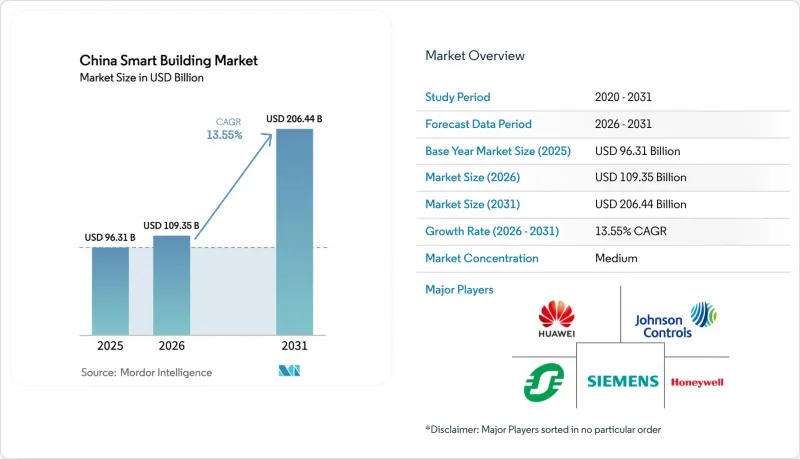
According to Mordor Intelligence, the China smart building market size is expected to grow from USD 96.31 billion in 2025 to USD 109.35 billion in 2026 and is forecast to reach USD 206.44 billion by 2031 at 13.55% CAGR over 2026-2031.
This report is Segmented by Solution (Building Energy Management Systems, Infrastructure Management Systems, Intelligent Security Systems, Integrated Workplace Management Platforms, and More), Component (Hardware, Software, Services), Connectivity Type (Wired, Wireless), Building Type (Residential, Commercial, Industrial), and Geography. Market Forecasts are Provided in Terms of Value (USD).
China Smart Building Market Trends and Insights
Expanding Government Smart City Initiatives
Beijing's 2024 guideline commits CNY 1.2 trillion (USD 165 billion) through 2027 to digitalize municipal services, treating smart buildings as core infrastructure alongside 5G and data centers. The directive covers 16 demonstration zones and requires new public buildings above 10,000 m2 to connect with city data platforms by 2026. Compliance timetables are driving a surge in turnkey projects, favoring vendors able to integrate automation, security, and energy modules under a single architecture. Local governments tie subsidy eligibility to adherence with the Ministry of Housing's 2024 smart-building technical specification, effectively raising market-entry barriers.As a result, the Chinese smart building market experiences policy-induced demand certainty even amid broader real-estate volatility.
Rising Demand for Energy-Efficient Retrofits in Existing Buildings
Roughly 60% of China's building stock predates the 2010 energy codes, representing more than 20 billion square meters of retrofit potential.The carbon peaking plan targets a 15% reduction in operational emissions by 2030, with retrofits accounting for half of the reduction. The People's Bank of China extended its carbon-reduction facility to cover building energy-management projects at an interest rate of 1.75%, trimming payback periods for landlords. Fourteen provinces now require energy-performance disclosure at lease renewal, creating rental premiums for smart-enabled assets, as seen in Shanghai, where automated buildings achieved 8-12% higher rents in 2024. These incentives convert energy systems from cost centers into revenue enhancers, sustaining double-digit uptake across the Chinese smart building market.
High Upfront Capital Expenditure for SMEs
Comprehensive smart retrofits cost up to USD 200 per m2, a hurdle for SMEs that hold 40% of commercial floor area but earn rental yields of only 4-6%. Commercial lending rates of 4.5-6.0% neutralize central-bank concessional lines reserved for state developers, stretching paybacks to 8-12 years. Subsidies covering 20-30% of costs in Zhejiang and Guangdong ease the burden yet remain confined to pilot budgets. As a result, the China smart building market shows bifurcation: tier-1 portfolios digitize rapidly while fragmented SME assets lag. Vendors are responding by offering modular kits, phased rollouts, and revenue-sharing energy contracts, but capital friction persists as a structural brake on nationwide penetration.
Other drivers and restraints analyzed in the detailed report include:
- Integration of 5G and AIoT Platforms in Building Automation
- Growing Corporate Net-Zero Carbon Commitments
- Shortage of Certified Smart-Building Facility Managers
For complete list of drivers and restraints, kindly check the Table Of Contents.
Segment Analysis
Building energy management systems captured 37.62% of the Chinese smart building market share in 2025, supported by disclosure rules for properties above 20,000 m2. Vendors bundle HVAC, lighting, and solar assets into algorithms that track weather and occupancy patterns, pushing the segment toward outcome-based contracts. Sliding hardware margins facilitate a shift to subscription models that ensure energy savings. Integrated workplace management, though smaller, is advancing at a 15.12% CAGR, helped by hybrid work trends and landlord demand for real-time space analytics. China Resources Land rolled out workplace dashboards across 2.8 million square meters in 2024, reducing tenant space by up to 20% and validating the segment's value proposition.
Energy, security, and workplace modules increasingly converge on a single data layer. Infrastructure management systems offer steady if slower growth tied to new-build volume. Security remains essential amid rising compliance requirements for visitor tracking, but privacy curbs limit the use of facial recognition in residential complexes. Lighting controls fold into energy platforms, with LED retrofits serving as entry points for broader automation. Cross-domain vendors that can stitch multiple functions together are best positioned to win bundled tenders across the Chinese smart building market.
Hardware generated 54.88% of 2025 revenue, yet it is losing pricing power as sensor and controller costs decline. Wireless 5G sensors further erode gateway demand, pressuring manufacturers that lack proprietary technology. Software layers, analytics, operating systems, and cyber-defense rise in strategic weight as clients seek insight rather than raw data. Subscription pricing, exemplified by Siemens Desigo CC, smooths cash flow and deepens stickiness.
Services, the smallest component in 2025, are on track for the fastest 13.95% CAGR through 2031. Integration complexity around legacy systems fuels demand for specialist integrators, while SMEs outsource operations to managed-service providers. Johnson Controls' OpenBlue bookings in China increased by 40% in 2024 under outcome-based contracts, demonstrating the acceptance of performance guarantees. As monetization shifts from one-off hardware sales to life-cycle services, vendors with dense local support networks gain market share across the entire China smart building market spectrum.
Complete Report Scope:
- By Solution
- Building Energy Management Systems
- Infrastructure Management Systems
- Intelligent Security Systems
- Integrated Workplace Management Platforms
- Lighting Control Systems
- By Component
- Hardware
- Software
- Services
- By Connectivity Type
- Wired
- Wireless
- By Building Type
- Residential
- Commercial
- Industrial
List of Companies Covered in this Report:
- Johnson Controls International plc
- Siemens Aktiengesellschaft
- Honeywell International Inc.
- Schneider Electric SE
- ABB Ltd.
- Azbil Corporation
- Hitachi Ltd.
- Huawei Technologies Co., Ltd.
- Cisco Systems, Inc.
- Xiaomi Corporation
- Zhejiang Dahua Technology Co., Ltd.
- Zhejiang Uniview Technologies Co., Ltd.
- SenseTime Group Inc.
- Shanghai Yunding Network Technology Co., Ltd. (Tuyasmart)
- Inspur Group Co., Ltd.
- Beijing Megvii Technology Limited
- Foxconn Industrial Internet Co., Ltd.
- Legrand (China) Co., Ltd.
- Delta Electronics (China) Co., Ltd.
- Advantech Co., Ltd.
- Gree Electric Appliances, Inc. of Zhuhai
- Hisense Smart Technology Co., Ltd.
- Broad Group Co., Ltd.
- Hollysys Automation Technologies Ltd.
- iSoftStone Information Technology (Group) Co., Ltd.
- Hikvision Digital Technology Co., Ltd.
Additional Benefits:
- The market estimate (ME) sheet in Excel format
- 3 months of analyst support
TABLE OF CONTENTS
1 INTRODUCTION
- 1.1 Study Assumptions and Market Definition
- 1.2 Scope of the Study
2 RESEARCH METHODOLOGY
3 EXECUTIVE SUMMARY
4 MARKET LANDSCAPE
- 4.1 Market Overview
- 4.2 Market Drivers
- 4.2.1 Expanding Government Smart City Initiatives
- 4.2.2 Rising Demand for Energy-Efficient Retrofits in Existing Buildings
- 4.2.3 Integration of 5G and AIoT Platforms in Building Automation
- 4.2.4 Growing Corporate Net-Zero Carbon Commitments
- 4.2.5 Rapid Growth of Smart Property Management Services
- 4.2.6 Emergence of Digital Twin-Based Urban Planning Mandates
- 4.3 Market Restraints
- 4.3.1 High Upfront Capital Expenditure for SMEs
- 4.3.2 Fragmented Building Communication Protocols
- 4.3.3 Data Privacy and Cyber-Security Compliance Gaps
- 4.3.4 Shortage of Certified Smart-Building Facility Managers
- 4.4 Impact of Macroeconomic Factors on the Market
- 4.5 Industry Value Chain Analysis
- 4.6 Regulatory Landscape
- 4.7 Technological Outlook
- 4.8 Porter's Five Forces Analysis
- 4.8.1 Threat of New Entrants
- 4.8.2 Bargaining Power of Buyers
- 4.8.3 Bargaining Power of Suppliers
- 4.8.4 Threat of Substitutes
- 4.8.5 Intensity of Competitive Rivalry
- 4.9 Investment Analysis
5 MARKET SIZE AND GROWTH FORECASTS (VALUE)
- 5.1 By Solution
- 5.1.1 Building Energy Management Systems
- 5.1.2 Infrastructure Management Systems
- 5.1.3 Intelligent Security Systems
- 5.1.4 Integrated Workplace Management Platforms
- 5.1.5 Lighting Control Systems
- 5.2 By Component
- 5.2.1 Hardware
- 5.2.2 Software
- 5.2.3 Services
- 5.3 By Connectivity Type
- 5.3.1 Wired
- 5.3.2 Wireless
- 5.4 By Building Type
- 5.4.1 Residential
- 5.4.2 Commercial
- 5.4.3 Industrial
6 COMPETITIVE LANDSCAPE
- 6.1 Market Concentration
- 6.2 Strategic Moves
- 6.3 Market Share Analysis
- 6.4 Company Profiles (includes Global level Overview, Market level overview, Core Segments, Financials as available, Strategic Information, Market Rank/Share for key companies, Products and Services, and Recent Developments)
- 6.4.1 Johnson Controls International plc
- 6.4.2 Siemens Aktiengesellschaft
- 6.4.3 Honeywell International Inc.
- 6.4.4 Schneider Electric SE
- 6.4.5 ABB Ltd.
- 6.4.6 Azbil Corporation
- 6.4.7 Hitachi Ltd.
- 6.4.8 Huawei Technologies Co., Ltd.
- 6.4.9 Cisco Systems, Inc.
- 6.4.10 Xiaomi Corporation
- 6.4.11 Zhejiang Dahua Technology Co., Ltd.
- 6.4.12 Zhejiang Uniview Technologies Co., Ltd.
- 6.4.13 SenseTime Group Inc.
- 6.4.14 Shanghai Yunding Network Technology Co., Ltd. (Tuyasmart)
- 6.4.15 Inspur Group Co., Ltd.
- 6.4.16 Beijing Megvii Technology Limited
- 6.4.17 Foxconn Industrial Internet Co., Ltd.
- 6.4.18 Legrand (China) Co., Ltd.
- 6.4.19 Delta Electronics (China) Co., Ltd.
- 6.4.20 Advantech Co., Ltd.
- 6.4.21 Gree Electric Appliances, Inc. of Zhuhai
- 6.4.22 Hisense Smart Technology Co., Ltd.
- 6.4.23 Broad Group Co., Ltd.
- 6.4.24 Hollysys Automation Technologies Ltd.
- 6.4.25 iSoftStone Information Technology (Group) Co., Ltd.
- 6.4.26 Hikvision Digital Technology Co., Ltd.
7 MARKET OPPORTUNITIES AND FUTURE OUTLOOK
- 7.1 White-Space and Unmet-Need Assessment

