PUBLISHER: Mordor Intelligence | PRODUCT CODE: 2124958

PUBLISHER: Mordor Intelligence | PRODUCT CODE: 2124958
Active Wound Care - Market Share Analysis, Industry Trends & Statistics, Growth Forecasts (2026 - 2031)
According to Mordor Intelligence, the active wound care market size is expected to grow from USD 3.02 billion in 2025 to USD 3.15 billion in 2026 and is forecast to reach USD 3.91 billion by 2031 at 4.38% CAGR over 2026-2031.
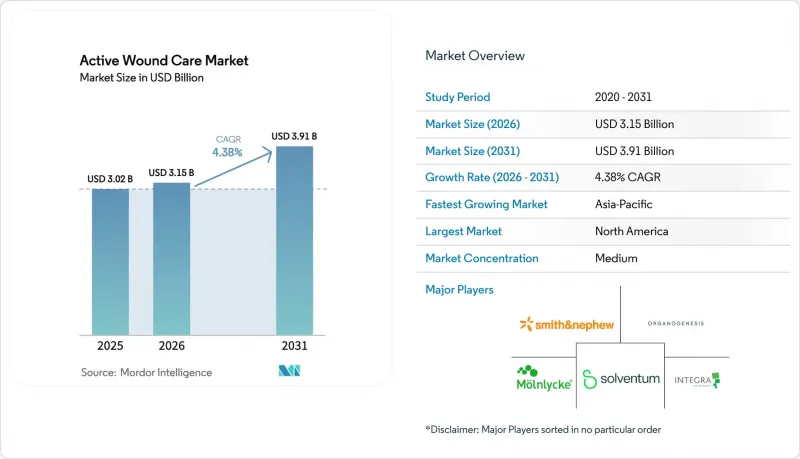
This report is Segmented by Product (Biomaterials, Skin Substitutes, Growth Factors), End User (Hospitals, Specialty Wound Clinics, Home Healthcare, Others), Application (Chronic Wounds, Acute Wounds), and Geography (North America, Europe, Asia-Pacific, Middle East and Africa, South America). The Market Forecasts are Provided in Terms of Value (USD).
Global Active Wound Care Market Trends and Insights
Rising Prevalence of Chronic Wounds (Diabetes, Obesity)
The global diabetes epidemic is fundamentally reshaping wound care demand patterns, with diabetic foot ulcers representing a USD 13 billion annual treatment burden that traditional therapies fail to address effectively. China's nationwide push of wound centers illustrates how health systems are scaling capacity to manage a mounting caseload of complex ulcers. The intersection of metabolic disorders with population aging ensures that chronic wounds stay the dominant revenue driver in the active wound care market through 2030.
Technological Innovations in Bioengineered Substitutes and Growth Factors
The 2024 FDA approval of Zevaskyn, a gene-based skin substitute that achieved an 81% closure rate in recessive dystrophic epidermolysis bullosa lesions, confirms rapid clinical translation of cellular reprogramming techniques. Emerging 3D-bioprinting processes enable patient-specific grafts containing vascularized constructs, addressing the long-standing hurdle of poor graft integration. These advances reposition the active wound care market from commodity supplies to precision, biologically active platforms capable of tailoring therapy to individual wound microenvironments.
High Product Costs and Uneven Reimbursement in Emerging Markets
Advanced matrices and growth-factor formulations carry price tags many multiples higher than gauze, impeding penetration where public systems cover only basic care. Localized manufacturing hubs in China and India bring down costs, yet reimbursement lags behind clinical guidelines, forcing patients to self-pay. Infrastructure limitations, including cold-chain distribution and trained application specialists, further restrict active product uptake outside Tier-1 hospitals, curbing the full potential of the active wound care market in low- and middle-income economies.
Other drivers and restraints analyzed in the detailed report include:
- Surge in Surgical and Trauma Procedures
- Expanding Reimbursement for Cellular/Tissue-Based Products
- Stringent Biologics Approval Pathways
For complete list of drivers and restraints, kindly check the Table Of Contents.
Segment Analysis
Biomaterials contributed 44.86% of revenue in 2025, affirming their role as first-line therapy across wound etiologies. Enhanced hydrogels, alginates, and foam composites offer moisture balance and exudate control at competitive price points, ensuring broad adoption in the active wound care market. Skin substitutes-biological, biosynthetic, and synthetic-are scaling faster, with a 4.78% CAGR forecast as next-generation matrices integrate viable cells and growth factors. The active wound care market growth propelled by approvals such as NexoBrid for severe burns that validate clinical efficacy.
Manufacturers increasingly embed micro-sensors and wireless modules into foam and hydrocolloid dressings, transforming a passive bandage into an IoT-enabled therapeutic with on-board diagnostics. Synthetic polymers derived from plant or fish collagen provide performance parity to human-derived extracellular matrices, mitigating supply constraints and ethical concerns. This product diversification supports resilience in the active wound care market against sourcing disruptions.
Complete Report Scope:
- By Product
- Biomaterials
- Skin Substitutes
- Biological Skin Substitutes
- Synthetic and Biosynthetic Skin Substitutes
- Growth Factors
- By End User
- Hospitals
- Specialty Wound Clinics
- Home Healthcare
- Others
- By Application
- Chronic Wounds
- Acute Wounds
- By Geography
- North America
- United States
- Canada
- Mexico
- Europe
- Germany
- United Kingdom
- France
- Italy
- Spain
- Rest of Europe
- Asia-Pacific
- China
- Japan
- India
- Australia
- South Korea
- Rest of Asia-Pacific
- Middle East and Africa
- GCC
- South Africa
- Rest of Middle East and Africa
- South America
- Brazil
- Argentina
- Rest of South America
- North America
Geography Analysis
North America retained 41.30% of global revenue in 2025 thanks to favorable reimbursement and a dense cluster of academic medical centers spearheading first-in-human trials. Ongoing Medicare Advantage expansion is accelerating private-sector investment in digital-therapeutic pairings that display quantifiable outcome gains, reinforcing regional leadership in the active wound care market.
Asia-Pacific registers the highest trajectory at 5.92% CAGR through 2031, galvanized by infrastructure upgrades and government backing of chronic disease management programs. China's continued allocation of innovation grants for biotech startups underpins a rapid skills and capacity build-out. In India and Indonesia, public insurance expansions are beginning to reimburse bioactive substitutes for diabetic ulcers, unlocking new patient cohorts for the active wound care market.
Europe presents a steady yet opportunity-rich environment shaped by stringent medical-device regulations that prioritize sustainability. Demand for biodegradable dressings and plant-based collagen is growing, driven by environmental directives and hospital green-procurement mandates. Middle East & Africa and South America contribute a smaller collective share but are moving into double-digit growth zones in select Gulf Cooperation Council (GCC) states and Brazil, respectively, as tertiary hospitals seek parity with OECD wound-care protocols.
- Smiths Group
- Solventum
- Molnlycke Health Care
- Organogenesis
- Integra LifeSciences Holdings Corp.
- MiMedx Group Inc.
- Tissue Regenix
- Stryker
- ConvaTec Group plc
- Baxter
- Coloplast
- Johnson & Johnson
- Medtronic
- Axio Biosolutions
- Fibroheal Woundcare Pvt. Ltd.
- Human BioSciences
- BSN medical (Essity)
- Aroa Biosurgery Ltd.
- Regenesis Biomedical
- Gunze Limited
Additional Benefits:
- The market estimate (ME) sheet in Excel format
- 3 months of analyst support
TABLE OF CONTENTS
1 Introduction
- 1.1 Study Assumptions & Market Definition
- 1.2 Scope of the Study
2 Research Methodology
3 Executive Summary
4 Market Landscape
- 4.1 Market Overview
- 4.2 Market Drivers
- 4.2.1 Rising Prevalence of Chronic Wounds (Diabetes, Obesity)
- 4.2.2 Surge In Surgical and Trauma Procedures
- 4.2.3 Technological Innovations in Bioengineered Substitutes and Growth Factors
- 4.2.4 Expanding Reimbursement for Cellular/Tissue-Based Products
- 4.2.5 Smart Sensor-Embedded Active Dressings Adoption
- 4.2.6 Military and Space-Medicine Funded Regenerative R&D
- 4.3 Market Restraints
- 4.3.1 High Product Costs and Uneven Reimbursement in EMs
- 4.3.2 Stringent Biologics Approval Pathways
- 4.3.3 Supply-Chain Limits for Human/Animal ECM Sourcing
- 4.3.4 Rising Antimicrobial Resistance Impacting Bioactive Dressings
- 4.4 Regulatory Landscape
- 4.5 Technological Outlook
- 4.6 Porter's Five Forces
- 4.6.1 Threat of New Entrants
- 4.6.2 Bargaining Power of Buyers
- 4.6.3 Bargaining Power of Suppliers
- 4.6.4 Threat of Substitutes
- 4.6.5 Competitive Rivalry
5 Market Size & Growth Forecasts (Value)
- 5.1 By Product
- 5.1.1 Biomaterials
- 5.1.2 Skin Substitutes
- 5.1.2.1 Biological Skin Substitutes
- 5.1.2.2 Synthetic and Biosynthetic Skin Substitutes
- 5.1.3 Growth Factors
- 5.2 By End User
- 5.2.1 Hospitals
- 5.2.2 Specialty Wound Clinics
- 5.2.3 Home Healthcare
- 5.2.4 Others
- 5.3 By Application
- 5.3.1 Chronic Wounds
- 5.3.2 Acute Wounds
- 5.4 By Geography
- 5.4.1 North America
- 5.4.1.1 United States
- 5.4.1.2 Canada
- 5.4.1.3 Mexico
- 5.4.2 Europe
- 5.4.2.1 Germany
- 5.4.2.2 United Kingdom
- 5.4.2.3 France
- 5.4.2.4 Italy
- 5.4.2.5 Spain
- 5.4.2.6 Rest of Europe
- 5.4.3 Asia-Pacific
- 5.4.3.1 China
- 5.4.3.2 Japan
- 5.4.3.3 India
- 5.4.3.4 Australia
- 5.4.3.5 South Korea
- 5.4.3.6 Rest of Asia-Pacific
- 5.4.4 Middle East and Africa
- 5.4.4.1 GCC
- 5.4.4.2 South Africa
- 5.4.4.3 Rest of Middle East and Africa
- 5.4.5 South America
- 5.4.5.1 Brazil
- 5.4.5.2 Argentina
- 5.4.5.3 Rest of South America
- 5.4.1 North America
6 Competitive Landscape
- 6.1 Market Concentration
- 6.2 Market Share Analysis
- 6.3 Company Profiles (includes Global level Overview, Market level overview, Core Segments, Financials as available, Strategic Information, Market Rank/Share for key companies, Products & Services, and Recent Developments)
- 6.3.1 Smith & Nephew plc
- 6.3.2 Solventum
- 6.3.3 Molnlycke Health Care AB
- 6.3.4 Organogenesis Inc.
- 6.3.5 Integra LifeSciences Holdings Corp.
- 6.3.6 MiMedx Group Inc.
- 6.3.7 Tissue Regenix Group plc
- 6.3.8 Stryker Corp.
- 6.3.9 ConvaTec Group plc
- 6.3.10 Baxter International Inc.
- 6.3.11 Coloplast A/S
- 6.3.12 Johnson & Johnson (Ethicon)
- 6.3.13 Medtronic plc
- 6.3.14 Axio Biosolutions
- 6.3.15 Fibroheal Woundcare Pvt. Ltd.
- 6.3.16 Human BioSciences
- 6.3.17 BSN medical (Essity)
- 6.3.18 Aroa Biosurgery Ltd.
- 6.3.19 Regenesis Biomedical
- 6.3.20 Gunze Limited
7 Market Opportunities & Future Outlook
- 7.1 White-space & Unmet-need Assessment

