PUBLISHER: Mordor Intelligence | PRODUCT CODE: 2124962

PUBLISHER: Mordor Intelligence | PRODUCT CODE: 2124962
Microphone - Market Share Analysis, Industry Trends & Statistics, Growth Forecasts (2026 - 2031)
According to Mordor Intelligence, the microphone market size is projected to expand from USD 2.52 billion in 2025 and USD 2.96 billion in 2026 to USD 3.85 billion by 2031, registering a 5.4% CAGR between 2026 and 2031.
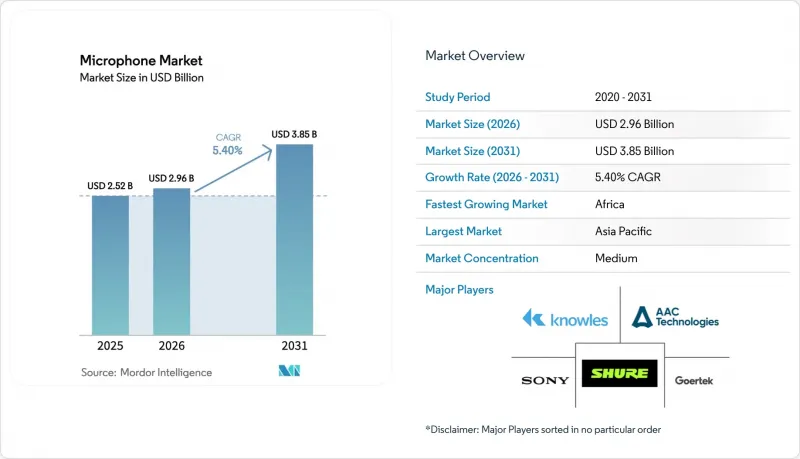
This report is Segmented by Technology (MEMS Microphones [Analog MEMS, and Digital MEMS], Electret Condenser, and More), Product Type (Handheld, Head-Worn, Gooseneck, and More), Communication Type (Wired, and Wireless), End-User Vertical (Broadcasting and Media, Consumer Electronics, Corporate and Institutional, and More), and Geography. The Market Forecasts are Provided in Terms of Value (USD).
Global Microphone Market Trends and Insights
Proliferation of MEMS Microphones in True-Wireless Earbuds Across Asia
True wireless earbuds remained the primary driver of shipments in the Microphone market in 2025, as Asia-Pacific brands outproduced competitors elsewhere. Digital MEMS capsules, small enough to fit 3 mm X 4 mm slots, now support multi-mic active noise cancellation and far-field voice pickup while drawing minimal power. Syntiant's 2024 acquisition of Knowles' consumer MEMS unit aligns neural processors with sensors, reducing latency for always-on voice wake functions. Chinese suppliers AAC Technologies and Goertek expanded 200 mm wafer capacity to serve domestic smartphone OEMs, further amplifying supply advantages. The shift to digital interfaces such as I2S simplifies PCB routing and reduces EMI, which matters more as Bluetooth 5.3 and LE Audio introduce tighter RF coexistence requirements.
Surge in Health-Wearables Deploying Acoustic Biosensing Microphones
Healthcare wearables are emerging as a major demand node because MEMS microphones enable continuous, non-invasive capture of cardio-respiratory signals with clinical-grade fidelity. A 2025 Scientific Reports study reported 93.21% accuracy in classifying lung sounds using MEMS sensors, validating the viability of remote auscultation. Device makers now pair sensors with on-device neural models that spot cough events and respiratory distress in real time, supporting telemedicine workflows. Growth is strongest in North America, where reimbursement codes for remote patient monitoring already exist, and in Asia-Pacific, where aging populations drive preventive-care spending. Suppliers that integrate acoustic sensors with low-power edge-AI increasingly win design slots because hospitals demand HIPAA-compliant, always-on endpoints that never upload raw voice data to the cloud.
RF Congestion and Interference Risk in Sub-1 GHz Bands for Wireless Mics
As the FCC auctions 600 MHz blocks to mobile carriers, analog wireless microphones lose clear spectrum, forcing users into the crowded 2.4 GHz ISM band. Digital systems offer encryption and eliminate companding artifacts but face packet-loss spikes when Wi-Fi, Bluetooth and Zigbee traffic peaks. The added complexity of channel scanning and firmware updates slows adoption among budget-constrained schools and theaters, holding back revenue growth in specific professional-audio niches within the Microphone market.
Other drivers and restraints analyzed in the detailed report include:
- Automotive OEM Shift to In-Cabin Voice UX for EV Platforms
- Rapid Adoption of AI-Enabled Beam-Forming Arrays in Enterprise UC Equipment
- BOM-Cost Inflation from Silicon Substrate Shortages (MEMS Fabs)
For complete list of drivers and restraints, kindly check the Table Of Contents.
Segment Analysis
MEMS microphones held a 56.81% Microphone market share in 2025, and the segment is on track for a 5.88% CAGR through 2031. Digital variants displace analog MEMS because on-package A-to-D conversion eliminates EMI issues and reduces PCB complexity. Cirrus Logic began sampling an ultra-low-power voice-wake codec for AI-ready laptops in late 2025, signaling a fresh wave of demand for digital MEMS front ends. Electret condensers remain cost-effective for cost-sensitive applications, while dynamic capsules remain relevant for high-SPL applications like live sound. Ribbon microphones retain a boutique footprint in studio recording, valued for their figure-8 polar patterns. The Microphone market size attributable to MEMS is therefore expanding faster than the overall category as consumer electronics OEMs demand higher integration and lower power profiles.
Analog MEMS remain attractive for cabin-noise cancellation in automobiles and basic industrial monitoring, where simple analog chains suffice. Yet the ecosystem momentum behind I2S and SoundWire bus architectures ensures that digital MEMS will continue climbing the mix. Suppliers able to embed DSP or neural accelerators inside the microphone package differentiate on latency and power, critical for always-listening devices. Consequently, design wins now hinge on total module functionality rather than raw acoustic specifications, accelerating platform lock-in across smartphones, laptops and wearables.
Array and beam-forming modules recorded the fastest growth rate at 6.02% CAGR as enterprises swapped boundary microphones for ceiling arrays that streamline meeting spaces. Head-worn systems held 32.47% of shipments in 2025 because fitness instructors and broadcasters value mobility; however, their unit growth trails that of arrays. Freestanding USB mics such as Logitech's Blue Sona cater to the creator economy that prizes plug-and-play gain boosts.
Dynamic handheld microphones remain staples for live vocals, supported by condenser variants on instruments and in studio situations. Gooseneck models still anchor podiums but face encroachment from wireless tabletop units that remove cable management headaches. The microphone market size for array modules is set to widen as AI software bundles automate beamforming, echo cancellation, and noise suppression, reducing commissioning time for IT departments and integrators.
Complete Report Scope:
- By Technology
- MEMS Microphones
- Analog MEMS
- Digital MEMS
- Electret Condenser Microphones (ECM)
- Dynamic Microphones
- Ribbon Microphones
- MEMS Microphones
- By Product Type
- Handheld
- Head-worn
- Gooseneck
- Freestanding / USB
- Array and Beam-forming Modules
- By Communication Type
- Wired
- Wireless
- By End-user Vertical
- Broadcasting and Media
- Consumer Electronics
- Corporate and Institutional
- Live Performances and Events
- Automotive
- Healthcare and Medical Devices
- Industrial and Environmental
- By Geography
- North America
- United States
- Canada
- Mexico
- Europe
- Germany
- United Kingdom
- France
- Italy
- Spain
- Rest of Europe
- Asia-Pacific
- China
- Japan
- South Korea
- India
- South East Asia
- Australia
- Rest of Asia-Pacific
- South America
- Brazil
- Argentina
- Rest of South America
- Middle East
- United Arab Emirates
- Saudi Arabia
- Rest of Middle East
- Africa
- South Africa
- Nigeria
- Rest of Africa
- North America
Geography Analysis
Asia-Pacific held 45.77% of global revenue in 2025, underpinned by China's scale in MEMS wafer processing and module assembly. Local champions AAC Technologies and Goertek secure preferential supply for domestic smartphone giants, reinforcing regional dominance. Japan and South Korea focus on packaging innovation and high-SNR performance, while India and Southeast Asia attract new green-field plants that hedge geopolitical exposure.
North America ranked second, buoyed by enterprise spending on hybrid-work upgrades and a vibrant creator economy purchasing premium USB and XLR devices. Content platforms such as YouTube and Twitch incentivize high-quality audio capture, creating a steady pull for mid-range condenser microphones. Europe emphasizes WEEE and RoHS compliance, concentrating share among established brands that can shoulder recycling costs. EU rules also encourage modular designs that simplify end-of-life disassembly, subtly altering product roadmaps for global vendors.
The Middle East and Africa region, though small in absolute dollars, is forecast to post the fastest expansion at 6.11% CAGR, driven by Saudi Arabia and the United Arab Emirates deploying telemedicine and distance-learning infrastructure. South America's growth is moderate as macroeconomic headwinds curb capital outlays in broadcast and live-event markets. Overall, regional variations in regulatory policy, supply-chain incentives and digital-transformation budgets shape localized opportunity pockets within the microphone market.
- Shure Incorporated
- Sennheiser Electronic GmbH and Co. KG
- Audio-Technica Corporation
- AKG Acoustics
- Georg Neumann GmbH
- Sony Corporation
- Harman International (Inc. AKG, JBL)
- Logitech International (Blue Microphones)
- RODE Microphones
- Knowles Corporation
- AAC Technologies Holdings Inc.
- Goertek Inc.
- TDK Corporation
- Infineon Technologies AG
- Robert Bosch GmbH
- STMicroelectronics N.V.
- Cirrus Logic Inc.
- Omron Corporation
- Hosiden Corporation
- Valeo SA
- Qorvo Inc.
- Yamaha Corporation
Additional Benefits:
- The market estimate (ME) sheet in Excel format
- 3 months of analyst support
TABLE OF CONTENTS
1 INTRODUCTION
- 1.1 Study Assumptions and Market Definition
- 1.2 Scope of the Study
2 RESEARCH METHODOLOGY
3 EXECUTIVE SUMMARY
4 MARKET LANDSCAPE
- 4.1 Market Overview
- 4.2 Market Drivers
- 4.2.1 Proliferation of MEMS Microphones in True-wireless Earbuds
- 4.2.2 Automotive OEM Shift to In-cabin Voice UX for EV Platforms
- 4.2.3 Rapid Adoption of AI-enabled Beam-forming Arrays in Enterprise UC Equipment
- 4.2.4 Content-creator Economy Fueling Premium Handheld and USB Mics
- 4.2.5 Government Mandates for Wireless Spectrum Re-farming Driving Digital Migration
- 4.2.6 Surge in Health-wearables Deploying Acoustic Biosensing Microphones
- 4.3 Market Restraints
- 4.3.1 RF Congestion and Interference Risk in Sub-1 GHz Bands for Wireless Mics
- 4.3.2 BOM-cost Inflation From Silicon Substrate Shortages (MEMS fabs)
- 4.3.3 Counterfeit After-market Capsules Diluting Brand Value in Asia-Pacific
- 4.3.4 Stringent EU WEEE/RoHS Recycling Targets Raising Compliance Costs
- 4.4 Industry Value Chain Analysis
- 4.5 Regulatory Landscape
- 4.6 Porter's Five Forces Analysis
- 4.6.1 Bargaining Power of Suppliers
- 4.6.2 Bargaining Power of Buyers
- 4.6.3 Threat of New Entrants
- 4.6.4 Threat of Substitutes
- 4.6.5 Competitive Rivalry
5 MARKET SIZE AND GROWTH FORECASTS (VALUE)
- 5.1 By Technology
- 5.1.1 MEMS Microphones
- 5.1.1.1 Analog MEMS
- 5.1.1.2 Digital MEMS
- 5.1.2 Electret Condenser Microphones (ECM)
- 5.1.3 Dynamic Microphones
- 5.1.4 Ribbon Microphones
- 5.1.1 MEMS Microphones
- 5.2 By Product Type
- 5.2.1 Handheld
- 5.2.2 Head-worn
- 5.2.3 Gooseneck
- 5.2.4 Freestanding / USB
- 5.2.5 Array and Beam-forming Modules
- 5.3 By Communication Type
- 5.3.1 Wired
- 5.3.2 Wireless
- 5.4 By End-user Vertical
- 5.4.1 Broadcasting and Media
- 5.4.2 Consumer Electronics
- 5.4.3 Corporate and Institutional
- 5.4.4 Live Performances and Events
- 5.4.5 Automotive
- 5.4.6 Healthcare and Medical Devices
- 5.4.7 Industrial and Environmental
- 5.5 By Geography
- 5.5.1 North America
- 5.5.1.1 United States
- 5.5.1.2 Canada
- 5.5.1.3 Mexico
- 5.5.2 Europe
- 5.5.2.1 Germany
- 5.5.2.2 United Kingdom
- 5.5.2.3 France
- 5.5.2.4 Italy
- 5.5.2.5 Spain
- 5.5.2.6 Rest of Europe
- 5.5.3 Asia-Pacific
- 5.5.3.1 China
- 5.5.3.2 Japan
- 5.5.3.3 South Korea
- 5.5.3.4 India
- 5.5.3.5 South East Asia
- 5.5.3.6 Australia
- 5.5.3.7 Rest of Asia-Pacific
- 5.5.4 South America
- 5.5.4.1 Brazil
- 5.5.4.2 Argentina
- 5.5.4.3 Rest of South America
- 5.5.5 Middle East
- 5.5.5.1 United Arab Emirates
- 5.5.5.2 Saudi Arabia
- 5.5.5.3 Rest of Middle East
- 5.5.6 Africa
- 5.5.6.1 South Africa
- 5.5.6.2 Nigeria
- 5.5.6.3 Rest of Africa
- 5.5.1 North America
6 COMPETITIVE LANDSCAPE
- 6.1 Market Concentration
- 6.2 Strategic Moves
- 6.3 Market Share Analysis
- 6.4 Company Profiles (includes Global level Overview, Market level overview, Core Segments, Financials as available, Strategic Information, Market Rank/Share for key companies, Products and Services, Recent Developments)
- 6.4.1 Shure Incorporated
- 6.4.2 Sennheiser Electronic GmbH and Co. KG
- 6.4.3 Audio-Technica Corporation
- 6.4.4 AKG Acoustics
- 6.4.5 Georg Neumann GmbH
- 6.4.6 Sony Corporation
- 6.4.7 Harman International (Inc. AKG, JBL)
- 6.4.8 Logitech International (Blue Microphones)
- 6.4.9 RODE Microphones
- 6.4.10 Knowles Corporation
- 6.4.11 AAC Technologies Holdings Inc.
- 6.4.12 Goertek Inc.
- 6.4.13 TDK Corporation
- 6.4.14 Infineon Technologies AG
- 6.4.15 Robert Bosch GmbH
- 6.4.16 STMicroelectronics N.V.
- 6.4.17 Cirrus Logic Inc.
- 6.4.18 Omron Corporation
- 6.4.19 Hosiden Corporation
- 6.4.20 Valeo SA
- 6.4.21 Qorvo Inc.
- 6.4.22 Yamaha Corporation
7 MARKET OPPORTUNITIES AND FUTURE OUTLOOK
- 7.1 White-space and Unmet-Need Assessment

