PUBLISHER: Mordor Intelligence | PRODUCT CODE: 2125256

PUBLISHER: Mordor Intelligence | PRODUCT CODE: 2125256
Asia-Pacific Professional Audio-Visual Systems - Market Share Analysis, Industry Trends & Statistics, Growth Forecasts (2026 - 2031)
According to Mordor Intelligence, the Asia-Pacific professional audio-visual system market size is expected to grow from USD 48.3 billion in 2025 to USD 51.07 billion in 2026 and is forecast to reach USD 67.46 billion by 2031 at 5.74% CAGR over 2026-2031.
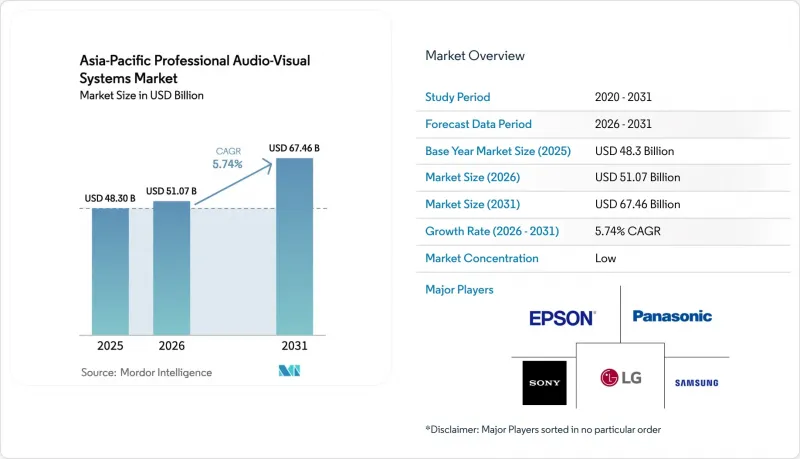
This report is Segmented by Type (Capture and Production Equipment, and More), Component (Audio Equipment, Display and Projection Systems, and More), End-User Vertical (Corporate, Venues and Events, Retail, Education, and More), and Geography (China, Japan, India, South Korea, South-East Asia, Rest of Asia-Pacific). The Market Forecasts are Provided in Terms of Value (USD).
Asia-Pacific Professional Audio-Visual Systems Market Trends and Insights
Hybrid-workplace demand for cloud-native UC suites
Enterprises across the Asia-Pacific professional audio-visual system market are standardizing on Microsoft Teams Rooms and similar platforms, prompting integrators to deliver turnkey packages that blend cameras, microphones, interactive displays, and AI-driven sound processing. Spatial audio functions and automated framing make meetings more inclusive for distributed employees, a priority for Chinese and Japanese multinationals managing cross-border teams. Converged AV-IT networks also streamline managed services, cutting truck-roll costs for facility managers and helping corporations meet internal carbon-reduction goals through power-optimized device scheduling.
Expansion of digital signage in experiential retail
Interactive LED facades and 8K videowalls are transforming flagship stores, with regional retailers using large-format displays to bridge physical shopping and social-commerce engagement. The Asia-Pacific professional audio-visual system market benefits from falling pixel-pitch pricing and higher-efficiency micro-LED modules that meet sustainability regulations without sacrificing brightness. Post-pandemic safety messaging hastened display roll-outs, and content management software now integrates occupancy sensors to trigger real-time visual prompts, a feature retailers in Singapore and Seoul deploy to comply with local health codes.
High operating and compliance costs of complex AV projects
Integrated solutions now blend video, audio, control, and cybersecurity safeguards, raising design hours and specialist wages, particularly outside primary metro areas. Training pipelines lag demand: fewer than 3,000 Asia-Pacific engineers hold advanced SDVoE certification, prompting firms to rely on freelancers who may not stay through warranty periods. AV-as-a-Service contracts transfer capex to opex but include SLA penalties tied to uptime and data-protection audits, making smaller integrators financially cautious.
Other drivers and restraints analyzed in the detailed report include:
- Government-led "smart classroom" capex
- Live-event rebound lifts rental and staging
- Carbon-border tariffs inflate export BOM costs
For complete list of drivers and restraints, kindly check the Table Of Contents.
Segment Analysis
Streaming Media, Storage, and Distribution holds a 35.15% share of the Asia-Pacific professional audio-visual system market, underlining its role as the backbone for distance collaboration and direct-to-consumer entertainment. The wave of 5G private networks across factories further entrenches cloud gateways that ingest, transcode, and forward 4K content in under a second, unlocking remote quality-assurance reviews without on-site staff. Capture and Production Equipment, projected to clock a 6.62% CAGR, thrives on influencer-economy growth and affordable mirrorless cameras paired with AI auto-tracking tripods. Legacy video projection remains relevant for lecture halls and hotel ballrooms craving bright, lamp-free units able to run 24/7 with minimal maintenance.
Second-generation edge encoders compress HEVC streams at half the bit-rate, shrinking bandwidth fees for distance-learning providers. Managed-service vendors bundle them with content-delivery-network subscriptions, shifting the Asia-Pacific professional audio-visual system market from hardware sales toward recurring revenue models. Experimental holographic displays surface in surgical-planning labs, yet most enterprises still pilot them under research and development budgets rather than mainstream roll-outs.
Complete Report Scope:
- By Type
- Capture and Production Equipment
- Video Projection
- Streaming Media, Storage and Distribution
- Services
- Other Types
- By Component
- Audio Equipment (mics, mixers, amps)
- Display and Projection Systems
- Control and Processing
- Storage and Distribution Hardware
- By End-user Vertical
- Corporate
- Venues and Events
- Retail
- Media and Entertainment
- Education
- Government
- Healthcare
- Other End-user Vertical
- By Country
- China
- Japan
- India
- South Korea
- South-East Asia
- Rest of Asia-Pacific
List of Companies Covered in this Report:
- Sony Corporation
- Samsung Electronics
- Panasonic Corporation
- LG Electronics
- Epson
- Barco NV
- Alpine Electronics Inc.
- Kramer Electronics
- Crestron Electronics
- Bose Professional
- Shure Incorporated
- Extron Electronics
- Planar Systems Inc.
- Vega Global
- Elmo
- Guangzhou Baolun Electronic Co.
- Guangzhou DSPPA Audio Co.
- Sennheiser Electronic
Additional Benefits:
- The market estimate (ME) sheet in Excel format
- 3 months of analyst support
TABLE OF CONTENTS
1 INTRODUCTION
- 1.1 Study Assumptions and Market Definition
- 1.2 Scope of the Study
2 RESEARCH METHODOLOGY
3 EXECUTIVE SUMMARY
4 MARKET LANDSCAPE
- 4.1 Market Overview
- 4.2 Market Drivers
- 4.2.1 Hybrid-Workplace Demand for Cloud-Native UC and C Suites
- 4.2.2 Expansion of Digital Signage Networks in Experiential Retail
- 4.2.3 Government-Led "Smart Classroom" Capex Across Emerging Asia
- 4.2.4 Live-Event Rebound Accelerating Rental and Staging Spend
- 4.2.5 5G-Enabled Remote Production and AVoIP Workflows
- 4.2.6 Carbon-Neutral Procurement Mandates for Energy-Efficient AV
- 4.3 Market Restraints
- 4.3.1 High Operating and Compliance Costs of Complex AV Projects
- 4.3.2 Persistent Chipset and Optical-Component Supply Bottlenecks
- 4.3.3 Shortage of Certified AV Technicians in Tier-2 Asian Cities
- 4.3.4 Carbon-Border Tariffs Inflating Export BOM Costs
- 4.4 Impact of Macroeconomic Factors
- 4.5 Industry Value Chain Analysis
- 4.6 Regulatory Landscape
- 4.7 Technological Outlook
- 4.8 Porter's Five Forces Analysis
- 4.8.1 Threat of New Entrants
- 4.8.2 Bargaining Power of Buyers/Consumers
- 4.8.3 Bargaining Power of Suppliers
- 4.8.4 Threat of Substitute Products
- 4.8.5 Intensity of Competitive Rivalry
5 MARKET SIZE AND GROWTH FORECASTS (VALUE)
- 5.1 By Type
- 5.1.1 Capture and Production Equipment
- 5.1.2 Video Projection
- 5.1.3 Streaming Media, Storage and Distribution
- 5.1.4 Services
- 5.1.5 Other Types
- 5.2 By Component
- 5.2.1 Audio Equipment (mics, mixers, amps)
- 5.2.2 Display and Projection Systems
- 5.2.3 Control and Processing
- 5.2.4 Storage and Distribution Hardware
- 5.3 By End-user Vertical
- 5.3.1 Corporate
- 5.3.2 Venues and Events
- 5.3.3 Retail
- 5.3.4 Media and Entertainment
- 5.3.5 Education
- 5.3.6 Government
- 5.3.7 Healthcare
- 5.3.8 Other End-user Vertical
- 5.4 By Country
- 5.4.1 China
- 5.4.2 Japan
- 5.4.3 India
- 5.4.4 South Korea
- 5.4.5 South-East Asia
- 5.4.6 Rest of Asia-Pacific
6 COMPETITIVE LANDSCAPE
- 6.1 Market Concentration
- 6.2 Strategic Moves
- 6.3 Market Share Analysis
- 6.4 Company Profiles (includes Global-level Overview, Market-level Overview, Core Segments, Financials as available, Strategic Information, Market Rank/Share for key companies, Products and Services, and Recent Developments)
- 6.4.1 Sony Corporation
- 6.4.2 Samsung Electronics
- 6.4.3 Panasonic Corporation
- 6.4.4 LG Electronics
- 6.4.5 Epson
- 6.4.6 Barco NV
- 6.4.7 Alpine Electronics Inc.
- 6.4.8 Kramer Electronics
- 6.4.9 Crestron Electronics
- 6.4.10 Bose Professional
- 6.4.11 Shure Incorporated
- 6.4.12 Extron Electronics
- 6.4.13 Planar Systems Inc.
- 6.4.14 Vega Global
- 6.4.15 Elmo
- 6.4.16 Guangzhou Baolun Electronic Co.
- 6.4.17 Guangzhou DSPPA Audio Co.
- 6.4.18 Sennheiser Electronic
7 MARKET OPPORTUNITIES AND FUTURE OUTLOOK
- 7.1 White-Space and Unmet-Need Assessment

