PUBLISHER: Mordor Intelligence | PRODUCT CODE: 2125290

PUBLISHER: Mordor Intelligence | PRODUCT CODE: 2125290
AI Video Analytics - Market Share Analysis, Industry Trends & Statistics, Growth Forecasts (2026 - 2031)
According to Mordor Intelligence, the AI video analytics market size is projected to expand from USD 5.04 billion in 2025 and USD 6.19 billion in 2026 to USD 17.23 billion by 2031, registering a 22.72% CAGR between 2026 and 2031.
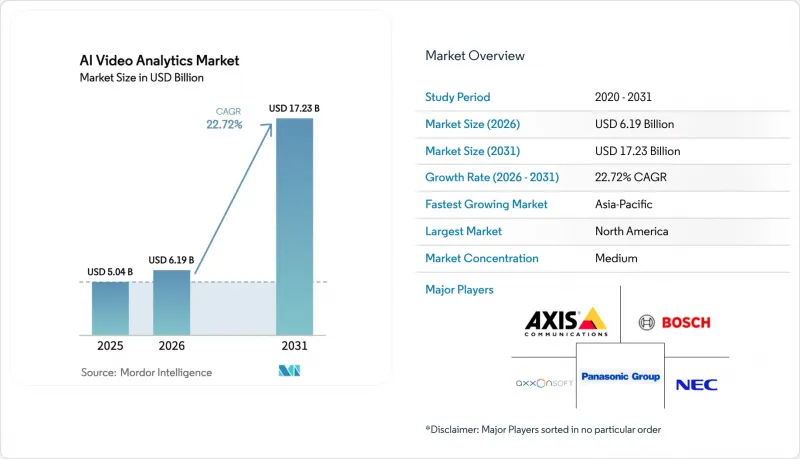
This report is Segmented by Component (Software, Hardware, Services), Deployment Mode (On-Premises, Cloud, Hybrid/Edge), Analytics Type (Crowd and Behavior Detection, Gesture/Action Recognition, and More), Application (Retail Customer Insight, Healthcare Monitoring, and More), End-User (Manufacturing, Healthcare, and More), and Geography. The Market Forecasts are Provided in Terms of Value (USD).
Global AI Video Analytics Market Trends and Insights
Integration of AI-Equipped CCTV in Smart-City Projects
Municipal programs are moving video analytics from basic surveillance to integrated city-operating platforms. Hangzhou's City Brain handled more than 1 million video streams in real time by late 2025, optimizing traffic-light cycles and flagging illegal parking. India earmarked USD 1.2 billion in 2025 for AI-enabled surveillance across 100 cities, with edge inference mandated under the Digital Personal Data Protection Act. The United Arab Emirates awarded a USD 340 million contract to modernize camera networks in Dubai and Abu Dhabi, aiming to cut emergency-response times by 30% by 2027. Procurement is shifting toward multi-year platform deals that bundle hardware, software, and managed services, favoring vendors with strong systems integration practices.
Rising Retail and E-commerce Demand for In-Store Behavior Analytics
Brick-and-mortar chains use AI vision to track dwell time, heat maps, and shelf engagement, mirroring data granularity long enjoyed by e-commerce. Walmart reported a 15% drop in inventory loss after rolling out camera-based shrinkage analytics in 3,500 U.S. stores. Carrefour's 2025 deployment across 200 European hypermarkets aims to cut out-of-stock incidents by 20%. Tokyo pilots at 7-Eleven sites lifted same-store sales 7% by aligning stock with real-time demographic insights. Privacy objections under Europe's GDPR are pushing retailers toward anonymous heat-mapping or consent-based biometric modules.
Data-Privacy Regulation Barriers to Facial Recognition
New laws are fragmenting biometric deployments. The European Union AI Act requires conformity assessments and human oversight for real-time public-space facial recognition, sharply limiting commercial rollouts. California's 2025 biometric rules force opt-in consent, prompting some U.S. retailers to turn off facial modules. India's 2025 data law adds privacy-impact assessments to all biometric processing. China amended its privacy law in 2024 to restrict facial analytics in residential complexes unless residents provide written consent. Resulting compliance costs slow adoption outside law-enforcement scenarios.
Other drivers and restraints analyzed in the detailed report include:
- Proactive Threat Detection Amid Escalating Security Risks
- Declining Cost of Edge-AI Chipsets
- High Integration Cost With Legacy CCTV
For complete list of drivers and restraints, kindly check the Table Of Contents.
Segment Analysis
Software accounted for 64.57% of 2025 revenue, as platform licenses, analytics engines, and model libraries formed the core of most deployments. Services are expected to post a 23.39% CAGR to 2031, the highest across components, because enterprises rely on third-party integrators for model tuning, CCTV bridgework, and continuous compliance checks. Accenture found that 73% of organizations hired external experts for AI video rollouts lasting 9-14 months. The AI video analytics market size for services could therefore rival software by the end of the forecast period, shifting margin pools away from hardware. Hardware remains essential, especially where specialty thermal or multispectral cameras fetch premium pricing, but commoditization moderates growth.
Recognizing a skill shortage, enterprises are pivoting to services: A Deloitte report reveals that 68% of enterprises lack in-house AI vision capabilities. In response, vendors are increasingly bundling managed services with their hardware offerings. Meanwhile, ISO/IEC 42001 is gaining traction as a foundational certification for liability protection. With customers increasingly favoring outcome-based contracts, recurring revenue models are gaining momentum, further solidifying the dominance of services in the AI video analytics market.
Cloud deployment accounted for 57.89% of 2025 revenue, owing to elastic scaling and alignment with existing SaaS estates. Yet hybrid and edge solutions are forecast to grow at a 23.34% CAGR, narrowing the gap as smart-city traffic lights, factory inspection lines, and hospital wards require millisecond responses. The AI video analytics market share of hybrid architectures will expand further, as data-sovereignty rules discourage bulk video uploads. Microsoft reported Azure hybrid AI sales doubling in fiscal 2025, while AWS launched Panorama Appliance 2.0 for local processing.
Edge devices handle inference, pushing anonymized metadata to cloud dashboards that supervise model retraining and firmware updates, thereby satisfying GDPR minimization norms. On-premises stacks linger in defense and classified environments but grow slowly because sovereign clouds now meet many security stipulations. This two-tier design becomes the default blueprint for large-scale deployments in the AI video analytics market.
Complete Report Scope:
- By Component
- Software
- Hardware
- Services
- By Deployment Mode
- On-premises
- Cloud
- Hybrid / Edge
- By Analytics Type
- Video Content Analytics
- Facial Recognition
- Crowd and Behavior Detection
- Automatic Number-Plate Recognition
- Gesture / Action Recognition
- By Application
- Security and Surveillance
- Traffic and Transportation Management
- Retail Customer Insight
- Industrial Quality Inspection
- Healthcare Monitoring
- Other Applications
- By End-User
- Government and Public Safety
- Retail and E-commerce
- Transportation and Logistics
- Manufacturing
- BFSI
- Healthcare
- Other End-Users
- By Geography
- North America
- United States
- Canada
- Mexico
- South America
- Brazil
- Argentina
- Rest of South America
- Europe
- Germany
- United Kingdom
- France
- Italy
- Russia
- Rest of Europe
- Asia Pacific
- China
- Japan
- South Korea
- India
- Australia
- Rest of Asia Pacific
- Middle East and Africa
- Middle East
- United Arab Emirates
- Saudi Arabia
- Turkey
- Rest of Middle East
- Africa
- South Africa
- Egypt
- Rest of Africa
- Middle East
- North America
Geography Analysis
North America generated 32.44% of 2025 revenue, supported by USD 1.2 billion in federal smart-city grants and retailer pilots that marry computer vision with point-of-sale data. Canada backed municipal deployments with CAD 85 million (USD 63 million) in grants. Mexico's expanded C5 centers processed more than 50,000 concurrent feeds by late 2025. Widespread edge adoption positions the region for steady, though not fastest, growth.
Asia Pacific is expected to post the strongest CAGR of 23.77%. China had over 600 million AI-ready cameras by end-2025, integrated with national ID databases for real-time alerts. India's Smart Cities Mission deployed AI video analytics in 82 cities, emphasizing edge inference for localization compliance. Japan is committed to AI-based crowd monitoring at major rail hubs to prevent falls. The region's greenfield projects and large urban populations underpin the sustained expansion of the AI video analytics market.
Europe maintains sizable spending, but stricter privacy curbs slow facial recognition rollouts. Twelve German states paused pilots in 2025, awaiting AI Act guidance. The United Kingdom nonetheless awarded GBP 120 million for AI analytics in transport and critical infrastructure, with algorithmic transparency requirements. Middle Eastern initiatives under Vision 2030 continue despite GPU shortages that briefly stalled tenders. South America and Africa stay smaller as budget and skills gaps temper deployment speed, though cities like Sao Paulo and Lagos pilot traffic and safety systems.
- Hangzhou Hikvision Digital Technology Co., Ltd
- IndigoVision Group Limited
- AxxonSoft Inc.
- Zhejiang Dahua Technology Co., Ltd.
- Axis Communications AB
- Huawei Technologies
- Bosch Security Systems
- Motorola Solutions
- Canon Inc.
- Honeywell International
- Panasonic Holdings Corporation
- NEC Corporation
- Gorilla Technology Group
- Verint Systems Inc.
- iOmniscient Pty. Ltd.
- Irisity AB (publ)
- Senstar Corporation
- AnyVision Ltd.
- SenseTime Ltd.
- Vintra Inc.
- IntelliVision Ltd.
- OpenCV.ai Ltd.
Additional Benefits:
- The market estimate (ME) sheet in Excel format
- 3 months of analyst support
TABLE OF CONTENTS
1 INTRODUCTION
- 1.1 Study Assumptions and Market Definition
- 1.2 Scope of the Study
2 RESEARCH METHODOLOGY
3 EXECUTIVE SUMMARY
4 MARKET LANDSCAPE
- 4.1 Market Overview
- 4.2 Market Drivers
- 4.2.1 Integration of AI-equipped CCTV in Smart-City Projects
- 4.2.2 Rising Retail and E-commerce Demand for In-Store Behavior Analytics
- 4.2.3 Proactive Threat Detection amid Escalating Security Risks
- 4.2.4 Declining Cost of Edge-AI Chipsets
- 4.2.5 Legislation on Visual Process-Transparency in Industry
- 4.2.6 Privacy-Preserving Federated Learning Models
- 4.3 Market Restraints
- 4.3.1 Data-Privacy Regulation Barriers to Facial Recognition
- 4.3.2 High Integration Cost with Legacy CCTV
- 4.3.3 Model Bias and False-Positive Risk
- 4.3.4 GPU Supply-Chain Volatility
- 4.4 Impact of Macroeconomic Factors on the Market
- 4.5 Industry Value Chain Analysis
- 4.6 Regulatory Landscape
- 4.7 Technological Outlook
- 4.8 Porter's Five Forces Analysis
- 4.8.1 Bargaining Power of Buyers
- 4.8.2 Bargaining Power of Suppliers
- 4.8.3 Threat of New Entrants
- 4.8.4 Threat of Substitutes
- 4.8.5 Competitive Rivalry
5 MARKET SIZE AND GROWTH FORECASTS (VALUE)
- 5.1 By Component
- 5.1.1 Software
- 5.1.2 Hardware
- 5.1.3 Services
- 5.2 By Deployment Mode
- 5.2.1 On-premises
- 5.2.2 Cloud
- 5.2.3 Hybrid / Edge
- 5.3 By Analytics Type
- 5.3.1 Video Content Analytics
- 5.3.2 Facial Recognition
- 5.3.3 Crowd and Behavior Detection
- 5.3.4 Automatic Number-Plate Recognition
- 5.3.5 Gesture / Action Recognition
- 5.4 By Application
- 5.4.1 Security and Surveillance
- 5.4.2 Traffic and Transportation Management
- 5.4.3 Retail Customer Insight
- 5.4.4 Industrial Quality Inspection
- 5.4.5 Healthcare Monitoring
- 5.4.6 Other Applications
- 5.5 By End-User
- 5.5.1 Government and Public Safety
- 5.5.2 Retail and E-commerce
- 5.5.3 Transportation and Logistics
- 5.5.4 Manufacturing
- 5.5.5 BFSI
- 5.5.6 Healthcare
- 5.5.7 Other End-Users
- 5.6 By Geography
- 5.6.1 North America
- 5.6.1.1 United States
- 5.6.1.2 Canada
- 5.6.1.3 Mexico
- 5.6.2 South America
- 5.6.2.1 Brazil
- 5.6.2.2 Argentina
- 5.6.2.3 Rest of South America
- 5.6.3 Europe
- 5.6.3.1 Germany
- 5.6.3.2 United Kingdom
- 5.6.3.3 France
- 5.6.3.4 Italy
- 5.6.3.5 Russia
- 5.6.3.6 Rest of Europe
- 5.6.4 Asia Pacific
- 5.6.4.1 China
- 5.6.4.2 Japan
- 5.6.4.3 South Korea
- 5.6.4.4 India
- 5.6.4.5 Australia
- 5.6.4.6 Rest of Asia Pacific
- 5.6.5 Middle East and Africa
- 5.6.5.1 Middle East
- 5.6.5.1.1 United Arab Emirates
- 5.6.5.1.2 Saudi Arabia
- 5.6.5.1.3 Turkey
- 5.6.5.1.4 Rest of Middle East
- 5.6.5.2 Africa
- 5.6.5.2.1 South Africa
- 5.6.5.2.2 Egypt
- 5.6.5.2.3 Rest of Africa
- 5.6.5.1 Middle East
- 5.6.1 North America
6 COMPETITIVE LANDSCAPE
- 6.1 Market Concentration
- 6.2 Strategic Moves
- 6.3 Market Share Analysis
- 6.4 Company Profiles (includes Global Level Overview, Market Level Overview, Core Segments, Financials as Available, Strategic Information, Market Rank/Share for Key Companies, Products and Services, and Recent Developments)
- 6.4.1 Hangzhou Hikvision Digital Technology Co., Ltd
- 6.4.2 IndigoVision Group Limited
- 6.4.3 AxxonSoft Inc.
- 6.4.4 Zhejiang Dahua Technology Co., Ltd.
- 6.4.5 Axis Communications AB
- 6.4.6 Huawei Technologies
- 6.4.7 Bosch Security Systems
- 6.4.8 Motorola Solutions
- 6.4.9 Canon Inc.
- 6.4.10 Honeywell International
- 6.4.11 Panasonic Holdings Corporation
- 6.4.12 NEC Corporation
- 6.4.13 Gorilla Technology Group
- 6.4.14 Verint Systems Inc.
- 6.4.15 iOmniscient Pty. Ltd.
- 6.4.16 Irisity AB (publ)
- 6.4.17 Senstar Corporation
- 6.4.18 AnyVision Ltd.
- 6.4.19 SenseTime Ltd.
- 6.4.20 Vintra Inc.
- 6.4.21 IntelliVision Ltd.
- 6.4.22 OpenCV.ai Ltd.
7 MARKET OPPORTUNITIES AND FUTURE OUTLOOK
- 7.1 White-Space and Unmet-Need Assessment

