PUBLISHER: Mordor Intelligence | PRODUCT CODE: 2125291

PUBLISHER: Mordor Intelligence | PRODUCT CODE: 2125291
India Smart Wearable - Market Share Analysis, Industry Trends & Statistics, Growth Forecasts (2026 - 2031)
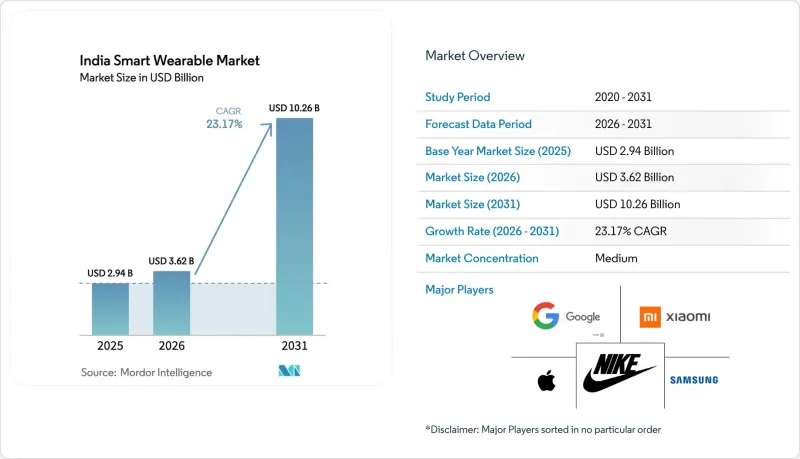
According to Mordor Intelligence, the India smart wearable market size was valued at USD 2.94 billion in 2025 and estimated to grow from USD 3.62 billion in 2026 to reach USD 10.26 billion by 2031, at a CAGR of 23.17% during the forecast period (2026-2031).
This report is Segmented by Product Type (Smartwatches, Fitness Bands, Smart Rings, Smart Glasses, and Other Product Types), Connectivity Technology (Bluetooth-Only, Bluetooth + LTE/ESIM, and NFC-Enabled), End-Use Application (Health and Fitness Tracking, Chronic-Disease Remote Monitoring, Payments and Access Control, and More). The Market Forecasts are Provided in Terms of Value (USD).
India Smart Wearable Market Trends and Insights
Rising Health-Focused Middle Class
India's urban and peri-urban middle class now views connected sensors as practical tools for managing chronic ailments. An estimated 172,148 Health and Wellness Centers had delivered 2.59 billion wellness sessions by mid-2025, creating day-to-day demand for automated vitals capture.Simultaneously, 65 crore citizens have generated Ayushman Bharat Health Accounts (ABHA), normalizing digital medical records that can ingest smartwatch or smart-ring data. These parallel developments position the India smart wearable market as an indispensable adjunct to the primary-care network rather than an optional consumer gadget category.
Rapid ASP Decline from Domestic Competition
Local assemblers operating under the Electronics Component Manufacturing Scheme receive cap-ex and turnover subsidies that reduce bill-of-materials costs by up to 12%. As a result, nine out of every ten smartwatches shipped in Q1 2025 retailed below INR 5,000, accelerating device diffusion in Tier 2 geographies. While ASP contraction squeezes gross margins, the volume surge enlarges the active installed base, creating follow-on opportunities for subscription software, accessories, and replacement straps that offset hardware compression.
ASP Erosion Squeezing OEM Margins
Price wars have already reduced smartwatch ASPs by 42% since 2023, eroding gross margins for second-tier brands. Unless firms monetize cloud analytics or expand into adjacent audio accessories, cash-flow stress could force consolidation, trimming the long-tail of competitors that now accounts for 38% of shipments. Over 2026-2027, fewer SKUs may translate into slower feature innovation, introducing softness in the India smart wearable market growth curve.
Other drivers and restraints analyzed in the detailed report include:
- Government PLI and Digital-Health Schemes
- Insurance Discounts for Wellness Data
- Data-Privacy and Cybersecurity Concerns
For complete list of drivers and restraints, kindly check the Table Of Contents.
Segment Analysis
Smartwatches generated 62.78% of the India smart wearable market size in 2025, buoyed by multi-sensor arrays that bundle fitness, communication, and UPI payments in a single wrist-top interface. In contrast, smart rings, while still niche, are tracking a 24.4% CAGR as jewelry-friendly aesthetics appeal to style-conscious millennials.
Continued smartwatch leadership is underwritten by rapid feature creep, such as LTE modules, 2 GB RAM, and a full Android OS that converts the device into a phone substitute. Yet rings enjoy a higher average revenue per unit, USD 204, subsidizing premium titanium builds and medical-grade photoplethysmography sensors. Over the forecast horizon, rings could capture cardiometabolic-monitoring niches even while watches retain mass-market status, ensuring both categories coexist rather than cannibalize within the India smart wearable market.
Complete Report Scope:
- By Product Type (Value)
- Smartwatches
- Fitness Bands
- Smart Rings
- Smart Glasses
- Other Product Types
- By Connectivity Technology (Value)
- Bluetooth-only
- Bluetooth + LTE/eSIM
- NFC-enabled
- By End-Use Application (Value)
- Health and Fitness Tracking
- Chronic-disease Remote Monitoring
- Payments and Access Control
- Industrial and Field Workforce
- Other End-Use Applications
List of Companies Covered in this Report:
- Nexxbase Marketing Private Limited (Noise)
- Fire-Boltt Innovations Private Limited
- Imagine Marketing Limited (boAt)
- Samsung Electronics Co., Ltd.
- Apple Inc.
- Garmin Ltd.
- Xiaomi Corporation
- Huawei Technologies Co., Ltd.
- Fitbit LLC (Alphabet Inc. subsidiary)
- Titan Company Limited
- GOQii Technologies Pvt. Ltd.
- Nike, Inc.
- Realme Mobile Telecommunications (India) Pvt. Ltd.
- OnePlus Technology (Shenzhen) Co., Ltd.
- Oppo Mobile Telecommunications Corp., Ltd.
- Zepp Health Corporation (Amazfit)
- Lenovo Group Limited
- Zebronics India Pvt. Ltd.
- Portronics Digital Pvt. Ltd.
- Fastrack (Division of Titan Company Limited)
- Sony Group Corporation
- Google LLC (Pixel Watch)
Additional Benefits:
- The market estimate (ME) sheet in Excel format
- 3 months of analyst support
TABLE OF CONTENTS
1 INTRODUCTION
- 1.1 Study Assumptions and Market Definition
- 1.2 Scope of the Study
2 RESEARCH METHODOLOGY
3 EXECUTIVE SUMMARY
4 MARKET LANDSCAPE
- 4.1 Market Overview
- 4.2 Market Drivers
- 4.2.1 Rising health- and fitness-conscious middle class
- 4.2.2 Rapid ASP decline from intense domestic competition
- 4.2.3 Government PLI and Digital Health incentives
- 4.2.4 Health-insurance discounts for wearables data
- 4.2.5 Emergence of smart rings as jewellery-friendly form factor
- 4.2.6 UPI-enabled contactless payments via wearables
- 4.3 Market Restraints
- 4.3.1 ASP erosion squeezing OEM margins
- 4.3.2 Data-privacy and cybersecurity concerns
- 4.3.3 Lengthening replacement cycles after first-time buyer boom
- 4.3.4 CDSCO ambiguity on medical-grade wearables
- 4.4 Regulatory Landscape
- 4.5 Technological Outlook
- 4.6 Porter's Five Forces Analysis
- 4.6.1 Threat of New Entrants
- 4.6.2 Bargaining Power of Suppliers
- 4.6.3 Bargaining Power of Buyers
- 4.6.4 Threat of Substitutes
- 4.6.5 Competitive Rivalry
5 MARKET SIZE AND GROWTH FORECASTS (VALUE)
- 5.1 By Product Type (Value)
- 5.1.1 Smartwatches
- 5.1.2 Fitness Bands
- 5.1.3 Smart Rings
- 5.1.4 Smart Glasses
- 5.1.5 Other Product Types
- 5.2 By Connectivity Technology (Value)
- 5.2.1 Bluetooth-only
- 5.2.2 Bluetooth + LTE/eSIM
- 5.2.3 NFC-enabled
- 5.3 By End-Use Application (Value)
- 5.3.1 Health and Fitness Tracking
- 5.3.2 Chronic-disease Remote Monitoring
- 5.3.3 Payments and Access Control
- 5.3.4 Industrial and Field Workforce
- 5.3.5 Other End-Use Applications
6 COMPETITIVE LANDSCAPE
- 6.1 Market Concentration
- 6.2 Strategic Moves
- 6.3 Market Share Analysis
- 6.4 Company Profiles (includes Global level Overview, Market level overview, Core Segments, Financials as available, Strategic Information, Market Rank/Share for key companies, Products and Services, and Recent Developments)
- 6.4.1 Nexxbase Marketing Private Limited (Noise)
- 6.4.2 Fire-Boltt Innovations Private Limited
- 6.4.3 Imagine Marketing Limited (boAt)
- 6.4.4 Samsung Electronics Co., Ltd.
- 6.4.5 Apple Inc.
- 6.4.6 Garmin Ltd.
- 6.4.7 Xiaomi Corporation
- 6.4.8 Huawei Technologies Co., Ltd.
- 6.4.9 Fitbit LLC (Alphabet Inc. subsidiary)
- 6.4.10 Titan Company Limited
- 6.4.11 GOQii Technologies Pvt. Ltd.
- 6.4.12 Nike, Inc.
- 6.4.13 Realme Mobile Telecommunications (India) Pvt. Ltd.
- 6.4.14 OnePlus Technology (Shenzhen) Co., Ltd.
- 6.4.15 Oppo Mobile Telecommunications Corp., Ltd.
- 6.4.16 Zepp Health Corporation (Amazfit)
- 6.4.17 Lenovo Group Limited
- 6.4.18 Zebronics India Pvt. Ltd.
- 6.4.19 Portronics Digital Pvt. Ltd.
- 6.4.20 Fastrack (Division of Titan Company Limited)
- 6.4.21 Sony Group Corporation
- 6.4.22 Google LLC (Pixel Watch)
7 MARKET OPPORTUNITIES AND FUTURE OUTLOOK
- 7.1 White-space and Unmet-need Assessment

