PUBLISHER: Mordor Intelligence | PRODUCT CODE: 2125293

PUBLISHER: Mordor Intelligence | PRODUCT CODE: 2125293
Social Networking - Market Share Analysis, Industry Trends & Statistics, Growth Forecasts (2026 - 2031)
According to Mordor Intelligence, the social networking market size is expected to increase from USD 180.5 billion in 2025 to USD 210.66 billion in 2026 and reach USD 411.27 billion by 2031, growing at a CAGR of 14.32% over 2026-2031.
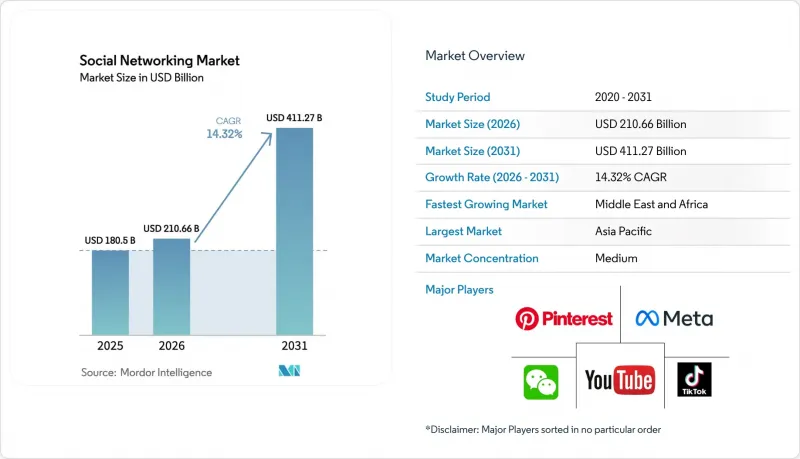
This report is Segmented by Revenue Stream (Advertising, In-App Purchases, Subscriptions, and Virtual Goods and Gifting), Device Type (Smartphone, and More), Platform Type (Traditional Social Networks, and More), User Demographics (13-24 Years, 25-34 Years, 35-44 Years, and 45+ Years), and Geography. The Market Forecasts are Provided in Terms of Value (USD).
Global Social Networking Market Trends and Insights
Rising Mobile-Internet Penetration
Global smartphone users reached 5.7 billion in 2025, and 5G subscriptions crossed 1.9 billion connections, lifting average monthly data use to 25 gigabytes in developed markets. First-time internet access now occurs primarily through budget Android handsets, with India alone adding 120 million smartphone users during 2023-2025. Platforms that bundle lite apps and 3G-fallback modes win share in bandwidth-constrained regions, as illustrated by the Philippines' daily average of 3 hours 32 minutes on social media in 2025. These conditions reinforce the global social networking market's ability to reach new users without desktop dependence.
Surge in Digital Ad Spend on Social Media
Instagram supplied more than half of Meta's United States advertising revenue in 2025 as brands redirected budgets to Stories, Reels, and Shop tabs that merge content discovery with checkout. Machine-learning models lowered cost-per-acquisition on Meta platforms by 18% year over year, validating performance-first budget allocations. Snap logged USD 1.5 billion in third-quarter 2025 revenue, with augmented-reality lenses driving 22% of impressions and 30% higher click-through rates than static units. Spending momentum supports sustained monetization across the global social networking market.
Intensifying Data-Privacy and Security Regulations
The European Union fined Meta EUR 251 million (USD 268 million) in 2024 for GDPR breaches, lifting cumulative penalties to EUR 1.2 billion (USD 1.28 billion) since 2018. Australia's under-16 access ban, effective 10 December 2025, forces platforms to deploy age-verification layers and accept AUD 49.5 million (USD 32.7 million) breach risks. Compliance investments in data localization, consent management, and audits elevate cost structures across the global social networking market.
Other drivers and restraints analyzed in the detailed report include:
- Short-Form Video Adoption Across Regions
- Expansion of Social Commerce and Live Shopping Tools
- Global Antitrust Scrutiny of Dominant Platforms
For complete list of drivers and restraints, kindly check the Table Of Contents.
Segment Analysis
Advertising generated 87.03% of 2025 revenue, confirming its outsized influence on the global social networking market. Meta booked USD 50.1 billion in third-quarter 2025 ad sales after algorithmic tweaks cut cost-per-click, helping advertisers secure sub-USD 5 acquisition costs. The global social networking market size tied to ad spend still dwarfs other levers, but risk exposure is growing.
Virtual goods and gifting are the fastest-rising stream, advancing at a 14.89% CAGR through 2031. TikTok's USD 2.5 billion creator payouts in 2024 illustrate how direct user-to-creator payments can scale without gatekeeper ad exchanges. Subscriptions are gaining relevance, with Snapchat+ delivering USD 150 million in quarterly revenue from 17 million users. The revenue remix reduces cyclicality in the global social networking industry and unlocks predictable cash flow.
Smartphones retained 78.21% of user sessions in 2025, cementing their role as the dominant interface for the global social networking market. Tablets and desktops held modest shares linked to long-form video and professional networking.
Wearables and "other" form factors, however, are projected to post a 15.72% CAGR to 2031. Meta's Messenger integration into Quest headsets and broader smartwatch notification ecosystems allow quick replies and voice-to-text input. For the global social networking market size attributed to wearables, cross-device sync and low-latency identity management remain gating factors, but adoption in high-income regions signals a shift toward always-on ambient networking.
Complete Report Scope:
- By Revenue Stream
- Advertising
- In-App Purchases
- Subscriptions
- Virtual Goods and Gifting
- By Device Type
- Smartphone
- Tablet
- Desktop or Laptop
- Wearable and Others
- By Platform Type
- Traditional Social Networks
- Media-Sharing Networks
- Messaging or Communication Apps
- Professional Networks
- Niche and Interest-Based Networks
- Decentralized or Web3 Networks
- By User Demographics (Age Group)
- 13-24 Years
- 25-34 Years
- 35-44 Years
- 45+ Years
- By Geography
- North America
- United States
- Canada
- Mexico
- South America
- Brazil
- Argentina
- Rest of South America
- Europe
- United Kingdom
- Germany
- France
- Italy
- Spain
- Rest of Europe
- Asia Pacific
- China
- India
- Japan
- South Korea
- Southeast Asia
- Australia
- Rest of Asia Pacific
- Middle East
- Saudi Arabia
- UAE
- Turkey
- Rest of Middle East
- Africa
- South Africa
- Nigeria
- Egypt
- Rest of Africa
- North America
Geography Analysis
Asia Pacific produced 34.83% of 2025 revenue, powered by China's super-app ecosystems and India's 120 million new smartphone users added during 2023-2025. TikTok usage in Southeast Asia exceeded 45 hours per month, and Indonesia devoted 42.6% of online time to social media. The global social networking market size attributable to the region is poised for further upticks as vernacular interfaces and integrated payments deepen adoption.
The Middle East and Africa is forecast to register a 15.81% CAGR through 2031, the fastest globally. Saudi Arabia's social-media penetration reached 111% in 2025, while the United Arab Emirates posted a 73% social-commerce conversion rate. Data-center buildouts under Vision 2030, worth USD 2.7 billion, reduce latency for live shopping and augmented reality, widening monetization capacity.
North America and Europe remain income leaders thanks to high average revenue per user, but their mature user bases mean single-digit growth. Regulatory expenses linked to GDPR, CCPA, and pending antitrust actions temper margins. South America and Africa boast faster user-base expansion; Brazil's penetration crossed 70% in 2025, and Nigeria's youthful demographics present large upside, yet monetization trails due to infrastructure gaps and lower disposable income. Australia's under-16 ban illustrates how regional regulation can curtail reachable audiences in otherwise high-value markets.
- Meta Platforms Inc.
- Alphabet Inc.
- ByteDance Ltd.
- Tencent Holdings Ltd.
- Snap Inc.
- Pinterest Inc.
- Reddit Inc.
- X Corp.
- LinkedIn Corporation
- Discord Inc.
- Telegram FZ-LLC
- Kuaishou Technology
- LINE Corporation
- VK Company Limited
- Weibo Corporation
- Baidu Inc.
- Tumblr (Automattic Inc.)
- Quora Inc.
- Clubhouse Media Group Inc.
- Mastodon gGmbH
Additional Benefits:
- The market estimate (ME) sheet in Excel format
- 3 months of analyst support
TABLE OF CONTENTS
1 INTRODUCTION
- 1.1 Study Assumptions and Market Definition
- 1.2 Scope of the Study
2 RESEARCH METHODOLOGY
3 EXECUTIVE SUMMARY
4 MARKET LANDSCAPE
- 4.1 Market Overview
- 4.2 Market Drivers
- 4.2.1 Rising Mobile-Internet Penetration
- 4.2.2 Surge in Digital Ad Spend on Social Media
- 4.2.3 Short-Form Video Adoption Across Regions
- 4.2.4 Expansion of Social Commerce and Live Shopping Tools
- 4.2.5 Decentralized Social Protocols and Blockchain ID Adoption
- 4.2.6 Synthetic-Media Influencers Unlocking New Engagement Models
- 4.3 Market Restraints
- 4.3.1 Intensifying Data-Privacy and Security Regulations
- 4.3.2 Global Antitrust Scrutiny of Dominant Platforms
- 4.3.3 User-Attention Saturation and Engagement Fatigue
- 4.3.4 Algorithmic Bias and Misinformation Hurting Brand Safety
- 4.4 Industry Value-Chain Analysis
- 4.5 Regulatory Landscape
- 4.6 Technological Outlook
- 4.7 Impact of Macroeconomic Factors on the Market
- 4.8 Porter's Five Forces Analysis
- 4.8.1 Bargaining Power of Suppliers
- 4.8.2 Bargaining Power of Buyers or Consumers
- 4.8.3 Threat of New Entrants
- 4.8.4 Threat of Substitute Products
- 4.8.5 Intensity of Competitive Rivalry
- 4.9 Analysis of Major Case Studies and Use Cases
5 MARKET SIZE AND GROWTH FORECASTS (VALUES)
- 5.1 By Revenue Stream
- 5.1.1 Advertising
- 5.1.2 In-App Purchases
- 5.1.3 Subscriptions
- 5.1.4 Virtual Goods and Gifting
- 5.2 By Device Type
- 5.2.1 Smartphone
- 5.2.2 Tablet
- 5.2.3 Desktop or Laptop
- 5.2.4 Wearable and Others
- 5.3 By Platform Type
- 5.3.1 Traditional Social Networks
- 5.3.2 Media-Sharing Networks
- 5.3.3 Messaging or Communication Apps
- 5.3.4 Professional Networks
- 5.3.5 Niche and Interest-Based Networks
- 5.3.6 Decentralized or Web3 Networks
- 5.4 By User Demographics (Age Group)
- 5.4.1 13-24 Years
- 5.4.2 25-34 Years
- 5.4.3 35-44 Years
- 5.4.4 45+ Years
- 5.5 By Geography
- 5.5.1 North America
- 5.5.1.1 United States
- 5.5.1.2 Canada
- 5.5.1.3 Mexico
- 5.5.2 South America
- 5.5.2.1 Brazil
- 5.5.2.2 Argentina
- 5.5.2.3 Rest of South America
- 5.5.3 Europe
- 5.5.3.1 United Kingdom
- 5.5.3.2 Germany
- 5.5.3.3 France
- 5.5.3.4 Italy
- 5.5.3.5 Spain
- 5.5.3.6 Rest of Europe
- 5.5.4 Asia Pacific
- 5.5.4.1 China
- 5.5.4.2 India
- 5.5.4.3 Japan
- 5.5.4.4 South Korea
- 5.5.4.5 Southeast Asia
- 5.5.4.6 Australia
- 5.5.4.7 Rest of Asia Pacific
- 5.5.5 Middle East
- 5.5.5.1 Saudi Arabia
- 5.5.5.2 UAE
- 5.5.5.3 Turkey
- 5.5.5.4 Rest of Middle East
- 5.5.6 Africa
- 5.5.6.1 South Africa
- 5.5.6.2 Nigeria
- 5.5.6.3 Egypt
- 5.5.6.4 Rest of Africa
- 5.5.1 North America
6 COMPETITIVE LANDSCAPE
- 6.1 Market Concentration
- 6.2 Strategic Moves
- 6.3 Market Share Analysis
- 6.4 Company Profiles (includes Global level Overview, Market level overview, Core Segments, Financials as available, Strategic Information, Market Rank/Share for key companies, Products and Services, and Recent Developments)
- 6.4.1 Meta Platforms Inc.
- 6.4.2 Alphabet Inc.
- 6.4.3 ByteDance Ltd.
- 6.4.4 Tencent Holdings Ltd.
- 6.4.5 Snap Inc.
- 6.4.6 Pinterest Inc.
- 6.4.7 Reddit Inc.
- 6.4.8 X Corp.
- 6.4.9 LinkedIn Corporation
- 6.4.10 Discord Inc.
- 6.4.11 Telegram FZ-LLC
- 6.4.12 Kuaishou Technology
- 6.4.13 LINE Corporation
- 6.4.14 VK Company Limited
- 6.4.15 Weibo Corporation
- 6.4.16 Baidu Inc.
- 6.4.17 Tumblr (Automattic Inc.)
- 6.4.18 Quora Inc.
- 6.4.19 Clubhouse Media Group Inc.
- 6.4.20 Mastodon gGmbH
7 MARKET OPPORTUNITIES AND FUTURE OUTLOOK
- 7.1 White-Space and Unmet-Need Assessment

