PUBLISHER: Mordor Intelligence | PRODUCT CODE: 2125295

PUBLISHER: Mordor Intelligence | PRODUCT CODE: 2125295
India Faucet - Market Share Analysis, Industry Trends & Statistics, Growth Forecasts (2026 - 2031)
According to Mordor Intelligence, India faucets market size in 2026 is estimated at USD 1.89 billion, growing from 2025 value of USD 1.76 billion with 2031 projections showing USD 2.66 billion, growing at 7.12% CAGR over 2026-2031.
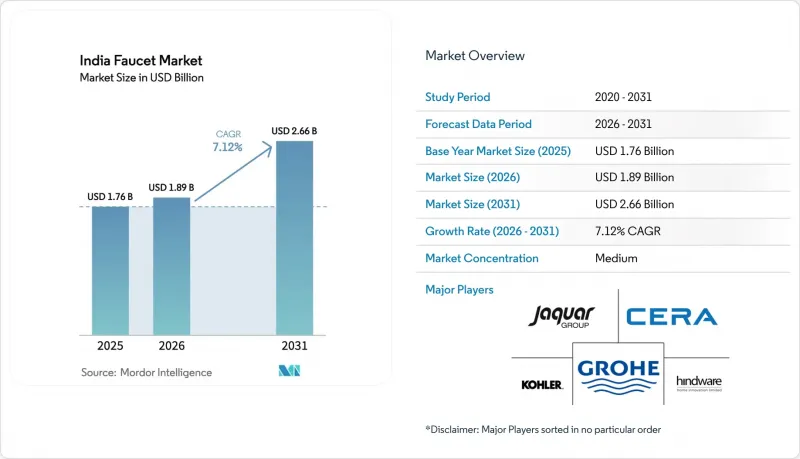
This report is Segmented by Product Type (Ball, Disc, Cartridge, Compression), Material (Chrome, Stainless Steel, Brass, and More), Technology (Manual, Automatic), Installation Type (Deck Mount, Wall Mount), Application Type (Kitchen Sink, Bathroom Sink), End-User (Residential, Commercial), Distribution Channel (B2C/Retail, B2B/Project), and Geography. The Market Forecasts are Provided in Terms of Value (USD).
India Faucet Market Trends and Insights
Rapid Urban Housing Projects & Smart Cities Mission
Government programs reshape faucet demand through scale procurement that locks in standard specifications. The Smart Cities Mission earmarked INR 5,961 crore for smart water systems, triggering bulk orders for sensor-ready fixtures. PMAY-U approvals covering 12.2 million units stabilize long-run volumes and favor firms with reliable supply chains. Institutional buyers insist on water-efficient models, speeding mainstream adoption of aerators and flow restrictors. Predictable tender cycles allow factories to plan tooling upgrades and reduce per-unit costs. Compliance requirements also edge out informal makers that lack certification infrastructure.
Rising Hotel-Hospital Capex in Tier-2/3 Cities
Secondary cities witness brisk hotel construction as leisure and business travel disperse beyond metros. Developers specify sturdy, stylish faucets that endure high footfall yet match premium decor. Parallel healthcare spending adds demand for touchless units that enhance infection control. Stainless steel gains traction for its durable finish and low-maintenance profile in intensive-use settings. Regional OEMs with quick service networks win contracts by cutting downtime for maintenance calls. The combined pipeline lifts commercial sales faster than housing replacements through 2030.
Unorganised/Grey Market Price Competition
Micro-scale workshops, which avoid paying GST, offer products priced approximately 18% lower than branded SKUs. This pricing strategy appeals to cost-conscious buyers, particularly in non-metro regions. Local plumbers often recommend these taps because they earn higher profit margins compared to the commissions they receive from selling branded products. Additionally, the shorter delivery distances associated with these workshops reduce freight costs and enable same-day restocking, making them a convenient option. However, the inconsistent quality of alloy grades used in these taps results in higher failure rates, which gradually diminishes buyer confidence. The government's initiative to implement e-invoicing is expected to reduce these price differences after 2026.
Other drivers and restraints analyzed in the detailed report include:
- E-commerce Accelerating Branded Faucet Penetration
- Water-Scarcity Push for Low-Flow & WaterSense-Style Products
- Volatile Copper & Zinc Alloy Input Prices
For complete list of drivers and restraints, kindly check the Table Of Contents.
Segment Analysis
Cartridge assemblies held 69.78% of the India faucets market share in 2025 on the back of familiarity, easy replaceability, and broad price coverage from entry to mid-premium. Yet disc mechanisms posted the quickest momentum at a 7.18% CAGR, adding roughly 4 percentage points to the overall India faucets market by 2031. Consumers in metros value ceramic discs for mineral-build-up resistance and feather-touch operation, ideal for hard-water zones in Delhi NCR. Manufacturers integrate dual-ceramic seals that last up to 500,000 cycles, halving lifetime maintenance versus conventional cartridges. Price compression from Chinese imports and localized disc production in Tamil Nadu narrow the upfront cost gap. Retailers now market disc faucets as "install-and-forget" options, fostering higher ticket sizes.
At the same time ball and compression faucets retain a foothold in rental housing and heritage renovations, respectively. Local authorities restoring colonial structures in Kolkata specify compression types to match historical authenticity, keeping this sub-segment alive. However, rising GST scrutiny and evolving consumer education tilt incremental volumes toward disc and cartridge hybrids that merge field-service simplicity with ceramic sealing. The India faucets market continues to favor modular valves where handles can interchange across designs, pushing OEMs to standardize spindle dimensions for cartridge and disc formats alike.
Brass covered 48.71% of the India faucets market in 2025 due to its machinability, corrosion tolerance, and perceived premium finish. Nonetheless, stainless-steel SKUs are forecast to outpace the broader India faucets market, gaining 7.45% CAGR as urban homeowners gravitate to a contemporary brushed aesthetic. The alloy's lead-free nature aligns with potable-water directives, strengthening its institutional pull in school and hospital contracts. Stainless items also resist fingerprint smudges, vital for high-traffic food-service restrooms.
Brass remains entrenched in luxury villas where heritage gold-tone plating and intricate knurling rule design briefs. OEMs counter stainless momentum by offering low-lead brass blends certified under IS 1264:2021, retaining upscale luster while meeting health norms. Chrome-plated zinc caters to budget refurbishments, though scratch susceptibility limits its commercial usage. PTMT polymer enjoys tax incentives under the government's plastics processing cluster scheme, carving cost-driven demand in semi-urban self-build homes. Across all materials, recyclability considerations grow salient, pressuring producers to adopt take-back programs and closed-loop smelting for scrap brass.
Manual valves dominated 81.06% of 2025 shipments as price sensitivity defines the mass segment. Yet the automatic cohort is registering an 8.04% CAGR, twice the broader India faucets market pace, aided by falling infrared sensor costs and battery lives now exceeding 300,000 activations. Hotels in Jaipur report water-use cuts of 28% after migrating to touchless taps, translating to one-year payback that resonates with asset managers. Government guidelines for infection control in healthcare also stipulate hands-free operation in ICU suites, driving institutional tenders toward automatic options.
Integration features climb up the specification ladder: Bluetooth modules feed facility dashboards, and solar trickle charging eliminates scheduled battery swaps in office campuses. For residential buyers, inductive recharge cables simplify maintenance anxiety that previously curbed sensor uptake. Domestic brands strike licensing deals with Taiwanese chip makers, embedding AI-based occupancy algorithms that calibrate flow duration to usage patterns. These innovations keep automated formats on an upswing even as manual valves retain baseline volume, ensuring a steady technology mix within the India faucets market.
Complete Report Scope:
- By Product Type
- Ball
- Disc
- Cartridge
- Compression
- By Material
- Chrome
- Stainless Steel
- Brass
- Polytetra Methylene Terephthalate (PTMT) Plastic
- Other Materials
- By Technology
- Manual
- Automatic
- By Installation Type
- Deck Mount
- Wall Mount
- By Application Type
- Kitchen Sink Faucets
- Bathroom Sink Faucets
- By End-User
- Residential
- Commercial
- By Distribution Channel
- B2C/Retail Distribution Channel
- Multi-Brand Stores
- Exclusive Brand Outlets
- Online
- Local Hardware Stores
- B2B/Project
- B2C/Retail Distribution Channel
- By Region
- North India
- South India
- West India
- East India
List of Companies Covered in this Report:
- Jaquar Group
- Hindware Home Innovation
- Cera Sanitaryware
- Kohler India
- Grohe India (LIXIL)
- Roca Parryware
- Delta Faucet (Masco)
- Hansgrohe SE
- American Standard (LIXIL)
- Moen (Fortune Brands)
- Toto Ltd
- Jaquar Artize
- Dornbracht
- Vitra
- Johnson Bathrooms
- Kerovit (Kajaria)
- Ess Ess (Asian Paints)
- Eauset
- Waterman
- Prayag Polymers
Additional Benefits:
- The market estimate (ME) sheet in Excel format
- 3 months of analyst support
TABLE OF CONTENTS
1 Introduction
- 1.1 Study Assumptions & Market Definition
- 1.2 Scope of the Study
2 Research Methodology
3 Executive Summary
4 Market Landscape
- 4.1 Market Overview
- 4.2 Market Drivers
- 4.2.1 Rapid urban housing projects & Smart Cities Mission
- 4.2.2 Rising hotel?hospital capex in Tier-2/3 cities
- 4.2.3 E-commerce accelerating branded faucet penetration
- 4.2.4 Water-scarcity push for low-flow & WaterSense-style products
- 4.2.5 IoT-enabled "smart" kitchens & bathrooms adoption
- 4.2.6 GST-credit advantage shifting share to organised players
- 4.3 Market Restraints
- 4.3.1 Unorganised/grey market price competition
- 4.3.2 Volatile copper & zinc alloy input prices
- 4.3.3 Fragmented plumbing channel beyond metros
- 4.3.4 Delay in BIS water-efficiency labelling roll-out
- 4.4 Industry Value Chain Analysis
- 4.5 Regulatory Landscape
- 4.6 Porter's Five Forces
- 4.6.1 Threat of New Entrants
- 4.6.2 Bargaining Power of Suppliers
- 4.6.3 Bargaining Power of Buyers
- 4.6.4 Threat of Substitutes
- 4.6.5 Competitive Rivalry
- 4.7 Insights into the Latest Trends and Innovations in the Market
- 4.8 Insights on Recent Developments (New Product Launches, Strategic Initiatives, Investments, Partnerships, JVs, Expansion, M&As, etc.) in the Industry
5 Market Size & Growth Forecasts (Value in USD)
- 5.1 By Product Type
- 5.1.1 Ball
- 5.1.2 Disc
- 5.1.3 Cartridge
- 5.1.4 Compression
- 5.2 By Material
- 5.2.1 Chrome
- 5.2.2 Stainless Steel
- 5.2.3 Brass
- 5.2.4 Polytetra Methylene Terephthalate (PTMT) Plastic
- 5.2.5 Other Materials
- 5.3 By Technology
- 5.3.1 Manual
- 5.3.2 Automatic
- 5.4 By Installation Type
- 5.4.1 Deck Mount
- 5.4.2 Wall Mount
- 5.5 By Application Type
- 5.5.1 Kitchen Sink Faucets
- 5.5.2 Bathroom Sink Faucets
- 5.6 By End-User
- 5.6.1 Residential
- 5.6.2 Commercial
- 5.7 By Distribution Channel
- 5.7.1 B2C/Retail Distribution Channel
- 5.7.1.1 Multi-Brand Stores
- 5.7.1.2 Exclusive Brand Outlets
- 5.7.1.3 Online
- 5.7.1.4 Local Hardware Stores
- 5.7.2 B2B/Project
- 5.7.1 B2C/Retail Distribution Channel
- 5.8 By Region
- 5.8.1 North India
- 5.8.2 South India
- 5.8.3 West India
- 5.8.4 East India
6 Competitive Landscape
- 6.1 Market Concentration
- 6.2 Strategic Moves
- 6.3 Market Share Analysis
- 6.4 Company Profiles (includes Global level Overview, Market level overview, Core Segments, Financials as available, Strategic Information, Market Rank/Share for key companies, Products & Services, and Recent Developments)
- 6.4.1 Jaquar Group
- 6.4.2 Hindware Home Innovation
- 6.4.3 Cera Sanitaryware
- 6.4.4 Kohler India
- 6.4.5 Grohe India (LIXIL)
- 6.4.6 Roca Parryware
- 6.4.7 Delta Faucet (Masco)
- 6.4.8 Hansgrohe SE
- 6.4.9 American Standard (LIXIL)
- 6.4.10 Moen (Fortune Brands)
- 6.4.11 Toto Ltd
- 6.4.12 Jaquar Artize
- 6.4.13 Dornbracht
- 6.4.14 Vitra
- 6.4.15 Johnson Bathrooms
- 6.4.16 Kerovit (Kajaria)
- 6.4.17 Ess Ess (Asian Paints)
- 6.4.18 Eauset
- 6.4.19 Waterman
- 6.4.20 Prayag Polymers
7 Market Opportunities & Future Outlook
- 7.1 Affordable smart faucets for mid-priced residential upgrades
- 7.2 Retrofit low-flow & sensor conversion kits for legacy installations

