PUBLISHER: Mordor Intelligence | PRODUCT CODE: 2125297

PUBLISHER: Mordor Intelligence | PRODUCT CODE: 2125297
Servo Motor - Market Share Analysis, Industry Trends & Statistics, Growth Forecasts (2026 - 2031)
According to Mordor Intelligence, the servo motor market size is expected to increase from USD 14.57 billion in 2025 to USD 15.38 billion in 2026 and reach USD 20.14 billion by 2031, growing at a CAGR of 5.53% over 2026-2031.
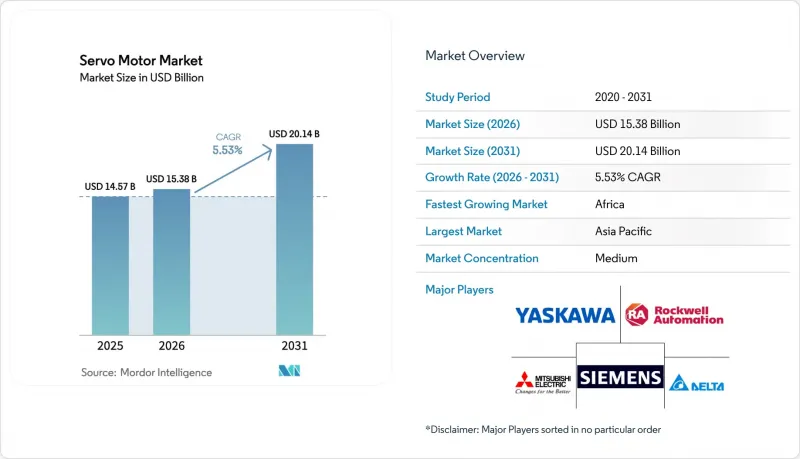
This report is Segmented by Motor Type (AC Servo Motor, and DC Servo Motor), Axis Configuration (Single-Axis, and Multi-Axis), Power Rating (<=750 W, 750 W - 2 KW, and >2 KW), Communication Interface (Analog/PWM, and Digital Fieldbus), End-User Industry (Oil and Gas, Chemical and Petrochemical, and More), and Geography (North America, Europe, and More). The Market Forecasts are Provided in Terms of Value (USD).
Global Servo Motor Market Trends and Insights
Adoption Of International Energy-Efficiency Standards
IEC 61800-9-2:2025 established IE4 and IE5 benchmarks, forcing vendors to redesign windings, magnets, and firmware to lower drivetrain losses. EU member states are expected to embed the standard in public procurement rules by mid-2025, triggering large-scale retrofits in municipal water networks. Japan and South Korea linked tax credits to compliance, accelerating adoption across automotive paint shops and semiconductor fabs. The rule also mandates the disclosure of full-load efficiency curves, shifting competition from sticker price to life-cycle operating costs. North America is lagging but is likely to catch up as the U.S. Department of Energy references the standard in its 2027 rulemaking.
Industry-Wide Drive Toward Smart And Flexible Automation
Manufacturers are abandoning hard-tooled transfer lines for reconfigurable work-cells equipped with servo-driven gantries and cobots connected over deterministic Ethernet. Operational industrial robots reached 4.28 million units by the end of 2023. EtherCAT penetration among German machine builders reached 62% in 2024, underscoring the shift toward distributed-clock motion networks. Edge AI chips mounted on drives are predicting bearing failures up to 30 days in advance, cutting unplanned stoppages by 40% in pilot lines. The servo motor market, therefore, benefits not only from mechanical precision but from data-driven uptime improvements.
Proliferation Of Low-Cost Stepper And BLDC Alternatives
Open-loop stepper and sensor-based BLDC motors cost 40-60% less than servo systems, a gap that appeals to price-sensitive buyers in Africa and South America. Chinese suppliers shipped over 12 million steppers in 2024, primarily for use in servicing 3D printers, CNC routers, and textile machinery. Texas Instruments' USD 5 encoder IC blurs the line by adding closed-loop feedback to BLDC motors. As a result, servo adoption is deferred in cost-elastic markets by up to three years.
Other drivers and restraints analyzed in the detailed report include:
- Rising Deployment Of Industrial And Collaborative Robots
- Integration Of Servo Drives With Edge AI Chips For On-Motor Analytics
- Rare-Earth Magnet Supply Risks Amid Geopolitical Tensions
For complete list of drivers and restraints, kindly check the Table Of Contents.
Segment Analysis
Brushless DC motors accounted for the fastest-growing share within the servo motor market, advancing at a 6.47% CAGR as medical, agricultural, and mobile-robot OEMs prioritize compact form factors. AC counterparts still dominated with 71.47% revenue share in 2025, reflecting their hold on heavy industrial processes that tap three-phase grids. Battery-powered surgical robots and exoskeletons favor frameless BLDC units, while silicon-carbide inverters narrow the efficiency gap to legacy induction platforms.
AC designs nonetheless retain an advantage in regenerative energy recovery, a decisive feature in vertical-axis CNC and high-bay crane applications. Vendors such as Yaskawa integrated 23-bit encoders and silicon-carbide drives into next-gen AC platforms, extending mean time between failures to 100,000 hours and reinforcing their presence in the servo motor market.
Single-axis systems still accounted for 63.41% of installations in 2025, primarily used for conveyor indexing and valve actuation tasks. Yet, multi-axis architectures are expanding at a 7.32% CAGR, propelled by cobots that require six coordinated joints. EtherCAT and PROFINET backbones deliver sub-microsecond synchronization across axes, enabling compliant motion without the need for cages.
Automotive welding lines are transitioning from fixed spot guns to multi-axis gantries that adapt in real-time to panel distortion. Siemens launched turnkey packages integrating vision guidance with multi-axis drives, reducing programming labor by 60% and deepening penetration of the servo motor market.
Complete Report Scope:
- By Motor Type
- AC Servo Motor
- DC Servo Motor
- By Axis Configuration
- Single-Axis
- Multi-Axis
- By Power Rating
- <750 W
- 750 W - 2 kW
- >2 kW
- By Communication Interface
- Analog / PWM
- Digital Fieldbus (CANopen, EtherCAT, PROFINET)
- By End-User Industry
- Oil and Gas
- Chemical and Petrochemical
- Power Generation
- Water and Wastewater
- Metal and Mining
- Food and Beverage
- Discrete Industries
- Automotive
- Electronics and Semiconductor
- Packaging
- By Geography
- North America
- United States
- Canada
- Mexico
- South America
- Brazil
- Argentina
- Rest of South America
- Europe
- Germany
- United Kingdom
- France
- Italy
- Spain
- Russia
- Rest of Europe
- Asia Pacific
- China
- Japan
- South Korea
- India
- Australia
- New Zealand
- Rest of Asia Pacific
- Middle East
- United Arab Emirates
- Saudi Arabia
- Turkey
- Rest of Middle East
- Africa
- South Africa
- Nigeria
- Kenya
- Rest of Africa
- North America
Geography Analysis
Asia Pacific generated 43.74% of 2025 revenue, anchored by China's dominance in smartphone assembly and South Korea's USD 44 billion semiconductor CAPEX wave. Government subsidies in India under the Production-Linked Incentive scheme reimburse 25% of automation spend, accelerating servo adoption across automotive and pharma lines.[3]
Africa, although only a small portion of the current servo motor market, is forecast to expand at an 8.13% CAGR through 2031, driven by South Africa's EV program, Nigerian food-processing upgrades, and Kenyan textile exports. Limited grid reliability and servicing expertise, however, keep low-cost stepper alternatives in contention, tempering upside.
North America and Europe remain mature but show pockets of double-digit growth in medical devices and aerospace, segments willing to pay premiums for IP69K stainless motors or DO-178-certified software stacks. South America lags as macro volatility lifts imported-equipment costs, although Brazil's automotive sector could reaccelerate once borrowing costs retreat below 10%. The Middle East, led by Saudi Arabia's Vision 2030, is selectively installing servo-driven CNC and additive manufacturing cells in new industrial zones.
- Yaskawa Electric Corporation
- Mitsubishi Electric Corp.
- Siemens AG
- Rockwell Automation Inc.
- Delta Electronics Inc.
- ABB Ltd.
- FANUC Corp.
- Schneider Electric SE
- Bosch Rexroth AG
- Kollmorgen Corporation
- Omron Corporation
- Parker Hannifin Corp.
- Nidec Corporation
- Oriental Motor Co. Ltd.
- Lenze SE
- Panasonic Industry Co.
- Toshiba Infrastructure Systems
- Estun Automation Co. Ltd.
- Maxon Group
- Sanyo Denki (SANMOTION)
Additional Benefits:
- The market estimate (ME) sheet in Excel format
- 3 months of analyst support
TABLE OF CONTENTS
1 INTRODUCTION
- 1.1 Study Assumptions and Market Definition
- 1.2 Scope of the Study
2 RESEARCH METHODOLOGY
3 EXECUTIVE SUMMARY
4 MARKET LANDSCAPE
- 4.1 Market Overview
- 4.2 Industry ValueChain Analysis
- 4.3 Market Drivers
- 4.3.1 Adoption of International Energy-Efficiency Standards
- 4.3.2 Industry-Wide Drive Toward Smart and Flexible Automation
- 4.3.3 Rising Deployment of Industrial and Collaborative Robots
- 4.3.4 Integration of Servo Drives with Edge AI Chips for On-motor Analytics
- 4.3.5 Miniaturized Servo Solutions for Medical Exoskeletons
- 4.3.6 High-Torque Servo Use in Autonomous Agricultural Equipment
- 4.4 Market Restraints
- 4.4.1 Proliferation of Low-Cost Stepper and BLDC Alternatives
- 4.4.2 High Upfront Capital Expenditure for Multi-Axis Servo Systems
- 4.4.3 Rare-Earth Magnet Supply Risks Amid Geopolitical Tensions
- 4.4.4 Cyber-Security Concerns in Networked Motion Control
- 4.5 Impact of Macroeconomic Factors on the Market
- 4.6 Regulatory Landscape
- 4.7 Technological Outlook
- 4.8 Porter's Five Forces Analysis
- 4.8.1 Bargaining Power of Suppliers
- 4.8.2 Bargaining Power of Buyers
- 4.8.3 Threat of New Entrants
- 4.8.4 Threat of Substitutes
- 4.8.5 Intensity of Competitive Rivalry
5 MARKET SIZE AND GROWTH FORECASTS (VALUE)
- 5.1 By Motor Type
- 5.1.1 AC Servo Motor
- 5.1.2 DC Servo Motor
- 5.2 By Axis Configuration
- 5.2.1 Single-Axis
- 5.2.2 Multi-Axis
- 5.3 By Power Rating
- 5.3.1 <750 W
- 5.3.2 750 W - 2 kW
- 5.3.3 >2 kW
- 5.4 By Communication Interface
- 5.4.1 Analog / PWM
- 5.4.2 Digital Fieldbus (CANopen, EtherCAT, PROFINET)
- 5.5 By End-User Industry
- 5.5.1 Oil and Gas
- 5.5.2 Chemical and Petrochemical
- 5.5.3 Power Generation
- 5.5.4 Water and Wastewater
- 5.5.5 Metal and Mining
- 5.5.6 Food and Beverage
- 5.5.7 Discrete Industries
- 5.5.7.1 Automotive
- 5.5.7.2 Electronics and Semiconductor
- 5.5.7.3 Packaging
- 5.6 By Geography
- 5.6.1 North America
- 5.6.1.1 United States
- 5.6.1.2 Canada
- 5.6.1.3 Mexico
- 5.6.2 South America
- 5.6.2.1 Brazil
- 5.6.2.2 Argentina
- 5.6.2.3 Rest of South America
- 5.6.3 Europe
- 5.6.3.1 Germany
- 5.6.3.2 United Kingdom
- 5.6.3.3 France
- 5.6.3.4 Italy
- 5.6.3.5 Spain
- 5.6.3.6 Russia
- 5.6.3.7 Rest of Europe
- 5.6.4 Asia Pacific
- 5.6.4.1 China
- 5.6.4.2 Japan
- 5.6.4.3 South Korea
- 5.6.4.4 India
- 5.6.4.5 Australia
- 5.6.4.6 New Zealand
- 5.6.4.7 Rest of Asia Pacific
- 5.6.5 Middle East
- 5.6.5.1 United Arab Emirates
- 5.6.5.2 Saudi Arabia
- 5.6.5.3 Turkey
- 5.6.5.4 Rest of Middle East
- 5.6.6 Africa
- 5.6.6.1 South Africa
- 5.6.6.2 Nigeria
- 5.6.6.3 Kenya
- 5.6.6.4 Rest of Africa
- 5.6.1 North America
6 COMPETITIVE LANDSCAPE
- 6.1 Market Concentration
- 6.2 Strategic Moves
- 6.3 Market Share Analysis
- 6.4 Company Profiles (includes Global Level Overview, Market Level Overview, Core Segments, Financials, Strategic Information, Market Rank/Share, Products and Services, Recent Developments)
- 6.4.1 Yaskawa Electric Corporation
- 6.4.2 Mitsubishi Electric Corp.
- 6.4.3 Siemens AG
- 6.4.4 Rockwell Automation Inc.
- 6.4.5 Delta Electronics Inc.
- 6.4.6 ABB Ltd.
- 6.4.7 FANUC Corp.
- 6.4.8 Schneider Electric SE
- 6.4.9 Bosch Rexroth AG
- 6.4.10 Kollmorgen Corporation
- 6.4.11 Omron Corporation
- 6.4.12 Parker Hannifin Corp.
- 6.4.13 Nidec Corporation
- 6.4.14 Oriental Motor Co. Ltd.
- 6.4.15 Lenze SE
- 6.4.16 Panasonic Industry Co.
- 6.4.17 Toshiba Infrastructure Systems
- 6.4.18 Estun Automation Co. Ltd.
- 6.4.19 Maxon Group
- 6.4.20 Sanyo Denki (SANMOTION)
7 MARKET OPPORTUNITIES AND FUTURE OUTLOOK
- 7.1 White-Space and Unmet-Need Assessment

