PUBLISHER: Mordor Intelligence | PRODUCT CODE: 2125299

PUBLISHER: Mordor Intelligence | PRODUCT CODE: 2125299
Europe Food Contract Manufacturing And Packaging - Market Share Analysis, Industry Trends & Statistics, Growth Forecasts (2026 - 2031)
According to Mordor Intelligence, the Europe food contract manufacturing and packaging market size was valued at USD 104.49 billion in 2025 and estimated to grow from USD 114.71 billion in 2026 to reach USD 182.86 billion by 2031, at a CAGR of 9.78% during the forecast period (2026-2031).
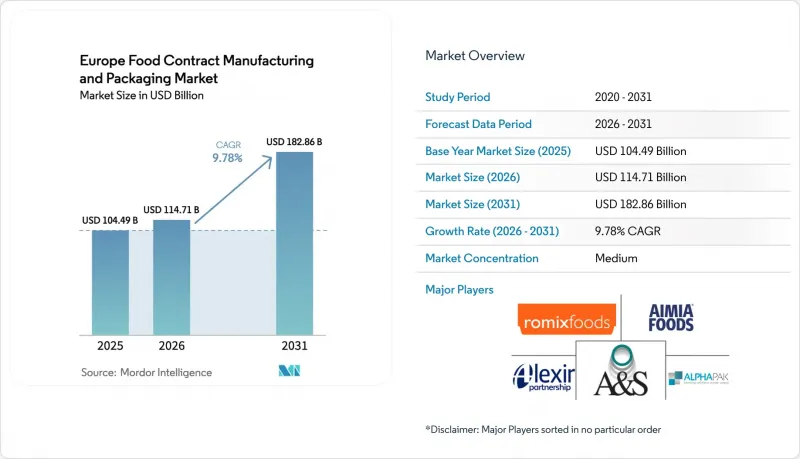
This report is Segmented by Service Type (Processing and Manufacturing, Packaging, Warehousing and Fulfilment, Custom Formulation and R&D), End-Use Industry (Bakery and Confectionery, Dairy Products, Convenience and Ready Meals, and More), Packaging Format (Flexible, Rigid), and Country. The Market Forecasts are Provided in Terms of Value (USD).
Europe Food Contract Manufacturing And Packaging Market Trends and Insights
Contract-Manufacturers Investing in Allergen-Free and Plant-Based Lines
Facilities dedicated to allergen-free and plant-based production are scaling across Europe in response to stricter oversight from national food safety agencies. Mars allocated USD 140.4 million to modernize eight French sites in 2024, installing segregated air-handling and storage systems that eliminate cross-contact risk. Early movers secure multi-year contracts from brands that lack capital for specialized retrofits. The conversion cycle spans 18-24 months, temporarily tightening outsourced capacity but ultimately lifting overall throughput once finished. Demand is buoyed by a surge in vegan product launches and by public health authorities linking lifestyle diseases to overconsumption of animal proteins. For contract manufacturers, plant-protein texturization lines offer premium fees that offset the higher utility and certification expenses associated with allergen management. As a result, this trend lifts both revenue density and bargaining power within the Europe food contract manufacturing and packaging market.
Retail Private-Label Expansion Seeking Flexible Capacity
European grocers now use private-label margins to shield consumers from inflation shocks, driving unprecedented volatility in production schedules. NewPrinces' USD 1 billion acquisition of Carrefour Italia in 2025 affirms the strategic value of in-house and contracted capacity that can handle multi-temperature portfolios. Retailers increasingly issue quarterly bid cycles rather than annual tenders, rewarding contractors that demonstrate sub-24-hour changeover. Flexible capacity contracts, typically 12-18 months in length, now include variable-volume clauses that shift inventory risk back to manufacturers. Those able to amortize frequent start-ups through digital twin scheduling and rapid sanitization protocols capture disproportionate wallet share in the Europe food contract manufacturing and packaging market.
Compression of Brand Owner Price Margins Passed to Contractors
Food inflation peaked at 5.1% in the United Kingdom during 2025, prompting retailers to cap shelf prices and force suppliers to absorb input spikes. Electricity and gas tariffs doubled versus 2020 baselines, eroding contribution margins on energy-intensive cooking and drying lines. While tier-one contractors negotiate pass-through clauses or hedge energy, mid-sized firms face a margin squeeze that dampens capital spending. Constrained cash flow slows automation upgrades, widening performance gaps inside the Europe food contract manufacturing and packaging market.
Other drivers and restraints analyzed in the detailed report include:
- Digitalization and Cloud-Connected Factories Improving Line-Changeover Speeds
- E-Commerce Meal-Kit Boom Demanding Fulfillment-Ready Packaging
- Tightening EU Single-Use Plastics and PPWR Rules Raising Compliance Costs
For complete list of drivers and restraints, kindly check the Table Of Contents.
Segment Analysis
Processing and manufacturing held 46.88% of the Europe food contract manufacturing and packaging market share in 2025, underscoring its role as the volume backbone for private-label staples. Its scale benefits allow contractors to leverage bulk ingredient procurement and continuous-flow machinery, keeping unit costs competitive for branded and retailer customers. Simultaneously, the custom formulation and R&D segment is forecast to grow at a 10.18% CAGR through 2031, signaling brand owner urgency to commercialize differentiated concepts without building in-house pilot plants. The Europe food contract manufacturing and packaging market size for custom formulation services is thus expected to swell as clinical-substantiated nutraceuticals and clean-label emulsions move from lab to shelf within a single quarterly cycle.
Advances in micro-batch encapsulation, such as ACG's personalized capsule platform, illustrate how contractors monetize formulation IP through premium fee structures. Warehousing and fulfillment services benefit from rising direct-to-consumer flows, but pricing remains volume-linked, placing a strategic emphasis on real-time inventory visibility to optimize cube utilization. Packaging services face margin uplift as EU recyclability mandates require continuous redesign and regulatory validation, a complexity most brand owners prefer to outsource. Overall, the Europea food contract manufacturing and packaging market continues to tilt toward contractors capable of bundling formulation, processing, and compliant packaging into a single turnkey proposition..
Complete Report Scope:
- By Service Type
- Processing and Manufacturing
- Packaging
- Warehousing and Fulfilment
- Custom Formulation and R&D
- By End-Use Industry
- Bakery and Confectionery
- Dairy Products
- Convenience and Ready Meals
- Functional and Nutraceutical Products
- Other End-Use Industries
- By Packaging Format
- Flexible
- Pouches and Sachets
- Bags
- Other Flexible Packaging
- Rigid
- Bottles and Jars
- Cans
- Pallets
- Cartons
- Other Rigid Packaging
- Flexible
- By Country
- United Kingdom
- Germany
- France
- Italy
- Spain
- Rest of Europe
List of Companies Covered in this Report:
- Romix Foods Limited
- Aimia Foods Ltd
- Norvik Foods Limited
- A and S Packing Company Limited
- Alexir Co-Packers Limited
- Alphapak International Ltd
- Agilery GmbH
- SternMaid GmbH and Co. KG
- Hearthside Food Solutions Europe B.V.
- STOCKMEIER Food GmbH and Co. KG
- Budelpack Poortvliet B.V.
- Complete Co-Packing Services Ltd
- Marvinpac SA
- Marsden Packaging Ltd
- HACO Holding AG
- ID Logistics SE
- PacMoore Europe B.V.
- Thrive Foods Europe Ltd
- Kilfera Food Manufacturers Limited
- Prima Foods UK Ltd
Additional Benefits:
- The market estimate (ME) sheet in Excel format
- 3 months of analyst support
TABLE OF CONTENTS
1 INTRODUCTION
- 1.1 Study Assumptions and Market Definition
- 1.2 Scope of the Study
2 RESEARCH METHODOLOGY
3 EXECUTIVE SUMMARY
4 MARKET LANDSCAPE
- 4.1 Market Overview
- 4.2 Market Drivers
- 4.2.1 Contract-manufacturers investing in allergen-free and plant-based lines
- 4.2.2 Retail private-label expansion seeking flexible capacity
- 4.2.3 Digitalisation and cloud-connected factories improving line-changeover speeds
- 4.2.4 E-commerce meal-kit boom demanding fulfilment-ready packaging
- 4.2.5 EU Green Deal incentives for low-carbon packaging operations
- 4.2.6 Commercialisation of upcycled ingredients supplying new value streams
- 4.3 Market Restraints
- 4.3.1 Compression of brand owner price margins passed to contractors
- 4.3.2 Tightening EU Single-Use Plastics and PPWR rules raising compliance costs
- 4.3.3 Heightened food-safety liability driven by Listeria/Allergen recalls
- 4.3.4 Volatile energy and logistics prices disrupting production planning
- 4.4 Industry Value Chain Analysis
- 4.5 Porter's Five Forces Analysis
- 4.5.1 Bargaining Power of Suppliers
- 4.5.2 Bargaining Power of Buyers/Consumers
- 4.5.3 Threat of New Entrants
- 4.5.4 Threat of Substitute Products
- 4.5.5 Intensity of Competitive Rivalry
- 4.6 Impact of Macroeconomic Factors on the Market
- 4.7 Regulatory Landscape
- 4.8 Technological Outlook
5 MARKET SIZE AND GROWTH FORECASTS (VALUE)
- 5.1 By Service Type
- 5.1.1 Processing and Manufacturing
- 5.1.2 Packaging
- 5.1.3 Warehousing and Fulfilment
- 5.1.4 Custom Formulation and R&D
- 5.2 By End-Use Industry
- 5.2.1 Bakery and Confectionery
- 5.2.2 Dairy Products
- 5.2.3 Convenience and Ready Meals
- 5.2.4 Functional and Nutraceutical Products
- 5.2.5 Other End-Use Industries
- 5.3 By Packaging Format
- 5.3.1 Flexible
- 5.3.1.1 Pouches and Sachets
- 5.3.1.2 Bags
- 5.3.1.3 Other Flexible Packaging
- 5.3.2 Rigid
- 5.3.2.1 Bottles and Jars
- 5.3.2.2 Cans
- 5.3.2.3 Pallets
- 5.3.2.4 Cartons
- 5.3.2.5 Other Rigid Packaging
- 5.3.1 Flexible
- 5.4 By Country
- 5.4.1 United Kingdom
- 5.4.2 Germany
- 5.4.3 France
- 5.4.4 Italy
- 5.4.5 Spain
- 5.4.6 Rest of Europe
6 COMPETITIVE LANDSCAPE
- 6.1 Market Concentration
- 6.2 Strategic Moves
- 6.3 Market Share Analysis
- 6.4 Company Profiles (includes Global level Overview, Market level overview, Core Segments, Financials as available, Strategic Information, Market Rank/Share for key companies, Products and Services, and Recent Developments)
- 6.4.1 Romix Foods Limited
- 6.4.2 Aimia Foods Ltd
- 6.4.3 Norvik Foods Limited
- 6.4.4 A and S Packing Company Limited
- 6.4.5 Alexir Co-Packers Limited
- 6.4.6 Alphapak International Ltd
- 6.4.7 Agilery GmbH
- 6.4.8 SternMaid GmbH and Co. KG
- 6.4.9 Hearthside Food Solutions Europe B.V.
- 6.4.10 STOCKMEIER Food GmbH and Co. KG
- 6.4.11 Budelpack Poortvliet B.V.
- 6.4.12 Complete Co-Packing Services Ltd
- 6.4.13 Marvinpac SA
- 6.4.14 Marsden Packaging Ltd
- 6.4.15 HACO Holding AG
- 6.4.16 ID Logistics SE
- 6.4.17 PacMoore Europe B.V.
- 6.4.18 Thrive Foods Europe Ltd
- 6.4.19 Kilfera Food Manufacturers Limited
- 6.4.20 Prima Foods UK Ltd
7 MARKET OPPORTUNITIES and FUTURE OUTLOOK
- 7.1 White-space and Unmet-Need Assessment

