PUBLISHER: Mordor Intelligence | PRODUCT CODE: 2125307

PUBLISHER: Mordor Intelligence | PRODUCT CODE: 2125307
Metering Pumps - Market Share Analysis, Industry Trends & Statistics, Growth Forecasts (2026 - 2031)
According to Mordor Intelligence, the metering pumps market size was valued at USD 7.5 billion in 2025 and estimated to grow from USD 7.79 billion in 2026 to reach USD 9.44 billion by 2031, at a CAGR of 3.92% during the forecast period (2026-2031).
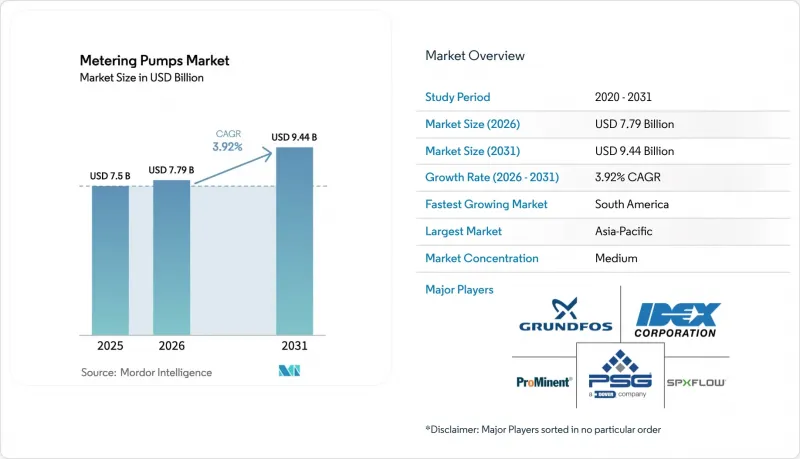
This report is Segmented by Type (Diaphragm, Gear, Rotary Lobe, and More), Drive Mechanism (Motor-Driven, Solenoid-Driven, and More), Discharge Pressure (Up To 50 Bar, 51-100 Bar, and More), End-User (Water Treatment, Oil & Gas, Chemical Processing, Pharmaceuticals, and More), and Geography. The Market Forecasts are Provided in Terms of Value (USD).
Global Metering Pumps Market Trends and Insights
Strict Industrial Waste-water Norms Accelerating Chemical Dosing in Asia
Sweeping 2024 amendments to China's Water Pollution Prevention and Control Law cut allowable effluent loads by 40%, forcing roughly 65,000 factories to add multiple chemical dosing points and digital data logging. Upgrades across electroplating, textile, and pharma corridors now account for 35% of all new installs in Asia, with IIoT-ready pumps preferred to satisfy record-keeping mandates mee.gov.cn. These standards are expected to ripple through Southeast Asia and India over the next three years, underpinning consistent demand growth within the metering pumps market.
Rapid Digitalization of Water Utilities Demanding Smart Dosing Accuracy
Utilities integrating SCADA and IoT platforms have uncovered 15-22% chemical savings when pumps adjust doses in real time. The shift is shortening replacement cycles from 12 years to near 8 years and raising average selling prices by one-quarter. Regions facing water scarcity, such as the US Southwest and parts of Spain, are early adopters as they balance quality assurance with chemical cost control. Service-based revenue models around predictive maintenance are emerging, enlarging the opportunity set for vendors.
Requirement of Frequent Maintenance
Mechanical diaphragm pumps often need service after 4,000-6,000 hours, interrupting continuous processes that can lose USD 5,000-15,000 per hour during downtime. Emerging markets suffer most because skilled technicians are scarce, prompting some operators to consider less precise but lower-maintenance alternatives.
Other drivers and restraints analyzed in the detailed report include:
- Fertigation Boom in High-Value Horticulture across the Middle East
- Increasing Offshore Enhanced-Oil-Recovery Chemical Injection Needs
- Growing Customization Demands (Fluid-Property-Driven Design Tweaks)
For complete list of drivers and restraints, kindly check the Table Of Contents.
Segment Analysis
Diaphragm pumps controlled 63.35% of global revenue in 2025. Their leak-free architecture fits corrosive water-treatment chemistries, cementing leadership across compliance-driven markets. Plunger/piston models are expanding at 7.02% annually as upstream operators push injection pressures above 100 bar. This differential signals a migration toward high-pressure niches where flow stability under extreme conditions outweighs higher lifecycle costs. Gear, rotary lobe, and peristaltic designs address narrower needs such as pulse-free polymer blending or hygienic pharma fills.
Recent elastomer advances have extended peristaltic tube life by 40%, elevating their appeal in sterile dosing lines. Gear and lobe pumps maintain steady uptake in polymer compounding where continuous, shear-controlled feed rates matter. Collectively, these trends support a diverse technology mix inside the metering pumps market.
Motor-driven units captured 54.45% of 2025 sales thanks to rugged construction and simple integration with legacy control loops. Solenoid-driven pumps, though smaller in absolute value, are climbing 5.88% per year on the back of energy efficiency and digital-native design. New magnetic circuit geometries raise their flow and pressure ceiling by almost one-third while trimming power draw roughly 30%. Pneumatic and hydraulic drives retain roles in hazardous or power-poor sites, yet their share is stable rather than rising.
Solenoid evolution dovetails with the surge in smart water and chemical plants, positioning this architecture as a growth engine for the metering pumps market through 2031
Complete Report Scope:
- By Type
- Diaphragm
- Piston / Plunger
- Peristaltic
- Gear
- Rotary Lobe
- By Drive Mechanism
- Motor-Driven
- Solenoid-Driven
- Hydraulic-Driven
- Pneumatic-Driven
- By Discharge Pressure
- Up to 50 bar
- 51 - 100 bar
- 101 - 150 bar
- Above 150 bar
- By Pump Material
- Metallic (Stainless-steel, Alloy-20, Duplex)
- Non-Metallic (PVC, PVDF, PP)
- By End-User Industry
- Water Treatment
- Oil and Gas
- Chemical Processing
- Pharmaceuticals
- Food and Beverage
- Pulp and Paper
- Agriculture and Fertigation
- Mining and Minerals
- Textiles
- Power Generation and Others
- By Geography
- North America
- United States
- Canada
- Mexico
- Europe
- United Kingdom
- Germany
- France
- Italy
- Rest of Europe
- Asia-Pacific
- China
- Japan
- India
- South Korea
- Rest of Asia-Pacific
- Middle East
- Israel
- Saudi Arabia
- United Arab Emirates
- Turkey
- Rest of Middle East
- Africa
- South Africa
- Egypt
- Rest of Africa
- South America
- Brazil
- Argentina
- Rest of South America
- North America
Geography Analysis
Asia-Pacific dominated the metering pumps market with 39.55% of 2025 revenue. China's latest five-year plan earmarks widespread industrial effluent upgrades, while India's Jal Jeevan Mission drives rural water quality investments. High-purity pharma growth in Singapore and South Korea stimulates demand for skid-mounted, digitally certified dosing modules. Local manufacturers undercut imported models in commodity ranges, yet Western brands keep premium share in high-pressure or exotic-material builds.
South America is the fastest-growing geography at a 5.27% CAGR to 2031. Brazil's new sanitation law triggers chlorination and pH control rollouts, and other countries in South America export manufacturing sector increases solvent recycling and wastewater neutralization installations. Vendors emphasize voltage-tolerant drives and simplified service kits to suit local infrastructure.
North America and Europe are mature but innovation-intensive. Utility operators here spearhead integration of pumps with cloud-hosted dashboards, favoring solutions that broadcast status over MQTT or OPC UA. The US EPA's lead and copper rule revisions and Europe's tightening of PFAS discharge limits both raise dosing accuracy thresholds. Meanwhile, Gulf producers and arid African nations channel spending toward desalination and reuse, preserving a steady pipeline of orders for corrosion-resistant PVDF and super-duplex pumps.
- Grundfos Holding A/S
- IDEX Corporation
- PSG - Dover Corp.
- SPX Flow, Inc.
- LEWA GmbH (Nikkiso)
- ProMinent GmbH
- Milton Roy (Ingersoll Rand)
- Seko S.p.A
- Watson-Marlow Fluid Tech Grp. (Spirax-Sarco)
- Seepex GmbH
- Verder Group
- Blue-White Industries
- Xylem Inc.
- Flowserve Corporation
- Iwaki Co., Ltd.
- Netzsch Pumpen GmbH
- Atlas Copco (Lewa-Triplex)
- Roto Pumps Ltd.
- Haosh Pump Co.
- Swelore Engineering
- Tacmina Corp.
- Ingersoll Rand (Haskel)
- Idemitsu Kosan (Eagle Industry)
Additional Benefits:
- The market estimate (ME) sheet in Excel format
- 3 months of analyst support
TABLE OF CONTENTS
1 INTRODUCTION
- 1.1 Study Assumptions and Market Definition
- 1.2 Scope of the Study
2 RESEARCH METHODOLOGY
3 EXECUTIVE SUMMARY
4 MARKET LANDSCAPE
- 4.1 Market Overview
- 4.2 Market Drivers
- 4.2.1 Strict Industrial Waste-water Norms Accelerating Chemical Dosing in Asia
- 4.2.2 Rapid Digitalization of Water Utilities Demanding Smart Dosing Accuracy
- 4.2.3 Fertigation Boom in High-Value Horticulture across the Middle East
- 4.2.4 Increasing Offshore Enhanced-Oil-Recovery (EOR) Chemical Injection Needs
- 4.2.5 Growing Use of High-Purity API Skids in Continuous-Flow Pharma Plants
- 4.2.6 Extensive Demand from Chemical Plants
- 4.3 Market Restraints
- 4.3.1 Requirement of Frequent Maintenance
- 4.3.2 Growing Customization Demands (Fluid-Property-Driven Design Tweaks)
- 4.3.3 Cavitation Risk in High-Viscosity Peristaltic Lines Limiting Adoption
- 4.3.4 Availability of Low-cost Chinese Knock-offs Eroding Margins Globally
- 4.4 Value / Supply-Chain Analysis
- 4.5 Regulatory Outlook
- 4.6 Technological Outlook (IIoT-enabled Smart Dosing, Predictive Sensors)
- 4.7 Investment Analysis
- 4.8 Porter's Five Forces
- 4.8.1 Bargaining Power of Suppliers
- 4.8.2 Bargaining Power of Buyers
- 4.8.3 Threat of New Entrants
- 4.8.4 Threat of Substitutes
- 4.8.5 Intensity of Competitive Rivalry
5 MARKET SIZE AND GROWTH FORECASTS (VALUE)
- 5.1 By Type
- 5.1.1 Diaphragm
- 5.1.2 Piston / Plunger
- 5.1.3 Peristaltic
- 5.1.4 Gear
- 5.1.5 Rotary Lobe
- 5.2 By Drive Mechanism
- 5.2.1 Motor-Driven
- 5.2.2 Solenoid-Driven
- 5.2.3 Hydraulic-Driven
- 5.2.4 Pneumatic-Driven
- 5.3 By Discharge Pressure
- 5.3.1 Up to 50 bar
- 5.3.2 51 - 100 bar
- 5.3.3 101 - 150 bar
- 5.3.4 Above 150 bar
- 5.4 By Pump Material
- 5.4.1 Metallic (Stainless-steel, Alloy-20, Duplex)
- 5.4.2 Non-Metallic (PVC, PVDF, PP)
- 5.5 By End-User Industry
- 5.5.1 Water Treatment
- 5.5.2 Oil and Gas
- 5.5.3 Chemical Processing
- 5.5.4 Pharmaceuticals
- 5.5.5 Food and Beverage
- 5.5.6 Pulp and Paper
- 5.5.7 Agriculture and Fertigation
- 5.5.8 Mining and Minerals
- 5.5.9 Textiles
- 5.5.10 Power Generation and Others
- 5.6 By Geography
- 5.6.1 North America
- 5.6.1.1 United States
- 5.6.1.2 Canada
- 5.6.1.3 Mexico
- 5.6.2 Europe
- 5.6.2.1 United Kingdom
- 5.6.2.2 Germany
- 5.6.2.3 France
- 5.6.2.4 Italy
- 5.6.2.5 Rest of Europe
- 5.6.3 Asia-Pacific
- 5.6.3.1 China
- 5.6.3.2 Japan
- 5.6.3.3 India
- 5.6.3.4 South Korea
- 5.6.3.5 Rest of Asia-Pacific
- 5.6.4 Middle East
- 5.6.4.1 Israel
- 5.6.4.2 Saudi Arabia
- 5.6.4.3 United Arab Emirates
- 5.6.4.4 Turkey
- 5.6.4.5 Rest of Middle East
- 5.6.5 Africa
- 5.6.5.1 South Africa
- 5.6.5.2 Egypt
- 5.6.5.3 Rest of Africa
- 5.6.6 South America
- 5.6.6.1 Brazil
- 5.6.6.2 Argentina
- 5.6.6.3 Rest of South America
- 5.6.1 North America
6 COMPETITIVE LANDSCAPE
- 6.1 Market Concentration
- 6.2 Strategic Moves
- 6.3 Market Share Analysis
- 6.4 Company Profiles {(includes Global level Overview, Market level overview, Core Segments, Financials as available, Strategic Information, Market Rank/Share for key companies, Products and Services, and Recent Developments)}
- 6.4.1 Grundfos Holding A/S
- 6.4.2 IDEX Corporation
- 6.4.3 PSG - Dover Corp.
- 6.4.4 SPX Flow, Inc.
- 6.4.5 LEWA GmbH (Nikkiso)
- 6.4.6 ProMinent GmbH
- 6.4.7 Milton Roy (Ingersoll Rand)
- 6.4.8 Seko S.p.A
- 6.4.9 Watson-Marlow Fluid Tech Grp. (Spirax-Sarco)
- 6.4.10 Seepex GmbH
- 6.4.11 Verder Group
- 6.4.12 Blue-White Industries
- 6.4.13 Xylem Inc.
- 6.4.14 Flowserve Corporation
- 6.4.15 Iwaki Co., Ltd.
- 6.4.16 Netzsch Pumpen GmbH
- 6.4.17 Atlas Copco (Lewa-Triplex)
- 6.4.18 Roto Pumps Ltd.
- 6.4.19 Haosh Pump Co.
- 6.4.20 Swelore Engineering
- 6.4.21 Tacmina Corp.
- 6.4.22 Ingersoll Rand (Haskel)
- 6.4.23 Idemitsu Kosan (Eagle Industry)
7 MARKET OPPORTUNITIES AND FUTURE OUTLOOK
- 7.1 White-space and Unmet-Need Assessment

