PUBLISHER: Mordor Intelligence | PRODUCT CODE: 2125322

PUBLISHER: Mordor Intelligence | PRODUCT CODE: 2125322
Label - Market Share Analysis, Industry Trends & Statistics, Growth Forecasts (2026 - 2031)
According to Mordor Intelligence, the label market size is expected to increase from USD 47.01 billion in 2025 to USD 49.37 billion in 2026 and reach USD 64.26 billion by 2031, growing at a CAGR of 5.41% over 2026-2031.
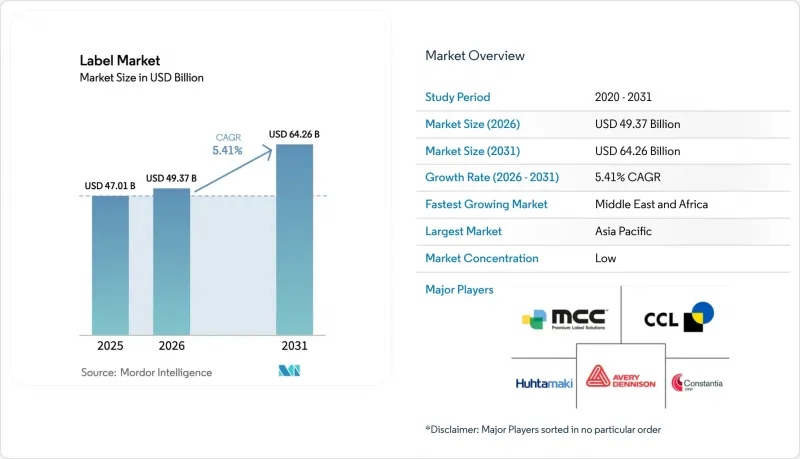
This report is Segmented by Type (Pressure-Sensitive, Shrink, In-Mold, and More), Material (Paper, Polypropylene, Polyethylene, Polyethylene-Terephthalate And, Other Materials), Print Technology (Flexographic, Offset, Gravure, and More), End-User Industry (Food, Beverage, Healthcare and Pharmaceutical, Cosmetics and Personal Care, and More), and Geography. The Market Forecasts are Provided in Terms of Value (USD).
Global Label Market Trends and Insights
E-commerce Boom Driving Variable-Data Shipping Labels
Global parcel volumes surpassed 21 billion units in 2024, and every box still needs at least one scannable identifier. Converters are responding with high-speed digital inkjet presses that print unique barcodes above 100 meters per minute, enabling same-day fulfillment for flash-sale retailers. Pharmaceutical cold-chain logistics adds complexity because temperature-indicator labels must also carry batch and expiry codes required by the U.S. Drug Supply Chain Security Act. Cross-border parcels entering the European Union must display QR codes linked to digital product passports introduced under the Packaging and Packaging Waste Regulation in 2025. Converters lacking digital capacity risk share loss to agile peers already scaled for short runs and variable data.
Sustainability Regulations Accelerating Liner-less and Recyclable Formats
The European Union now requires all packaging to be recyclable by 2030 and mandates 30% rPET in bottles by the same year. These rules push label market participants to adopt wash-off adhesives and liner-less constructions that remove silicone-coated release liners. UPM Raflatac's RafCycle network, recently expanded to Poland and Thailand, diverts about 10 000 metric tons of liner waste annually. Similar programs are emerging in North America as extended producer responsibility laws roll out in California and Oregon. Brand owners also face PFAS bans in food-contact labels, prompting converters to invest in fluorine-free coatings certified under ISO 14021.
Raw-Material Cost Volatility in Films and Adhesives
Polypropylene film traded between USD 1 200-1 600 per metric ton during 2025 as crude-oil swings and supply outages in Asia-Pacific petrochemical hubs unsettled converters. Adhesive-resin prices for acrylic emulsions climbed 12% year on year, eroding EBITDA margins that average just 8-12% for mid-sized converters. Locked-price contracts with consumer-goods multinationals limit cost-pass-through, forcing converters to negotiate multi-year supply deals or invest in solvent-free technologies that reduce resin consumption. Recycled PET resin faced similar volatility, reflecting tight bottle-flake supplies under Europe's 30% rPET mandate. Smaller converters, lacking vertical integration into film extrusion, carry the most exposure to these input shocks.
Other drivers and restraints analyzed in the detailed report include:
- Smart and Connected Packaging Unlocking New Revenue Streams
- Food and Beverage Demand for Premium Compliance-Driven Packaging
- Shift Toward Stand-Up Pouches and Direct-to-Object Printing
For complete list of drivers and restraints, kindly check the Table Of Contents.
Segment Analysis
Shrink labels are forecast to grow at a 6.25% CAGR through 2031, outstripping the overall label market. Their popularity stems from 360-degree decoration that merges branding, regulatory text, and tamper evidence in one sleeve. Pressure-sensitive formats still held 47.44% of the label market share in 2025 thanks to versatility across substrates and rapid application speeds that exceed 500 units per minute. Wrap-around labels remain endemic to mainstream carbonated drinks but face pilot replacements by laser-etched or direct-print solutions. In-mold labels add process efficiency in dairy tubs and ice-cream containers by integrating decoration during blow molding, cutting a full downstream step. Smaller categories such as glue-applied and heat-transfer styles survive where glass-bottle prestige or industrial durability governs material choice. Shrink sleeves will keep gaining because low-density PET-G and PP films now separate cleanly at recycling plants, addressing circularity concerns.
Converters will still prioritize pressure-sensitive labels for pharmaceuticals, logistics, and chemical drums because stringent wash-off and variable-data needs align with that format's modular construction. However, wider shrink-sleeve roll widths and automated seaming equipment have reduced per-unit costs, encouraging beverage brands to migrate SKUs that historically used wrap-around film. At the premium end, multi-layer heat-transfer labels with metallic accents are defending share in craft spirits that value tactile differentiation. Overall, the type segment remains a study in application-specific trade-offs where performance, recyclability, and shelf impact counterbalance cost.
PET film sales are projected to grow at a 6.72% CAGR through 2031 as brand-owner commitments and regulatory quotas boost demand for rPET-ready facestocks. Polypropylene accounted for 36.77% of the market share in 2025 because of its low density and clarity, which support both shrink sleeves and in-mold labels, offering freight savings and optical quality. Paper maintains relevance in premium wine and craft-beer end-markets where textured, FSC-certified stocks evoke authenticity. Polyethylene remains indispensable for frozen foods and squeeze bottles due to its flexibility at sub-zero temperatures. Other polymers, such as PVC and PLA, have niche applications: PVC persists in beverage multipacks despite end-of-life challenges, while PLA films meet compostable-pack aspirations where industrial composting is available.
The European Packaging and Packaging Waste Regulation that enforces 30% rPET in bottles by 2030 drives converters to secure feedstock via bottle-flake supply contracts. UPM Raflatac and Avery Dennison expanded rPET film capacity in 2024-2025, signaling confidence in demand durability. Advances in mono-material polypropylene structures, aligning facestock, adhesive, and over-laminate within PP families, address circularity without material separation. Conversely, paper's flat outlook reflects vulnerability to moisture, yet premium spirits still specify pulp-based facestocks enhanced with foil stamping and tactile varnishes for shelf appeal.
Complete Report Scope:
- By Type
- Pressure-Sensitive Labels
- Shrink Labels
- In-Mold Labels
- Wrap-Around Labels
- Other Types
- By Material
- Paper
- Polypropylene (PP)
- Polyethylene (PE)
- Polyethylene-Terephthalate (PET)
- Other Materials
- By Print Technology
- Flexographic Printing
- Offset Printing
- Gravure Printing
- Digital Inkjet Printing
- Other Printing Technologies
- By End-User Industry
- Food
- Beverage
- Healthcare and Pharmaceutical
- Cosmetics and Personal Care
- Chemicals and Industrial
- Other End-user Industries
- By Geography
- North America
- United States
- Canada
- Mexico
- South America
- Brazil
- Argentina
- Rest of South America
- Europe
- Germany
- United Kingdom
- France
- Italy
- Spain
- Rest of Europe
- Asia-Pacific
- China
- Japan
- India
- South Korea
- Australia and New Zealand
- Rest of Asia-Pacific
- Middle East and Africa
- Middle East
- United Arab Emirates
- Turkey
- Saudi Arabia
- Africa
- South Africa
- Nigeria
- Rest of Africa
- Middle East
- North America
Geography Analysis
Asia-Pacific retained 40.14% market share in 2025, underscoring its position as the manufacturing nucleus for global consumer goods. China's parcel-delivery network exceeded 130 billion shipments in 2024, each driving a variable-data logistics label. India's pharmaceutical exports to the United States necessitate serialized labels compliant with the Drug Supply Chain Security Act, while Japan pioneers NFC-enabled labels that verify brand authenticity and extend customer engagement. South Korea's cosmetics exporters fuel demand for premium finishes, and Australia's strict food-safety codes require moisture-resistant adhesives across fresh-produce supply chains. Growth in Southeast Asia is checked by limited liner-waste recycling, yet regional governments are drafting EPR laws that will raise collection rates over the next decade.
The Middle East and Africa is positioned for the fastest 7.11% CAGR to 2031, spurred by modern retail and infrastructure investments. The United Arab Emirates and Saudi Arabia continue building cold-chain capacity, triggering orders for low-temperature-tolerant pressure-sensitive labels. Turkey's status as a Europe-facing manufacturing hub is attracting multinational converters aiming for near-shore supply. South Africa supplies beverage, pharmaceutical, and household-care labels across sub-Saharan Africa, while Nigeria's urban middle class is swelling packaged-goods volumes. Despite infrastructure gaps and currency risks, harmonization with GS1 barcoding and nutrition labelling standards points to sustained label market expansion.
North America and Europe remain innovation centers rather than volume growth engines. The United States enforces traceability for high-risk foods under FSMA Section 204, pushing adoption of QR-embedded labels. Simultaneously, state-level EPR schemes shift end-of-life costs to brand owners, lifting demand for liner-less formats that lower waste tonnage. Europe's Packaging and Packaging Waste Regulation obliges recyclable packaging by 2030 and sets progressive rPET thresholds, encouraging converters to pilot wash-off adhesives and paper-free liner-less constructions. South America, led by Brazil and Argentina, experiences middle-single-digit growth paced by beverage and soy-based food exports, although macroeconomic volatility adds forecasting uncertainty.
- CCL Industries Inc.
- Avery Dennison Corporation
- Multi-Color Corporation
- Huhtamaki Oyj
- Constantia Flexibles GmbH
- UPM Raflatac (UPM Group)
- Mondi plc
- Fuji Seal International Inc.
- Fort Dearborn Company
- Lintec Corporation
- 3M Company
- Smurfit Westrock
- Amcor plc
- Taghleef Industries
- Stora Enso Oyj
- Xeikon BV
- KRIS Flexipacks Pvt Ltd
- Royal Sens Group
- Leading Edge Labels and Packaging
Additional Benefits:
- The market estimate (ME) sheet in Excel format
- 3 months of analyst support
TABLE OF CONTENTS
1 INTRODUCTION
- 1.1 Study Assumptions and Market Definition
- 1.2 Scope of the Study
2 RESEARCH METHODOLOGY
3 EXECUTIVE SUMMARY
4 MARKET LANDSCAPE
- 4.1 Market Overview
- 4.2 Market Drivers
- 4.2.1 E-commerce Boom Driving Variable-Data Shipping Labels
- 4.2.2 Sustainability Regulations Accelerating Liner-less and Recyclable Formats
- 4.2.3 Food and Beverage Demand for Premium Compliance-Driven Packaging
- 4.2.4 Smart and Connected Packaging Unlocking New Revenue Streams
- 4.2.5 EV Battery-Safety Mandates Spurring High-Spec Pressure-Sensitive Labels
- 4.2.6 ASEAN Label-Free Bottle Pilots Catalyzing Direct-to-Container Printing
- 4.3 Market Restraints
- 4.3.1 Raw-Material Cost Volatility in Films and Adhesives
- 4.3.2 Shift Toward Stand-Up Pouches and Direct-to-Object Printing
- 4.3.3 Limited Global Liner-Waste Recycling Infrastructure
- 4.3.4 Emerging Label-Free Bottle Regulations Reducing Wrap-Around Demand
- 4.4 Industry Value Chain Analysis
- 4.5 Regulatory Landscape
- 4.6 Technological Outlook
- 4.7 Porter's Five Forces Analysis
- 4.7.1 Bargaining Power of Suppliers
- 4.7.2 Bargaining Power of Consumers
- 4.7.3 Threat of New Entrants
- 4.7.4 Threat of Substitutes
- 4.7.5 Intensity of Competitive Rivalry
- 4.8 Impact of Macroeconomic Factors on the Market
5 MARKET SIZE AND GROWTH FORECASTS (VALUE)
- 5.1 By Type
- 5.1.1 Pressure-Sensitive Labels
- 5.1.2 Shrink Labels
- 5.1.3 In-Mold Labels
- 5.1.4 Wrap-Around Labels
- 5.1.5 Other Types
- 5.2 By Material
- 5.2.1 Paper
- 5.2.2 Polypropylene (PP)
- 5.2.3 Polyethylene (PE)
- 5.2.4 Polyethylene-Terephthalate (PET)
- 5.2.5 Other Materials
- 5.3 By Print Technology
- 5.3.1 Flexographic Printing
- 5.3.2 Offset Printing
- 5.3.3 Gravure Printing
- 5.3.4 Digital Inkjet Printing
- 5.3.5 Other Printing Technologies
- 5.4 By End-User Industry
- 5.4.1 Food
- 5.4.2 Beverage
- 5.4.3 Healthcare and Pharmaceutical
- 5.4.4 Cosmetics and Personal Care
- 5.4.5 Chemicals and Industrial
- 5.4.6 Other End-user Industries
- 5.5 By Geography
- 5.5.1 North America
- 5.5.1.1 United States
- 5.5.1.2 Canada
- 5.5.1.3 Mexico
- 5.5.2 South America
- 5.5.2.1 Brazil
- 5.5.2.2 Argentina
- 5.5.2.3 Rest of South America
- 5.5.3 Europe
- 5.5.3.1 Germany
- 5.5.3.2 United Kingdom
- 5.5.3.3 France
- 5.5.3.4 Italy
- 5.5.3.5 Spain
- 5.5.3.6 Rest of Europe
- 5.5.4 Asia-Pacific
- 5.5.4.1 China
- 5.5.4.2 Japan
- 5.5.4.3 India
- 5.5.4.4 South Korea
- 5.5.4.5 Australia and New Zealand
- 5.5.4.6 Rest of Asia-Pacific
- 5.5.5 Middle East and Africa
- 5.5.5.1 Middle East
- 5.5.5.1.1 United Arab Emirates
- 5.5.5.1.2 Turkey
- 5.5.5.1.3 Saudi Arabia
- 5.5.5.2 Africa
- 5.5.5.2.1 South Africa
- 5.5.5.2.2 Nigeria
- 5.5.5.2.3 Rest of Africa
- 5.5.5.1 Middle East
- 5.5.1 North America
6 COMPETITIVE LANDSCAPE
- 6.1 Market Concentration
- 6.2 Strategic Moves
- 6.3 Market Share Analysis
- 6.4 Company Profiles (Includes Global Level Overview, Market Level Overview, Core Segments, Financials as Available, Strategic Information, Market Rank/Share, Products and Services, and Recent Developments)
- 6.4.1 CCL Industries Inc.
- 6.4.2 Avery Dennison Corporation
- 6.4.3 Multi-Color Corporation
- 6.4.4 Huhtamaki Oyj
- 6.4.5 Constantia Flexibles GmbH
- 6.4.6 UPM Raflatac (UPM Group)
- 6.4.7 Mondi plc
- 6.4.8 Fuji Seal International Inc.
- 6.4.9 Fort Dearborn Company
- 6.4.10 Lintec Corporation
- 6.4.11 3M Company
- 6.4.12 Smurfit Westrock
- 6.4.13 Amcor plc
- 6.4.14 Taghleef Industries
- 6.4.15 Stora Enso Oyj
- 6.4.16 Xeikon BV
- 6.4.17 KRIS Flexipacks Pvt Ltd
- 6.4.18 Royal Sens Group
- 6.4.19 Leading Edge Labels and Packaging
7 MARKET OPPORTUNITIES AND FUTURE OUTLOOK
- 7.1 White-Space and Unmet-Need Assessment

