PUBLISHER: Mordor Intelligence | PRODUCT CODE: 2125331

PUBLISHER: Mordor Intelligence | PRODUCT CODE: 2125331
Europe Business Software - Market Share Analysis, Industry Trends & Statistics, Growth Forecasts (2026 - 2031)
According to Mordor Intelligence, the Europe business software market size stood at USD 75.78 billion in 2026 and is projected to register an 8.21% CAGR, lifting revenue to USD 112.41 billion by 2031.
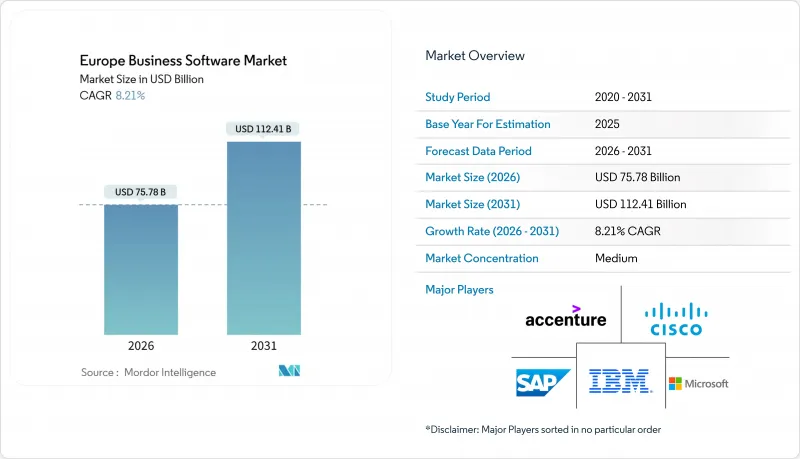
This report is Segmented by Software Type (ERP, CRM, BI and Analytics, Supply-Chain Management, and Other), Deployment Model (Cloud, and On-Premise), End-User Vertical (BFSI, Healthcare and Life Sciences, Public Sector, Retail and E-Commerce, and More), Enterprise Size (Large, Mid-Sized, and Small), and Geography. Market Forecasts are Provided in Terms of Value (USD).
Europe Business Software Market Trends and Insights
Cloud-First Shift Across European Mid-Market Firms
Recovery and Resilience Facility grants are lowering capital barriers, allowing mid-sized enterprises to decommission aging servers and adopt subscription licenses. Eurofound and Cedefop found in 2025 that 73% of small and medium-sized enterprises had reached basic digital intensity, yet regional disparities persist, especially in Southern Europe. United Kingdom studies suggest that a 1% productivity uplift from digital tools could add GBP 94 billion (USD 119 billion) to GDP, encouraging policymakers to underwrite CTO-as-a-service programs. PwC reported that 94% of organizations plan to redesign cloud architecture to reflect geopolitical realities. Hyperscaler revenue is therefore climbing, yet German and French enterprises increasingly trial sovereign platforms from OVHcloud and Scaleway to keep sensitive data inside the bloc. Because only one-third of European firms have migrated more than half of their workloads, a substantial runway remains for workload re-platforming.
AI-Enabled Decisioning Embedded in ERP and SCM Suites
Generative AI is moving from pilot to production across core business suites, trimming cycle times and reducing manual effort. SAP infused Business AI into S/4HANA, while Microsoft launched Copilot inside Dynamics 365 Supply Chain Management, claiming up to 30% forecast-error reductions. BCG estimates that generative models can cut ERP implementation labour by 20-40%. Oracle, Salesforce, and regional vendors are racing to match these capabilities, shifting buyer expectations so that predictive analytics becomes a baseline requirement. European manufacturers are early adopters, using AI-driven visibility tools to offset semiconductor shortages; Apollo Tyres' European division saved GBP 9.2 million (USD 11.7 million) through route optimization. Vendors unable to release credible AI roadmaps risk commoditization as procurement teams bake intelligent automation into request-for-proposal templates.
Unresolved EU-Wide Skills Shortage in Low-Code Platforms
The European Commission reported that 77% of enterprises struggled to hire ICT specialists in 2024, hindering low-code uptake despite the promise of citizen development. Only 54% of the population has basic digital skills, while advanced competencies such as API design and cybersecurity remain scarcer. OECD analysis of Czech SMEs showed just 16% invest in ICT training, a pattern mirrored across several Central and Eastern European markets. This talent gap bifurcates the market: large enterprises deploy low-code to accelerate backlog reduction, whereas mid-market firms remain stuck at proof-of-concept. Vendors are responding with academy programs, but progress is slow, placing a drag on license growth forecasts.
Other drivers and restraints analyzed in the detailed report include:
- EU Data Act Spurring SaaS Analytics Modernization
- Green-Taxonomies Driving ESG Reporting Module Uptake
- Mounting Sovereignty Concerns over US-Hosted SaaS
For complete list of drivers and restraints, kindly check the Table Of Contents.
Segment Analysis
Enterprise resource planning applications accounted for 34.19% of 2025 revenue, confirming their role as the transactional backbone for finance, procurement, and human capital across Europe Business Software market deployments. Business intelligence and analytics suites are poised to record the fastest 9.43% CAGR, helped by EU Data Act mandates that require open data models and the proliferation of agent-based dashboarding. Vendors are embedding natural language interfaces and predictive logic that surface insights without manual SQL, which shortens decision loops for line-of-business managers.
In the decision stack, customer relationship management remains crucial, especially in financial services, while supply chain management gains urgency as manufacturers localize sourcing to manage geopolitical risk. The Europe Business Software market size for emerging niches such as environmental, social, and governance reporting has grown rapidly following the Corporate Sustainability Reporting Directive, giving pure-play providers an entry wedge. Competitive positioning is shifting toward composable architectures, allowing customers to assemble best-of-breed combinations from SAP, Microsoft, Salesforce, and a growing roster of mid-market specialists.
Cloud installations comprised 72.34% of total revenue in 2025, and the segment is likely to outpace overall Europe Business Software market growth at a 9.85% CAGR through 2031. Hyperscalers are expanding data-center footprints from Dublin to Warsaw, ensuring sub-20-millisecond latency for most users. Yet sovereignty clauses in public tenders oblige providers to guarantee in-region processing and European legal jurisdiction, spawning a new tier of protected instances that balance compliance and innovation.
On-premises remains relevant for critical infrastructure, defense, and certain bank workloads, but even these users are adopting containerized platforms that can shift between private and public environments. Multi-cloud configurations dominate architecture roadmaps, giving enterprises flexibility to arbitrage pricing and resilience. As reserved-instance contracts proliferate, finance teams are sharpening FinOps practices to limit unbudgeted consumption, moderating the Europe Business Software market share gains of hyperscalers but solidifying cloud as the default deployment choice.
Complete Report Scope:
- By Software Type
- ERP Software
- CRM Software
- BI and Analytics Software
- Supply-Chain Management Software
- Other Software Type
- By Deployment Model
- Cloud
- On-premise
- By End-User Vertical
- BFSI
- Healthcare and Life Sciences
- Public Sector and Institutions
- Retail and E-commerce
- Transportation and Logistics
- Manufacturing and Industrials
- Telecom and Media
- By Enterprise Size
- Large Enterprises
- Mid-sized
- Small Businesses
- By Country
- United Kingdom
- Germany
- France
- Italy
- Spain
- Rest of Europe
List of Companies Covered in this Report:
- SAP SE
- Oracle Corporation
- Microsoft Corporation
- Salesforce, Inc.
- International Business Machines Corporation
- The Sage Group plc
- Infor Global Solutions, LLC
- IFS AB
- Unit4 N.V.
- Epicor Software Corporation
- Workday, Inc.
- Dassault Systemes SE
- Siemens Aktiengesellschaft
- Software AG
- QlikTech International AB
- Tableau Software, LLC
- HubSpot, Inc.
- Zoho Corporation
- Odoo S.A.
- Litmos, LLC
- Pipedrive OU
- Kinaxis Inc.
- Manhattan Associates, Inc.
- WiseTech Global Limited
- TOTVS Labs Europe Ltd.
Additional Benefits:
- The market estimate (ME) sheet in Excel format
- 3 months of analyst support
TABLE OF CONTENTS
1 INTRODUCTION
- 1.1 Study Assumptions and Market Definition
- 1.2 Scope of the Study
2 RESEARCH METHODOLOGY
3 EXECUTIVE SUMMARY
4 MARKET LANDSCAPE
- 4.1 Market Overview
- 4.2 Market Drivers
- 4.2.1 Cloud-First Shift Across European Mid-Market Firms
- 4.2.2 AI-Enabled Decisioning Embedded in ERP and SCM Suites
- 4.2.3 Post-BREXIT Compliance Push for Multi-Entity Finance Suites
- 4.2.4 EU Data Act Spurring SaaS Analytics Modernization
- 4.2.5 Green-Taxonomies Driving ESG Reporting Modules Uptake
- 4.2.6 Manufacturing Renaissance Funds (IPCEI) Favouring Vertical ERP
- 4.3 Market Restraints
- 4.3.1 Unresolved EU-Wide Skills Shortage in Low-Code Platforms
- 4.3.2 Mounting Sovereignty Concerns over US-Hosted SaaS
- 4.3.3 Fragmented VAT Regimes Complicating Multi-Country Rollouts
- 4.3.4 Rising Total-Cost-of-Ownership for Hyperscaler Consumption
- 4.4 Industry Value-Chain Analysis
- 4.5 Regulatory Landscape
- 4.6 Technological Outlook
- 4.7 Impact of Macroeconomic Factors on the Market
- 4.8 Porter's Five Forces Analysis
- 4.8.1 Bargaining Power of Buyers
- 4.8.2 Bargaining Power of Suppliers
- 4.8.3 Threat of New Entrants
- 4.8.4 Threat of Substitutes
- 4.8.5 Intensity of Competitive Rivalry
5 MARKET SIZE AND GROWTH FORECASTS (VALUE)
- 5.1 By Software Type
- 5.1.1 ERP Software
- 5.1.2 CRM Software
- 5.1.3 BI and Analytics Software
- 5.1.4 Supply-Chain Management Software
- 5.1.5 Other Software Type
- 5.2 By Deployment Model
- 5.2.1 Cloud
- 5.2.2 On-premise
- 5.3 By End-User Vertical
- 5.3.1 BFSI
- 5.3.2 Healthcare and Life Sciences
- 5.3.3 Public Sector and Institutions
- 5.3.4 Retail and E-commerce
- 5.3.5 Transportation and Logistics
- 5.3.6 Manufacturing and Industrials
- 5.3.7 Telecom and Media
- 5.4 By Enterprise Size
- 5.4.1 Large Enterprises
- 5.4.2 Mid-sized
- 5.4.3 Small Businesses
- 5.5 By Country
- 5.5.1 United Kingdom
- 5.5.2 Germany
- 5.5.3 France
- 5.5.4 Italy
- 5.5.5 Spain
- 5.5.6 Rest of Europe
6 COMPETITIVE LANDSCAPE
- 6.1 Market Concentration
- 6.2 Strategic Moves
- 6.3 Market Share Analysis
- 6.4 Company Profiles (includes Global Level Overview, Market Level Overview, Core Segments, Financials as Available, Strategic Information, Market Rank/Share for Key Companies, Products and Services, and Recent Developments)
- 6.4.1 SAP SE
- 6.4.2 Oracle Corporation
- 6.4.3 Microsoft Corporation
- 6.4.4 Salesforce, Inc.
- 6.4.5 International Business Machines Corporation
- 6.4.6 The Sage Group plc
- 6.4.7 Infor Global Solutions, LLC
- 6.4.8 IFS AB
- 6.4.9 Unit4 N.V.
- 6.4.10 Epicor Software Corporation
- 6.4.11 Workday, Inc.
- 6.4.12 Dassault Systemes SE
- 6.4.13 Siemens Aktiengesellschaft
- 6.4.14 Software AG
- 6.4.15 QlikTech International AB
- 6.4.16 Tableau Software, LLC
- 6.4.17 HubSpot, Inc.
- 6.4.18 Zoho Corporation
- 6.4.19 Odoo S.A.
- 6.4.20 Litmos, LLC
- 6.4.21 Pipedrive OU
- 6.4.22 Kinaxis Inc.
- 6.4.23 Manhattan Associates, Inc.
- 6.4.24 WiseTech Global Limited
- 6.4.25 TOTVS Labs Europe Ltd.
7 MARKET OPPORTUNITIES AND FUTURE OUTLOOK
- 7.1 White-Space and Unmet-Need Assessment

