PUBLISHER: Mordor Intelligence | PRODUCT CODE: 2125334

PUBLISHER: Mordor Intelligence | PRODUCT CODE: 2125334
Gear Pumps - Market Share Analysis, Industry Trends & Statistics, Growth Forecasts (2026 - 2031)
According to Mordor Intelligence, the gear pumps market size is expected to grow from USD 4.9 billion in 2025 to USD 5.04 billion in 2026 and is forecast to reach USD 5.82 billion by 2031 at 2.93% CAGR over 2026-2031.
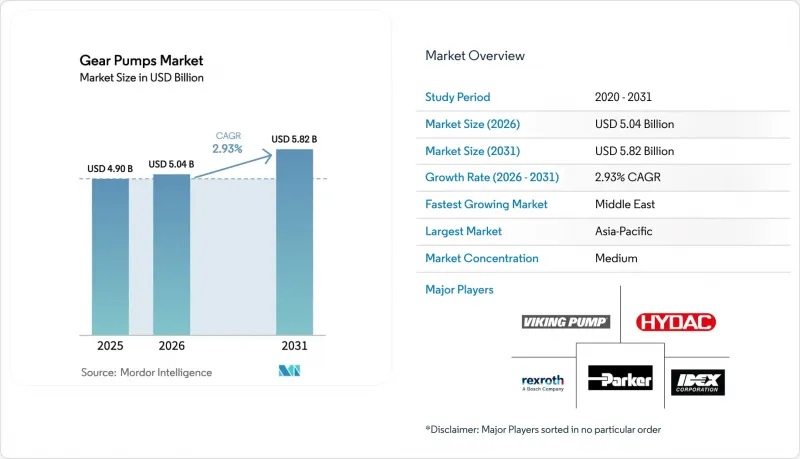
This report is Segmented by Type (External Gear Pump, and Internal Gear Pump), Material (Cast Iron, Stainless Steel, and More), End-User Industry (Oil and Gas, Chemical, Food and Beverage, Pharmaceutical, Power Generation, and More), Displacement (Fixed Displacement, and Variable Displacement), and Geography (North America, Europe, Asia Pacific, and More). The Market Forecasts are Provided in Terms of Value (USD).
Global Gear Pumps Market Trends and Insights
Increasing Demand from Oil and Gas Upstream Projects
Rebounding capital spending across unconventional shale and offshore plays is driving orders for high-pressure external gear pumps that can withstand abrasive drilling muds and aggressive fracturing fluids. Floating production, storage, and offloading vessels rely on robust hydraulic packages, which maintain high reliability requirements. Drillers specify advanced surface treatments and tighter tolerances to prolong service life in corrosive, high-temperature wells, driving continued design upgrades.
Rapid Capacity Expansion in Petrochemical Complexes
Asia-Pacific's multi-billion-dollar cracker and polymer projects dominate global capacity additions, each requiring hundreds of specialty gear pumps for catalyst circulation, polymer transfer, and metering duties. Local content policies in China and preferential financing in the Middle East further stimulate demand, while U.S. Gulf Coast debottlenecking secures a secondary growth stream.
Volatility in Industrial Capex Cycles
Boom-and-bust investment patterns in energy, mining, and chemicals result in uneven project backlogs, which tax production planning and cash-flow management. Inflationary raw material spikes and lengthening lead times add further uncertainty, prompting suppliers to hold larger inventories and offer more flexible delivery schedules.
Other drivers and restraints analyzed in the detailed report include:
- Shift Toward Modular Hydraulic Systems in Mobile Machinery
- Electrification of Off-Highway Equipment Requires Silent Hydraulic Sources
- Growing Penetration of Screw and Vane Pumps in High-Viscosity Duties
For complete list of drivers and restraints, kindly check the Table Of Contents.
Segment Analysis
External gear pumps accounted for 61.78% of the gear pumps market in 2025, reflecting superior pressure capability above 3,000 psi and robust tolerance of contaminated fluids. Fixed-tooth geometry simplifies machining and lowers service costs, sustaining dominance in drilling, fracturing, and heavy manufacturing. Internal gear pumps, although smaller in share, advance at a 4.55% CAGR due to their higher volumetric efficiency and quiet, pulse-free delivery. The gear pumps market size for internal variants is set to widen as food, pharma, and fine-chemical operators demand sanitary, low-noise performance.
Pharmaceutical facilities are increasingly specifying crevice-free internal designs in 316L stainless steel to comply with hygiene regulations. Parker Hannifin's FDA-compliant series exemplifies this pivot, pairing magnetic drives with polished internals for CIP-compatible transfer duties. External units retain primacy in the oil and gas industry, where rugged metallurgy and field-service familiarity often trump noise or efficiency. Aerospace OEMs, however, are exploring compact internal pumps to reduce weight and power draw in next-generation flight control systems.
Cast iron accounted for 50.88% of 2025 revenue due to its low cost, proven machinability, and ample mechanical strength in non-corrosive applications. The gear pumps market size derived from cast iron applications spans industrial hydraulics, drilling mud circulation, and general factory service. Stainless steel, projected to grow at a 4.01% annual rate, is capturing adoption across bioprocess, dairy, and specialty chemicals, where corrosion or hygiene drives total cost of ownership. Duplex alloys are gaining a foothold in offshore topside packages, striking a balance between resistance and price.
Material upgrades track stricter validation demands, especially FDA 21 CFR Part 11 electronic record requirements that favor stainless units to reduce cleaning protocol complexity. Cast iron's share endures in rugged mobile machines, where abrasion and impact, not corrosion, govern lifecycle economics. Hybrid assemblies that combine cast iron housings with stainless gears offer a compromise for mid-tier chemical plants pursuing incremental upgrades.
Complete Report Scope:
- By Type
- External Gear Pumps
- Internal Gear Pumps
- By Material
- Cast Iron
- Stainless Steel
- Other Materials
- By End-User Industry
- Oil and Gas
- Chemical
- Food and Beverage
- Pharmaceutical
- Power Generation
- Other End-User Industries
- By Displacement
- Fixed Displacement
- Variable Displacement
- By Geography
- North America
- United States
- Canada
- Mexico
- Europe
- Germany
- United Kingdom
- France
- Russia
- Rest of Europe
- Asia-Pacific
- China
- Japan
- India
- South Korea
- Australia
- Rest of Asia-Pacific
- Middle East and Africa
- Middle East
- Saudi Arabia
- United Arab Emirates
- Rest of Middle East
- Africa
- South Africa
- Egypt
- Rest of Africa
- Middle East
- South America
- Brazil
- Argentina
- Rest of South America
- North America
Geography Analysis
Asia-Pacific's 35.29% share underscores its role as the center of gravity for petrochemical, electronics, and heavy equipment manufacturing. Large-scale projects in China's coastal industrial zones and India's new dedicated freight corridors underpin a steady pipeline of hydraulic installations. Southeast Asian nations attract factory relocations from higher-cost locales, further expanding the installed base of smaller gear pumps. Government incentives for clean energy, including solar wafer fabs and battery plants, introduce new hygienic and chemical-resistant pump requirements.
The Middle East is projected to record a 3.41% CAGR, driven by USD 20 billion in petrochemical investments under Saudi Vision 2030, which will demand corrosion-resistant gear pumps for ethylene, polyethylene, and specialty chemical units. The UAE aims to establish itself as a regional manufacturing hub, commissioning aluminum, steel, and modular housing factories that utilize decentralized hydraulic networks. Qatar's harbor expansions and industrial cities require robust construction machinery equipped with high-pressure external pumps.
North America and Europe remain mature yet innovative. U.S. shale drillers order abrasion-tolerant pumping packages while embracing predictive maintenance sensors that feed real-time data to cloud platforms. European regulations on noise and efficiency are pushing OEMs toward variable, low-decibel designs, thereby bolstering R&D. Germany's machine builders are embedding smart gear pumps into automated lines, aligning with the country's Industry 4.0 blueprint.
- Bosch Rexroth AG
- Parker-Hannifin Corporation
- Hydac International GmbH
- Viking Pump, Inc.
- IDEX Corporation
- Haight Pump Company, Inc.
- Danfoss A/S
- Kawasaki Heavy Industries Ltd.
- Bailey International, LLC
- Flowserve Corporation
- Albany Pumps Ltd.
- Sumitomo Heavy Industries, Ltd.
- Eaton Corporation plc
- Bucher Hydraulics GmbH
- Marzocchi Pompe S.p.A.
- Yuken Kogyo Co., Ltd.
- Liquiflo Equipment Corporation
- Cascon, Inc.
Additional Benefits:
- The market estimate (ME) sheet in Excel format
- 3 months of analyst support
TABLE OF CONTENTS
1 INTRODUCTION
- 1.1 Study Assumptions and Market Definition
- 1.2 Scope of the Study
2 RESEARCH METHODOLOGY
3 EXECUTIVE SUMMARY
4 MARKET LANDSCAPE
- 4.1 Market Overview
- 4.2 Market Drivers
- 4.2.1 Increasing Demand from Oil and Gas Upstream Projects
- 4.2.2 Rapid Capacity Expansion in Petrochemical Complexes
- 4.2.3 Shift Toward Modular Hydraulic Systems in Mobile Machinery
- 4.2.4 Electrification of Off-Highway Equipment Requires Silent Hydraulic Sources
- 4.2.5 Smart Factory Adoption Driving Predictive-Maintenance Retrofit Pumps
- 4.2.6 Transition to Bio-Based Hydraulic Fluids Necessitates Compatible Gear Pumps
- 4.3 Market Restraints
- 4.3.1 Volatility in Industrial Capex Cycles
- 4.3.2 Growing Penetration of Screw and Vane Pumps in High-Viscosity Duties
- 4.3.3 Stricter Energy-Efficiency Regulations for Continuous-Duty Motors
- 4.3.4 Supply Chain Disruptions in Specialty Alloy Castings
- 4.4 Industry Value Chain Analysis
- 4.5 Regulatory Landscape
- 4.6 Technological Outlook
- 4.7 Porter's Five Forces Analysis
- 4.7.1 Bargaining Power of Suppliers
- 4.7.2 Bargaining Power of Buyers
- 4.7.3 Threat of New Entrants
- 4.7.4 Threat of Substitutes
- 4.7.5 Intensity of Competitive Rivalry
- 4.8 Impact of Macroeconomic Factors
5 MARKET SIZE AND GROWTH FORECASTS (VALUE)
- 5.1 By Type
- 5.1.1 External Gear Pumps
- 5.1.2 Internal Gear Pumps
- 5.2 By Material
- 5.2.1 Cast Iron
- 5.2.2 Stainless Steel
- 5.2.3 Other Materials
- 5.3 By End-User Industry
- 5.3.1 Oil and Gas
- 5.3.2 Chemical
- 5.3.3 Food and Beverage
- 5.3.4 Pharmaceutical
- 5.3.5 Power Generation
- 5.3.6 Other End-User Industries
- 5.4 By Displacement
- 5.4.1 Fixed Displacement
- 5.4.2 Variable Displacement
- 5.5 By Geography
- 5.5.1 North America
- 5.5.1.1 United States
- 5.5.1.2 Canada
- 5.5.1.3 Mexico
- 5.5.2 Europe
- 5.5.2.1 Germany
- 5.5.2.2 United Kingdom
- 5.5.2.3 France
- 5.5.2.4 Russia
- 5.5.2.5 Rest of Europe
- 5.5.3 Asia-Pacific
- 5.5.3.1 China
- 5.5.3.2 Japan
- 5.5.3.3 India
- 5.5.3.4 South Korea
- 5.5.3.5 Australia
- 5.5.3.6 Rest of Asia-Pacific
- 5.5.4 Middle East and Africa
- 5.5.4.1 Middle East
- 5.5.4.1.1 Saudi Arabia
- 5.5.4.1.2 United Arab Emirates
- 5.5.4.1.3 Rest of Middle East
- 5.5.4.2 Africa
- 5.5.4.2.1 South Africa
- 5.5.4.2.2 Egypt
- 5.5.4.2.3 Rest of Africa
- 5.5.4.1 Middle East
- 5.5.5 South America
- 5.5.5.1 Brazil
- 5.5.5.2 Argentina
- 5.5.5.3 Rest of South America
- 5.5.1 North America
6 COMPETITIVE LANDSCAPE
- 6.1 Market Concentration
- 6.2 Strategic Moves
- 6.3 Market Share Analysis
- 6.4 Company Profiles (includes Global level Overview, Market level overview, Core Segments, Financials as available, Strategic Information, Market Rank/Share for key companies, Products and Services, and Recent Developments)
- 6.4.1 Bosch Rexroth AG
- 6.4.2 Parker-Hannifin Corporation
- 6.4.3 Hydac International GmbH
- 6.4.4 Viking Pump, Inc.
- 6.4.5 IDEX Corporation
- 6.4.6 Haight Pump Company, Inc.
- 6.4.7 Danfoss A/S
- 6.4.8 Kawasaki Heavy Industries Ltd.
- 6.4.9 Bailey International, LLC
- 6.4.10 Flowserve Corporation
- 6.4.11 Albany Pumps Ltd.
- 6.4.12 Sumitomo Heavy Industries, Ltd.
- 6.4.13 Eaton Corporation plc
- 6.4.14 Bucher Hydraulics GmbH
- 6.4.15 Marzocchi Pompe S.p.A.
- 6.4.16 Yuken Kogyo Co., Ltd.
- 6.4.17 Liquiflo Equipment Corporation
- 6.4.18 Cascon, Inc.
7 MARKET OPPORTUNITIES AND FUTURE OUTLOOK
- 7.1 White-Space and Unmet-Need Assessment

