PUBLISHER: Mordor Intelligence | PRODUCT CODE: 2125355

PUBLISHER: Mordor Intelligence | PRODUCT CODE: 2125355
Metal Powder - Market Share Analysis, Industry Trends & Statistics, Growth Forecasts (2026 - 2031)
According to Mordor Intelligence, the metal powder market size is projected to expand from USD 7.21 billion in 2025 and USD 7.52 billion in 2026 to USD 9.53 billion by 2031, registering a CAGR of 4.86% between 2026 to 2031.
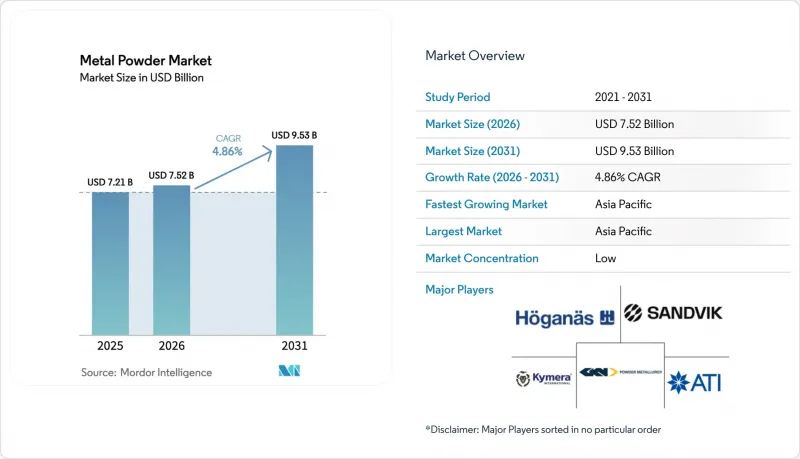
This report is Segmented by Type (Iron, Bronze, and More), Process (Atomization, Reduction of Compounds, Electrolysis, and Other Processes), Manufacturing Method (Press and Sinter, Metal Injection Molding, and More), End-User Industry (Transportation, Electrical and Electronics, Medical, and More), and Geography (Asia-Pacific, North America, and More). The Market Forecasts are Provided in Terms of Value (USD).
Global Metal Powder Market Trends and Insights
Surge in Automotive and Aerospace Lightweighting Programs
Automotive and aerospace manufacturers are increasingly turning to powder metallurgy for components like gears, connecting rods, brackets, and hydraulic manifolds. This shift not only reduces the mass of vehicles and aircraft but also leads to significant cuts in lifecycle emissions and fuel consumption. For instance, General Motors has integrated press-and-sinter gears into its Ultium electric-vehicle platform, achieving a reduction in component mass while retaining fatigue life over 200,000 cycles. Similarly, Airbus has adopted aluminum-silicon powder brackets for its A320neo, resulting in a weight reduction and a significant reduction in lead times. These achievements have paved the way for multi-year powder supply contracts, tightening atomization capacity. Consequently, prices for aerospace-grade aluminum powder are projected to rise in 2025. With regulatory pressures from CAFE and Euro 7 pushing for lightweighting, powder suppliers holding aerospace certifications stand to gain margin premiums, a privilege not extended to commodity iron-powder vendors.
Rapid Industrialization of Binder-Jet Additive Manufacturing
Desktop Metal's P-50 system has propelled binder-jet technology from mere prototyping to full-scale serial production. This advancement allows automotive suppliers to competitively price their offerings, matching the cost-efficiency of metal-injection molding for unit batches. In a significant endorsement, GE Aerospace has approved binder-jet titanium for its RISE engine program, noting a sintered density surpassing wrought materials. While the demand for powder is increasingly leaning towards a highly spherical titanium feedstock, a bottleneck emerges: a scarcity of high-temperature vacuum furnaces is extending lead times to a year. This situation is advantageous for vertically integrated firms that possess both powder and sintering capabilities.
Respiratory and Explosion Hazards in Nano-Scale Production
In January 2025, OSHA mandated enclosed handling and live particulate monitoring for powders smaller than 10 µm. This requirement has raised compliance costs significantly for each production line. Meanwhile, European ATEX regulations are pushing smaller producers away from nano-powder lines due to the high costs of retrofitting for explosion-proof electrics and inert-gas blanketing. Following a series of dust explosions in 2024, insurance premiums have increased. This spike has led to a concentration of supply among integrated players, who can spread the burden of safety investments across their broader portfolios.
Other drivers and restraints analyzed in the detailed report include:
- Electronics Densification Driving Ultra-Fine Powder Demand
- Rise of Hydrogen-Based DRI Routes Creating High-Purity Fe Powders
- Energy-Intensive Atomization Undermining Sustainability Metrics
For complete list of drivers and restraints, kindly check the Table Of Contents.
Segment Analysis
Iron accounted for a 44.08% share in 2025, reflecting its role in high-volume gears, bearings, and structural components, but commoditization continues to suppress margins. "Other Types" are forecast to grow 5.85% annually as orthopedic and dental implants, hypersonic systems, and semiconductor thermal-management parts demand ultra-clean powders. Iron suppliers hedge margin risk by capturing vehicular electrification volumes in EV battery trays, while premium-alloy producers secure long-term take-or-pay contracts with medical and defense customers that insulate pricing.
Atomization delivered 69.79% of the metal powder market share in 2025 because decades of investment locked in low-cost production for press-and-sinter iron and aluminum powders. "Other Processes" will expand at a 5.38% CAGR through 2031 as fluidized-bed electrolysis and hydrogen reduction slash energy use and accept lower-grade ores, tightening the metal powder market size cost gap versus traditional atomization. Atomization incumbents leverage scale, captive scrap, and tolling deals with automotive tier-ones, yet they invest in plasma and hydrogen-plasma upgrades to defend share. Electrochemical challengers focus on titanium, copper, and nickel powders for electronics and aerospace, where purity and morphology command premiums, avoiding head-on volume battles until cost parity approaches at smaller batch sizes. Competitive intensity, therefore, pivots on energy economics and feedstock flexibility rather than throughput alone.
Complete Report Scope:
- Type
- Iron
- Bronze
- Aluminum
- Silicon
- Nickel
- Other Types (Titanium, etc.)
- Process
- Atomization
- Reduction of Compounds
- Electrolysis
- Other Processes (Hydrometallurgical Routes, etc.)
- Manufacturing Method
- Press and Sinter (Conventional PM)
- Metal Injection Molding
- Additive Manufacturing/3D Printing
- Other Methods (Hot Isostatic Pressing, etc.)
- End-User Industry
- Transportation
- Electrical and Electronics
- Medical
- Chemical and Metallurgical
- Defense
- Construction
- Other End-User Industries (Additive Manufacturing Service Bureaus, etc.)
- Geography
- Asia-Pacific
- China
- India
- Japan
- South Korea
- Thailand
- Indonesia
- Vietnam
- Malaysia
- Philippines
- Rest of Asia-Pacific
- North America
- United States
- Canada
- Mexico
- Europe
- Germany
- United Kingdom
- France
- Italy
- Spain
- Russia
- NORDIC Countries
- Turkey
- Rest of Europe
- South America
- Brazil
- Argentina
- Colombia
- Rest of South America
- Middle-East and Africa
- Saudi Arabia
- United Arab Emirates
- Qatar
- South Africa
- Nigeria
- Egypt
- Rest of Middle-East and Africa
- Asia-Pacific
Geography Analysis
Asia-Pacific held 44.26% of the metal powder market share in 2025 and is projected to post the fastest 5.48% CAGR to 2031. This growth is largely fueled by initiatives in China and India, notably in hydrogen-DRI production and the expansion of electric vehicle platforms. Chinese industry leader Baowu is reaping significant cost advantages over Western counterparts by seamlessly integrating upstream sponge iron with water-atomization. Meanwhile, India's Production-Linked Incentive (PLI) scheme unveiled a significant boost in press-and-sinter capacity in 2025. Both Japan and South Korea have carved a niche, specializing in ultra-fine copper and silver powders tailored for multilayer ceramic capacitors, solidifying their export dominance in the Americas and Europe.
North America accounted for a substantial portion of the 2025 market volume, propelled by robust demand from the aerospace, defense, and electric vehicle sectors. Domestic titanium-powder production lines received a boost from Title III grants, while the Inflation Reduction Act's advanced-manufacturing credit is driving green-powder production, essential for EV motors and wind turbine gearboxes. Leveraging its hydropower advantage, Quebec's cluster is positioning giants like Rio Tinto Metal Powders and Tekna as prime low-carbon suppliers to both the U.S. and Europe.
Europe, holding a significant share of the market in 2025, faced growth constraints due to stagnant light-vehicle output. However, the region found momentum in scope-3 decarbonization incentives, which favor low-CO2 powders. Companies like Hoganas and Metalysis are racing ahead, fast-tracking hydrogen-plasma and electrolysis technologies, eyeing market leadership as CBAM tariffs push import prices higher. Meanwhile, smaller atomizers in Germany and Italy are honing in on aerospace and luxury tooling powders, strategically safeguarding their profit margins. Though South America and the Middle-East and Africa collectively account for a smaller portion of the market, there's potential for growth, especially with Brazil's automotive ambitions and Saudi Arabia's push towards renewables and hydrogen-DRI strategies.
- Advanced Technology & Materials Co., Ltd.
- Alcoa Corporation
- ATI
- Aubert & Duval
- BASF
- CNPC Powder
- CRS Holdings, LLC.
- Erasteel
- GKN Powder Metallurgy
- H.C. Starck Tungsten GmbH
- Hitachi High-Tech India Private Limited
- Hoganas AB
- JFE Steel Corporation
- Kymera International
- Linde Plc
- Metalysis Ltd.
- Outokumpu
- Polema
- Rio Tinto Metal Powders
- Sandvik AB
- Seiko Epson Corporation
- Tekna
- Valimet
Additional Benefits:
- The market estimate (ME) sheet in Excel format
- 3 months of analyst support
TABLE OF CONTENTS
1 Introduction
- 1.1 Study Assumptions and Market Definition
- 1.2 Scope of the Study
2 Research Methodology
3 Executive Summary
4 Market Landscape
- 4.1 Market Overview
- 4.2 Market Drivers
- 4.2.1 Surge in automotive and aerospace light-weighting programs
- 4.2.2 Rapid industrialisation of binder-jet additive manufacturing
- 4.2.3 Electronics densification driving ultra-fine powder demand
- 4.2.4 Rise of hydrogen-based DRI routes creating high-purity Fe powders
- 4.2.5 Defense-grade refractory alloys for hypersonic systems
- 4.3 Market Restraints
- 4.3.1 Respiratory and explosion hazards in nano-scale production
- 4.3.2 Quality drift in recycled feedstock streams
- 4.3.3 Energy-intensive atomisation impacting sustainability metrics
- 4.4 Value Chain Analysis
- 4.5 Porter's Five Forces
- 4.5.1 Bargaining Power of Suppliers
- 4.5.2 Bargaining Power of Buyers
- 4.5.3 Threat of New Entrants
- 4.5.4 Threat of Substitutes
- 4.5.5 Degree of Competition
5 Market Size and Growth Forecasts (Value)
- 5.1 Type
- 5.1.1 Iron
- 5.1.2 Bronze
- 5.1.3 Aluminum
- 5.1.4 Silicon
- 5.1.5 Nickel
- 5.1.6 Other Types (Titanium, etc.)
- 5.2 Process
- 5.2.1 Atomization
- 5.2.2 Reduction of Compounds
- 5.2.3 Electrolysis
- 5.2.4 Other Processes (Hydrometallurgical Routes, etc.)
- 5.3 Manufacturing Method
- 5.3.1 Press and Sinter (Conventional PM)
- 5.3.2 Metal Injection Molding
- 5.3.3 Additive Manufacturing/3D Printing
- 5.3.4 Other Methods (Hot Isostatic Pressing, etc.)
- 5.4 End-User Industry
- 5.4.1 Transportation
- 5.4.2 Electrical and Electronics
- 5.4.3 Medical
- 5.4.4 Chemical and Metallurgical
- 5.4.5 Defense
- 5.4.6 Construction
- 5.4.7 Other End-User Industries (Additive Manufacturing Service Bureaus, etc.)
- 5.5 Geography
- 5.5.1 Asia-Pacific
- 5.5.1.1 China
- 5.5.1.2 India
- 5.5.1.3 Japan
- 5.5.1.4 South Korea
- 5.5.1.5 Thailand
- 5.5.1.6 Indonesia
- 5.5.1.7 Vietnam
- 5.5.1.8 Malaysia
- 5.5.1.9 Philippines
- 5.5.1.10 Rest of Asia-Pacific
- 5.5.2 North America
- 5.5.2.1 United States
- 5.5.2.2 Canada
- 5.5.2.3 Mexico
- 5.5.3 Europe
- 5.5.3.1 Germany
- 5.5.3.2 United Kingdom
- 5.5.3.3 France
- 5.5.3.4 Italy
- 5.5.3.5 Spain
- 5.5.3.6 Russia
- 5.5.3.7 NORDIC Countries
- 5.5.3.8 Turkey
- 5.5.3.9 Rest of Europe
- 5.5.4 South America
- 5.5.4.1 Brazil
- 5.5.4.2 Argentina
- 5.5.4.3 Colombia
- 5.5.4.4 Rest of South America
- 5.5.5 Middle-East and Africa
- 5.5.5.1 Saudi Arabia
- 5.5.5.2 United Arab Emirates
- 5.5.5.3 Qatar
- 5.5.5.4 South Africa
- 5.5.5.5 Nigeria
- 5.5.5.6 Egypt
- 5.5.5.7 Rest of Middle-East and Africa
- 5.5.1 Asia-Pacific
6 Competitive Landscape
- 6.1 Market Concentration
- 6.2 Strategic Moves
- 6.3 Market Share(%)/Ranking Analysis
- 6.4 Company Profiles (includes Global level Overview, Market level overview, Core Segments, Financials as available, Strategic Information, Products and Services, Recent Developments)
- 6.4.1 Advanced Technology & Materials Co., Ltd.
- 6.4.2 Alcoa Corporation
- 6.4.3 ATI
- 6.4.4 Aubert & Duval
- 6.4.5 BASF
- 6.4.6 CNPC Powder
- 6.4.7 CRS Holdings, LLC.
- 6.4.8 Erasteel
- 6.4.9 GKN Powder Metallurgy
- 6.4.10 H.C. Starck Tungsten GmbH
- 6.4.11 Hitachi High-Tech India Private Limited
- 6.4.12 Hoganas AB
- 6.4.13 JFE Steel Corporation
- 6.4.14 Kymera International
- 6.4.15 Linde Plc
- 6.4.16 Metalysis Ltd.
- 6.4.17 Outokumpu
- 6.4.18 Polema
- 6.4.19 Rio Tinto Metal Powders
- 6.4.20 Sandvik AB
- 6.4.21 Seiko Epson Corporation
- 6.4.22 Tekna
- 6.4.23 Valimet
7 Market Opportunities and Future Outlook
- 7.1 White-space and Unmet-Need Assessment
- 7.2 Increasing Developments in Healthcare Industries

