PUBLISHER: Mordor Intelligence | PRODUCT CODE: 2125361

PUBLISHER: Mordor Intelligence | PRODUCT CODE: 2125361
Clinical Trial Supply - Market Share Analysis, Industry Trends & Statistics, Growth Forecasts (2026 - 2031)
According to Mordor Intelligence, the clinical trial supply market size was valued at USD 4.31 billion in 2025 and is estimated to grow from USD 4.60 billion in 2026 to reach USD 6.73 billion by 2031, at a CAGR of 7.92% during the forecast period (2026-2031).
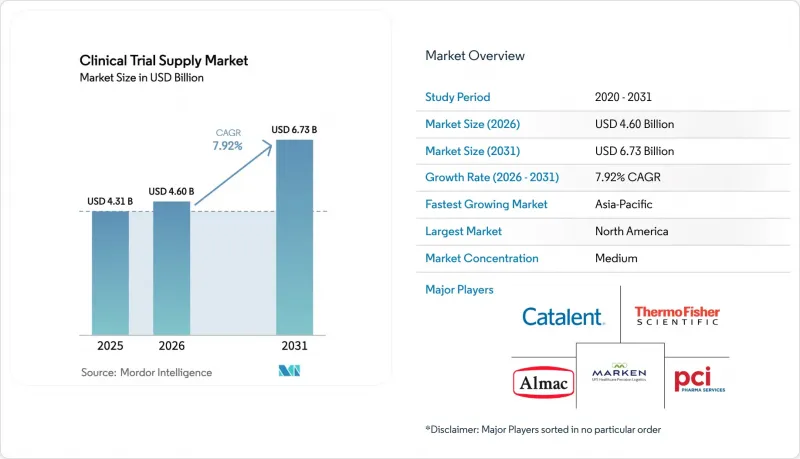
This report is Segmented by Service (Logistics & Distribution, Storage & Retention, Packaging, Labelling & Blinding, Manufacturing, and More), Phase (Bioavailability / Bioequivalence, and More), Therapeutic Area (Cardiovascular Diseases, and More), End User (Pharmaceutical Companies, and More), and Geography (North America, and More). The Market Forecasts are Provided in Terms of Value (USD).
Global Clinical Trial Supply Market Trends and Insights
Increasing Volume of Phase III Multicountry Trials
Final FDA guidance on electronic common technical document (eCTD) submissions, issued in January 2025, has cut duplicate paperwork and shortened review cycles by roughly 15%. Sponsors now consolidate packaging and labeling in regional hubs to manage divergent language and artwork needs while still keeping end-to-end inventory visibility through cloud-based randomization and trial supply management platforms. Oncology and rare-disease programs frequently span 20-plus countries, pushing demand for logistics partners skilled at cross-border comparator sourcing. The EMA's Clinical Trials Information System, operational since early 2025, lets a single application cover all 27 EU member states, further amplifying the need for scale and harmonized quality processes. These shifts enlarge shipment volumes, increase depot touchpoints, and elevate revenue opportunities across the clinical trial supply market.
Expansion of Decentralized & Direct-To-Patient Logistics Models
May 2024 FDA guidance formally endorsed home delivery of investigational products under rigorous risk controls, accelerating deployment of direct-to-patient models. Sponsors report 30% faster enrollment and 25% lower screen-failure rates when travel burdens drop, leading to earlier submissions and faster commercialization. Couriers now offer ambient, refrigerated, and frozen lanes with GPS tracking and electronic proof of delivery, while blockchain logs ensure immutable audit trails compliant with 21 CFR Part 11 and EU Annex 11. Adoption has been strongest in chronic cardiovascular, respiratory, and central-nervous-system trials whose treatments lend themselves to home administration. As a result, last-mile expertise is becoming a premium service line within the clinical trial supply market.
Rising Cross-Border Regulatory Divergence Inflating Compliance Costs
China's NMPA began pre-approval audits of overseas packaging plants in June 2024, adding 8-12 weeks to study start-up timelines. Brazil's ANVISA followed in March 2025 with rules demanding local-formulation comparators, forcing sponsors to run duplicate supply chains. A 2025 multi-sponsor survey found regulatory compliance costs for a 15-country Phase III trial had climbed 19% since 2022, eroding margins and stretching project calendars. Maintaining multiple labeling versions and quality-control tests drains resources across the clinical trial supply market.
Other drivers and restraints analyzed in the detailed report include:
- Growth in Temperature-Sensitive Biologics & ATMP Pipelines
- AI-Driven Demand Forecasting Reducing Overage & Waste
- Persistent Temperature-Excursion Losses in Emerging Markets
For complete list of drivers and restraints, kindly check the Table Of Contents.
Segment Analysis
Manufacturing, while smaller in absolute value than logistics, is projected to outpace the overall clinical trial supply market with a 9.32% CAGR through 2031, reflecting deeper reliance on contract development and manufacturing organizations for fill-finish, lyophilization, and comparator procurement. In 2025 logistics and distribution retained 29.65% of revenue, underscoring the sector's foundational role in moving investigational medicinal products between global nodes. Packaging, labeling, and blinding remain indispensable, particularly for double-blind cardiovascular and CNS studies, and automation is reducing release-cycle times. Storage and retention track overall growth as regulators stretch stability obligations. Supply-chain forecasting services are carving a new niche by cutting overage; a 2025 European case study logged a 22% inventory reduction, spotlighting AI as a differentiator.
The comparator sourcing is poised for premium pricing because regulators now insist that reference batches match local formulations, especially in Latin America. The rise of cell and gene therapies is accelerating demand for cryogenic fill-finish and just-in-time packaging close to infusion centers. Providers earning ISO 13485 alongside GMP enjoy an edge when supporting drug-device combination trials, extending their influence within the clinical trial supply market size envelope.
Phase III dominated 41.24% of 2025 value due to large patient cohorts and long study durations, yet Phase II is forecast to post a 10.72% CAGR to 2031, the highest among phases, as adaptive enrichment strategies compress development timelines. The FDA's Project Optimus mandates explorations of multiple dose levels in oncology Phase II trials, multiplying SKU counts and requiring flexible depots. Bioavailability and bioequivalence remain niche but stable, serving generic entrants. Phase I's modest volumes stem from tight cohort sizes and on-site manufacturing. Phase IV studies, tied to post-marketing safety, are expanding gradually, ensuring sustained if slower demand.
Adaptive designs often demand mid-study drug transfer between arms, a capability best served by providers with real-time visibility into site inventory. As a result, logistics partners offering granular tracking and rapid resupply are winning new Phase II contracts and broadening their clinical trial supply market share.
Complete Report Scope:
- By Service
- Logistics & Distribution
- Storage & Retention
- Packaging, Labelling & Blinding
- Manufacturing
- Comparator Sourcing
- Supply-Chain Management / Forecasting
- By Phase
- Bioavailability / Bioequivalence
- Phase I
- Phase II
- Phase III
- Phase IV / Post-Marketing
- By Therapeutic Area
- Cardiovascular Diseases
- Oncology
- Respiratory Diseases
- CNS & Mental Disorders
- Infectious Diseases
- Rare & Orphan Disorders
- By End User
- Pharmaceutical Companies
- Biologics / Biotech Companies
- Contract Research Organisations (CROs & CDMOs)
- Medical-Device Companies
- By Geography
- North America
- United States
- Canada
- Mexico
- Europe
- Germany
- France
- United Kingdom
- Italy
- Spain
- Rest of Europe
- Asia-Pacific
- China
- Japan
- India
- South Korea
- Australia
- Rest of Asia-Pacific
- Middle East & Africa
- GCC
- South Africa
- Rest of Middle East & Africa
- South America
- Brazil
- Argentina
- Rest of South America
- North America
Geography Analysis
North America generated 35.77% of 2025 revenue, anchored by dense site networks, mature depots, and pioneering FDA decentralized-trial guidance that accelerates direct-to-patient pilots in oncology and rare diseases. Canada and Mexico benefit from near-shoring; 40% of U.S. sponsors shifted some packaging to Mexico by 2025 to offset tariff risk. Labor shortages in GMP packaging and quality assurance inflate costs and lengthen timelines, particularly in Mid-Atlantic and Midwest hubs, prompting automation investments.
Asia-Pacific is projected to post a 9.44% CAGR to 2031, the fastest regional climb. China's conditional-approval pathway and India's expansion of GMP-certified facilities pull late-stage studies eastward. Japan aligned eCTD rules with ICH M8 in 2025, allowing seamless global dossiers. South Korea and Australia capture cardiovascular and metabolic trials via co-funding incentives. Nevertheless, cold-chain gaps in Southeast Asia keep excursion rates high; 11% of shipments breached temperature limits in a 2024 study.
Europe leverages the EMA's centralized application system to streamline multicountry studies and remains a powerhouse for large cardiovascular and respiratory trials. Spain and Italy are winning share because of lower per-patient costs, while Germany, France, and the U.K. retain leadership in complex oncology protocols. The Middle East is building temperature-controlled hubs in Dubai and Riyadh, positioning the Gulf as a springboard into North Africa. South America's contribution is smaller, yet Brazil and Argentina offer genetically diverse populations and cost advantages, making them attractive for large Phase III cardiovascular programs despite comparator-sourcing hurdles under ANVISA's 2025 rules.
- Almac Group
- Biocair International
- Catalent
- DHL Global Forwarding / Life Sciences
- Eurofins
- FedEx HealthCare Logistics
- ICON
- IQVIA Supply Chain Services
- KLIFO A/S
- Lonza Group
- Marken (UPS Healthcare)
- Movianto (Yusen Logistics)
- Myonex
- N-SIDE
- Parexel International
- PCI Pharma Services
- Piramal Group
- Sharp Services LLC
- Thermo Fisher Scientific (Patheon)
- World Courier ( Cencora)
Additional Benefits:
- The market estimate (ME) sheet in Excel format
- 3 months of analyst support
TABLE OF CONTENTS
1 Introduction
- 1.1 Study Assumptions & Market Definition
- 1.2 Scope of the Study
2 Research Methodology
3 Executive Summary
4 Market Landscape
- 4.1 Market Overview
- 4.2 Market Drivers
- 4.2.1 Increasing Volume of Phase III Multicountry Trials
- 4.2.2 Expansion of Decentralized & Direct-To-Patient Logistics Models
- 4.2.3 Growth in Temperature-Sensitive Biologics & ATMP Pipelines
- 4.2.4 AI-Driven Demand Forecasting Reducing Overage & Waste
- 4.2.5 Tariff-Driven Near-Shoring of Packaging and Depot Networks
- 4.2.6 Sustainability & ESG Mandates Driving Adoption of Reusable, Low-Carbon Packaging
- 4.3 Market Restraints
- 4.3.1 Rising Cross-Border Regulatory Divergence Inflating Compliance Costs
- 4.3.2 Persistent Temperature-Excursion Losses in Emerging Markets
- 4.3.3 Skilled-Labor Shortages in GMP Packaging & QA Functions
- 4.3.4 Cyber-Security Risks to IRT / RTSM Platforms
- 4.4 Value / Supply-Chain Analysis
- 4.5 Regulatory Landscape
- 4.6 Technological Outlook
- 4.7 Porter's Five Forces Analysis
- 4.7.1 Threat of New Entrants
- 4.7.2 Bargaining Power of Suppliers
- 4.7.3 Bargaining Power of Buyers
- 4.7.4 Threat of Substitutes
- 4.7.5 Intensity of Competitive Rivalry
5 Market Size & Growth Forecasts (Value in USD)
- 5.1 By Service
- 5.1.1 Logistics & Distribution
- 5.1.2 Storage & Retention
- 5.1.3 Packaging, Labelling & Blinding
- 5.1.4 Manufacturing
- 5.1.5 Comparator Sourcing
- 5.1.6 Supply-Chain Management / Forecasting
- 5.2 By Phase
- 5.2.1 Bioavailability / Bioequivalence
- 5.2.2 Phase I
- 5.2.3 Phase II
- 5.2.4 Phase III
- 5.2.5 Phase IV / Post-Marketing
- 5.3 By Therapeutic Area
- 5.3.1 Cardiovascular Diseases
- 5.3.2 Oncology
- 5.3.3 Respiratory Diseases
- 5.3.4 CNS & Mental Disorders
- 5.3.5 Infectious Diseases
- 5.3.6 Rare & Orphan Disorders
- 5.4 By End User
- 5.4.1 Pharmaceutical Companies
- 5.4.2 Biologics / Biotech Companies
- 5.4.3 Contract Research Organisations (CROs & CDMOs)
- 5.4.4 Medical-Device Companies
- 5.5 By Geography
- 5.5.1 North America
- 5.5.1.1 United States
- 5.5.1.2 Canada
- 5.5.1.3 Mexico
- 5.5.2 Europe
- 5.5.2.1 Germany
- 5.5.2.2 France
- 5.5.2.3 United Kingdom
- 5.5.2.4 Italy
- 5.5.2.5 Spain
- 5.5.2.6 Rest of Europe
- 5.5.3 Asia-Pacific
- 5.5.3.1 China
- 5.5.3.2 Japan
- 5.5.3.3 India
- 5.5.3.4 South Korea
- 5.5.3.5 Australia
- 5.5.3.6 Rest of Asia-Pacific
- 5.5.4 Middle East & Africa
- 5.5.4.1 GCC
- 5.5.4.2 South Africa
- 5.5.4.3 Rest of Middle East & Africa
- 5.5.5 South America
- 5.5.5.1 Brazil
- 5.5.5.2 Argentina
- 5.5.5.3 Rest of South America
- 5.5.1 North America
6 Competitive Landscape
- 6.1 Market Concentration
- 6.2 Market Share Analysis
- 6.3 Company Profiles (includes Global level Overview, Market level overview, Core Segments, Financials as available, Strategic Information, Market Rank/Share for key companies, Products and Services, and Recent Developments)
- 6.3.1 Almac Group
- 6.3.2 Biocair International
- 6.3.3 Catalent Inc.
- 6.3.4 DHL Global Forwarding / Life Sciences
- 6.3.5 Eurofins Scientific
- 6.3.6 FedEx HealthCare Logistics
- 6.3.7 ICON plc
- 6.3.8 IQVIA Supply Chain Services
- 6.3.9 KLIFO A/S
- 6.3.10 Lonza Group
- 6.3.11 Marken (UPS Healthcare)
- 6.3.12 Movianto (Yusen Logistics)
- 6.3.13 Myonex
- 6.3.14 N-SIDE
- 6.3.15 Parexel International
- 6.3.16 PCI Pharma Services
- 6.3.17 Piramal Pharma Solutions
- 6.3.18 Sharp Services LLC
- 6.3.19 Thermo Fisher Scientific (Patheon)
- 6.3.20 World Courier ( Cencora)
7 Market Opportunities & Future Outlook
- 7.1 White-space & Unmet-Need Assessment

