PUBLISHER: Mordor Intelligence | PRODUCT CODE: 2125369

PUBLISHER: Mordor Intelligence | PRODUCT CODE: 2125369
Packaging Machinery - Market Share Analysis, Industry Trends & Statistics, Growth Forecasts (2026 - 2031)
According to Mordor Intelligence, the packaging machinery market size in 2026 is estimated at USD 76.03 billion, growing from 2025 value of USD 72.25 billion with 2031 projections showing USD 98.12 billion, growing at 5.23% CAGR over 2026-2031.
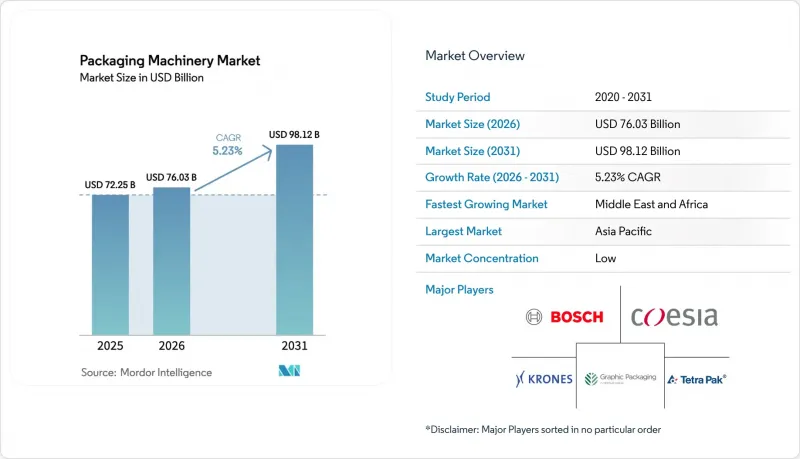
This report is Segmented by Machine Type (Filling and Dosing, Labelling Decorating and Coding, and More), Automation Level (Manual, and More), End-User Industry (Food, Beverages, Pharmaceuticals, and More), Technology Platform (General Packaging Conventional, Modified Atmosphere Packaging MAP, and More), and Geography. The Market Forecasts are Provided in Terms of Value USD.
Global Packaging Machinery Market Trends and Insights
Expansion of Flexibles and Pouch Formats Driving High-Speed Filling Lines
Flexible pack formats are spreading from snacks to beverages, forcing brand owners to install faster horizontal and vertical form-fill-seal platforms. New models such as Mespack's UHS Performa deliver higher uptime and lower film waste, trimming unit costs while improving sustainability targets. Suppliers are embedding film-splicing modules that sustain continuous motion to raise overall equipment effectiveness. In APAC, consumer goods makers favor pouches to reach rural markets with lightweight packs that lower freight expenses. North American beverage firms are testing spouted pouches to differentiate premium juices, spurring demand for hygienic, high-speed dosing heads that handle viscous products.
Rapid Shift to Sustainable Paper-Based Packs in Europe Necessitating New Cartoning Technologies
Europe's Packaging and Packaging Waste Regulation, effective February 2025, pushes companies to replace plastic secondary packs with recyclable paper structures. The transition has triggered a wave of cartoner retrofits that manage thinner board grades without compromising seal integrity. Diageo's 90% paper bottle for Johnnie Walker validates strong brand interest in fiber solutions that cut carbon emissions nearly 47%. OEMs are refining blank handling systems, gluing stations, and vision-guided quality checks to ensure mono-material cartons reach line speeds equal to legacy plastic formats. The paper shift is cascading to North America as retailers adopt similar eco-scorecards for suppliers.
Surge in Stainless-Steel Prices Inflating Capital Cost of High-Hygiene Machinery
Nickel price volatility has pushed stainless-steel quotes toward the upper USD 700-800 per ton range, squeezing margins on wash-down fillers, aseptic blocs, and pharma lines. OEMs are redesigning frames with hybrid alloys and strategic reinforcement to curb weight without sacrificing rigidity. Some buyers delay purchase decisions, opting for refurbishments until metal markets stabilize. European suppliers hedge costs with long-term steel contracts but pass a portion to customers through surcharges. The inflationary effect is most severe for dairy and infant-formula plants that must meet 316L specs.
Other drivers and restraints analyzed in the detailed report include:
- E-commerce "Ship-in-Own-Container" Adoption Boosting End-of-Line Automation in North America
- Rising Need for Integrated Packaging Solutions
- Lengthy IQ/OQ Validation Cycles Slowing Pharma Equipment Orders in USA
For complete list of drivers and restraints, kindly check the Table Of Contents.
Segment Analysis
In 2025, filling and dosing equipment accounted for 20.08% of packaging machinery market share, underscoring its indispensability across food, beverage, and pharma lines. Cartoning units, however, are advancing at a 7.56% CAGR, benefitting from Europe's shift to paper formats and e-commerce demand for robust secondary packs. GEA's compact thermoforming cartoner for SMEs highlights how suppliers target smaller plants with plug-and-play solutions. Cartoners now include servo-controlled blank feeders that handle recycled board with high dimensional variability. Meanwhile, the packaging machinery market size linked to labelling and coding systems is expanding steadily as traceability rules tighten.
The blister, thermoforming, and vacuum equipment niche focuses on barrier-enhancing films that lengthen shelf life for meat and ready meals. Bottling line demand remains resilient, driven by premium water and functional drinks growth. Palletizing systems gain traction from warehouse automation programs that favor end-of-line robotic cells over manual stretch-wrap turntables. Upgrades in wrapping and bundling machines center on variable-format technology that optimizes film usage, aligning with sustainability targets.
Fully automatic and robotics-integrated lines captured 55.12% of packaging machinery market size in 2025 and will compound at 7.78% through 2031. Rapid payback stems from labor savings, higher OEE, and improved hygiene. Pharmaceutical vial handling illustrates the benefits - TM Robotics' QPack-1 processes 7,200 vials per hour versus 2,000 in manual set-ups, cutting contamination risks. Semi-automatic lines remain relevant where producers phase upgrades in stages or manage short runs. Manual stations persist in artisanal or low-volume operations across Africa and parts of Southeast Asia. Robotics adoption is also spreading to case packing and palletizing, where vision-guided pick heads enable mixed-SKU layering.
Driven by labor shortages, the packaging machinery market is witnessing a boom in user-friendly programming suites that allow rapid recipe changes without coding knowledge. Predictive maintenance analytics further reduce unplanned downtime, pushing many operators to retrofit legacy machines with sensor kits before committing to full line replacements.
Complete Report Scope:
- By Machine Type
- Filling and Dosing
- Labelling, Decorating, and Coding
- Case Handling
- Bottling Line
- Cartoning
- Palletizing and Depalletizing
- Wrapping and Bundling
- Blister / Thermoforming / Skin / Vacuum Packaging
- Other Machine Type
- By Automation Level
- Manual
- Semi-Automatic
- Fully Automatic / Robotics-Integrated
- By End-User Industry
- Food
- Beverages
- Pharmaceuticals
- Cosmetics and Personal Care
- Industrial Chemicals
- Other End-use Industry
- By Technology Platform
- General Packaging (Conventional)
- Modified Atmosphere Packaging (MAP)
- Vacuum Packaging
- Aseptic Packaging Lines
- Intelligent / Connected (QR / RFID-Enabled) Packaging Lines
- By Geography
- North America
- United States
- Canada
- Mexico
- Europe
- Germany
- United Kingdom
- France
- Italy
- Spain
- Russia
- Rest of Europe
- Asia-Pacific
- China
- India
- Japan
- South Korea
- Australia and New Zealand
- Rest of Asia-Pacific
- Middle East and Africa
- Middle East
- United Arab Emirates
- Saudi Arabia
- Turkey
- Rest of Middle East
- Africa
- South Africa
- Nigeria
- Egypt
- Rest of Africa
- Middle East
- South America
- Brazil
- Argentina
- Rest of South America
- North America
Geography Analysis
Asia Pacific accounted for 45.72% of packaging machinery market share in 2025, propelled by China's scale and India's rising packaged-goods consumption. Regional suppliers displayed over 2,500 automation exhibits at ProPak China 2025, showcasing AI-driven inspection and logistics integration. Japan and South Korea contribute high-precision robotics, while Indonesia hosts new flexible packaging plants that serve regional snack and noodle brands. The packaging machinery market size in Asia Pacific is further backed by government incentives for smart manufacturing and Industry 4.0 adoption.
The Middle East and Africa record the fastest 6.08% CAGR through 2031 as Saudi Arabia, Egypt, and South Africa localize beverage and dairy processing. Sidel's agreement with Saudi stakeholders illustrates state-supported moves to reduce import dependence. Nonetheless, chronic power outages in parts of Sub-Saharan Africa raise operating costs, prompting producers to install solar arrays and energy-efficient motors. Equipment vendors partner with local integrators to navigate import duties and service challenges.
North America retains strong demand due to e-commerce fulfillment centers investing in end-of-line automation. U.S. shipments climbed 5.8% in 2023 to USD 10.9 billion, reflecting sustained capital replacement cycles. Canada's food processors adopt robotic case packers to offset labor shortages, while Mexico attracts investment from multinational beverage firms establishing regional hubs. Europe focuses on sustainability compliance, driving high uptake of recyclable-ready cartoners and mono-material pouch lines. South America shows growth pockets in Brazil and Colombia, though skills shortages in robot programming slow adoption among smaller converters.
- Tetra Laval Group (Sidel, Tetra Pak)
- Krones AG
- Coesia S.p.A.
- Syntegon Technology GmbH
- IMA Group S.p.A.
- Barry-Wehmiller Companies Inc.
- MULTIVAC Group
- Ishida Co. Ltd.
- SACMI Imola SC
- Graphic Packaging International LLC
- Marchesini Group S.p.A.
- Aetna Group (ROBOPAC)
- ABB Ltd. (Robotics Packaging)
- Fanuc Corp.
- ProMach Inc.
- Bradman Lake Ltd.
- Signode Industrial Group
- KHS GmbH
- Mitsubishi Electric Corp. (Palletizers)
- FUJI MACHINERY CO.,LTD.
- Sidel Group
- Optima Packaging Group
- PacTech Holdings
- Echo Machinery
- Herma GmbH (Labelling)
Additional Benefits:
- The market estimate (ME) sheet in Excel format
- 3 months of analyst support
TABLE OF CONTENTS
1 INTRODUCTION
- 1.1 Study Assumptions and Market Definition
- 1.2 Scope of the Study
2 RESEARCH METHODOLOGY
3 EXECUTIVE SUMMARY
4 MARKET LANDSCAPE
- 4.1 Market Overview
- 4.2 Market Drivers
- 4.2.1 Expansion of Flexibles and Pouch Formats Driving High-Speed Filling Lines
- 4.2.2 Rapid Shift to Sustainable Paper-Based Packs in Europe Necessitating New Cartoning Technologies
- 4.2.3 E-commerce "Ship-in-Own-Container" Adoption Boosting End-of-Line Automation in North America
- 4.2.4 Rising Need For Integrated Packaging Solutions
- 4.2.5 Pharma Serialization Mandates (EU-FMD, DSCSA) Fueling Global Labelling and Coding Upgrades
- 4.3 Market Restraints
- 4.3.1 Surge in Stainless-Steel Prices Inflating Capital Cost of High-Hygiene Machinery
- 4.3.2 Lengthy IQ/OQ Validation Cycles Slowing Pharma Equipment Orders in U.S.
- 4.3.3 Skill-Gaps in Robot Programming Hindering SME Automation in LATAM
- 4.3.4 Power Reliability Issues Elevating Operating Costs for African Bottlers
- 4.4 Supply-Chain Analysis
- 4.5 Regulatory Outlook
- 4.6 Porter's Five Forces Analysis
- 4.6.1 Bargaining Power of Suppliers
- 4.6.2 Bargaining Power of Buyers
- 4.6.3 Threat of New Entrants
- 4.6.4 Threat of Substitutes
- 4.6.5 Intensity of Competitive Rivalry
5 MARKET SIZE AND GROWTH FORECASTS (VALUE)
- 5.1 By Machine Type
- 5.1.1 Filling and Dosing
- 5.1.2 Labelling, Decorating, and Coding
- 5.1.3 Case Handling
- 5.1.4 Bottling Line
- 5.1.5 Cartoning
- 5.1.6 Palletizing and Depalletizing
- 5.1.7 Wrapping and Bundling
- 5.1.8 Blister / Thermoforming / Skin / Vacuum Packaging
- 5.1.9 Other Machine Type
- 5.2 By Automation Level
- 5.2.1 Manual
- 5.2.2 Semi-Automatic
- 5.2.3 Fully Automatic / Robotics-Integrated
- 5.3 By End-User Industry
- 5.3.1 Food
- 5.3.2 Beverages
- 5.3.3 Pharmaceuticals
- 5.3.4 Cosmetics and Personal Care
- 5.3.5 Industrial Chemicals
- 5.3.6 Other End-use Industry
- 5.4 By Technology Platform
- 5.4.1 General Packaging (Conventional)
- 5.4.2 Modified Atmosphere Packaging (MAP)
- 5.4.3 Vacuum Packaging
- 5.4.4 Aseptic Packaging Lines
- 5.4.5 Intelligent / Connected (QR / RFID-Enabled) Packaging Lines
- 5.5 By Geography
- 5.5.1 North America
- 5.5.1.1 United States
- 5.5.1.2 Canada
- 5.5.1.3 Mexico
- 5.5.2 Europe
- 5.5.2.1 Germany
- 5.5.2.2 United Kingdom
- 5.5.2.3 France
- 5.5.2.4 Italy
- 5.5.2.5 Spain
- 5.5.2.6 Russia
- 5.5.2.7 Rest of Europe
- 5.5.3 Asia-Pacific
- 5.5.3.1 China
- 5.5.3.2 India
- 5.5.3.3 Japan
- 5.5.3.4 South Korea
- 5.5.3.5 Australia and New Zealand
- 5.5.3.6 Rest of Asia-Pacific
- 5.5.4 Middle East and Africa
- 5.5.4.1 Middle East
- 5.5.4.1.1 United Arab Emirates
- 5.5.4.1.2 Saudi Arabia
- 5.5.4.1.3 Turkey
- 5.5.4.1.4 Rest of Middle East
- 5.5.4.2 Africa
- 5.5.4.2.1 South Africa
- 5.5.4.2.2 Nigeria
- 5.5.4.2.3 Egypt
- 5.5.4.2.4 Rest of Africa
- 5.5.4.1 Middle East
- 5.5.5 South America
- 5.5.5.1 Brazil
- 5.5.5.2 Argentina
- 5.5.5.3 Rest of South America
- 5.5.1 North America
6 COMPETITIVE LANDSCAPE
- 6.1 Market Concentration
- 6.2 Strategic Moves
- 6.3 Market Share Analysis
- 6.4 Company Profiles (includes Global level Overview, Market level overview, Core Segments, Financials as available, Strategic Information, Market Rank/Share for key companies, Products and Services, and Recent Developments)
- 6.4.1 Tetra Laval Group (Sidel, Tetra Pak)
- 6.4.2 Krones AG
- 6.4.3 Coesia S.p.A.
- 6.4.4 Syntegon Technology GmbH
- 6.4.5 IMA Group S.p.A.
- 6.4.6 Barry-Wehmiller Companies Inc.
- 6.4.7 MULTIVAC Group
- 6.4.8 Ishida Co. Ltd.
- 6.4.9 SACMI Imola SC
- 6.4.10 Graphic Packaging International LLC
- 6.4.11 Marchesini Group S.p.A.
- 6.4.12 Aetna Group (ROBOPAC)
- 6.4.13 ABB Ltd. (Robotics Packaging)
- 6.4.14 Fanuc Corp.
- 6.4.15 ProMach Inc.
- 6.4.16 Bradman Lake Ltd.
- 6.4.17 Signode Industrial Group
- 6.4.18 KHS GmbH
- 6.4.19 Mitsubishi Electric Corp. (Palletizers)
- 6.4.20 FUJI MACHINERY CO.,LTD.
- 6.4.21 Sidel Group
- 6.4.22 Optima Packaging Group
- 6.4.23 PacTech Holdings
- 6.4.24 Echo Machinery
- 6.4.25 Herma GmbH (Labelling)
7 MARKET OPPORTUNITIES AND FUTURE OUTLOOK
- 7.1 White-Space and Unmet-Need Assessment

