PUBLISHER: Mordor Intelligence | PRODUCT CODE: 2125371

PUBLISHER: Mordor Intelligence | PRODUCT CODE: 2125371
Online Racing Games - Market Share Analysis, Industry Trends & Statistics, Growth Forecasts (2026 - 2031)
According to Mordor Intelligence, the global online racing games market size was valued at USD 12.97 billion in 2025 and estimated to grow from USD 13.69 billion in 2026 to reach USD 17.92 billion by 2031, at a CAGR of 5.54% during the forecast period (2026-2031).
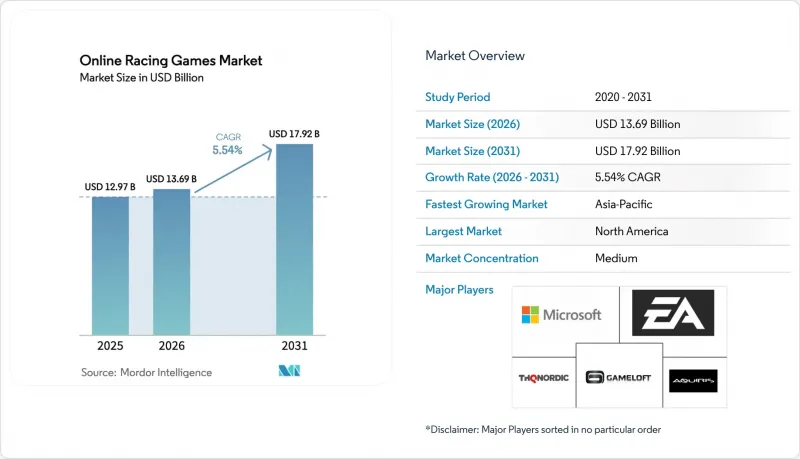
This report is Segmented by Revenue Model (Advertising-Supported, In-App Purchase, and More), Platform (Mobile, Pcs, Game Consoles, and More), Game Type (Arcade Racing, Simulation Racing, and More), Player Engagement Level (Casual/Hyper-casual, Mid-Core Competitive, and Hardcore Simulation/Esports), and Geography. The Market Forecasts are Provided in Terms of Value (USD).
Global Online Racing Games Market Trends and Insights
Smartphone and 5G Penetration Expands Low-Latency Play
Mobile-first racing titles now capitalize on sub-20 ms radio latencies that allow real-time multiplayer parity with console lobbies, eliminating the lag disadvantages that once discouraged cross-platform pools. T-Mobile's L4S deployment cut perceived latency another 40%, while Microsoft's 50 gaming data centers route compute within metropolitan reach, letting mobile drivers compete against rig-equipped PC users without physics desync. The resulting uplift in competitive integrity converts casual mobile users into repeat buyers of cosmetic items and battle-pass tiers, strengthening recurring revenue for the online racing games market. Publishers also bundle cloud-assisted rendering that off-loads physics to edge nodes, boosting frame stability on mid-range handsets and reducing hardware churn. Carriers reciprocate through zero-rating promotions that drop data fees for partnered titles, further lowering entry barriers across price-sensitive economies.
Cloud-Gaming Lowers Hardware Barriers
Streaming removes the USD 500-800 console outlay once prerequisite for authentic simulation experiences, broadening emerging-market demand and elevating lifetime value per gamer for the online racing games market.NVIDIA GeForce Now now pipes RTX 4080-level visuals to Chromebook users, while monthly infrastructure cost per active subscriber averages EUR 4.20, allowing gross margins to stay positive once adoption scales beyond 1 million users per region. Platform holders cement their reach by embedding cloud-play buttons inside digital storefronts, exemplified by Microsoft's Xbox store integration that transitions locally installed sessions to the cloud with a single click. License holders, in turn, repackage archival titles at subscription tiers, monetizing back catalogs without porting expenditures. Because rendering occurs server-side, developers decouple content updates from console generation cycles, shortening time-to-market for seasonal expansions and live-ops events.
UA Costs Surge Post-Privacy Changes
Apple's App Tracking Transparency policy stripped third-party identifiers that publishers relied on to model lifetime value, pushing iOS cost-per-install for sports and racing genres to USD 3.50, versus USD 2.50 on Android. In response, studios pivot to first-party telemetry and contextual ad buys, but ramp-up lead times inflate marketing overhead for new releases. Subscription models soften volatility yet demand continuous content drops to curb churn. GDPR compliance compounds complexity across Europe, as explicit consent gates throttle data-driven personalization that could offset UA inefficiencies, shaving 70-basis-points from the online racing games market CAGR projection through 2030.
Other drivers and restraints analyzed in the detailed report include:
- Esports Integration Boosts Engagement and Spend
- AI-Generated Tracks Cut Content Costs and Refresh Cycles
- AAA Racing Development Budgets Escalate
For complete list of drivers and restraints, kindly check the Table Of Contents.
Segment Analysis
In 2025, in-app purchases held 46.10% share of the online racing games market size, driven by cosmetic skins and performance parts that preserve competitive balance while generating dependable microtransaction revenue. Subscriptions and season passes are rising 6.64% annually, supporting predictable cash flows that sustain live-ops content teams and analytics functions. Advertising-supported formats remain viable in regions with low card penetration, yet privacy limits dampen CPMs, nudging publishers toward brand partnerships and sponsored challenges.
Segment evolution shows how value shifts from one-off sales to recurrent access. Minecraft's Marketplace Pass illustrates subscription value hinges on a steady cadence of user-generated tracks and vehicles. For simulation die-hards, premium outright purchases coexist with optional telemetry modules and coaching subscriptions, reflecting a hybrid stack of monetization tailored to engagement depth. As churn sensitivities mount, studios invest in sentiment analysis bots monitoring Discord and Reddit for early churn predictors, refining content drops that stabilize recurring revenue within the online racing games market.
Mobile accounted for 52.10% of 2025 revenue, cementing its primacy in the online racing games market. Improved SoC efficiency lets 120 fps arcade racers run on USD 200 handsets, while gyroscope steering eases onboarding for casual audiences. Concurrently, cloud-streaming clients are projected to grow at 6.78% CAGR, vaulting them from experimentation to mainstream by 2031. PC rigs preserve simulation loyalty because triple-screen cockpits and load-cell pedals remain unmatched in fidelity.
Console vendors counter attrition with cross-gen entitlements and 120 hz performance modes, yet increasingly pivot toward cloud APIs that extend their storefronts to smart TVs. VR and AR headsets add a premium strata; although volumes are nascent, attach-rate for high-ticket DLC doubles that of flatscreen cohorts. The cross-pollination of local rendering for UI and streamed physics calculations optimizes battery life on mobile, making performance parity credible and enlarging subscriber funnels for the online racing games market.
Complete Report Scope:
- By Revenue Model
- Advertising-supported
- In-App Purchase (Micro-transactions)
- Premium Purchase (Paid App / Full Game)
- Subscription / Season Pass
- By Platform
- Mobile Smartphones and Tablets
- PCs
- Game Consoles
- Cloud-Streaming Clients
- VR / AR Headsets
- By Game Type
- Arcade Racing
- Simulation Racing
- Kart and Party Racing
- Open-World / Street Racing
- MILE-style Mass Events
- By Player Engagement Level
- Casual / Hyper-casual
- Mid-core Competitive
- Hardcore Simulation / Esports
- By Geography
- North America
- United States
- Canada
- South America
- Brazil
- Argentina
- Rest of South America
- Europe
- Germany
- United Kingdom
- France
- Spain
- Russia
- Rest of Europe
- Asia Pacific
- China
- Japan
- India
- South Korea
- Rest of Asia Pacific
- Middle East and Africa
- Middle East
- Saudi Arabia
- United Arab Emirates
- Rest of Middle East
- Africa
- South Africa
- Nigeria
- Rest of Africa
- Middle East
- North America
Geography Analysis
North America retained 37.40% share in 2025, buoyed by entrenched console culture and early 5G rollouts that underpin low-latency cross-play. Publishers leverage favorable ARPPU and live-service adoption as 83% of Electronic Arts' USD 1.67 billion Q1 FY26 revenue flowed from recurring content. Canada's e-hockey fandom overlaps with racing through cross-promotions, and Mexico's mobile uptake accelerates through prepaid 5G bundles.
Asia-Pacific is the fastest-growing region at 6.18% CAGR to 2031, with China's mobile games reaching USD 86.6 billion in 2024 and racing showing resilience amid overall download softness. Japan's USD 21 ARPU motivates premium haptic-enabled releases, while South Korea's PC-bang culture hosts licensed simulation leagues. India leads in volume with 8.45 billion downloads yet lags in monetization, spurring studios to add regionalized storylines and low-SKU cosmetic tiers tailored to local payment norms.
Europe balances privacy rigor with premium spending, as GDPR compliance bolsters user trust that supports subscription uptake. Automotive OEM density in Germany, Italy, and the U.K. fuels branded content alliances, while pan-EU esports circuits add broadcast value. The Middle East and Africa witness rapid mobile adoption; youth bulges and improving fintech rails unlock new payer cohorts, albeit with localization demands on livery design and event timing to respect cultural norms. These dynamics collectively shape regional revenue trajectories for the online racing games market.
- Electronic Arts Inc.
- Codemasters Software Company Ltd.
- Tencent Holdings Ltd.
- Microsoft Corporation
- Sony Interactive Entertainment LLC
- Ubisoft Entertainment SA
- Nintendo Co. Ltd.
- Nexon Co. Ltd.
- NetEase Inc.
- Take-Two Interactive Software Inc.
- Motorsport Games Inc.
- Polyphony Digital Inc.
- Playground Games Ltd.
- THQ Nordic GmbH
- Sumo Digital Ltd.
- Gameloft SE
- Fingersoft Oy
- Boss Alien Ltd.
- NaturalMotion Ltd.
- Slightly Mad Studios Ltd.
- Vector Unit Inc.
- Aquiris Game Studio SA
- Bongfish GmbH
- iRacing.com Motorsport Simulations LLC
Additional Benefits:
- The market estimate (ME) sheet in Excel format
- 3 months of analyst support
TABLE OF CONTENTS
1 INTRODUCTION
- 1.1 Study Assumptions and Market Definition
- 1.2 Scope of the Study
2 RESEARCH METHODOLOGY
3 EXECUTIVE SUMMARY
4 MARKET LANDSCAPE
- 4.1 Market Overview
- 4.2 Market Drivers
- 4.2.1 Smartphone and 5G penetration expands low-latency play
- 4.2.2 Cloud-gaming lowers hardware barriers
- 4.2.3 Esports integration boosts engagement and spend
- 4.2.4 AI-generated tracks cut content costs and refresh cycles
- 4.2.5 VR haptics create premium immersion spend
- 4.2.6 In-game OEM brand placements add revenue streams
- 4.3 Market Restraints
- 4.3.1 UA costs surge post-privacy changes
- 4.3.2 AAA racing development budgets escalate
- 4.3.3 Latency-sensitive gameplay raises regional server costs
- 4.3.4 Fragmented IP/licensing for cars and tracks
- 4.4 Regulatory Landscape
- 4.5 Technological Outlook
- 4.6 Porter's Five Forces Analysis
- 4.6.1 Threat of New Entrants
- 4.6.2 Bargaining Power of Buyers
- 4.6.3 Bargaining Power of Suppliers
- 4.6.4 Threat of Substitutes
- 4.6.5 Intensity of Competitive Rivalry
- 4.7 Impact of Macroeconomic Factors on the Market
5 MARKET SIZE AND GROWTH FORECASTS (VALUE)
- 5.1 By Revenue Model
- 5.1.1 Advertising-supported
- 5.1.2 In-App Purchase (Micro-transactions)
- 5.1.3 Premium Purchase (Paid App / Full Game)
- 5.1.4 Subscription / Season Pass
- 5.2 By Platform
- 5.2.1 Mobile Smartphones and Tablets
- 5.2.2 PCs
- 5.2.3 Game Consoles
- 5.2.4 Cloud-Streaming Clients
- 5.2.5 VR / AR Headsets
- 5.3 By Game Type
- 5.3.1 Arcade Racing
- 5.3.2 Simulation Racing
- 5.3.3 Kart and Party Racing
- 5.3.4 Open-World / Street Racing
- 5.3.5 MILE-style Mass Events
- 5.4 By Player Engagement Level
- 5.4.1 Casual / Hyper-casual
- 5.4.2 Mid-core Competitive
- 5.4.3 Hardcore Simulation / Esports
- 5.5 By Geography
- 5.5.1 North America
- 5.5.1.1 United States
- 5.5.1.2 Canada
- 5.5.2 South America
- 5.5.2.1 Brazil
- 5.5.2.2 Argentina
- 5.5.2.3 Rest of South America
- 5.5.3 Europe
- 5.5.3.1 Germany
- 5.5.3.2 United Kingdom
- 5.5.3.3 France
- 5.5.3.4 Spain
- 5.5.3.5 Russia
- 5.5.3.6 Rest of Europe
- 5.5.4 Asia Pacific
- 5.5.4.1 China
- 5.5.4.2 Japan
- 5.5.4.3 India
- 5.5.4.4 South Korea
- 5.5.4.5 Rest of Asia Pacific
- 5.5.5 Middle East and Africa
- 5.5.5.1 Middle East
- 5.5.5.1.1 Saudi Arabia
- 5.5.5.1.2 United Arab Emirates
- 5.5.5.1.3 Rest of Middle East
- 5.5.5.2 Africa
- 5.5.5.2.1 South Africa
- 5.5.5.2.2 Nigeria
- 5.5.5.2.3 Rest of Africa
- 5.5.5.1 Middle East
- 5.5.1 North America
6 COMPETITIVE LANDSCAPE
- 6.1 Market Concentration
- 6.2 Strategic Moves
- 6.3 Market Share Analysis
- 6.4 Company Profiles (includes Global level Overview, Market level overview, Core Segments, Financials as available, Strategic Information, Market Rank/Share for key companies, Products and Services, and Recent Developments)
- 6.4.1 Electronic Arts Inc.
- 6.4.2 Codemasters Software Company Ltd.
- 6.4.3 Tencent Holdings Ltd.
- 6.4.4 Microsoft Corporation
- 6.4.5 Sony Interactive Entertainment LLC
- 6.4.6 Ubisoft Entertainment SA
- 6.4.7 Nintendo Co. Ltd.
- 6.4.8 Nexon Co. Ltd.
- 6.4.9 NetEase Inc.
- 6.4.10 Take-Two Interactive Software Inc.
- 6.4.11 Motorsport Games Inc.
- 6.4.12 Polyphony Digital Inc.
- 6.4.13 Playground Games Ltd.
- 6.4.14 THQ Nordic GmbH
- 6.4.15 Sumo Digital Ltd.
- 6.4.16 Gameloft SE
- 6.4.17 Fingersoft Oy
- 6.4.18 Boss Alien Ltd.
- 6.4.19 NaturalMotion Ltd.
- 6.4.20 Slightly Mad Studios Ltd.
- 6.4.21 Vector Unit Inc.
- 6.4.22 Aquiris Game Studio SA
- 6.4.23 Bongfish GmbH
- 6.4.24 iRacing.com Motorsport Simulations LLC
7 MARKET OPPORTUNITIES AND FUTURE OUTLOOK
- 7.1 White-space and Unmet-need Assessment

