PUBLISHER: Mordor Intelligence | PRODUCT CODE: 2125375

PUBLISHER: Mordor Intelligence | PRODUCT CODE: 2125375
Master Data Management - Market Share Analysis, Industry Trends & Statistics, Growth Forecasts (2026 - 2031)
According to Mordor Intelligence, master data management market size in 2026 is estimated at USD 21.63 billion, growing from 2025 value of USD 18.23 billion with 2031 projections showing USD 50.85 billion, growing at 18.66% CAGR over 2026-2031.
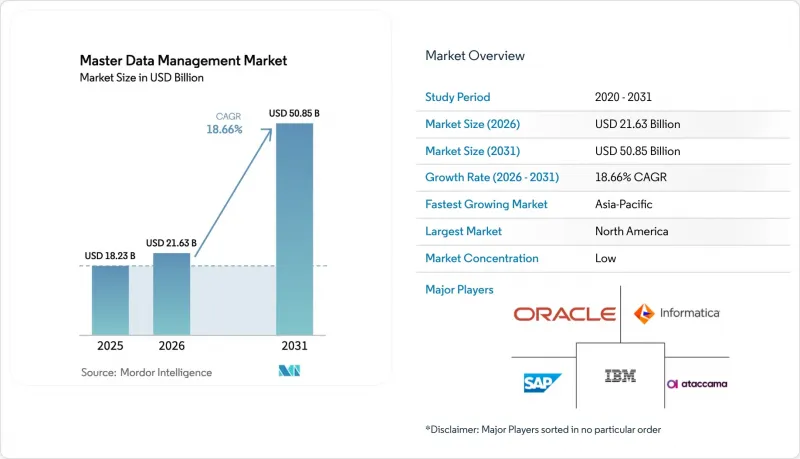
This report is Segmented by Component (Software, Service), Deployment Model (On-Premise, Cloud), Enterprise Size (Large Enterprises, Small and Medium Enterprises), Application (Supplier, Product, and More), Industry Vertical (IT and Telecommunication, BFSI, and More), Integration Pattern (Batch ETL and Mor), Cloud Deployment Type (Multi-Tenant SaaS and More) and Geography.
Global Master Data Management Market Trends and Insights
Surging Gen-AI Readiness Drives Need for High-Quality Training Data
Generative-AI projects expose the direct link between model accuracy and master data consistency. Informatica's AI-enhanced cloud processed 86 trillion transactions, helping customers cut data-program time-to-value by 40%. Healthcare and financial services adopters are blending ChatGPT-style enrichment with MDM to raise data-matching accuracy to 80%, turning data quality from a compliance checkbox into a competitive edge. Continuous validation, enrichment, and lineage tracking are therefore moving from optional add-ons to core platform requirements inside the Master Data Management market.
Regulatory Shift to Real-Time ESG Disclosures
The EU's Digital Operational Resilience Act obliges financial entities to maintain exhaustive ICT risk controls, including auditable master data governance that supports real-time ESG reporting. Traditional quarterly cycles cannot supply investors with carbon-footprint or supply-chain-ethics metrics at the required granularity, pushing enterprises toward platforms that reconcile sustainability data with the rigor of financial ledgers. Multi-jurisdictional operations must additionally accommodate differing data-sovereignty rules, complicating centralization strategies and fuelling hybrid-MDM demand.
Shortage of MDM-Skilled Data Stewards
Seventy-five percent of manufacturers reported difficulty filling data-steward roles in 2024, reflecting demand for professionals who blend domain expertise with AI and governance fluency. While automation eases repetitive cleansing, human oversight remains vital for policy definition and exception handling. Managed-service and embedded-governance offerings are therefore rising as stop-gaps, especially in emerging markets where skill pipelines lag digital-transformation ambitions.
Other drivers and restraints analyzed in the detailed report include:
- Data-Fabric & Data-Mesh Architectures Mainstreaming
- Rapid Cloud ERP Migrations in Mid-Market Firms
- Hidden Technical Debt in Legacy Source Systems
For complete list of drivers and restraints, kindly check the Table Of Contents.
Segment Analysis
Software delivered 67.42% of 2025 revenue, but services are accelerating at 19.26% CAGR, signalling that the Master Data Management market is no longer technology-first. Enterprises in healthcare and banking invest in advisory, data-architecture design, and change management to navigate complex compliance landscapes. Professional services now encompass governance framework development and cross-domain policy harmonization, extending far beyond initial system integration.
Managed-service adoption among mid-market organizations shows that outsourcing stewardship and platform operations can balance limited internal capacity with quality expectations. As vertical regulations tighten, service partners with domain credentials become pivotal to monetizing software capabilities, reinforcing a shift where value lies in sustained governance outcomes.
Cloud deployments commanded a 60.35% share in 2025 and are scaling at a 20.88% CAGR, redefining vendor selection criteria inside the Master Data Management market. Elastic scaling, automated patching, and usage-based pricing lower entry barriers, while pre-built connectors shorten time-to-insight for analytics teams.
Even highly regulated sectors now blend on-premise controls with cloud agility through containerized or SaaS edge nodes. The Master Data Management industry benefits as platforms integrate natively with cloud AI services, enabling real-time enrichment without heavyweight data-movement pipelines. Hybrid patterns thus satisfy sovereignty, latency, and economics in one architecture.
Large enterprises still hold a 63.25% share, yet SMEs are growing at a 19.74% CAGR as subscription models democratize the Master Data Management market. Smaller firms typically target single-domain wins-customer data unification or product catalog clarity-before expanding scope.
Cloud-native vendors supply template libraries and guided workflows that cut configuration effort, letting SMEs realize 15% revenue uplift and 20% lower risk exposure from better analytics. These proof points reinforce the business-case narrative that robust master data is no longer a luxury reserved for global conglomerates.
Complete Report Scope:
- By Component
- Software
- Services
- By Deployment Model
- On-premise
- Cloud
- By Enterprise Size
- Large Enterprises
- Small and Medium Enterprises
- By Application Domain
- Customer
- Product
- Supplier
- Finance and Reference Data
- Asset and Location
- By Industry Vertical
- BFSI
- Healthcare and Life Sciences
- Retail and e-Commerce
- Manufacturing
- IT and Telecom
- Government and Public Sector
- Energy and Utilities
- Others (Education, Media, etc.)
- By Integration Pattern
- Batch ETL
- Real-time/Event-driven
- API-led Micro-services
- By Cloud Deployment Type
- Multi-tenant SaaS
- Single-tenant SaaS
- Self-managed Cloud (IaaS)
- Hybrid (Cloud + On-prem)
- By Geography
- North America
- United States
- Canada
- Mexico
- South America
- Brazil
- Argentina
- Chile
- Rest of South America
- Europe
- Germany
- United Kingdom
- France
- Italy
- Spain
- Netherlands
- Russia
- Rest of Europe
- Asia-Pacific
- China
- India
- Japan
- South Korea
- ASEAN
- Rest of Asia-Pacific
- Middle East and Africa
- Middle East
- GCC (Saudi Arabia, UAE, Qatar, etc.)
- Turkey
- Rest of Middle East
- Africa
- South Africa
- Nigeria
- Kenya
- Rest of Africa
- Middle East
- North America
Geography Analysis
North America led with a 38.55% share of the Master Data Management market in 2025, supported by stringent sectoral regulations and early AI adoption. U.S. firms such as WeightWatchers streamlined 30 million client records using Oracle Customer Hub, illustrating how mature governance programs translate into lower customer-experience frictions. Canadian and Mexican enterprises are close behind, exploiting cross-border commerce and USMCA incentives to modernize data architectures.
Asia Pacific is forecast to grow at 19.14% CAGR through 2031 as data-localization mandates reshape enterprise strategies. China's rapid data-center build-out, coupled with constraints on cross-border transfers, drives demand for domestically hosted MDM solutions that interoperate with global supply-chain data . India's 2025 Digital Personal Data Protection Act draft rules intensify the focus on consent management and data-lineage transparency, prompting local firms to adopt governance-rich platforms ahead of enforcement thresholds. ASEAN's 20% data-center revenue growth signals rising capacity to support region-wide MDM rollouts
Europe maintains steady expansion under GDPR, DORA, and the incoming EU AI Act, positioning the region as a global benchmark for comprehensive data governance. Institutions such as Deutsche Borse centralized master data with SAP Master Data Governance to cut manual maintenance and accelerate product launches. Heightened enforcement actions in nations like the Netherlands propel investment in lineage-rich solutions that can evidence compliance when regulators demand audits. Hybrid architectures dominate European roadmaps, balancing sovereignty with the need to tap global cloud ecosystems.
- IBM
- SAP SE
- Oracle Corporation
- Informatica Inc.
- SAS Institute Inc.
- TIBCO Software Inc.
- Talend (Qlik)
- Ataccama
- Stibo Systems
- Profisee
- Reltio
- Semarchy
- Syndigo
- Teradata Corporation
- Riversand (Syndigo)
- Magnitude Software
- Informatica MDM Cloud
- CluedIn
- Pimcore
Additional Benefits:
- The market estimate (ME) sheet in Excel format
- 3 months of analyst support
TABLE OF CONTENTS
1 INTRODUCTION
- 1.1 Study Assumptions and Market Definition
- 1.2 Scope of the Study
2 RESEARCH METHODOLOGY
3 EXECUTIVE SUMMARY
4 MARKET LANDSCAPE
- 4.1 Market Overview
- 4.2 Market Drivers
- 4.2.1 Surging Gen-AI readiness drives need for high-quality training data
- 4.2.2 Regulatory shift to real-time ESG disclosures
- 4.2.3 Data-fabric and data-mesh architectures mainstreaming
- 4.2.4 Rapid Cloud ERP migrations in mid-market firms
- 4.2.5 Expansion of industry-specific 360-MDM SaaS (e.g., Retail, Life Sciences)
- 4.2.6 Cyber-resilience mandates for critical infrastructure (NIS2, DORA)
- 4.3 Market Restraints
- 4.3.1 Shortage of MDM-skilled data stewards
- 4.3.2 Hidden technical debt in legacy source systems
- 4.3.3 Access-control conflicts under emerging data sovereignty laws
- 4.3.4 Rising hyperscaler egress fees inflating total cost of ownership
- 4.4 Value/Supply-Chain Analysis
- 4.5 Regulatory Landscape
- 4.6 Technological Outlook
- 4.7 Porters Five Forces Analysis
- 4.7.1 Bargaining Power of Suppliers
- 4.7.2 Bargaining Power of Buyers
- 4.7.3 Threat of New Entrants
- 4.7.4 Threat of Substitutes
- 4.7.5 Intensity of Rivalry
5 MARKET SIZE AND GROWTH FORECASTS
- 5.1 By Component
- 5.1.1 Software
- 5.1.2 Services
- 5.2 By Deployment Model
- 5.2.1 On-premise
- 5.2.2 Cloud
- 5.3 By Enterprise Size
- 5.3.1 Large Enterprises
- 5.3.2 Small and Medium Enterprises
- 5.4 By Application Domain
- 5.4.1 Customer
- 5.4.2 Product
- 5.4.3 Supplier
- 5.4.4 Finance and Reference Data
- 5.4.5 Asset and Location
- 5.5 By Industry Vertical
- 5.5.1 BFSI
- 5.5.2 Healthcare and Life Sciences
- 5.5.3 Retail and e-Commerce
- 5.5.4 Manufacturing
- 5.5.5 IT and Telecom
- 5.5.6 Government and Public Sector
- 5.5.7 Energy and Utilities
- 5.5.8 Others (Education, Media, etc.)
- 5.6 By Integration Pattern
- 5.6.1 Batch ETL
- 5.6.2 Real-time/Event-driven
- 5.6.3 API-led Micro-services
- 5.7 By Cloud Deployment Type
- 5.7.1 Multi-tenant SaaS
- 5.7.2 Single-tenant SaaS
- 5.7.3 Self-managed Cloud (IaaS)
- 5.7.4 Hybrid (Cloud + On-prem)
- 5.8 By Geography
- 5.8.1 North America
- 5.8.1.1 United States
- 5.8.1.2 Canada
- 5.8.1.3 Mexico
- 5.8.2 South America
- 5.8.2.1 Brazil
- 5.8.2.2 Argentina
- 5.8.2.3 Chile
- 5.8.2.4 Rest of South America
- 5.8.3 Europe
- 5.8.3.1 Germany
- 5.8.3.2 United Kingdom
- 5.8.3.3 France
- 5.8.3.4 Italy
- 5.8.3.5 Spain
- 5.8.3.6 Netherlands
- 5.8.3.7 Russia
- 5.8.3.8 Rest of Europe
- 5.8.4 Asia-Pacific
- 5.8.4.1 China
- 5.8.4.2 India
- 5.8.4.3 Japan
- 5.8.4.4 South Korea
- 5.8.4.5 ASEAN
- 5.8.4.6 Rest of Asia-Pacific
- 5.8.5 Middle East and Africa
- 5.8.5.1 Middle East
- 5.8.5.1.1 GCC (Saudi Arabia, UAE, Qatar, etc.)
- 5.8.5.1.2 Turkey
- 5.8.5.1.3 Rest of Middle East
- 5.8.5.2 Africa
- 5.8.5.2.1 South Africa
- 5.8.5.2.2 Nigeria
- 5.8.5.2.3 Kenya
- 5.8.5.2.4 Rest of Africa
- 5.8.5.1 Middle East
- 5.8.1 North America
6 COMPETITIVE LANDSCAPE
- 6.1 Market Concentration
- 6.2 Strategic Moves
- 6.3 Market Share Analysis
- 6.4 Company Profiles (includes Global level Overview, Market level overview, Core Segments, Financials as available, Strategic Information, Market Rank/Share, Products and Services, Recent Developments)
- 6.4.1 IBM
- 6.4.2 SAP SE
- 6.4.3 Oracle Corporation
- 6.4.4 Informatica Inc.
- 6.4.5 SAS Institute Inc.
- 6.4.6 TIBCO Software Inc.
- 6.4.7 Talend (Qlik)
- 6.4.8 Ataccama
- 6.4.9 Stibo Systems
- 6.4.10 Profisee
- 6.4.11 Reltio
- 6.4.12 Semarchy
- 6.4.13 Syndigo
- 6.4.14 Teradata Corporation
- 6.4.15 Riversand (Syndigo)
- 6.4.16 Magnitude Software
- 6.4.17 Informatica MDM Cloud
- 6.4.18 CluedIn
- 6.4.19 Pimcore
7 MARKET OPPORTUNITIES AND FUTURE OUTLOOK
- 7.1 White-space and Unmet-need Assessment

