PUBLISHER: Mordor Intelligence | PRODUCT CODE: 2125380

PUBLISHER: Mordor Intelligence | PRODUCT CODE: 2125380
Application Outsourcing - Market Share Analysis, Industry Trends & Statistics, Growth Forecasts (2026 - 2031)
According to Mordor Intelligence, the application outsourcing market size is expected to grow from USD 131.22 billion in 2025 to USD 142.53 billion in 2026 and is forecast to reach USD 215.46 billion by 2031 at 8.62% CAGR over 2026-2031.
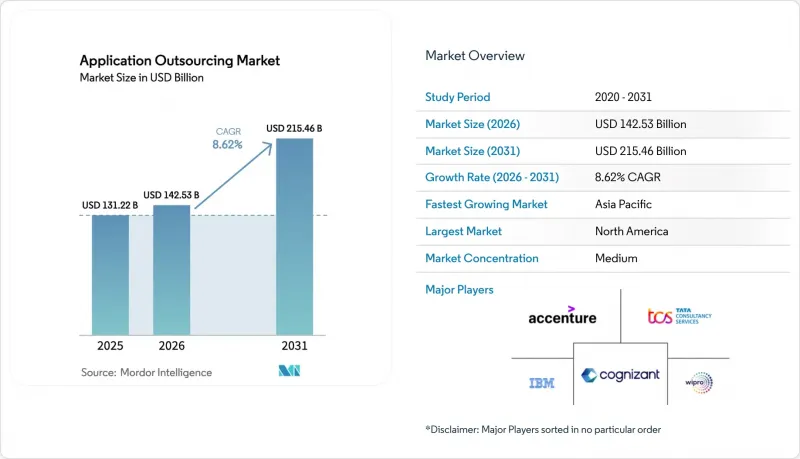
This report is Segmented by Service Type (Application Development and Integration, Application Maintenance and Support, and More), Deployment Model (On-Premise, Cloud, and Hybrid), End-User Industry (BFSI, Healthcare and Life Sciences, and More), Organisation Size (Large Enterprises and Small and Medium Enterprises), Contract Model (Fixed-Price, Time and Material, and More), and Geography.
Global Application Outsourcing Market Trends and Insights
Surging digital-transformation programmes among SMEs
SMEs now treat outsourcing as the fastest path to modern applications that improve productivity and customer reach. In the United States, 60% of smaller firms plan to outsource software builds in 2025, attracted by flexible consumption models that remove upfront capital barriers. With more than 40,000 companies worldwide generating between USD 500 million and USD 5 billion in revenue, the segment offers a USD 300-400 billion pool for service providers. Providers respond by packaging cloud-first, API-driven offerings that fit limited budgets yet scale easily. As a result, SME revenue is expected to outpace overall application outsourcing market growth through 2030.
BFSI's pivot to platform banking and open-finance APIs
Banks and insurers accelerate application spending to support embedded finance, open-API ecosystems, and cloud-native architectures. JPMorgan Chase reports that moving workloads to the cloud unlocks advanced data capabilities and cements its AI leadership. Nearly 72% of financial institutions already outsource substantial IT functions, and that intensity rises when regulatory deadlines push rapid platform changes. Providers with domain knowledge in risk, compliance, and payments integration gain a competitive edge as BFSI contributes the single largest slice of the application outsourcing market.
Rising compliance costs for cross-border data transfer
Tighter data-sovereignty rules such as GDPR, CCPA, and sector-specific mandates force enterprises to redesign delivery models and sometimes split workloads by region. Legal counsel warns that non-compliance fines and remediation can offset labor arbitrage gains. Providers answer with regional cloud zones and nearshore centers, yet extra encryption, audit, and transfer-impact assessments still raise project costs and slow deal cycles.
Other drivers and restraints analyzed in the detailed report include:
- Cloud-native application demand for AI/ML workloads
- Cost-optimisation pressure post-2022 tech-margin squeeze
- Talent attrition and wage inflation in offshore hotspots
For complete list of drivers and restraints, kindly check the Table Of Contents.
Segment Analysis
Application Maintenance & Support contributed USD 40.49 billion in 2025, translating to 30.85% of the overall application outsourcing market. Long-running ERP, CRM, and supply-chain platforms still require dependable uptime and incremental upgrades, which keeps steady demand for managed services. Yet rising zero-day exploits and regulatory fines move security from an ancillary service into a growth engine.
Application Security Services expand at 12.61% CAGR as boards elevate cyber risk. Enterprises prefer external specialists who combine code-scanning tools with 24X7 SOC talent. As a result, the application outsourcing market size for security projects is forecast to climb sharply, while maintenance's share slowly contracts. Development, integration, modernization, and testing services round out the portfolio, with 92% of firms planning some level of legacy refactoring before 2030.
Cloud deployments own 56.35% of 2025 revenue, equivalent to USD 73.96 billion, underscoring how subscription infrastructure and automated scaling now define modernization roadmaps. Enterprises moving analytics, digital commerce, and collaboration workloads to the cloud create the largest single contributor to the application outsourcing market.
Hybrid models rise at a 9.81% CAGR because regulated industries cannot abandon on-premises systems overnight. Providers deliver Kubernetes-based toolchains that bridge data centers and hyperscaler regions, keeping latency and compliance in check. As this balance matures, the application outsourcing market share for on-premises environments gradually declines, yet on-premises remains relevant for ultra-low-latency or sovereign data tasks. The segment keeps providers busy governing network, identity, and observability layers across mixed estates.
Complete Report Scope:
- By Service Type
- Application Development and Integration
- Application Maintenance and Support
- Application Testing and QA
- Application Modernisation and Migration
- Application Security Services
- Others
- By Deployment Model
- On-premise
- Cloud
- Hybrid
- By End-user Industry
- BFSI
- Healthcare and Life Sciences
- Media and Entertainment
- Logistics and Transportation
- Retail and E-commerce
- Manufacturing
- Government and Public Sector
- IT and Telecom
- Other End-User Industries
- By Organisation Size
- Large Enterprises
- Small & Medium Enterprises (SMEs)
- By Contract Model
- Fixed-price
- Time and Material
- Outcome-based / Managed Services
- Build-Operate-Transfer (BOT)
- By Geography
- North America
- United States
- Canada
- Mexico
- South America
- Brazil
- Argentina
- Chile
- Rest of South America
- Europe
- Germany
- United Kingdom
- France
- Russia
- Italy
- Spain
- Rest of Europe
- Asia-Pacific
- China
- India
- Japan
- South Korea
- Australia
- Malaysia
- Singapore
- Rest of Asia-Pacific
- Middle East and Africa
- Middle East
- United Arab Emirates
- Saudi Arabia
- Turkey
- Rest of Middle East
- Africa
- South Africa
- Nigeria
- Rest of Africa
- Middle East
- North America
Geography Analysis
North America generated USD 55.05 billion, equating to 41.95% of 2025 revenue within the application outsourcing market. Enterprises adopt AI, event-driven architectures, and zero-trust security at scale. Nearshore centers across Mexico, Colombia, and Costa Rica grow close to 20% annually, easing time-zone friction for agile teams.
Asia-Pacific posts the fastest 11.85% CAGR, with India, Vietnam, and the Philippines anchoring delivery. India alone targets USD 20.81 billion in software exports by 2029. China's domestic cloud push opens fresh consulting work, while Australia and Singapore become regional hubs for regulated workloads. Wage inflation and attrition keep vendors investing in automation and second-tier cities.
Europe shows steady demand, shaped by data-sovereignty directives. Germany and the United Kingdom remain top buyers, and Poland, Romania, and Ukraine attract nearshore budgets from Western clients thanks to linguistic alignment. The Netherlands BPO market is tracking a 6.7% CAGR through 2025. Local cloud regions built by hyperscalers remove earlier latency barriers and support edge analytics deals.
Latin America, the Middle East, and Africa represent newer growth theaters. Brazil, Chile, and Argentina offer cost-competitive agile squads for North American firms. Gulf governments fund large digital services programs, creating demand for cloud and cybersecurity know-how, while South Africa and Nigeria develop fintech and telecom coding bases. Regulatory clarity and network capacity improvements will decide how much of the wider application outsourcing market these regions capture by 2030.
- Accenture Plc
- IBM Consulting (IBM Corporation)
- Tata Consultancy Services (TCS) Ltd.
- Cognizant Technology Solutions Corporation
- Wipro Limited
- Capgemini SE
- DXC Technology
- HCL Technologies
- Infosys Limited
- NTT DATA Group Corporation
- Atos SE
- CGI Inc.
- Fujitsu Limited
- Tech Mahindra Limited
- LTIMindtree Limited
- Sopra Steria Group SA
- EPAM Systems Inc.
- Endava PLC
- Globant S.A
- Persistent Systems Limited
- Softtek Ltd.
- UST Global
- Hexaware Technologies Limited
- Virtusa Corporation
- Mphasis Limited
- Unisys Corporation
Additional Benefits:
- The market estimate (ME) sheet in Excel format
- 3 months of analyst support
TABLE OF CONTENTS
1 INTRODUCTION
- 1.1 Study Assumptions and Market Definition
- 1.2 Scope of the Study
2 RESEARCH METHODOLOGY
3 EXECUTIVE SUMMARY
4 MARKET LANDSCAPE
- 4.1 Market Overview
- 4.2 Market Drivers
- 4.2.1 Surging digital-transformation programmes among SMEs
- 4.2.2 BFSI's pivot to platform banking and open-finance APIs
- 4.2.3 Cloud-native application demand for AI/ML workloads
- 4.2.4 Cost-optimisation pressure post-2022 tech-margin squeeze
- 4.2.5 Vendor-consolidation to single-pane service partners
- 4.2.6 Near-shore delivery expansion into Latin-America Tier-2 hubs
- 4.3 Market Restraints
- 4.3.1 Rising compliance costs for cross-border data transfer
- 4.3.2 Talent attrition and wage inflation in offshore hotspots
- 4.3.3 Heightened cyber-supply-chain breach incidents
- 4.3.4 AI-driven low-code platforms cannibalising traditional ADM
- 4.4 Industry Value Chain Analysis
- 4.5 Regulatory Landscape
- 4.6 Technological Outlook
- 4.7 Industry Attractiveness - Porter's Five Forces Analysis
- 4.7.1 Bargaining Power of Suppliers
- 4.7.2 Bargaining Power of Buyers
- 4.7.3 Threat of New Entrants
- 4.7.4 Threat of Substitutes
- 4.7.5 Intensity of Competitive Rivalry
- 4.8 Impact of Macroeconomic Factors on the Market
5 MARKET SIZE AND GROWTH FORECASTS (VALUES)
- 5.1 By Service Type
- 5.1.1 Application Development and Integration
- 5.1.2 Application Maintenance and Support
- 5.1.3 Application Testing and QA
- 5.1.4 Application Modernisation and Migration
- 5.1.5 Application Security Services
- 5.1.6 Others
- 5.2 By Deployment Model
- 5.2.1 On-premise
- 5.2.2 Cloud
- 5.2.3 Hybrid
- 5.3 By End-user Industry
- 5.3.1 BFSI
- 5.3.2 Healthcare and Life Sciences
- 5.3.3 Media and Entertainment
- 5.3.4 Logistics and Transportation
- 5.3.5 Retail and E-commerce
- 5.3.6 Manufacturing
- 5.3.7 Government and Public Sector
- 5.3.8 IT and Telecom
- 5.3.9 Other End-User Industries
- 5.4 By Organisation Size
- 5.4.1 Large Enterprises
- 5.4.2 Small & Medium Enterprises (SMEs)
- 5.5 By Contract Model
- 5.5.1 Fixed-price
- 5.5.2 Time and Material
- 5.5.3 Outcome-based / Managed Services
- 5.5.4 Build-Operate-Transfer (BOT)
- 5.6 By Geography
- 5.6.1 North America
- 5.6.1.1 United States
- 5.6.1.2 Canada
- 5.6.1.3 Mexico
- 5.6.2 South America
- 5.6.2.1 Brazil
- 5.6.2.2 Argentina
- 5.6.2.3 Chile
- 5.6.2.4 Rest of South America
- 5.6.3 Europe
- 5.6.3.1 Germany
- 5.6.3.2 United Kingdom
- 5.6.3.3 France
- 5.6.3.4 Russia
- 5.6.3.5 Italy
- 5.6.3.6 Spain
- 5.6.3.7 Rest of Europe
- 5.6.4 Asia-Pacific
- 5.6.4.1 China
- 5.6.4.2 India
- 5.6.4.3 Japan
- 5.6.4.4 South Korea
- 5.6.4.5 Australia
- 5.6.4.6 Malaysia
- 5.6.4.7 Singapore
- 5.6.4.8 Rest of Asia-Pacific
- 5.6.5 Middle East and Africa
- 5.6.5.1 Middle East
- 5.6.5.1.1 United Arab Emirates
- 5.6.5.1.2 Saudi Arabia
- 5.6.5.1.3 Turkey
- 5.6.5.1.4 Rest of Middle East
- 5.6.5.2 Africa
- 5.6.5.2.1 South Africa
- 5.6.5.2.2 Nigeria
- 5.6.5.2.3 Rest of Africa
- 5.6.5.1 Middle East
- 5.6.1 North America
6 COMPETITIVE LANDSCAPE
- 6.1 Market Concentration
- 6.2 Strategic Moves
- 6.3 Market Share Analysis
- 6.4 Company Profiles (includes Global level Overview, Market level overview, Core Segments, Financials as available, Strategic Information, Market Rank/Share for key companies, Products and Services, and Recent Developments)
- 6.4.1 Accenture Plc
- 6.4.2 IBM Consulting (IBM Corporation)
- 6.4.3 Tata Consultancy Services (TCS) Ltd.
- 6.4.4 Cognizant Technology Solutions Corporation
- 6.4.5 Wipro Limited
- 6.4.6 Capgemini SE
- 6.4.7 DXC Technology
- 6.4.8 HCL Technologies
- 6.4.9 Infosys Limited
- 6.4.10 NTT DATA Group Corporation
- 6.4.11 Atos SE
- 6.4.12 CGI Inc.
- 6.4.13 Fujitsu Limited
- 6.4.14 Tech Mahindra Limited
- 6.4.15 LTIMindtree Limited
- 6.4.16 Sopra Steria Group SA
- 6.4.17 EPAM Systems Inc.
- 6.4.18 Endava PLC
- 6.4.19 Globant S.A
- 6.4.20 Persistent Systems Limited
- 6.4.21 Softtek Ltd.
- 6.4.22 UST Global
- 6.4.23 Hexaware Technologies Limited
- 6.4.24 Virtusa Corporation
- 6.4.25 Mphasis Limited
- 6.4.26 Unisys Corporation
7 MARKET OPPORTUNITIES AND FUTURE TRENDS
- 7.1 White-space and Unmet-Need Assessment

