PUBLISHER: Mordor Intelligence | PRODUCT CODE: 2125383

PUBLISHER: Mordor Intelligence | PRODUCT CODE: 2125383
HR Management Software (Personnel And Organization) - Market Share Analysis, Industry Trends & Statistics, Growth Forecasts (2026 - 2031)
According to Mordor Intelligence, the HR management software market size is expected to grow from USD 17.74 billion in 2025 to USD 19.57 billion in 2026 and is forecast to reach USD 31.89 billion by 2031 at 10.29% CAGR over 2026-2031.
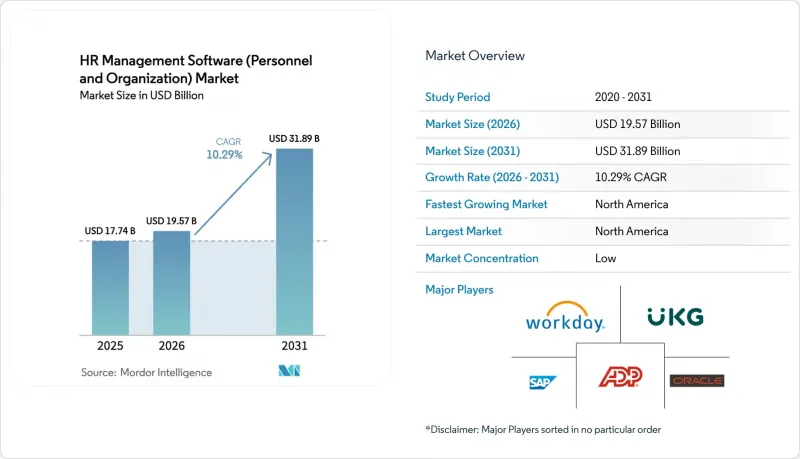
This report is Segmented by Type (Core HR, Talent Management, Workforce Management, Payroll and Compensation, Learning and Development, and More), Deployment (Cloud-Based, On-Premise, Hybrid), End-User (IT and Telecom, BFSI, and More), Organization Size (Large Enterprises, Small and Medium Enterprises), and Geography. The Market Forecasts are Provided in Terms of Value (USD).
Global HR Management Software (Personnel And Organization) Market Trends and Insights
Advancement in Cloud-Native Architecture and Composable HR Suites
Composable HR design lets firms assemble micro-services without full-stack replacements, cutting integration debt and time-to-value. Enterprises such as Coca-Cola European Partners have layered API-first talent modules on legacy payroll cores to modernize gradually. The MACH Alliance framework (micro-services, API-first, cloud-native SaaS, headless) underpins most new suite roadmaps, allowing faster updates and lower vendor-lock-in. Vendors respond by exposing granular REST APIs and low-code tooling, which shorten implementation cycles for distributed teams. The shift strengthens upgrade revenue and encourages multi-module up-sell as customers plug in analytics, learning, or scheduling add-ons when budgets allow.
Generative-AI Copilots Accelerating HR Automation
Vendors embed large language and large action models to auto-draft job descriptions, screening questions, and even promotion cases at scale. UKG's Bryte AI Agents orchestrate multi-step workflows-such as gathering peer feedback and authorizing compensation changes-without manual intervention. Workday reports 75% of customers testing its Talent Optimizer bots to surface internal mobility matches. Early adopters credit AI with cutting time-to-hire by 30% while improving candidate experience metrics. As regulations tighten, explainable-AI dashboards are bundled to evidence fairness and reduce litigation risk.
Heightened Data-Sovereignty Regulations (EU-CSRD)
The Corporate Sustainability Reporting Directive obligates enterprises to disclose up to 17 workforce metrics, forcing HR systems to build granular tracking and assurance layers. Multinationals must harmonize data models across subsidiaries, increasing configuration complexity and TCO. Vendors respond with regional hosting, secure data lakes, and out-of-the-box CSRD templates, yet implementation timelines stretch as legal teams vet cross-border data flows.
Other drivers and restraints analyzed in the detailed report include:
- SMB Digitization Wave in Emerging Economies
- Post-Pandemic Hybrid Work Permanentization
- AI-Bias Litigation and Algorithmic Audit Costs
For complete list of drivers and restraints, kindly check the Table Of Contents.
Segment Analysis
Talent Management generated the largest 19.86% slice of the HR management software market in 2025 as enterprises prioritized skills-based hiring and internal mobility. The HR management software market size for Talent Management is projected to expand further as AI matching elevates time-to-productivity metrics. Implementation of talent marketplaces by firms such as Salesforce achieved 90% profile completion rates, proving engagement. Managed Cloud Services posted the quickest 11.31% CAGR, reflecting demand for integrated hosting, upgrades, and compliance wrapped into subscription pricing. Core HR and Payroll remain foundational, anchoring suite expansion into analytics and well-being.
Growing reliance on advanced recruiting algorithms bolsters Applicant Tracking and Recruiting and Sourcing modules. Learning and Development gains momentum as reskilling budgets rise to close digital skill gaps. Vendors bundle blended-learning paths with talent marketplace recommendations, driving cross-sell. Smaller categories such as employee wellness and people analytics enrich the ecosystem, capitalizing on open APIs within composable stacks.
Cloud options accounted for 68.05% revenue in 2025, thanks to scalability and fast updates. However, hybrid adoption is surging at a 12.14% CAGR as organizations safeguard highly sensitive data behind private firewalls while exploiting public-cloud innovation for less regulated workflows. The HR management software market share for hybrid still trails cloud, yet momentum signals a maturing buyer appetite for configurable deployment.
On-premise persists in tightly regulated verticals, but vendors now supply containerized editions that align with composable principles. Enhanced zero-trust security, data-residency controls, and sovereign-cloud partnerships attract European public-sector agencies. Integration adapters streamline data movement between legacy ERP instances and SaaS micro-services, mitigating disruption risks for phased migrations.
Complete Report Scope:
- By Type
- Core HR
- Talent Management
- Workforce Management
- Payroll and Compensation
- Learning and Development
- Applicant Tracking System
- Recruiting and Sourcing
- Others
- By Deployment
- Cloud-Based
- On-Premise
- Hybrid
- By End-User
- IT and Telecom
- BFSI
- Manufacturing
- Retail and E-commerce
- Public Sector
- Healthcare
- Transportation and Logistics
- Education
- Professional Services
- Others
- By Organization Size
- Large Enterprises
- Small and Medium Enterprises (SMEs)
- By Geography
- North America
- United States
- Canada
- Mexico
- Europe
- Germany
- United Kingdom
- France
- Russia
- Rest of Europe
- Asia-Pacific
- China
- Japan
- India
- South Korea
- Australia
- Rest of Asia-Pacific
- Middle East and Africa
- Middle East
- Saudi Arabia
- United Arab Emirates
- Rest of Middle East
- Africa
- South Africa
- Egypt
- Rest of Africa
- Middle East
- South America
- Brazil
- Argentina
- Rest of South America
- North America
Geography Analysis
North America generated 37.16% of HR management software market revenue in 2025, buoyed by early SaaS maturity, sizable IT budgets, and regulatory catalysts such as SEC human-capital reporting. Vendors headquartered in the region, notably Workday and Oracle, reinvest heavily in AI R&D, sustaining product leadership and reinforcing regional dominance. A robust ecosystem of implementation partners accelerates enterprise adoption cycles.
Asia-Pacific is the second-largest contributor and maintains the highest absolute gains outside North America. SME digitization across India, Indonesia, and Malaysia fuels new-logo growth, while Japan and Australia upgrade legacy on-premise suites to cloud. National data-sovereignty rules drive interest in hybrid deployments, prompting hyperscalers to open local availability zones that comply with residency laws. The HR management software market share for Asia-Pacific is rising as domestic vendors localize UX and language support.
The Middle East shows standout momentum, with the UAE forecast at a 12.54% CAGR through 2031. Government initiatives under Vision 2030 and rising private-sector diversification projects boost demand for payroll localization, bilingual self-service, and leave management aligned with local labor law. Europe's growth moderates yet remains sizable; stringent GDPR and CSRD regulations spur demand for compliant analytics and audit trails. South America and Africa deliver early-stage expansion, propelled by cloud infra investments and fintech-HR synergies.
- SAP SE
- Oracle Corporation
- Automatic Data Processing, Inc. (ADP)
- Workday, Inc.
- UKG Inc.
- Ceridian HCM Holding Inc.
- Accenture plc
- International Business Machines Corporation (IBM)
- PwC International Limited
- Mercer LLC
- Cegid SA
- Cezanne HR Ltd.
- BambooHR LLC
- Cornerstone OnDemand, Inc.
- Gusto, Inc.
- TriNet Zenefits
- Zoho Corporation Pvt. Ltd.
- PeopleStrong Technologies Pvt. Ltd.
- SumTotal Systems, LLC
- Sage Group Plc
Additional Benefits:
- The market estimate (ME) sheet in Excel format
- 3 months of analyst support
TABLE OF CONTENTS
1 INTRODUCTION
- 1.1 Study Assumptions and Market Definition
- 1.2 Scope of the Study
2 RESEARCH METHODOLOGY
3 EXECUTIVE SUMMARY
4 MARKET LANDSCAPE
- 4.1 Market Overview
- 4.2 Market Drivers
- 4.2.1 Advancement in cloud-native architecture and composable HR suites
- 4.2.2 Generative-AI copilots accelerating HR automation
- 4.2.3 SMB digitisation wave in emerging economies
- 4.2.4 Post-pandemic hybrid work permanentisation
- 4.2.5 Rise of skills-based hiring and internal talent marketplaces
- 4.2.6 ESG-linked human-capital disclosure mandates
- 4.3 Market Restraints
- 4.3.1 Heightened data-sovereignty regulations (e.g., EU-CSRD)
- 4.3.2 AI-bias litigation and algorithmic audit costs
- 4.3.3 ERP-HCM integration debt in legacy enterprises
- 4.3.4 Vendor lock-in and escalating subscription TCO
- 4.4 Value / Supply-Chain Analysis
- 4.5 Regulatory Landscape
- 4.6 Technological Outlook
- 4.7 Porter's Five Forces Analysis
- 4.7.1 Threat of New Entrants
- 4.7.2 Bargaining Power of Buyers
- 4.7.3 Bargaining Power of Suppliers
- 4.7.4 Threat of Substitutes
- 4.7.5 Intensity of Competitive Rivalry
5 MARKET SIZE AND GROWTH FORECASTS (VALUE)
- 5.1 By Type
- 5.1.1 Core HR
- 5.1.2 Talent Management
- 5.1.3 Workforce Management
- 5.1.4 Payroll and Compensation
- 5.1.5 Learning and Development
- 5.1.6 Applicant Tracking System
- 5.1.7 Recruiting and Sourcing
- 5.1.8 Others
- 5.2 By Deployment
- 5.2.1 Cloud-Based
- 5.2.2 On-Premise
- 5.2.3 Hybrid
- 5.3 By End-User
- 5.3.1 IT and Telecom
- 5.3.2 BFSI
- 5.3.3 Manufacturing
- 5.3.4 Retail and E-commerce
- 5.3.5 Public Sector
- 5.3.6 Healthcare
- 5.3.7 Transportation and Logistics
- 5.3.8 Education
- 5.3.9 Professional Services
- 5.3.10 Others
- 5.4 By Organization Size
- 5.4.1 Large Enterprises
- 5.4.2 Small and Medium Enterprises (SMEs)
- 5.5 By Geography
- 5.5.1 North America
- 5.5.1.1 United States
- 5.5.1.2 Canada
- 5.5.1.3 Mexico
- 5.5.2 Europe
- 5.5.2.1 Germany
- 5.5.2.2 United Kingdom
- 5.5.2.3 France
- 5.5.2.4 Russia
- 5.5.2.5 Rest of Europe
- 5.5.3 Asia-Pacific
- 5.5.3.1 China
- 5.5.3.2 Japan
- 5.5.3.3 India
- 5.5.3.4 South Korea
- 5.5.3.5 Australia
- 5.5.3.6 Rest of Asia-Pacific
- 5.5.4 Middle East and Africa
- 5.5.4.1 Middle East
- 5.5.4.1.1 Saudi Arabia
- 5.5.4.1.2 United Arab Emirates
- 5.5.4.1.3 Rest of Middle East
- 5.5.4.2 Africa
- 5.5.4.2.1 South Africa
- 5.5.4.2.2 Egypt
- 5.5.4.2.3 Rest of Africa
- 5.5.4.1 Middle East
- 5.5.5 South America
- 5.5.5.1 Brazil
- 5.5.5.2 Argentina
- 5.5.5.3 Rest of South America
- 5.5.1 North America
6 COMPETITIVE LANDSCAPE
- 6.1 Market Concentration Analysis
- 6.2 Strategic Moves (M&A, Partnerships, Launches)
- 6.3 Market Share Analysis (Top-15, 2024)
- 6.4 Company Profiles (includes Global Level Overview, Market Level Overview, Core Segments, Financials as available, Strategic Information, Market Rank/Share, Products and Services, Recent Developments)
- 6.4.1 SAP SE
- 6.4.2 Oracle Corporation
- 6.4.3 Automatic Data Processing, Inc. (ADP)
- 6.4.4 Workday, Inc.
- 6.4.5 UKG Inc.
- 6.4.6 Ceridian HCM Holding Inc.
- 6.4.7 Accenture plc
- 6.4.8 International Business Machines Corporation (IBM)
- 6.4.9 PwC International Limited
- 6.4.10 Mercer LLC
- 6.4.11 Cegid SA
- 6.4.12 Cezanne HR Ltd.
- 6.4.13 BambooHR LLC
- 6.4.14 Cornerstone OnDemand, Inc.
- 6.4.15 Gusto, Inc.
- 6.4.16 TriNet Zenefits
- 6.4.17 Zoho Corporation Pvt. Ltd.
- 6.4.18 PeopleStrong Technologies Pvt. Ltd.
- 6.4.19 SumTotal Systems, LLC
- 6.4.20 Sage Group Plc
7 MARKET OPPORTUNITIES AND FUTURE TRENDS
- 7.1 White-space and Unmet-Need Assessment

