PUBLISHER: Mordor Intelligence | PRODUCT CODE: 2125402

PUBLISHER: Mordor Intelligence | PRODUCT CODE: 2125402
United Kingdom Wearable Technology - Market Share Analysis, Industry Trends & Statistics, Growth Forecasts (2026 - 2031)
According to Mordor Intelligence, the UK wearable technology market size is expected to grow from USD 5.89 billion in 2025 to USD 6.81 billion in 2026 and is forecast to reach USD 14.02 billion by 2031 at 15.55% CAGR over 2026-2031.
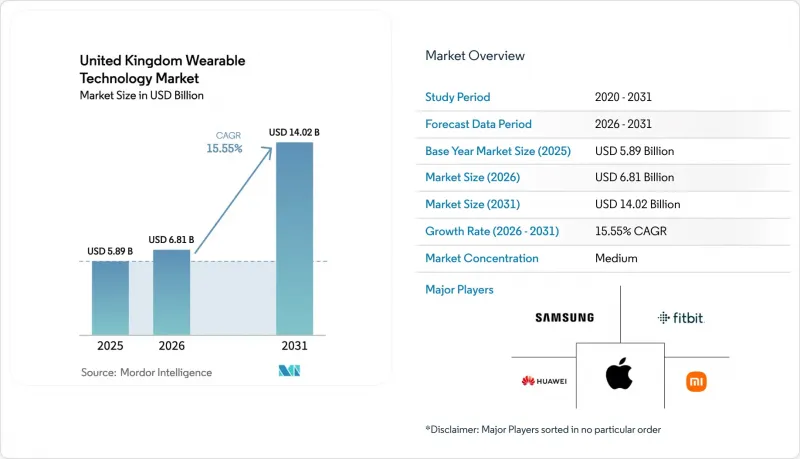
This report is Segmented by Device Type (Smart Watches, Head-Mounted Displays, Wristbands, and More), Connectivity Technology (Bluetooth, Cellular, and More), Operating System (watchOS, Wear OS, and More), Application (Consumer Fitness, Healthcare Monitoring, and More), Distribution Channel (Online Retail, and More), and Geography. The Market Forecasts are Provided in Terms of Value (USD).
United Kingdom Wearable Technology Market Trends and Insights
Proliferation of NHS Digital Health Initiatives
Virtual wards supported 4 million UK patients in 2024 and integrated care boards across West Yorkshire, Humber and North Yorkshire, and Cambridge and Peterborough plan broader coverage. Unified procurement frameworks shorten the path from clinical validation to national rollout, so device vendors with MHRA-cleared biosensors receive preferential consideration. Scotland and Wales mirror England's model, evidencing nation-wide adoption of remote patient monitoring that underpins steady demand for validated wearables. NHS targets prioritize chronic respiratory and cardiovascular programs, aligning with smart-watch blood-pressure and pulse-ox features. Predictive analytics platforms further amplify device utility by translating raw data into actionable care-team alerts.
Integration of Wearables with UK Fintech Ecosystem for Health-Insurance Incentives
Fintech insurers link step counts, heart-rate variability, and sleep scores to dynamic premium discounts, spurring usage across younger, digitally native groups. Open banking standards and FCA oversight ensure secure data exchange between wearable apps and financial dashboards, improving adoption confidence. Employers deploy the same data flows to trigger wellness bonuses that lower group health-cover costs. Device makers benefit from recurring revenue when insurers subsidize hardware in exchange for long-term data access. Cross-platform APIs reduce user friction, reinforcing ecosystem stickiness and keeping churn low.
Stricter UK Data Privacy Enforcement Post-GDPR
The Information Commissioner's Office intensifies audits of health-data processors and levies heavy fines for consent mis-steps, so smaller brands divert scarce funds into compliance or retreat from the UK. Mandatory data-protection-impact assessments slow new-feature rollouts, stretching time-to-market. Cross-border transfers to U.S. cloud servers trigger additional contractual safeguards that elevate operating expense. Established vendors capitalize on their mature privacy infrastructures, yet even they redesign user flows to gain granular consent without hurting engagement. Clear privacy victory messages on packaging now influence purchasing almost as strongly as battery life or waterproof ratings.
Other drivers and restraints analyzed in the detailed report include:
- Adoption of AI-Powered Predictive Health Analytics in Consumer Wearables
- Rise of Workplace Wellness Regulations in the UK
- Consumer Skepticism on Long-Term Accuracy of Biosensors
For complete list of drivers and restraints, kindly check the Table Of Contents.
Segment Analysis
Smart watches accounted for 56.16% of UK wearable technology market share in 2025 and generated the highest revenue as Apple Watch's hypertension clearance validated clinical utility. Ear-wearables lead growth at 16.11% CAGR, propelled by Meta's AR audio glasses and Apple's sensor-rich AirPods that discreetly record EEG and EMG signals.
Demand diversifies into smart rings and textile-embedded smart clothing. Oura doubled 2025 ring shipments, demonstrating appetite for minimalist form factors that deliver continuous monitoring without screen fatigue. Smart clothing pilots in elder-care homes record fall risk and hydration data through washable fibers, pointing to future convergence between fashion, medical monitoring, and ESG-compliant materials.
Bluetooth covered 65.95% of connections in 2025, but Ultra-Wideband adoption is rising 16.80% annually as hospitals and warehouses seek centimeter-level indoor location. 5G modems appear in cellular wristbands targeted at high-risk patients who require uninterrupted remote patient monitoring.
Mesh networking firmware lets smart rings relay data to a watch, then to a phone, cutting power draw while maintaining real-time transmission. Ofcom spectrum allocations guarantee coexistence, and device makers design dual-radio chipsets that switch automatically based on bandwidth needs and battery status.
Complete Report Scope:
- By Device Type
- Smart Watches
- Head-mounted Displays
- Wristbands
- Ear-wearables
- Smart Clothing
- Smart Rings
- Other Device Types
- By Connectivity Technology
- Bluetooth
- Wi-Fi
- Cellular
- NFC
- Ultra-Wideband
- 5G
- Other Connectivity Technologies
- By Operating System
- watchOS
- Wear OS
- Proprietary OS
- RTOS
- Linux
- Other Operating Systems
- By Application
- Consumer Fitness
- Healthcare Monitoring
- Remote Patient Monitoring
- Corporate Wellness
- Sports Performance
- Medical Diagnostics
- Other Applications
- By Distribution Channel
- Online Retail
- Offline Consumer Electronics
- Specialist Health Stores
- Pharmacies
- Department Stores
- Other Distribution Channels
- By Geography
- England
- Scotland
- Wales
- Northern Ireland
List of Companies Covered in this Report:
- Apple Inc.
- Samsung Electronics Co. Ltd.
- Fitbit LLC
- Huawei Technologies Co. Ltd.
- Xiaomi Inc.
- Garmin Ltd.
- Fossil Group Inc.
- OnePlus Technology (Shenzhen) Co. Ltd.
- Sekonda Ltd.
- Honor Device Co.
- Huami Corporation (Amazfit) Ltd.
- Withings SA
- Polar Electro Oy
- Suunto Oy
- Oura Health Oy
Additional Benefits:
- The market estimate (ME) sheet in Excel format
- 3 months of analyst support
TABLE OF CONTENTS
1 INTRODUCTION
- 1.1 Study Assumptions and Market Definition
- 1.2 Scope of the Study
2 RESEARCH METHODOLOGY
3 EXECUTIVE SUMMARY
4 MARKET LANDSCAPE
- 4.1 Market Overview
- 4.2 Market Drivers
- 4.2.1 Proliferation of NHS Digital Health Initiatives
- 4.2.2 Integration of Wearables with UK Fintech Ecosystem for Health Insurance Incentives
- 4.2.3 Adoption of AI-Powered Predictive Health Analytics in Consumer Wearables
- 4.2.4 Rise of Workplace Wellness Regulations in the UK
- 4.2.5 Expansion of 5G and IoT Infrastructure Across the UK
- 4.2.6 Growing Demand for Remote Patient Monitoring in Ageing Population
- 4.3 Market Restraints
- 4.3.1 Stricter UK Data Privacy Enforcement Post-GDPR
- 4.3.2 Wearable Device VAT Reclassification Risk
- 4.3.3 Battery Waste Regulations Increasing Compliance Cost
- 4.3.4 Consumer Skepticism on Long-Term Accuracy of Biosensors
- 4.4 Industry Ecosystem Analysis
- 4.5 Regulatory Landscape
- 4.6 Impact of Macroeconomic Factors
- 4.7 Technological Outlook
- 4.8 Porter's Five Forces Analysis
- 4.8.1 Bargaining Power of Suppliers
- 4.8.2 Bargaining Power of Consumers
- 4.8.3 Threat of New Entrants
- 4.8.4 Threat of Substitutes
- 4.8.5 Intensity of Competitive Rivalry
5 MARKET SIZE AND GROWTH FORECASTS (VALUE)
- 5.1 By Device Type
- 5.1.1 Smart Watches
- 5.1.2 Head-mounted Displays
- 5.1.3 Wristbands
- 5.1.4 Ear-wearables
- 5.1.5 Smart Clothing
- 5.1.6 Smart Rings
- 5.1.7 Other Device Types
- 5.2 By Connectivity Technology
- 5.2.1 Bluetooth
- 5.2.2 Wi-Fi
- 5.2.3 Cellular
- 5.2.4 NFC
- 5.2.5 Ultra-Wideband
- 5.2.6 5G
- 5.2.7 Other Connectivity Technologies
- 5.3 By Operating System
- 5.3.1 watchOS
- 5.3.2 Wear OS
- 5.3.3 Proprietary OS
- 5.3.4 RTOS
- 5.3.5 Linux
- 5.3.6 Other Operating Systems
- 5.4 By Application
- 5.4.1 Consumer Fitness
- 5.4.2 Healthcare Monitoring
- 5.4.3 Remote Patient Monitoring
- 5.4.4 Corporate Wellness
- 5.4.5 Sports Performance
- 5.4.6 Medical Diagnostics
- 5.4.7 Other Applications
- 5.5 By Distribution Channel
- 5.5.1 Online Retail
- 5.5.2 Offline Consumer Electronics
- 5.5.3 Specialist Health Stores
- 5.5.4 Pharmacies
- 5.5.5 Department Stores
- 5.5.6 Other Distribution Channels
- 5.6 By Geography
- 5.6.1 England
- 5.6.2 Scotland
- 5.6.3 Wales
- 5.6.4 Northern Ireland
6 COMPETITIVE LANDSCAPE
- 6.1 Market Concentration
- 6.2 Strategic Moves
- 6.3 Market Share Analysis
- 6.4 Company Profiles (includes Global level Overview, Market level overview, Core Segments, Financials as available, Strategic Information, Market Rank/Share for key companies, Products and Services, and Recent Developments)
- 6.4.1 Apple Inc.
- 6.4.2 Samsung Electronics Co. Ltd.
- 6.4.3 Fitbit LLC
- 6.4.4 Huawei Technologies Co. Ltd.
- 6.4.5 Xiaomi Inc.
- 6.4.6 Garmin Ltd.
- 6.4.7 Fossil Group Inc.
- 6.4.8 OnePlus Technology (Shenzhen) Co. Ltd.
- 6.4.9 Sekonda Ltd.
- 6.4.10 Honor Device Co.
- 6.4.11 Huami Corporation (Amazfit) Ltd.
- 6.4.12 Withings SA
- 6.4.13 Polar Electro Oy
- 6.4.14 Suunto Oy
- 6.4.15 Oura Health Oy
7 MARKET OPPORTUNITIES AND FUTURE OUTLOOK
- 7.1 White-space and Unmet-need Assessment

