PUBLISHER: Mordor Intelligence | PRODUCT CODE: 2125409

PUBLISHER: Mordor Intelligence | PRODUCT CODE: 2125409
Video Encoder - Market Share Analysis, Industry Trends & Statistics, Growth Forecasts (2026 - 2031)
According to Mordor Intelligence, the video encoder market size is expected to grow from USD 2.55 billion in 2025 to USD 2.67 billion in 2026 and is forecast to reach USD 3.33 billion by 2031 at 4.54% CAGR over 2026-2031.
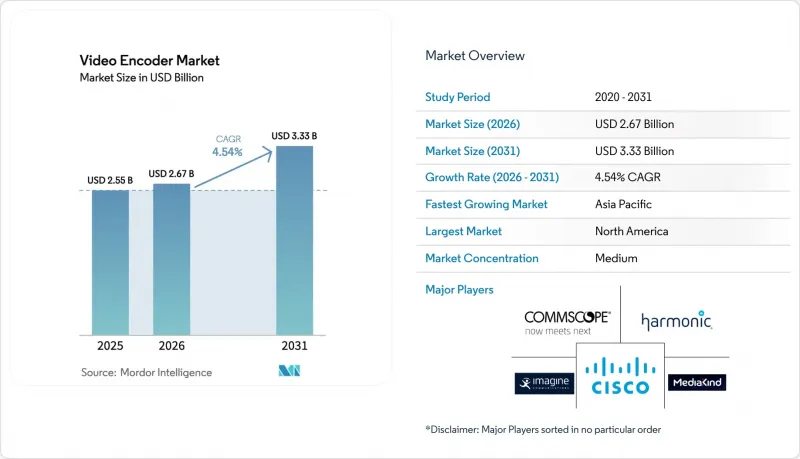
This report is Segmented by Encoder Type (Hardware, Software, and Cloud/SaaS), Encoding Standard (H. 264/AVC, H. 265/HEVC, AV1, and More), Application (Pay-TV, Broadcast and DTT, OTT and Live Streaming, Remote Education and Corporate Webcasting, and More), End-User Industry (Media and Entertainment, Enterprise/Corporate, and More), and Geography. The Market Forecasts are Provided in Terms of Value (USD).
Global Video Encoder Market Trends and Insights
Rising popularity of multiscreen and OTT video consumption
OTT platforms optimize delivery across smartphones, tablets, and connected TVs, often producing 15 adaptive-bitrate profiles per asset to guarantee uninterrupted playback. Netflix's shift to AV1 brought 30% bandwidth savings and lower CDN costs, proving the economic value of advanced compression. Manufacturers such as Samsung embed HDR10+ support that pushes content owners to preserve wider color gamut, raising demand for high-performance encoders able to process HDR and SDR simultaneously. As more smart-TV operating systems integrate voice-controlled search, frame-accurate trick-play features require additional metadata, further enlarging encoding workloads. These factors collectively sustain premium encoder adoption for multiscreen environments.
Proliferation of 5G networks enabling UHD live streaming
Commercial 5G deployments in Japan and South Korea have already enabled field tests of 8K and 4K60 live feeds, delivering uplink speeds of 100 Mbps from moving vehicles. Broadcasters can now bypass satellite links for remote production, trimming contribution costs and setup times. Low-latency edge nodes bring end-to-end delays below 50 ms, critical for interactive sports betting and fan engagement applications. China Mobile's rollout of 5G-based surveillance across 200 cities further underscores how cellular backhaul can substitute fixed fiber in massive video networks. Encoder vendors capable of integrating 5G modems and network slicing APIs gain first-mover advantage as mobile operators commercialize premium video tiers.
High capex for ultra-low-latency hardware encoders
Encoders delivering sub-20 ms glass-to-glass latency cost USD 50,000-200,000 per unit, pricing smaller broadcasters out of interactive or VR offerings. ASIC-based designs demand bespoke silicon, and volumes remain niche, limiting economies of scale. E-sports tournament organizers frequently allocate six-figure budgets merely for encoding rigs across multi-camera broadcasts, squeezing margins for mid-tier events. With semiconductor talent diverted toward AI inference and crypto, advances in purpose-built video silicon slow, prolonging premium pricing.
Other drivers and restraints analyzed in the detailed report include:
- Migration from AVC to high-efficiency, royalty-free codecs (AV1)
- Cloud-native encoding workflows lowering TCO for broadcasters
- Fragmented patent pools and codec royalty uncertainties
For complete list of drivers and restraints, kindly check the Table Of Contents.
Segment Analysis
Hardware appliances represented 53.74% of 2025 revenue, underscoring their legacy foothold in mission-critical contribution and distribution. Yet the video encoder market size for cloud/SaaS offerings is projected to expand at a 5.88% CAGR, the fastest among all types, as broadcasters prioritize opex flexibility over capex lock-in. Cloud adoption surges among digital-first studios needing instantaneous scale for episodic releases, while software encoders on COTS servers continue serving corporate campuses where IT staff can manage workloads internally.
In live sports, appliances retain primacy owing to deterministic performance and SDI integration, but hybrid architectures emerge wherein on-site gear sends mezzanine feeds to cloud clusters for ABR packaging at scale. Disaster recovery strategies increasingly mirror this approach, allowing rapid failover to the cloud without duplicating entire appliance fleets. Vendors able to orchestrate transcodes across heterogeneous infrastructures widen competitive moats as customers avoid single-point dependencies.
H.264/AVC still commands 44.20% of the video encoder market share because of near-universal device support, yet bandwidth pressures and royalty costs push operators toward alternatives. VVC/H.266 leads growth at a 5.29% CAGR thanks to 50% bitrate savings over HEVC, pivotal for 8K streaming. Meanwhile, AV1's royalty-free proposition lures OTT services seeking predictable costs, even if computational complexity remains higher today.
The video encoder market size tied to AV1 receives a tailwind from Intel's Arc Pro GPUs and Apple's iPhone 15, both offering native decode. As such, silicon populates consumer devices, and distributors accelerate AV1 adoption to reduce CDN bills. In the professional realm, GPU-accelerated VVC encoding within AWS MediaConvert removes prior performance bottlenecks, convincing early adopters to test live trials for 4K HDR channels. Multi-codec ladders will persist through 2031 as content owners hedge against licensing risks and device heterogeneity.
Complete Report Scope:
- By Encoder Type
- Hardware
- Software
- Cloud / SaaS
- By Encoding Standard
- H.264 / AVC
- H.265 / HEVC
- AV1
- VVC / H.266
- Other Encoding Standard
- By Application
- Pay-TV
- Broadcast and DTT
- OTT and Live Streaming
- Security and Surveillance
- Remote Education and Corporate Webcasting
- By End-user Industry
- Media and Entertainment
- Enterprise / Corporate
- Government and Defence
- Education
- Healthcare
- By Geography
- North America
- United States
- Canada
- Mexico
- Europe
- Germany
- United Kingdom
- France
- Russia
- Rest of Europe
- Asia-Pacific
- China
- Japan
- India
- South Korea
- Australia
- Rest of Asia-Pacific
- Middle East and Africa
- Middle East
- Saudi Arabia
- United Arab Emirates
- Rest of Middle East
- Africa
- South Africa
- Egypt
- Rest of Africa
- Middle East
- South America
- Brazil
- Argentina
- Rest of South America
- North America
Geography Analysis
North America generated 33.25% of revenue in 2025, underpinned by entrenched broadcast networks and the headquarters of major streaming services that demand premium UHD workflows. Replacement investment outweighs greenfield builds, yet software-defined transformations continue as cloud economics improve.
Asia-Pacific's video encoder market size is on a 5.26% CAGR path to 2031, buoyed by massive smart-city surveillance projects, rapid 5G densification, and growing appetite for multilingual OTT catalogs. Local manufacturing ecosystems for electronics and semiconductors shorten supply chains and accelerate pilot deployments.
Europe pursues sustainability by mandating lower power envelopes and enforcing privacy protections, prompting adoption of efficient codecs and on-premises processing for sensitive footage. Regional public broadcasters modernize in step with DVB and HbbTV updates, forming steady demand for hybrid workflows.
- Harmonic Inc.
- CommScope Holding Company, Inc.
- MediaKind Global, Inc.
- Cisco Systems, Inc.
- Imagine Communications Corp.
- Z3 Technology, LLC
- Ateme S.A.
- Adtec Digital, Inc.
- VITEC Holdings S.A.S.
- Axis Communications AB
- AWS Elemental, Inc.
- Haivision Systems Inc.
- Telestream, LLC
- Matrox Electronic Systems Ltd.
- AJA Video Systems, Inc.
- Brightcove Inc.
- Synamedia Ltd.
- Bitmovin, Inc.
- Beamr Imaging Ltd.
- Teradek, LLC
Additional Benefits:
- The market estimate (ME) sheet in Excel format
- 3 months of analyst support
TABLE OF CONTENTS
1 INTRODUCTION
- 1.1 Study Assumptions and Market Definition
- 1.2 Scope of the Study
2 RESEARCH METHODOLOGY
3 EXECUTIVE SUMMARY
4 MARKET LANDSCAPE
- 4.1 Market Overview
- 4.2 Market Drivers
- 4.2.1 Rising popularity of multiscreen and OTT video consumption
- 4.2.2 Proliferation of 5G networks enabling UHD live streaming
- 4.2.3 Migration from AVC to high-efficiency, royalty-free codecs (AV1)
- 4.2.4 Cloud-native encoding workflows lowering TCO for broadcasters
- 4.2.5 Edge encoding demand for low-latency interactive video
- 4.2.6 Government funding for emergency video surveillance networks
- 4.3 Market Restraints
- 4.3.1 High capex for ultra-low-latency hardware encoders
- 4.3.2 Fragmented patent pools and codec royalty uncertainties
- 4.3.3 Power-consumption limits in edge/portable use-cases
- 4.3.4 Supply-chain risks for ASIC/FPGA components
- 4.4 Industry Ecosystem Analysis
- 4.5 Regulatory Landscape
- 4.6 Technological Outlook
- 4.6.1 Analysis of Video Codecs and Their Evolution
- 4.6.2 List of VVC-Approved and Incorporated Companies
- 4.6.3 List of Companies Contributing to the VVC Standard
- 4.7 Porter's Five Forces Analysis
- 4.7.1 Bargaining Power of Suppliers
- 4.7.2 Bargaining Power of Buyers
- 4.7.3 Threat of New Entrants
- 4.7.4 Threat of Substitutes
- 4.7.5 Intensity of Competitive Rivalry
5 MARKET SIZE AND GROWTH FORECASTS (VALUE)
- 5.1 By Encoder Type
- 5.1.1 Hardware
- 5.1.2 Software
- 5.1.3 Cloud / SaaS
- 5.2 By Encoding Standard
- 5.2.1 H.264 / AVC
- 5.2.2 H.265 / HEVC
- 5.2.3 AV1
- 5.2.4 VVC / H.266
- 5.2.5 Other Encoding Standard
- 5.3 By Application
- 5.3.1 Pay-TV
- 5.3.2 Broadcast and DTT
- 5.3.3 OTT and Live Streaming
- 5.3.4 Security and Surveillance
- 5.3.5 Remote Education and Corporate Webcasting
- 5.4 By End-user Industry
- 5.4.1 Media and Entertainment
- 5.4.2 Enterprise / Corporate
- 5.4.3 Government and Defence
- 5.4.4 Education
- 5.4.5 Healthcare
- 5.5 By Geography
- 5.5.1 North America
- 5.5.1.1 United States
- 5.5.1.2 Canada
- 5.5.1.3 Mexico
- 5.5.2 Europe
- 5.5.2.1 Germany
- 5.5.2.2 United Kingdom
- 5.5.2.3 France
- 5.5.2.4 Russia
- 5.5.2.5 Rest of Europe
- 5.5.3 Asia-Pacific
- 5.5.3.1 China
- 5.5.3.2 Japan
- 5.5.3.3 India
- 5.5.3.4 South Korea
- 5.5.3.5 Australia
- 5.5.3.6 Rest of Asia-Pacific
- 5.5.4 Middle East and Africa
- 5.5.4.1 Middle East
- 5.5.4.1.1 Saudi Arabia
- 5.5.4.1.2 United Arab Emirates
- 5.5.4.1.3 Rest of Middle East
- 5.5.4.2 Africa
- 5.5.4.2.1 South Africa
- 5.5.4.2.2 Egypt
- 5.5.4.2.3 Rest of Africa
- 5.5.4.1 Middle East
- 5.5.5 South America
- 5.5.5.1 Brazil
- 5.5.5.2 Argentina
- 5.5.5.3 Rest of South America
- 5.5.1 North America
6 COMPETITIVE LANDSCAPE
- 6.1 Market Concentration
- 6.2 Strategic Moves
- 6.3 Market Share Analysis
- 6.4 Company Profiles (includes Global level Overview, Market level overview, Core Segments, Financials as available, Strategic Information, Market Rank/Share for key companies, Products and Services, and Recent Developments)
- 6.4.1 Harmonic Inc.
- 6.4.2 CommScope Holding Company, Inc.
- 6.4.3 MediaKind Global, Inc.
- 6.4.4 Cisco Systems, Inc.
- 6.4.5 Imagine Communications Corp.
- 6.4.6 Z3 Technology, LLC
- 6.4.7 Ateme S.A.
- 6.4.8 Adtec Digital, Inc.
- 6.4.9 VITEC Holdings S.A.S.
- 6.4.10 Axis Communications AB
- 6.4.11 AWS Elemental, Inc.
- 6.4.12 Haivision Systems Inc.
- 6.4.13 Telestream, LLC
- 6.4.14 Matrox Electronic Systems Ltd.
- 6.4.15 AJA Video Systems, Inc.
- 6.4.16 Brightcove Inc.
- 6.4.17 Synamedia Ltd.
- 6.4.18 Bitmovin, Inc.
- 6.4.19 Beamr Imaging Ltd.
- 6.4.20 Teradek, LLC
7 MARKET OPPORTUNITIES AND FUTURE OUTLOOK
- 7.1 White-space and Unmet-Need Assessment

