PUBLISHER: Mordor Intelligence | PRODUCT CODE: 2125421

PUBLISHER: Mordor Intelligence | PRODUCT CODE: 2125421
North America Secure Access Service Edge - Market Share Analysis, Industry Trends & Statistics, Growth Forecasts (2026 - 2031)
According to Mordor Intelligence, the secure access service edge market size in 2026 is estimated at USD 13.9 billion, growing from 2025 value of USD 11.63 billion with 2031 projections showing USD 33.97 billion, growing at 19.55% CAGR over 2026-2031.
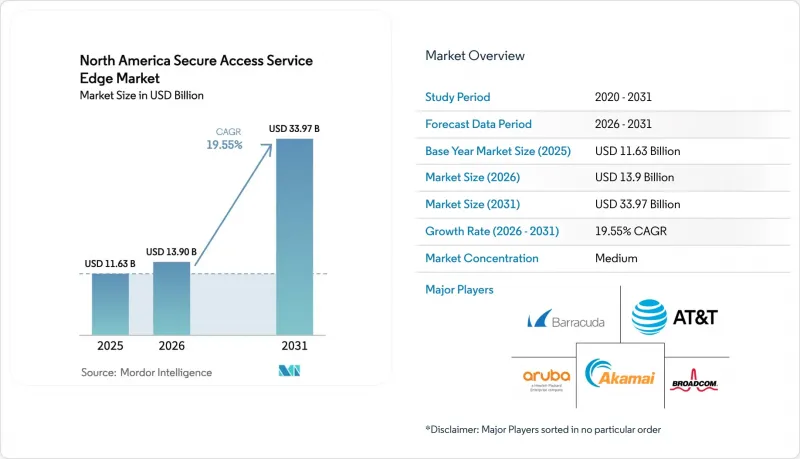
This report is Segmented by Offering Type (Network-As-A-Service, Security-As-A-Service, Managed SASE Services, Professional Services), Component (SD-WAN, SWG, and More), Deployment Mode (Cloud, On-Premise), Organization Size (Large Enterprises, Smes), End-User Vertical (BFSI, IT and Telecommunications and More), and Geography. The Market Forecasts are Provided in Terms of Value (USD).
North America Secure Access Service Edge Market Trends and Insights
Surge in Hybrid-Work Connectivity Demands
More than 80% of North American organizations plan Zero Trust adoption by 2026, reflecting a decisive shift away from legacy VPNs that reported an 82.5% increase in critical vulnerabilities between 2020 and 2025. SASE platforms enforce identity-centric access, micro-segmentation, and continuous verification, thereby stabilizing remote productivity. A case study from Salesforce recorded a fivefold bandwidth gain after swapping MPLS links for an SD-WAN-powered SASE backbone without inflating connectivity cost.
Exploding Multi-Cloud and SaaS Traffic Volumes
Direct cloud break-out via SD-WAN reduces round-trip latency up to five times compared with data-center backhaul, ensuring reliable SaaS performance. SASE delivers uniform policy across Amazon Web Services, Microsoft Azure, and Google Cloud workloads. Cisco's Cloud OnRamp cuts public-cloud onboarding from days to hours and optimizes routing for biopharma R&D platforms handling genome datasets.
Legacy MPLS Migration Complexity
MPLS bandwidth now grows only 6.7% through 2028, contrasted with cloud traffic that climbs 29% annually, leaving a widening performance gap. Rip-and-replace strategies risk downtime and mis-configured access controls, so many enterprises stage migration by overlaying SD-WAN tunnels on existing circuits. Temporary exposure of unused firewall rules can create lateral-movement opportunities that adversaries exploit during cut-over windows.
Other drivers and restraints analyzed in the detailed report include:
- Tightening Data-Privacy Mandates (CCPA, Quebec Bill-64)
- AI-Driven Policy Automation Lowering OPEX
- Cyber-Security Talent Scarcity
For complete list of drivers and restraints, kindly check the Table Of Contents.
Segment Analysis
The secure access service edge market records Security-as-a-Service at 52.85% contribution in 2025 owing to preference for subscription models that eliminate capex. Managed SASE Services, though smaller today, shows a 20.1% CAGR and benefits from bundled connectivity that collapses firewall, VPN, and SD-WAN into a per-site fee. Telecom carriers deepen addressable reach by embedding clientless authentication in SIM cards, reducing provisioning friction for field workers. Professional Services remain critical during transition, guiding assessments, design validation, and post-migration optimization for highly regulated sectors such as banking. Network-as-a-Service reinforces subscription momentum through bandwidth-on-demand that scales during seasonal traffic peaks. Strategic alliances between integrators and hyperscalers further streamline adoption cycles as pre-tested reference architectures shorten proof-of-concept phases.
Service evolution also reflects vendor appetite to bolster recurring revenue. Verizon's Advanced SASE, ATandT's edge computing partnership, and T-Mobile's 5G slices illustrate diversified roadmaps that broaden addressable verticals. Enterprises that once purchased security appliances every five years now renew cloud licenses annually, improving forecast accuracy for providers. As price competition intensifies, AI-enhanced self-service dashboards emerge as differentiation levers, empowering customers to tweak policies without professional-service engagements.
SD-WAN furnished 41.25% revenue in 2025 and remains the baseline for traffic steering and dynamic path selection. Yet growth moderates as the technology becomes table-stakes. Zero-Trust Network Access rises on a 20.9% CAGR trajectory as remote access modernizes beyond VPN. Incorporation of device posture checks and user behavioral analytics reduces attack surface inside high-value workloads. Secure Web Gateway and Cloud Access Security Broker still attract compliance-driven spending among financial and healthcare entities that must log every SaaS transaction. Firewall-as-a-Service migrates distributed policy engines to cloud points of presence, cutting update latency. Data Loss Prevention gains from privacy mandates, while Digital Experience Monitoring helps operations teams diagnose latency spikes with real-time hop-by-hop visibility.
Component convergence favors single-vendor catalogs: Gartner forecasts that unified platforms will control 65% of SD-WAN procurement by 2027, up from 20% in 2024. Netskope's purchase of Infiot produced a Borderless WAN delivering Zero Trust, quality-of-experience analytics, and application acceleration inside one portal. Fortinet integrates threat intelligence across next-generation firewall, SD-WAN, and secure edge, minimizing policy drift and expediting incident response.
Complete Report Scope:
- By Offering Type
- Network-as-a-Service
- Security-as-a-Service
- Managed SASE Services
- Professional Services (Assessment, Integration)
- By Component
- Software-defined WAN (SD-WAN)
- Secure Web Gateway (SWG)
- Cloud Access Security Broker (CASB)
- Zero-Trust Network Access (ZTNA)
- Firewall-as-a-Service (FWaaS)
- Data-Loss Prevention (DLP)
- Digital Experience Monitoring
- By Deployment Mode
- Cloud
- On-premise
- By Organization Size
- Large Enterprises
- SMEs
- By End-user Vertical
- Banking, Financial Services and Insurance (BFSI)
- IT and Telecommunications
- Retail and eCommerce
- Healthcare and Life Sciences
- Government and Public Sector
- Manufacturing and Industrial
- Education
- Other Industries
- By Country
- United States
- Canada
- Mexico
List of Companies Covered in this Report:
- Akamai Technologies Inc.
- Aruba Networks (an HPE Company)
- ATandT Inc.
- Barracuda Networks Inc.
- Broadcom Inc.
- Cato Networks Ltd.
- Check Point Software Technologies Ltd.
- Cisco Systems Inc.
- Citrix Systems Inc.
- Cloudflare Inc.
- Fortinet Inc.
- Forcepoint LLC
- Hewlett Packard Enterprise Co.
- Juniper Networks Inc.
- McAfee LLC
- Netskope Inc.
- Palo Alto Networks Inc.
- Verizon Communications Inc.
- Versa Networks Inc.
- VMware Inc.
Additional Benefits:
- The market estimate (ME) sheet in Excel format
- 3 months of analyst support
TABLE OF CONTENTS
1 INTRODUCTION
- 1.1 Study Assumptions and Market Definition
- 1.2 Scope of the Study
2 RESEARCH METHODOLOGY
3 EXECUTIVE SUMMARY
4 MARKET LANDSCAPE
- 4.1 Market Overview
- 4.2 Market Drivers
- 4.2.1 Surge in hybrid-work connectivity demands
- 4.2.2 Exploding multi-cloud and SaaS traffic volumes
- 4.2.3 Tightening data-privacy mandates (CCPA, Quebec Bill-64)
- 4.2.4 AI-driven policy automation lowering OPEX
- 4.2.5 5G carriers bundling managed SASE at the edge
- 4.2.6 Sustainability push to consolidate branch hardware
- 4.3 Market Restraints
- 4.3.1 Legacy MPLS migration complexity
- 4.3.2 Cyber-security talent scarcity
- 4.3.3 Single-vendor lock-in concerns
- 4.3.4 Rural-broadband latency constraints
- 4.4 Value / Supply-Chain Analysis
- 4.5 Technological Outlook
- 4.6 Regulatory Landscape
- 4.7 Porter's Five Forces
- 4.7.1 Threat of New Entrants
- 4.7.2 Bargaining Power of Suppliers
- 4.7.3 Bargaining Power of Buyers
- 4.7.4 Threat of Substitutes
- 4.7.5 Intensity of Competitive Rivalry
5 MARKET SIZE AND GROWTH FORECASTS (VALUE)
- 5.1 By Offering Type
- 5.1.1 Network-as-a-Service
- 5.1.2 Security-as-a-Service
- 5.1.3 Managed SASE Services
- 5.1.4 Professional Services (Assessment, Integration)
- 5.2 By Component
- 5.2.1 Software-defined WAN (SD-WAN)
- 5.2.2 Secure Web Gateway (SWG)
- 5.2.3 Cloud Access Security Broker (CASB)
- 5.2.4 Zero-Trust Network Access (ZTNA)
- 5.2.5 Firewall-as-a-Service (FWaaS)
- 5.2.6 Data-Loss Prevention (DLP)
- 5.2.7 Digital Experience Monitoring
- 5.3 By Deployment Mode
- 5.3.1 Cloud
- 5.3.2 On-premise
- 5.4 By Organization Size
- 5.4.1 Large Enterprises
- 5.4.2 SMEs
- 5.5 By End-user Vertical
- 5.5.1 Banking, Financial Services and Insurance (BFSI)
- 5.5.2 IT and Telecommunications
- 5.5.3 Retail and eCommerce
- 5.5.4 Healthcare and Life Sciences
- 5.5.5 Government and Public Sector
- 5.5.6 Manufacturing and Industrial
- 5.5.7 Education
- 5.5.8 Other Industries
- 5.6 By Country
- 5.6.1 United States
- 5.6.2 Canada
- 5.6.3 Mexico
6 COMPETITIVE LANDSCAPE
- 6.1 Market Concentration
- 6.2 Strategic Moves
- 6.3 Market Share Analysis
- 6.4 Company Profiles (includes Global level Overview, Market level overview, Core Segments, Financials as available, Strategic Information, Market Rank/Share for key companies, Products and Services, and Recent Developments)
- 6.4.1 Akamai Technologies Inc.
- 6.4.2 Aruba Networks (an HPE Company)
- 6.4.3 ATandT Inc.
- 6.4.4 Barracuda Networks Inc.
- 6.4.5 Broadcom Inc.
- 6.4.6 Cato Networks Ltd.
- 6.4.7 Check Point Software Technologies Ltd.
- 6.4.8 Cisco Systems Inc.
- 6.4.9 Citrix Systems Inc.
- 6.4.10 Cloudflare Inc.
- 6.4.11 Fortinet Inc.
- 6.4.12 Forcepoint LLC
- 6.4.13 Hewlett Packard Enterprise Co.
- 6.4.14 Juniper Networks Inc.
- 6.4.15 McAfee LLC
- 6.4.16 Netskope Inc.
- 6.4.17 Palo Alto Networks Inc.
- 6.4.18 Verizon Communications Inc.
- 6.4.19 Versa Networks Inc.
- 6.4.20 VMware Inc.
7 MARKET OPPORTUNITIES AND FUTURE OUTLOOK
- 7.1 White-space and Unmet-need Assessment

