PUBLISHER: Mordor Intelligence | PRODUCT CODE: 2125434

PUBLISHER: Mordor Intelligence | PRODUCT CODE: 2125434
Time And Attendance Software - Market Share Analysis, Industry Trends & Statistics, Growth Forecasts (2026 - 2031)
According to Mordor Intelligence, time and attendance software market size in 2026 is estimated at USD 4.31 billion, growing from 2025 value of USD 3.99 billion with 2031 projections showing USD 6.37 billion, growing at 8.1% CAGR over 2026-2031.
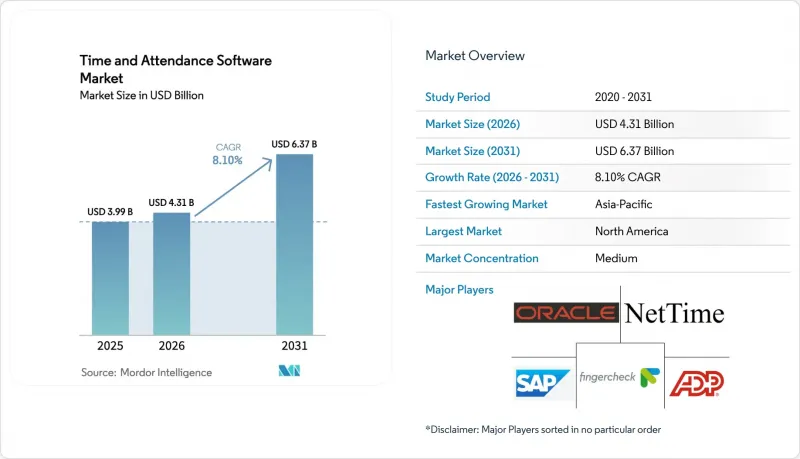
This report is Segmented by Component (Software, Services), Deployment Mode (On-Premise, Cloud), Organization Size (Small and Medium Enterprises, Large Enterprises), Application (Workforce Management and Scheduling, Core HR and Talent Acquisition, and More), End-User Industry (BFSI, Retail and E-Commerce, and More), and Geography. The Market Forecasts are Provided in Terms of Value (USD).
Global Time And Attendance Software Market Trends and Insights
Stringent Labor-Compliance Mandates Drive Adoption
Recent U.S. Department of Labor guidance on AI-based monitoring heightens record-keeping expectations, while the 2024 FLSA overtime threshold rules require more granular hour classification. European companies face parallel pressure under the Working Time Directive, spurring replacement of legacy systems that cannot automate multi-jurisdictional rules. AI monitoring amplifies legal complexity as firms balance productivity insights with worker privacy rights under GDPR and related statutes.
Hybrid and Remote Workforce Expansion Requires Cloud/Mobile Capture
With 80% of large organizations supporting mixed work patterns, demand has shifted to mobile-first systems that geofence location, authenticate biometrics, and sync data in real time. Cloud deployment removes on-premise constraints and aligns payroll across time zones. Vendors embed palm-vein and facial recognition to curb fraud while preserving convenience.
Data-Privacy and Biometric Regulations
Illinois' BIPA mandates explicit consent and imposes statutory damages, prompting firms to add consent workflows and local storage, thereby doubling some rollout budgets. GDPR further requires privacy-impact assessments and restricts cross-border data transfers, fragmenting system architectures.
Other drivers and restraints analyzed in the detailed report include:
- AI-Driven Productivity Analytics Optimize Labor Costs
- SMB Payroll Digitization via SaaS Platforms
- Integration Complexity with Legacy Systems
For complete list of drivers and restraints, kindly check the Table Of Contents.
Segment Analysis
Software held 67.35% of 2025 revenue, underscoring the primacy of cloud-native platforms in the time and attendance software market. Professional-services revenue is growing at 11.8% CAGR as organizations seek integration skills, biometric expertise, and compliance consulting. The services surge illustrates how complex deployments elevate demand for managed offerings that handle updates, rule changes, and mobile device management.
Services also differentiate vendors in an environment where core timekeeping functionality is commoditized. Managed services for SMEs outsource maintenance at predictable fees, freeing scarce IT staff. For global enterprises, consultancies configure multi-jurisdictional rule engines that codify overtime, break periods, and union agreements.
Cloud accounted for 71.25% of 2025 revenue and is expanding at an 11.35% CAGR, confirming that scalability and mobile accessibility outweigh legacy fears. Cloud platforms provide native smartphone apps with geofencing and biometric login, eliminating punch-clock hardware. Continuous software updates enable automatic compliance with evolving labor codes, an advantage on-premise systems cannot match.
Hybrid architectures persist where data sovereignty is critical, yet even those designs integrate public-cloud analytics for AI-driven insights. Vendors leverage cloud ecosystems to bundle payroll, onboarding, and analytics, deepening customer lock-in and extending average contract terms.
Complete Report Scope:
- By Component
- Software
- Stand-alone Time and Attendance Software
- Integrated HCM Suite Modules
- Services
- Professional Services
- Implementation and Integration
- Consulting and Training
- Managed Services
- Professional Services
- Software
- By Deployment Mode
- On-premise
- Cloud
- By Organization Size
- Small and Medium Enterprises
- Large Enterprises
- By Application
- Workforce Management and Scheduling
- Core HR and Talent Acquisition
- Payroll Integration and Compliance
- Other Applications
- By End-User Industry
- BFSI
- Retail and E-commerce
- IT and Telecommunications
- Government and Public Sector
- Healthcare and Life Sciences
- Manufacturing
- Education
- Other End-user Industries
- By Geography
- North America
- United States
- Canada
- Mexico
- Europe
- United Kingdom
- Germany
- France
- Italy
- Rest of Europe
- Asia-Pacific
- China
- Japan
- India
- South Korea
- Rest of Asia-Pacific
- South America
- Brazil
- Argentina
- Rest of South America
- Middle East and Africa
- Middle East
- GCC
- Turkey
- Israel
- Rest of Middle East
- Africa
- South Africa
- Nigeria
- Kenya
- Rest of Africa
- Middle East
- North America
Geography Analysis
North America commanded 34.55% of 2025 revenue, benefitting from strict overtime rules and advanced enterprise IT environments. Vendors such as UKG and Oracle iterate AI features rapidly, yet customer acquisition moderates as installed bases mature. Growth increasingly comes from upselling analytics, biometrics, and industry-specific modules rather than net-new logos.
Asia-Pacific is projected to grow at an 11.02% CAGR through 2031, propelled by government digitization drives and SME cloud readiness. Digital services trade in the region rose from USD 403.4 billion in 2005 to USD 1.4 trillion in 2019, underscoring a structural shift toward digital workflows. Local champions such as ZKTeco and Matrix pair competitive pricing with region-specific compliance features, while multinationals deepen channel partnerships.
Europe maintains steady expansion as GDPR enforces stringent biometric safeguards and the Working Time Directive continues to tighten record-keeping obligations. Public-sector digitization accelerates adoption, and manufacturing clusters in Germany and the Nordics deploy integrated attendance-and-shop-floor systems to lift productivity. Emerging markets in Latin America, the Middle East, and Africa remain earlier in the adoption curve, but cloud availability and mobile-first deployments lower entry barriers.
- SAP SE
- FingerCheck
- NETtime Solutions
- ADP, Inc.
- Oracle Corporation
- Reflexis Systems Inc.
- Replicon
- Ultimate Kronos Group (UKG)
- Paycor
- Paycom Software, Inc.
- Rippling
- Civica
- Ramco Systems
- Workday, Inc.
- Ceridian HCM
- ATOSS Software AG
- BambooHR LLC
- Zoho Corporation (Zoho People)
- Deputy Group Pty Ltd
- isolved HCM LLC
- Time Doctor LLC
- Kronotek
Additional Benefits:
- The market estimate (ME) sheet in Excel format
- 3 months of analyst support
TABLE OF CONTENTS
1 INTRODUCTION
- 1.1 Study Assumptions and Market Definition
- 1.2 Scope of the Study
2 RESEARCH METHODOLOGY
3 EXECUTIVE SUMMARY
4 MARKET LANDSCAPE
- 4.1 Market Overview
- 4.2 Market Drivers
- 4.2.1 Stringent Labor-Compliance Mandates (FLSA, EU Working Time Directive) Drives the Market
- 4.2.2 Hybrid and Remote Workforce Expansion Requiring Cloud/Mobile Time Capture
- 4.2.3 AI-Driven Productivity Analytics for Labor-Cost Optimization Drives the Market
- 4.2.4 SMB Digitization of Payroll and Time-Tracking via SaaS Platforms Drives the Market
- 4.2.5 Consolidation of HCM Modules to Reduce HR-Tech Stack Cost Drives the Market
- 4.3 Market Restraints
- 4.3.1 Data-Privacy and Biometric Regulations (GDPR, BIPA)
- 4.3.2 Integration Complexity with Legacy ERP and Payroll Systems
- 4.3.3 Price Sensitivity in Developing Economies Drives Manual/Freemium Use
- 4.3.4 Labor-Union Pushback on Perceived "Surveillance" Features
- 4.4 Value Chain Analysis
- 4.5 Regulatory Outlook
- 4.6 Technological Outlook
- 4.7 Porter's Five Forces Analysis
- 4.7.1 Bargaining Power of Suppliers
- 4.7.2 Bargaining Power of Buyers
- 4.7.3 Threat of New Entrants
- 4.7.4 Threat of Substitutes
- 4.7.5 Intensity of Competitive Rivalry
- 4.8 Assessment of Macro Economic Trends on the Market
5 MARKET SIZE and GROWTH FORECASTS (VALUES)
- 5.1 By Component
- 5.1.1 Software
- 5.1.1.1 Stand-alone Time and Attendance Software
- 5.1.1.2 Integrated HCM Suite Modules
- 5.1.2 Services
- 5.1.2.1 Professional Services
- 5.1.2.1.1 Implementation and Integration
- 5.1.2.1.2 Consulting and Training
- 5.1.2.2 Managed Services
- 5.1.2.1 Professional Services
- 5.1.1 Software
- 5.2 By Deployment Mode
- 5.2.1 On-premise
- 5.2.2 Cloud
- 5.3 By Organization Size
- 5.3.1 Small and Medium Enterprises
- 5.3.2 Large Enterprises
- 5.4 By Application
- 5.4.1 Workforce Management and Scheduling
- 5.4.2 Core HR and Talent Acquisition
- 5.4.3 Payroll Integration and Compliance
- 5.4.4 Other Applications
- 5.5 By End-User Industry
- 5.5.1 BFSI
- 5.5.2 Retail and E-commerce
- 5.5.3 IT and Telecommunications
- 5.5.4 Government and Public Sector
- 5.5.5 Healthcare and Life Sciences
- 5.5.6 Manufacturing
- 5.5.7 Education
- 5.5.8 Other End-user Industries
- 5.6 By Geography
- 5.6.1 North America
- 5.6.1.1 United States
- 5.6.1.2 Canada
- 5.6.1.3 Mexico
- 5.6.2 Europe
- 5.6.2.1 United Kingdom
- 5.6.2.2 Germany
- 5.6.2.3 France
- 5.6.2.4 Italy
- 5.6.2.5 Rest of Europe
- 5.6.3 Asia-Pacific
- 5.6.3.1 China
- 5.6.3.2 Japan
- 5.6.3.3 India
- 5.6.3.4 South Korea
- 5.6.3.5 Rest of Asia-Pacific
- 5.6.4 South America
- 5.6.4.1 Brazil
- 5.6.4.2 Argentina
- 5.6.4.3 Rest of South America
- 5.6.5 Middle East and Africa
- 5.6.5.1 Middle East
- 5.6.5.1.1 GCC
- 5.6.5.1.2 Turkey
- 5.6.5.1.3 Israel
- 5.6.5.1.4 Rest of Middle East
- 5.6.5.2 Africa
- 5.6.5.2.1 South Africa
- 5.6.5.2.2 Nigeria
- 5.6.5.2.3 Kenya
- 5.6.5.2.4 Rest of Africa
- 5.6.5.1 Middle East
- 5.6.1 North America
6 COMPETITIVE LANDSCAPE
- 6.1 Market Concentration
- 6.2 Market Share Analysis
- 6.3 Vendor Ranking Analysis
- 6.4 Company Profiles (includes Global level Overview, Market level overview, Core Segments, Financials as available, Strategic Information, Market Rank/Share for key companies, Products and Services, and Recent Developments)
- 6.4.1 SAP SE
- 6.4.2 FingerCheck
- 6.4.3 NETtime Solutions
- 6.4.4 ADP, Inc.
- 6.4.5 Oracle Corporation
- 6.4.6 Reflexis Systems Inc.
- 6.4.7 Replicon
- 6.4.8 Ultimate Kronos Group (UKG)
- 6.4.9 Paycor
- 6.4.10 Paycom Software, Inc.
- 6.4.11 Rippling
- 6.4.12 Civica
- 6.4.13 Ramco Systems
- 6.4.14 Workday, Inc.
- 6.4.15 Ceridian HCM
- 6.4.16 ATOSS Software AG
- 6.4.17 BambooHR LLC
- 6.4.18 Zoho Corporation (Zoho People)
- 6.4.19 Deputy Group Pty Ltd
- 6.4.20 isolved HCM LLC
- 6.4.21 Time Doctor LLC
- 6.4.22 Kronotek
7 MARKET OPPORTUNITIES AND FUTURE OUTLOOK
- 7.1 White-space and Unmet-Need Assessment

