PUBLISHER: Mordor Intelligence | PRODUCT CODE: 2125455

PUBLISHER: Mordor Intelligence | PRODUCT CODE: 2125455
Lip Care Products - Market Share Analysis, Industry Trends & Statistics, Growth Forecasts (2026 - 2031)
According to Mordor Intelligence, the lip care products market size is expected to increase from USD 3.38 billion in 2025 to USD 3.55 billion in 2026 and reach USD 4.62 billion by 2031, growing at a CAGR of 5.41% over 2026-2031.
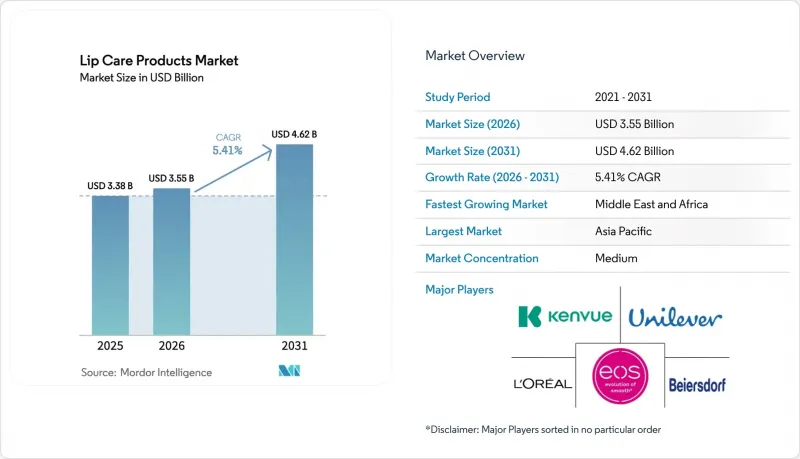
This report is Segmented by Product Type (Lip Balms, Lip Masks, Lip Salves, Lip Scrubs, Other Types), Nature (Conventional, Natural/Organic), Category (Mass, Premium), Packaging Type (Tubes, Tins, Jars), Distribution Channel (Supermarkets/Hypermarkets, Pharmacies/Drug Stores, Specialty Stores, and More), and Geography (North America, Europe, and More). Market Forecasts are Provided in Terms of Value (USD).
Global Lip Care Products Market Trends and Insights
Rising consumer focus on lip health, appearance, and everyday grooming routines
Consumer emphasis on lip health, appearance, and grooming routines is reshaping the lip care products market, as lips become integral to daily skincare and beauty regimens. In 2024, according to the Office for National Statistics (UK), UK households allocated approximately GBP 37.9 billion to personal care products and services, reflecting a readiness to invest in grooming essentials . This trend has elevated products like lip balms, scrubs, and tinted treatments from occasional use to everyday necessities. Established brands such as Vaseline and Nivea have diversified their offerings to include targeted repairing and moisturizing sticks, embedding lip care into daily skincare routines. Concurrently, beauty-focused companies like Fenty Beauty and Maybelline are integrating conditioning ingredients into glosses and tinted balms, addressing consumer demand for both aesthetic enhancement and long-term lip health. Rising awareness of environmental factors, including sun and pollution, has further driven demand for SPF and barrier-protective formats, emphasized by brands like La Roche-Posay and Aquaphor. Social media trends promoting multi-step lip routines and innovations in clean, multifunctional formulations, such as Burt's Bees' natural wax-based balms and Laneige-style overnight masks, are also contributing to market growth. North America and Europe, with their advanced beauty markets, continue to lead in premiumization trends, influencing global adoption and product positioning.
Strong demand for multifunctional lip products offering hydration, SPF protection, and anti-aging benefits
Consumer demand for multifunctional lip products that combine hydration, SPF protection, and anti-aging benefits is reshaping the lip care market. This shift reflects a preference for streamlined solutions addressing multiple concerns, driven by daily exposure to environmental stressors. Basic lip balms are evolving into advanced formulations incorporating ingredients like hyaluronic acid and ceramides for intense hydration, alongside broad-spectrum UV filters to combat dryness, chapping, and premature aging. Brands such as Cetaphil Protective Lip Balm exemplify this trend with SPF 50 lip balms formulated with Ethylhexyl Methoxycinnamate, meeting regulatory standards while aligning with minimalist skincare routines. Anti-aging actives, including peptides, are increasingly incorporated to target fine lines and improve elasticity, appealing to consumers seeking products that deliver visible results. For example, Lotus Herbals offers peptide-infused balms that strengthen the skin barrier while providing hydration and protection against pollution and sun damage. Social media and the "skinification" trend further amplify the adoption of products like Laneige's lip serums and overnight treatments, which repair and rejuvenate during sleep. Additionally, clean formulations using natural waxes instead of petrolatum enhance ingredient bioavailability without compromising texture. Regional climates, particularly in the Middle East and Africa, are influencing the development of climate-adaptive, multifunctional products designed for year-round use.
Difficulties in sourcing consistent-quality natural and organic ingredients
Sourcing consistent-quality natural and organic ingredients presents significant challenges for the lip care industry, as fluctuating availability and variability disrupt the production of clean beauty formulations. Consumers increasingly demand vegan and cruelty-free options, driven by trends in everyday grooming and multifunctional products. Brands like Burt's Bees face difficulties due to reliance on organic beeswax and peppermint sourced from regions prone to seasonal shortages, leading to formulation changes that may compromise hydration and SPF performance. Climate variability and regional biodiversity limitations further complicate the supply chain for natural actives such as shea butter and jojoba, delaying the introduction of anti-aging peptides and barrier-protective hybrids sought after in men's grooming products. Ethical sourcing requirements for alternatives like candelilla wax add regulatory complexities, slowing innovation in climate-adaptive solutions for pollution-exposed routines. Social media-driven consumer expectations amplify scrutiny, as variability in plant chemistry impacts product texture and efficacy, challenging brands to maintain premium quality without synthetic stabilizers. Diversifying suppliers mitigates single-source risks but increases costs for organic certifications, pressuring price-sensitive male consumers expanding beyond basic balms. Additionally, regulatory measures like the European Union Deforestation Regulation (EUDR) on palm derivatives limit ingredient options, further restraining the shift from petrolatum-based products to natural, multifunctional solutions.
Other drivers and restraints analyzed in the detailed report include:
- Growing preference for natural, organic, vegan, and cruelty-free formulations
- Expanding male grooming segment boosting demand for men-specific lip care solutions
- Consumer concerns over irritation, allergies, and product sensitivity risks
For complete list of drivers and restraints, kindly check the Table Of Contents.
Segment Analysis
Lip balms represent the largest share of the lip care products market, accounting for 86.62% of the projected 2025 revenue. These products are widely recognized as daily-use essentials, addressing consumer needs for hydration, SPF protection, and overall lip health. Their affordability and availability through supermarkets, pharmacies, and convenience stores drive broad adoption, including among male grooming segments and clean beauty consumers. Despite challenges in sourcing natural ingredients, lip balms remain integral to everyday grooming routines. Brands like Carmex, offering medicated relief in classic stick formats, further reinforce their role in routine integration while minimizing irritation risks for most users.
Lip scrubs, with a projected annual growth rate of 7.16% through 2031, are emerging as a fast-growing segment. These products complement lip balms by enabling multi-step care routines inspired by facial skincare practices. They address dryness and flakiness, preparing lips for the application of masks or tints, and appeal to consumers seeking vegan and organic formulations. Products like Fresh Sugar Lip Polish exemplify this trend, offering gentle exfoliation that smooths lips and enhances the absorption of anti-aging serums. This segment is also contributing to premiumization while addressing consumer concerns about allergies and synthetic irritants.
Conventional formulations are expected to account for the largest share, commanding 84.66% of the revenue in 2025. This is driven by mass-market brands focusing on cost efficiency, shelf stability, and broad retail distribution, catering to everyday grooming needs and the growing male consumer segment. These products rely on synthetic emollients like dimethicone and phenyl trimethicone, preservatives such as phenoxyethanol and approved parabens, and petroleum-derived waxes including petrolatum and microcrystalline wax. These ingredients ensure reliable hydration, SPF integration, and consistent texture, making them widely available in supermarkets and pharmacies. The stability of these formulations supports multifunctional demands, enabling brands like ChapStick to deliver consistent performance in tinted sticks that minimize irritation risks for regular users while addressing sourcing challenges in organic alternatives.
Natural and organic variants are projected to grow at a CAGR of 6.90% through 2031, driven by increasing demand for ingredient transparency, allergen avoidance, and environmental sustainability. These products align with consumer preferences for vegan, cruelty-free options and multi-step skincare routines. Despite challenges such as price volatility for shea butter and cocoa butter, higher organic certification costs, and extended lead times, these products command higher per-unit prices and foster loyalty among consumers upgrading to premium offerings like scrubs and masks. Brands such as Lush exemplify this trend with 100% natural lip scrubs and balms, addressing sensitivity concerns while offering premium formulations for daytime protection and overnight recovery.
Complete Report Scope:
- By Product Type
- Lip Balms
- Lip Masks
- Lip Salve
- Lip Scrubs
- Other Types (Lip Serums, Oils, Powders, Creams)
- Lip Balms
- By Nature
- Conventional
- Natural/Organic
- By Category
- Mass
- Premium
- By Packaging Type
- Tubes
- Tins
- Jars
- By Distribution Channel
- Supermarkets/Hypermarkets
- Pharmacies/Drug Stores
- Specialty Stores
- Online Retail Stores
- Other Distribution Channels
- By Geography
- North America
- United States
- Canada
- Mexico
- Rest of North America
- Europe
- Germany
- United Kingdom
- Italy
- France
- Spain
- Netherlands
- Poland
- Belgium
- Sweden
- Rest of Europe
- Asia-Pacific
- China
- India
- Japan
- Australia
- Indonesia
- South Korea
- Thailand
- Singapore
- Rest of Asia-Pacific
- South America
- Brazil
- Argentina
- Colombia
- Chile
- Peru
- Rest of South America
- Middle East and Africa
- South Africa
- Saudi Arabia
- United Arab Emirates
- Nigeria
- Egypt
- Morocco
- Turkey
- Rest of Middle East and Africa
- North America
Geography Analysis
Asia-Pacific held the largest share of 36.89% in the projected 2025 revenue for lip care products. This dominance is attributed to humid climates that drive product usage and encourage repeat purchases, alongside rising disposable incomes in India and Southeast Asia. Urbanization and the growth of digital commerce in India have improved access to both mass-market and premium lip care products, while regulatory frameworks are enhancing quality standards. The influence of K-beauty trends has accelerated the adoption of hybrid products that combine hydration, tint, and gloss in a single offering. Brands like Innisfree have capitalized on this trend by aligning their multifunctional lip balms with regional preferences. In China, compliance requirements from the National Medical Products Administration, including pre-market registration and ingredient safety assessments, add complexity but reinforce consumer trust. The ASEAN Cosmetic Directive simplifies market entry across key countries, though halal certification requirements from bodies like JAKIM and Majelis Ulama Indonesia provide access to ethically conscious consumers.
The Middle East and Africa region is expected to grow at the fastest annual rate of 6.47% through 2031. This growth is driven by increasing demand for halal-certified cosmetics, rapid urbanization in GCC states, and climate extremes that necessitate barrier-repair formulations. Hot and arid conditions, coupled with prolonged sun exposure, have increased the demand for long-wear lip products with SPF and hydration-locking ingredients such as hyaluronic acid and ceramides. In markets like the United Arab Emirates, a strong mall culture coexists with growing digital adoption, supporting omnichannel distribution for both premium and mass-market brands. Climate-induced dryness from air-conditioning has further amplified the preference for occlusive and moisture-sealing formulations, while halal certification enhances trust by aligning ingredient transparency with religious compliance.
North America and Europe remain significant markets due to their mature retail infrastructure and stringent regulatory standards, which often set global benchmarks. The European Union Cosmetics Regulation (EC) No 1223/2009 mandates comprehensive safety assessments, restricts over 1,600 substances, and requires the disclosure of 26 fragrance allergens, increasing formulation complexity while bolstering consumer confidence. In North America, brands like Burt's Bees leverage their natural product positioning within this regulatory framework to build trust and loyalty. South American markets, including Brazil, Argentina, and Colombia, benefit from rising middle-class incomes and deeper digital commerce penetration, though regulatory fragmentation and import tariffs pose challenges. In Africa outside MENA, urbanization and mobile commerce are creating long-term potential in countries like South Africa and Nigeria, though infrastructure gaps and currency volatility currently temper growth prospects.
- Unilever PLC
- L'Oreal SA
- The Clorox Company
- The Estee Lauder Companies
- Kenvue Inc.
- Revlon Inc
- Beiersdorf AG
- Carma Laboratories, Inc.
- Shiseido Company, Limited
- LVMH Moet Hennessy Louis Vuitton
- EOS Products LLC
- Amorepacific Corporation
- Kao Corporation
- Natura &Co Holding S.A.
- Oriflame Holding Limited
- L'Occitane International SA
- Blistex Inc.
- Rohto Pharmaceutical Co
- Himalaya Global Holdings Ltd.
- Dr. Bronner's
Additional Benefits:
- The market estimate (ME) sheet in Excel format
- 3 months of analyst support
TABLE OF CONTENTS
1 INTRODUCTION
- 1.1 Study Assumptions and Market Definition
- 1.2 Scope of the Study
2 RESEARCH METHODOLOGY
3 EXECUTIVE SUMMARY
4 MARKET DYNAMICS
- 4.1 Market Overview
- 4.2 Market Drivers
- 4.2.1 Rising consumer awareness about personal grooming and health of lips
- 4.2.2 Increasing demand for multifunctional lip care products combining hydration, sun protection, and anti-aging benefits
- 4.2.3 Growing popularity of natural, organic, and cruelty-free ingredients in lip care formulations
- 4.2.4 Hybrid "care X color" balms and oils boom
- 4.2.5 Rising demand for male grooming products driving growth in men's lip care categories
- 4.2.6 Surging trend of customization and personalization in lip care products
- 4.3 Market Restraints
- 4.3.1 Ingredient sourcing challenges especially for natural and organic components
- 4.3.2 Concerns about allergic reactions or sensitivity from some lip care products
- 4.3.3 Supply chain disruptions impacting availability and pricing of raw materials
- 4.3.4 Sustainability pressures increasing packaging costs for manufacturers
- 4.4 Value Chain Analysis
- 4.5 Regulatory Landscape
- 4.6 Technological Outlook
- 4.7 Porter's Five Forces Analysis
- 4.7.1 Threat of New Entrants
- 4.7.2 Bargaining Power of Suppliers
- 4.7.3 Bargaining Power of Buyers
- 4.7.4 Threat of Substitutes
- 4.7.5 Competitive Rivalry
5 MARKET SIZE AND GROWTH FORECASTS (VALUE)
- 5.1 By Product Type
- 5.1.1 Lip Balms
- 5.1.1.1 Lip Masks
- 5.1.1.2 Lip Salve
- 5.1.2 Lip Scrubs
- 5.1.3 Other Types (Lip Serums, Oils, Powders, Creams)
- 5.1.1 Lip Balms
- 5.2 By Nature
- 5.2.1 Conventional
- 5.2.2 Natural/Organic
- 5.3 By Category
- 5.3.1 Mass
- 5.3.2 Premium
- 5.4 By Packaging Type
- 5.4.1 Tubes
- 5.4.2 Tins
- 5.4.3 Jars
- 5.5 By Distribution Channel
- 5.5.1 Supermarkets/Hypermarkets
- 5.5.2 Pharmacies/Drug Stores
- 5.5.3 Specialty Stores
- 5.5.4 Online Retail Stores
- 5.5.5 Other Distribution Channels
- 5.6 By Geography
- 5.6.1 North America
- 5.6.1.1 United States
- 5.6.1.2 Canada
- 5.6.1.3 Mexico
- 5.6.1.4 Rest of North America
- 5.6.2 Europe
- 5.6.2.1 Germany
- 5.6.2.2 United Kingdom
- 5.6.2.3 Italy
- 5.6.2.4 France
- 5.6.2.5 Spain
- 5.6.2.6 Netherlands
- 5.6.2.7 Poland
- 5.6.2.8 Belgium
- 5.6.2.9 Sweden
- 5.6.2.10 Rest of Europe
- 5.6.3 Asia-Pacific
- 5.6.3.1 China
- 5.6.3.2 India
- 5.6.3.3 Japan
- 5.6.3.4 Australia
- 5.6.3.5 Indonesia
- 5.6.3.6 South Korea
- 5.6.3.7 Thailand
- 5.6.3.8 Singapore
- 5.6.3.9 Rest of Asia-Pacific
- 5.6.4 South America
- 5.6.4.1 Brazil
- 5.6.4.2 Argentina
- 5.6.4.3 Colombia
- 5.6.4.4 Chile
- 5.6.4.5 Peru
- 5.6.4.6 Rest of South America
- 5.6.5 Middle East and Africa
- 5.6.5.1 South Africa
- 5.6.5.2 Saudi Arabia
- 5.6.5.3 United Arab Emirates
- 5.6.5.4 Nigeria
- 5.6.5.5 Egypt
- 5.6.5.6 Morocco
- 5.6.5.7 Turkey
- 5.6.5.8 Rest of Middle East and Africa
- 5.6.1 North America
6 COMPETITIVE LANDSCAPE
- 6.1 Market Concentration
- 6.2 Strategic Moves
- 6.3 Market Share Analysis
- 6.4 Company Profiles (includes Global level Overview, Market level overview, Core Segments, Financials as available, Strategic Information, Market Rank/Share for key companies, Products and Services, and Recent Developments)
- 6.4.1 Unilever PLC
- 6.4.2 L'Oreal SA
- 6.4.3 The Clorox Company
- 6.4.4 The Estee Lauder Companies
- 6.4.5 Kenvue Inc.
- 6.4.6 Revlon Inc
- 6.4.7 Beiersdorf AG
- 6.4.8 Carma Laboratories, Inc.
- 6.4.9 Shiseido Company, Limited
- 6.4.10 LVMH Moet Hennessy Louis Vuitton
- 6.4.11 EOS Products LLC
- 6.4.12 Amorepacific Corporation
- 6.4.13 Kao Corporation
- 6.4.14 Natura &Co Holding S.A.
- 6.4.15 Oriflame Holding Limited
- 6.4.16 L'Occitane International SA
- 6.4.17 Blistex Inc.
- 6.4.18 Rohto Pharmaceutical Co
- 6.4.19 Himalaya Global Holdings Ltd.
- 6.4.20 Dr. Bronner's
7 MARKET OPPORTUNITIES AND FUTURE OUTLOOK

