PUBLISHER: Mordor Intelligence | PRODUCT CODE: 2125481

PUBLISHER: Mordor Intelligence | PRODUCT CODE: 2125481
Online Cosmetics - Market Share Analysis, Industry Trends & Statistics, Growth Forecasts (2026 - 2031)
According to Mordor Intelligence, the online cosmetics market size is expected to grow from USD 22.02 billion in 2025 to USD 23.48 billion in 2026 and is forecast to reach USD 32.34 billion by 2031 at 6.62% CAGR over 2026-2031.
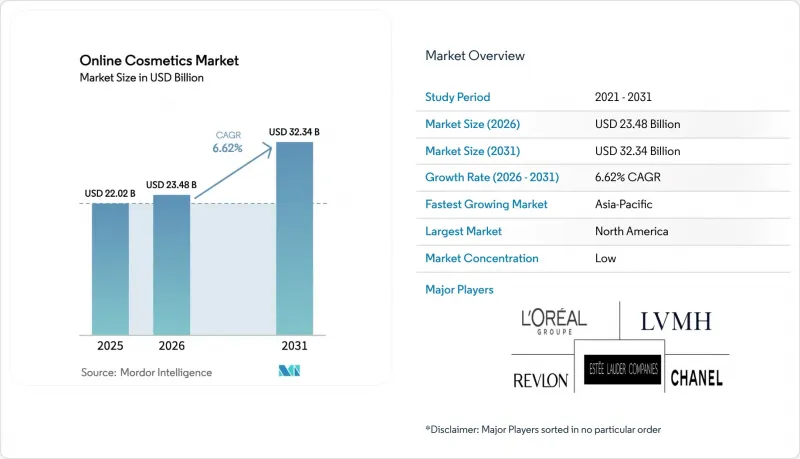
This report is Segmented by Product Type (Facial Cosmetics, Eye Cosmetics, Lip Cosmetics, and Nail Cosmetics), Category (Conventional and Organic), Price Range (Mass and Premium), Distribution Channel (Third-Party Retailer Platform, and Company-Owned Platform), and Geography (North America, Europe, and More). The Market Forecasts are Provided in Terms of Value (USD).
Global Online Cosmetics Market Trends and Insights
Personalization and Virtual Try-Ons
Advanced AI-powered personalization technologies are reshaping customer acquisition and retention strategies, with virtual try-on applications demonstrating measurable conversion improvements that justify significant technology investments. L'Oreal's Makeup Genius app has generated over 20 million downloads, while partnership case studies show conversion rates nearly doubling when consumers engage with AI-powered skincare advisors. The technology's impact extends beyond customer experience to supply chain optimization, enabling brands to predict demand patterns and reduce inventory risks through personalized product recommendations. Regulatory compliance frameworks under FDA's cosmetics modernization requirements favor companies with robust data collection capabilities, as personalization engines generate the traceability data needed for adverse event reporting and safety substantiation. The convergence of AI personalization with regulatory requirements creates competitive advantages for digitally native brands while challenging traditional players to accelerate their technology adoption timelines.
Expansion of Premium and Luxury Brands Online
Premium beauty brands are abandoning previous digital hesitancy as online channels prove capable of delivering the high-touch experiences previously exclusive to physical retail environments. Estee Lauder's expansion into Amazon Premium Beauty stores represents a strategic shift toward marketplace partnerships that maintain brand prestige while accessing broader customer bases. The premium segment's 7.37% CAGR outpaces mass market growth, driven by consumers' willingness to pay higher prices for authentic brand experiences and exclusive product access. Digital luxury positioning requires sophisticated content strategies and influencer partnerships, with brands investing heavily in virtual boutique experiences and limited-edition online exclusives. This premiumization trend creates margin expansion opportunities for established players while raising barriers to entry for new competitors lacking brand heritage and digital sophistication.
Increasing Market Penetration of Counterfeit Products
Counterfeit cosmetics proliferation threatens brand integrity and consumer safety, with fake products often containing dangerous substances including lead, beryllium, and harmful bacteria that pose serious health risks . The problem intensifies in online marketplaces where product authentication becomes challenging, particularly for premium brands whose higher margins make counterfeiting financially attractive. E-commerce platforms struggle to implement effective screening mechanisms, as sophisticated counterfeiters replicate packaging and product appearance while selling through unauthorized channels at significant discounts. The issue disproportionately affects developing markets where price sensitivity makes consumers more susceptible to deeply discounted fake products, potentially damaging brand reputation and customer trust. Brands are investing in blockchain-based authentication systems and working with platforms to improve seller verification, but the global nature of online commerce makes comprehensive enforcement difficult.
Other drivers and restraints analyzed in the detailed report include:
- Convenience and Timesaving
- Demand for Organic and Natural Products
- Consumer Awareness of Chemical Ingredients in Products Restricts Growth
For complete list of drivers and restraints, kindly check the Table Of Contents.
Segment Analysis
Facial cosmetics command 38.62% market share in 2025, reflecting their central role in daily beauty routines and the category's adaptability to digital shopping experiences through virtual try-on technologies and AI-powered shade matching. The segment benefits from frequent repurchase cycles and seasonal product launches that drive consistent revenue streams, while foundation and concealer subcategories leverage advanced formulation technologies that appeal to quality-conscious consumers. BB and CC creams gain traction as multifunctional products that align with convenience trends, offering skincare benefits alongside coverage that resonates with time-pressed consumers seeking simplified routines. Eye cosmetics maintain steady demand through social media-driven makeup tutorials, with kohl and kajal products particularly strong in Asian markets where cultural preferences drive consistent usage patterns.
Nail cosmetics emerge as the fastest-growing segment at 7.03% CAGR through 2031, driven by nail art trends popularized on social media platforms and the category's accessibility for experimentation without permanent commitment. The segment benefits from lower price points that encourage frequent purchases and color experimentation, while gel and long-lasting formulations meet consumer demands for durability and professional appearance. Lip cosmetics face intensifying competition from multifunctional products but maintain relevance through innovative textures and hybrid formulations that combine color with skincare benefits. The product type segmentation reflects broader industry trends toward personalization and multifunctionality, with successful brands investing in technology platforms that help consumers navigate extensive product ranges and find optimal matches for their specific needs and preferences.
Conventional products maintain 71.45% market share in 2025, demonstrating the continued dominance of traditional formulations that offer proven performance and accessible pricing for mass market consumers. The conventional segment benefits from established supply chains and manufacturing efficiencies that enable competitive pricing while meeting diverse consumer needs across multiple demographics and income levels. However, organic products surge ahead with 8.19% CAGR, reflecting consumer willingness to pay premium prices for products perceived as safer and more environmentally responsible. The organic segment's growth trajectory indicates a fundamental shift in consumer values, particularly among younger demographics who prioritize ingredient transparency and sustainability over price considerations.
USDA organic certification requirements create both opportunities and challenges for brands, as compliance with agricultural ingredient standards enables premium positioning while adding complexity to sourcing and manufacturing processes. The category distinction increasingly influences product development strategies, with conventional brands incorporating natural ingredients to appeal to health-conscious consumers while organic specialists focus on expanding product ranges and improving performance characteristics. The growth differential between categories suggests a gradual market evolution toward cleaner formulations, though conventional products will likely maintain majority share due to price sensitivity and performance requirements in specific product categories.
Complete Report Scope:
- By Product Type
- Facial Cosmetics
- Foundation
- Compact and Pressed Powder
- Highlighter
- Blush
- Concealer
- Make-Up Remover
- BB and CC Creams
- Others
- Eye Cosmetics
- Kohl and Kajal
- Eyeliners
- Mascara
- Others
- Lip Cosmetics
- Lipsticks
- Lip Gloss
- Others
- Nail Cosmetics
- Nail Polish
- Nail Polish Remover
- Facial Cosmetics
- By Category
- Conventional
- Organic
- By Price Range
- Mass
- Premium
- By Distribution Channel
- Third-Party Retailer Platform
- Company-Owned Platform
- By Geography
- North America
- United States
- Canada
- Mexico
- Rest of North America
- Europe
- Germany
- United Kingdom
- Italy
- France
- Spain
- Netherlands
- Poland
- Belgium
- Sweden
- Rest of Europe
- Asia-Pacific
- China
- India
- Japan
- Australia
- Indonesia
- South Korea
- Thailand
- Singapore
- Rest of Asia-Pacific
- South America
- Brazil
- Argentina
- Colombia
- Chile
- Peru
- Rest of South America
- Middle East and Africa
- South Africa
- Saudi Arabia
- United Arab Emirates
- Nigeria
- Egypt
- Morocco
- Turkey
- Rest of Middle East and Africa
- North America
Geography Analysis
North America commands 36.10% market share in 2025 while growing at a moderate pace, reflecting market maturity and the region's early adoption of e-commerce beauty shopping that created established consumer behaviors and competitive dynamics. The United States drives regional performance through sophisticated digital infrastructure and high consumer spending power that supports frequent beauty purchases and premium product adoption. Canada contributes steady growth through cross-border e-commerce facilitation and consumer preferences that align closely with U.S. trends, while Mexico represents an emerging opportunity as digital payment systems and logistics networks improve access to online beauty products. The region's growth trajectory reflects saturation in traditional categories offset by premiumization trends and the expansion of specialized segments like clean beauty and personalized products that command higher margins.
Asia-Pacific emerges as the fastest-growing region at 6.94% CAGR through 2031, driven by China's digital commerce leadership where beauty e-commerce penetration exceeds 40% and livestreaming commerce creates immediate purchase decisions through real-time product demonstrations. India represents significant untapped potential with digital beauty sales currently at 10% but rapidly expanding as mobile commerce infrastructure improves and disposable incomes rise among urban consumers. Japan maintains strong market presence, indicating opportunities for brands that can bridge digital and physical experiences through omnichannel strategies. South Korea leads innovation in K-beauty trends and digital marketing approaches that influence global beauty standards, while Southeast Asian markets benefit from increasing internet penetration and growing middle-class populations seeking quality beauty products.
Europe demonstrates steady growth supported by strong consumer preferences for organic and natural products that align with regional sustainability values and regulatory frameworks that favor clean beauty formulations. Germany and the United Kingdom lead regional e-commerce adoption with sophisticated logistics networks and consumer familiarity with online beauty shopping, while France maintains its position as a global beauty innovation center through luxury brand heritage and premium product development. The region's fragmented regulatory landscape creates complexity for online sellers but also opportunities for brands that can navigate compliance requirements across multiple markets while leveraging the European Union's digital single market initiatives. Smaller European markets benefit from cross-border e-commerce facilitation and shared cultural preferences that enable regional marketing strategies and distribution efficiencies.
List of Companies Covered in this Report:
- L'Oreal S.A.
- Estee Lauder Inc.
- LVMH Moet Hennessy Louis Vuitton SE
- Shiseido Company, Limited
- Puig Brands S.A.
- JAB Holding Company
- Revlon
- e.l.f. Beauty, Inc.
- Kose Corporation
- Huda Beauty Limited
- Seed Beauty, LLC
- Anastasia Beverly Hills, LLC
- Rare Beauty, LLC
- CHANEL
- Mary Kay Inc.
- Amorepacific Corporation
- Natura &Co Holding S.A.
- Beiersdorf AG
- Oriflame Holding AG
- Clarins S.A.
Additional Benefits:
- The market estimate (ME) sheet in Excel format
- 3 months of analyst support
TABLE OF CONTENTS
1 INTRODUCTION
- 1.1 Study Assumptions and Market Definition
- 1.2 Scope of the Study
2 RESEARCH METHODOLOGY
3 EXECUTIVE SUMMARY
4 MARKET LANDSCAPE
- 4.1 Market Overview
- 4.2 Market Drivers
- 4.2.1 Personalization and Virtual Try-Ons
- 4.2.2 Expansion of Premium and Luxury Brands Online
- 4.2.3 Convenience and Time-Saving
- 4.2.4 Innovative Marketing and E-commerce Strategies
- 4.2.5 Social Media Influence
- 4.2.6 Demand for Organic and Natural Products
- 4.3 Market Restraints
- 4.3.1 Increasing Market Penetration of Counterfeit Products
- 4.3.2 Consumer Awareness of Chemical Ingredients in Products Restricts Growth
- 4.3.3 Impact of Strict Regulations on New Product Development
- 4.3.4 Premium Pricing of Organic and Natural Products
- 4.4 Consumer Behaviour Analysis
- 4.5 Regulatory Landscape
- 4.6 Porter's Five Forces
- 4.6.1 Threat of New Entrants
- 4.6.2 Bargaining Power of Buyers
- 4.6.3 Bargaining Power of Suppliers
- 4.6.4 Threat of Substitutes
- 4.6.5 Competitive Rivalry
5 MARKET SIZE AND GROWTH FORECASTS (VALUE)
- 5.1 By Product Type
- 5.1.1 Facial Cosmetics
- 5.1.1.1 Foundation
- 5.1.1.2 Compact and Pressed Powder
- 5.1.1.3 Highlighter
- 5.1.1.4 Blush
- 5.1.1.5 Concealer
- 5.1.1.6 Make-Up Remover
- 5.1.1.7 BB and CC Creams
- 5.1.1.8 Others
- 5.1.2 Eye Cosmetics
- 5.1.2.1 Kohl and Kajal
- 5.1.2.2 Eyeliners
- 5.1.2.3 Mascara
- 5.1.2.4 Others
- 5.1.3 Lip Cosmetics
- 5.1.3.1 Lipsticks
- 5.1.3.2 Lip Gloss
- 5.1.3.3 Others
- 5.1.4 Nail Cosmetics
- 5.1.4.1 Nail Polish
- 5.1.4.2 Nail Polish Remover
- 5.1.1 Facial Cosmetics
- 5.2 By Category
- 5.2.1 Conventional
- 5.2.2 Organic
- 5.3 By Price Range
- 5.3.1 Mass
- 5.3.2 Premium
- 5.4 By Distribution Channel
- 5.4.1 Third-Party Retailer Platform
- 5.4.2 Company-Owned Platform
- 5.5 By Geography
- 5.5.1 North America
- 5.5.1.1 United States
- 5.5.1.2 Canada
- 5.5.1.3 Mexico
- 5.5.1.4 Rest of North America
- 5.5.2 Europe
- 5.5.2.1 Germany
- 5.5.2.2 United Kingdom
- 5.5.2.3 Italy
- 5.5.2.4 France
- 5.5.2.5 Spain
- 5.5.2.6 Netherlands
- 5.5.2.7 Poland
- 5.5.2.8 Belgium
- 5.5.2.9 Sweden
- 5.5.2.10 Rest of Europe
- 5.5.3 Asia-Pacific
- 5.5.3.1 China
- 5.5.3.2 India
- 5.5.3.3 Japan
- 5.5.3.4 Australia
- 5.5.3.5 Indonesia
- 5.5.3.6 South Korea
- 5.5.3.7 Thailand
- 5.5.3.8 Singapore
- 5.5.3.9 Rest of Asia-Pacific
- 5.5.4 South America
- 5.5.4.1 Brazil
- 5.5.4.2 Argentina
- 5.5.4.3 Colombia
- 5.5.4.4 Chile
- 5.5.4.5 Peru
- 5.5.4.6 Rest of South America
- 5.5.5 Middle East and Africa
- 5.5.5.1 South Africa
- 5.5.5.2 Saudi Arabia
- 5.5.5.3 United Arab Emirates
- 5.5.5.4 Nigeria
- 5.5.5.5 Egypt
- 5.5.5.6 Morocco
- 5.5.5.7 Turkey
- 5.5.5.8 Rest of Middle East and Africa
- 5.5.1 North America
6 COMPETITIVE LANDSCAPE
- 6.1 Market Concentration
- 6.2 Strategic Moves
- 6.3 Market Share Analysis
- 6.4 Company Profiles (includes Global level Overview, Market level overview, Core Segments, Financials as available, Strategic Information, Market Rank/Share for key companies, Products and Services, and Recent Developments)
- 6.4.1 L'Oreal S.A.
- 6.4.2 Estee Lauder Inc.
- 6.4.3 LVMH Moet Hennessy Louis Vuitton SE
- 6.4.4 Shiseido Company, Limited
- 6.4.5 Puig Brands S.A.
- 6.4.6 JAB Holding Company
- 6.4.7 Revlon
- 6.4.8 e.l.f. Beauty, Inc.
- 6.4.9 Kose Corporation
- 6.4.10 Huda Beauty Limited
- 6.4.11 Seed Beauty, LLC
- 6.4.12 Anastasia Beverly Hills, LLC
- 6.4.13 Rare Beauty, LLC
- 6.4.14 CHANEL
- 6.4.15 Mary Kay Inc.
- 6.4.16 Amorepacific Corporation
- 6.4.17 Natura &Co Holding S.A.
- 6.4.18 Beiersdorf AG
- 6.4.19 Oriflame Holding AG
- 6.4.20 Clarins S.A.
7 MARKET OPPORTUNITIES AND FUTURE OUTLOOK

