PUBLISHER: Mordor Intelligence | PRODUCT CODE: 2125484

PUBLISHER: Mordor Intelligence | PRODUCT CODE: 2125484
ELISA Analyzer - Market Share Analysis, Industry Trends & Statistics, Growth Forecasts (2026 - 2031)
According to Mordor Intelligence, the ELISA analyzer market size is expected to increase from USD 712.56 million in 2025 to USD 734.73 million in 2026 and reach USD 888.52 million by 2031, growing at a CAGR of 3.87% over 2026-2031.
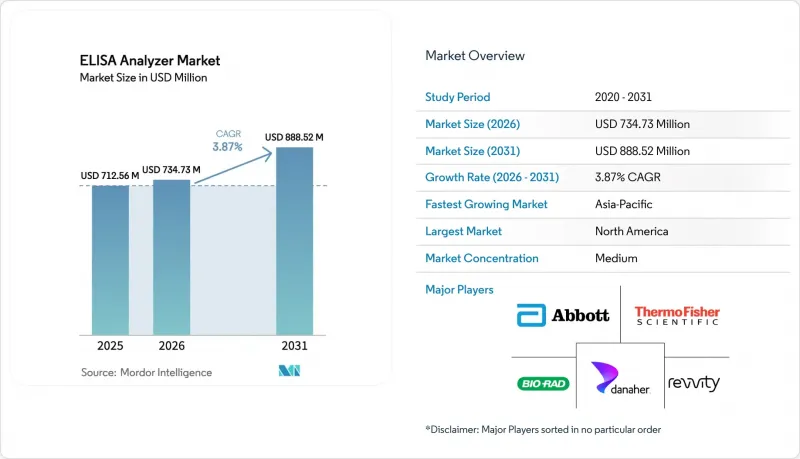
This report is Segmented by Product Type (Bench-Top, Portable, Automated Workstations, Microplate Readers), Automation Level (Fully Automated, Semi-Automated, Manual), Detection Technology (Colorimetric, Fluorescence, Chemiluminescence, Electrochemical), Application (Clinical Diagnostics, and More), End User (Hospitals, and More), and Geography (North America and More). Forecasts are in Value (USD).
Global ELISA Analyzer Market Trends and Insights
Rising Burden of Chronic & Infectious Diseases Driving High-Throughput Serology Demand
Cardiovascular and diabetes screening programs are pushing serology test volumes up 12%-15% per year in India and Indonesia, while the World Health Organization logged 249 million malaria cases in 2024. Vaccine-preventable disease surveillance now requires platforms that can process 200-400 samples in a standard shift, a throughput manual workflows cannot match. Aging Western populations need routine autoimmune and tumor-marker monitoring, compounding demand in wealthier regions. China's National Health Commission has ordered every county hospital to establish clinical immunology departments by 2025, fueling chemiluminescence purchases that replace labor-intensive manual protocols.
Automation Uptake Improving Lab Productivity & Turnaround Time
A 2025 Journal of Clinical Microbiology study showed fully automated ELISA workstations cut technologist hands-on time six- to ten-fold versus semi-automated pipetting systems. Same-day reporting for therapeutic drug levels is now routine in North American hospitals where onboard washers and incubators compress total assay time from four hours to 90 minutes. Labor savings can exceed USD 100,000 per full-time equivalent, an attractive proposition where technologist salaries top USD 60,000. Automation also lowers operator-dependent variability, a cornerstone of ISO 15189:2022 accreditation.
High Capex & Maintenance Costs of Fully Automated Systems
Turnkey analyzers list for USD 150,000-350,000, well above annual equipment budgets for most public laboratories in Asia-Pacific and South America. Five-year operating leases exist, yet uptake remains under 15% because IFRS 16 forces lease liabilities onto balance sheets. Proprietary reagent lock-in can inflate per-test costs 20%-25%, a barrier for budget-constrained facilities.
Other drivers and restraints analyzed in the detailed report include:
- Regulatory Push for Traceability in Diagnostic Labs
- Expansion of Decentralized & Point-of-Care Platforms in Emerging Markets
- Shortage of Skilled Personnel to Validate Complex Immunoassays
For complete list of drivers and restraints, kindly check the Table Of Contents.
Segment Analysis
Bench-top analyzers contributed 42.63% to ELISA analyzer market share in 2025. Their integrated washers and incubators make them indispensable in reference centers processing 500-2,000 samples daily. Yet portable systems are registering a 7.24% CAGR, reflecting robust demand from India's primary health clinics, Indonesian maternal-care sites, and sub-Saharan Africa's malaria-monitoring outposts. Pharmaceutical sponsors now ship handheld units directly to investigator clinics, cutting per-trial logistics costs by up to 50% and accelerating sample-to-result workflows.
The ELISA analyzer market size for portable systems is poised to widen as FDA 510(k) clearances validate analytical parity with laboratory-based readers. Portable adoption also dovetails with supply-chain re-shoring; locally assembled battery-powered analyzers reach customers in under eight weeks, compared with the 20-week lead times typical for imported bench-top units. Bench-top platforms will retain primacy where high-throughput and ISO accreditation dictate closed workflows, but decentralized programs are structurally changing procurement hierarchies.
Fully automated platforms accounted for 51.75% of ELISA analyzer market size in 2025 and are set to grow 6.14% through 2031. Their robotic sample handlers and barcode-driven tracking slash hands-on labor and make 200-400 samples per shift routine. Semi-automated systems still fit mid-tier hospitals that aim to improve throughput without the USD 150,000-300,000 capex of full automation. Manual readers are now confined to low-volume research labs.
Cost-benefit math drives uptake where technologist wages exceed USD 60,000, delivering payback in two-to-three years. Emerging-market buyers continue to view semi-automation as a stepping stone-vendors now offer modular add-ons that convert pipetting stations into fully robotic lines, protecting the original investment and smoothing upgrade paths.
Complete Report Scope:
- By Product Type
- Bench-Top ELISA Analyzers
- Portable / Handheld ELISA Analyzers
- Automated ELISA Workstations
- Microplate Readers
- By Automation Level
- Fully Automated Systems
- Semi-Automated Systems
- Manual Systems
- By Detection Technology
- Colorimetric
- Fluorescence
- Chemiluminescence
- Electrochemical
- By Application
- Clinical Diagnostics
- Vaccine Development
- Drug Discovery & Monitoring
- Food & Beverage Testing
- Environmental & Other Applications
- By End User
- Hospitals & Clinics
- Diagnostic Laboratories
- Research & Academic Institutions
- Pharmaceutical & Biotechnology Companies
- Food & Beverage Industry
- By Geography
- North America
- United States
- Canada
- Mexico
- Europe
- Germany
- France
- United Kingdom
- Italy
- Spain
- Rest of Europe
- Asia-Pacific
- China
- Japan
- India
- South Korea
- Australia
- Rest of Asia-Pacific
- Middle East & Africa
- GCC
- South Africa
- Rest of Middle East & Africa
- South America
- Brazil
- Argentina
- Rest of South America
- North America
Geography Analysis
North America generated 34.23% of 2025 revenue, buoyed by FDA traceability mandates and per-capita health spending above USD 12,000. Canada and Mexico provide additional lift; the latter became a manufacturing hub once Chinese suppliers opened assembly facilities in Monterrey and Tijuana to dodge U.S. tariffs. Forecast growth hovers around 3.2%-3.5% through 2031, tempered by saturation but supported by cell-therapy monitoring and next-wave mRNA vaccine pipelines.
Asia-Pacific is expanding 6.31% annually, led by China's county-hospital modernization and India's digital health mission. Domestic champions Mindray and Snibe control more than half of China's market by pricing 30%-40% below Western incumbents. Japan and South Korea show slower growth near 3%, while Australia's path-lab upgrades linked to ISO 15189 adoption lift regional demand.
In Europe, Germany, France, and the United Kingdom dominate regional buying, with laboratories racing to replace non-compliant hardware ahead of IVDR enforcement. The Middle East & and Africa is anchored by Saudi Arabia's SAR 12 billion laboratory-modernization plan. South America grows, although currency swings and import duties inflate capital costs by up to 35%.
- Abbott Laboratories
- Agilent Technologies
- Berthold Technologies GmbH
- Bio-Rad Laboratories
- Danaher
- DiaSorin
- Dynex Technologies
- EUROIMMUN AG
- Hamilton Robotics
- Mindray Bio-Medical Electronics Co., Ltd.
- Promega
- Revvity Inc.
- Sekisui Diagnostics
- Snibe Diagnostics
- STRATEC SE
- Tecan Group
- Thermo Fisher Scientific
Additional Benefits:
- The market estimate (ME) sheet in Excel format
- 3 months of analyst support
TABLE OF CONTENTS
1 Introduction
- 1.1 Study Assumptions & Market Definition
- 1.2 Scope of the Study
2 Research Methodology
3 Executive Summary
4 Market Landscape
- 4.1 Market Overview
- 4.2 Market Drivers
- 4.2.1 Rising Burden of Chronic & Infectious Diseases Driving High-Throughput Serology Demand
- 4.2.2 Automation Uptake Improving Lab Productivity & TAT
- 4.2.3 Regulatory Push for Traceability in Diagnostic Labs
- 4.2.4 Expansion Of Decentralized & POC Platforms in Emerging Markets
- 4.2.5 AI-Driven Analytics Enabling Predictive Maintenance & Result Interpretation
- 4.2.6 Geo-Political Trade Shifts Spurring Local Manufacturing & Equipment Refresh
- 4.3 Market Restraints
- 4.3.1 High Capex & Maintenance Costs of Fully Automated Systems
- 4.3.2 Shortage Of Skilled Personnel to Validate Complex Immunoassays
- 4.3.3 Competition From Multiplex Molecular Platforms with Faster TAT
- 4.3.4 Regulatory Variability & Lengthy Approvals for Software-Driven Upgrades
- 4.4 Value / Supply-Chain Analysis
- 4.5 Regulatory Landscape
- 4.6 Technological Outlook
- 4.7 Porter's Five Forces Analysis
- 4.7.1 Threat of New Entrants
- 4.7.2 Bargaining Power of Suppliers
- 4.7.3 Bargaining Power of Buyers
- 4.7.4 Threat of Substitute Products
- 4.7.5 Intensity of Competitive Rivalry
5 Market Size & Growth Forecasts (Value in USD)
- 5.1 By Product Type
- 5.1.1 Bench-Top ELISA Analyzers
- 5.1.2 Portable / Handheld ELISA Analyzers
- 5.1.3 Automated ELISA Workstations
- 5.1.4 Microplate Readers
- 5.2 By Automation Level
- 5.2.1 Fully Automated Systems
- 5.2.2 Semi-Automated Systems
- 5.2.3 Manual Systems
- 5.3 By Detection Technology
- 5.3.1 Colorimetric
- 5.3.2 Fluorescence
- 5.3.3 Chemiluminescence
- 5.3.4 Electrochemical
- 5.4 By Application
- 5.4.1 Clinical Diagnostics
- 5.4.2 Vaccine Development
- 5.4.3 Drug Discovery & Monitoring
- 5.4.4 Food & Beverage Testing
- 5.4.5 Environmental & Other Applications
- 5.5 By End User
- 5.5.1 Hospitals & Clinics
- 5.5.2 Diagnostic Laboratories
- 5.5.3 Research & Academic Institutions
- 5.5.4 Pharmaceutical & Biotechnology Companies
- 5.5.5 Food & Beverage Industry
- 5.6 By Geography
- 5.6.1 North America
- 5.6.1.1 United States
- 5.6.1.2 Canada
- 5.6.1.3 Mexico
- 5.6.2 Europe
- 5.6.2.1 Germany
- 5.6.2.2 France
- 5.6.2.3 United Kingdom
- 5.6.2.4 Italy
- 5.6.2.5 Spain
- 5.6.2.6 Rest of Europe
- 5.6.3 Asia-Pacific
- 5.6.3.1 China
- 5.6.3.2 Japan
- 5.6.3.3 India
- 5.6.3.4 South Korea
- 5.6.3.5 Australia
- 5.6.3.6 Rest of Asia-Pacific
- 5.6.4 Middle East & Africa
- 5.6.4.1 GCC
- 5.6.4.2 South Africa
- 5.6.4.3 Rest of Middle East & Africa
- 5.6.5 South America
- 5.6.5.1 Brazil
- 5.6.5.2 Argentina
- 5.6.5.3 Rest of South America
- 5.6.1 North America
6 Competitive Landscape
- 6.1 Market Concentration
- 6.2 Market Share Analysis
- 6.3 Company Profiles (includes Global level Overview, Market level overview, Core Segments, Financials as available, Strategic Information, Market Rank/Share for key companies, Products and Services, and Recent Developments)
- 6.3.1 Abbott Laboratories
- 6.3.2 Agilent Technologies, Inc.
- 6.3.3 Berthold Technologies GmbH
- 6.3.4 Bio-Rad Laboratories, Inc.
- 6.3.5 Danaher Corporation
- 6.3.6 DiaSorin S.p.A.
- 6.3.7 Dynex Technologies
- 6.3.8 EUROIMMUN AG
- 6.3.9 Hamilton Robotics
- 6.3.10 Mindray Bio-Medical Electronics Co., Ltd.
- 6.3.11 Promega Corporation
- 6.3.12 Revvity Inc.
- 6.3.13 Sekisui Diagnostics
- 6.3.14 Snibe Diagnostics
- 6.3.15 STRATEC SE
- 6.3.16 Tecan Group Ltd.
- 6.3.17 Thermo Fisher Scientific Inc.
7 Market Opportunities & Future Outlook
- 7.1 White-space & Unmet-Need Assessment

