PUBLISHER: Mordor Intelligence | PRODUCT CODE: 2125488

PUBLISHER: Mordor Intelligence | PRODUCT CODE: 2125488
Vietnam Metal Can Packaging - Market Share Analysis, Industry Trends & Statistics, Growth Forecasts (2026 - 2031)
According to Mordor Intelligence, the Vietnam metal can packaging market size was valued at USD 2.17 billion in 2025 and estimated to grow from USD 2.23 billion in 2026 to reach USD 2.58 billion by 2031, at a CAGR of 2.93% during the forecast period (2026-2031).
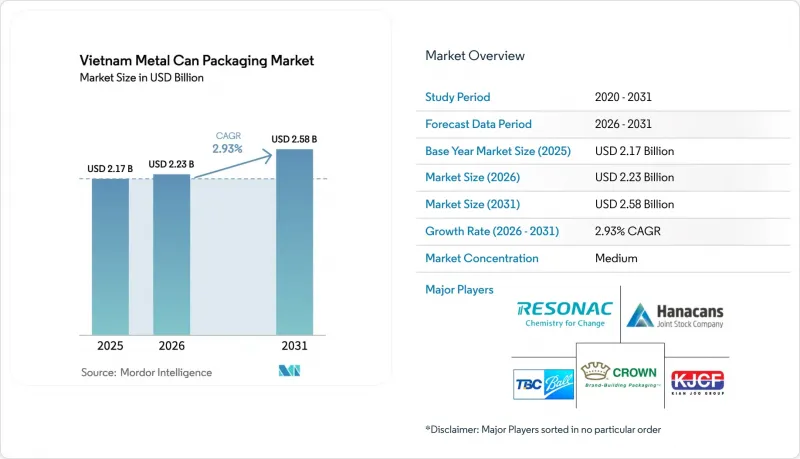
This report is Segmented by Material Type (Aluminium, and Steel), Can Structure (Two-Piece, Three-Piece, and Monobloc Aerosol), Capacity/Size (<=250 Ml, 250-500 Ml, 500-1, 000 Ml, >1, 000 Ml), Manufacturing Process (Drawn and Ironed, Drawn and Redrawn, and Impact Extrusion), and End-User Industry (Food, Beverage, and More). The Market Forecasts are Provided in Terms of Value (USD).
Vietnam Metal Can Packaging Market Trends and Insights
Growing Demand for Convenience Food and Beverages
Rapid urbanization is transforming grocery baskets and boosting single-serve formats. The food-processing sector expanded 7.4% in 2024 to USD 79.3 billion, and soft-drink consumption hit 4.658 billion liters, a 4.8% year-over-year increase. Domestic leaders such as Vinamilk posted Q2 2024 revenue of VND 11,850 billion (USD 478 million), reaffirming demand for shelf-stable, portion-controlled packages. The 250-500 ml range already dominates, yet <=250 ml cans record the fastest CAGR due to e-commerce and on-the-go lifestyles. Premium ready-to-drink energy beverages and alcoholic seltzers further widen the application base, sustaining volume growth for the Vietnam metal can packaging market.
High Recycling Rates and Sustainability Commitments
Vietnam's Extended Producer Responsibility law enforces a minimum 22% aluminum recycling rate from January 2024. HEINEKEN Vietnam processed 850 tonnes of used cans in its 2024 pilot, while Crown Holdings targets a 92% beverage-can collection rate by 2030. These initiatives cut raw-material costs, unlock secondary-aluminum feedstock and burnish brand credentials, giving the Vietnam metal can packaging market a clear sustainability advantage over flexible plastic competitors.
Rising Competition from Flexible Plastic and Paper Formats
Paper-based Tetra Recart claims 85% lower emissions than cans and began domestic runs at Doveco Sơn La in late 2024. SCG's USD 27.3 million purchase of Starprint Vietnam accelerates lightweight paper solutions. Nearly 4,000 plastic firms allocate 39% of capacity to packaging, exerting pricing pressure. Weight savings matter for e-commerce, yet cans still excel in carbonation retention, tamper evidence and premium cues, sustaining core demand for the Vietnam metal can packaging market.
Other drivers and restraints analyzed in the detailed report include:
- Expansion of Modern Retail and E-Commerce Networks
- Domestic HRC Capacity Expansion Improving Input Supply
- Metal Price Volatility and Emerging Trade Tariffs/CBAM
For complete list of drivers and restraints, kindly check the Table Of Contents.
Segment Analysis
Aluminum captured 70.02% of the Vietnam metal can packaging market share in 2025, a lead cemented by the 22% recycling quota that came into force the same year. The Vietnam metal can packaging market size for aluminum-based formats is projected to expand at a 4.21% CAGR through 2031 as pharmaceutical and personal-care brands prioritize high-purity barriers. Domestic plans to expand bauxite-to-aluminum refining at Lam Dong promise future supply security while cutting freight emissions.
Steel retains a foothold in large-volume food cans where rigidity and cost advantages prevail, especially above 1,000 ml. Hoa Phat's in-house HRC drives down delivered prices, but the metal's heavier weight handicaps long-distance logistics. As brand owners pledge carbon neutrality, aluminum's proven closed-loop recyclability keeps siphoning demand from steel, reinforcing the Vietnam metal can packaging market growth trajectory.
Two-piece cans accounted for 52.78% of the Vietnam metal can packaging market in 2025 thanks to high-speed D&I lines and photo-quality printing. Continuous lightweighting shrinks wall gauges without sacrificing strength, lowering per-unit metal use and freight costs. The Vietnam metal can packaging market size for two-piece formats will increase in tandem with beverage output and omnichannel retail growth.
Monobloc aerosol containers exhibit a 5.61% CAGR to 2031, propelled by personal-care and pharma spray products that demand seamless walls for pressure resistance. CANPACK's Quadromix short-run technology enables seasonal promotions, improving shelf visibility. While three-piece bodies serve bulky food packs, investments tilt toward flexible two-piece lines that maximize uptime and graphics flexibility.
Complete Report Scope:
- By Material Type
- Aluminium
- Steel
- By Can Structure
- Two-Piece
- Three-Piece
- Monobloc Aerosol
- By Capacity / Size
- <=250 ml
- 250-500 ml
- 500-1,000 ml
- >1,000 ml
- By Manufacturing Process
- Drawn and Ironed (D&I)
- Drawn and Redrawn (DRD)
- Impact Extrusion
- By End-User Industry
- Food
- Beverage
- Personal Care and Cosmetics
- Pharmaceuticals
- Paints and Industrial Chemicals
- Automotive Fluids and Lubricants
- Other End-User Industry
List of Companies Covered in this Report:
- TBC-Ball Beverage Can Vietnam Ltd (Ball Corporation)
- Resonac Holdings Corporation
- Hanacans Joint Stock Company
- Kian Joo Can (Vietnam) Co. Ltd (Kian Joo Can Factory Berhad)
- Crown Beverage Cans Vietnam Ltd (Crown Holdings Inc.)
- Can-Pack Vietnam Co. Ltd (Can-Pack SA)
- Vietnam Baosteel Can Co. Ltd (Baosteel Group Corp.)
- Royal Can Industries Company Ltd
- Superior Multi-Packaging Limited (Singapore)
- Nam Viet Packaging Manufacturing Co. Ltd
- My Chau Printing & Packaging Corp.
- Rexam Beverage Can Vietnam (Ardagh Group S.A.)
- Daiwa Can Company Vietnam Ltd
- Crown Asia Pacific Holdings Ltd - Danang Plant
- Alucon Public Company Ltd - Vietnam Rep. Office
- Thai Containers Group - Vietnam Metal Unit
- Dai Thien Loc Corporation (steel can-sheet supplier)
- Hoa Phat Steel Sheet Co. Ltd
- Novelis Asia (equity recycling affiliate)
- VNSteel Can Stock Division
Additional Benefits:
- The market estimate (ME) sheet in Excel format
- 3 months of analyst support
TABLE OF CONTENTS
1 INTRODUCTION
- 1.1 Study Assumptions and Market Definition
- 1.2 Scope of the Study
2 RESEARCH METHODOLOGY
3 EXECUTIVE SUMMARY
4 MARKET LANDSCAPE
- 4.1 Market Overview
- 4.2 Market Drivers
- 4.2.1 Growing demand for convenience food and beverages
- 4.2.2 High recycling rates and sustainability commitments
- 4.2.3 Expansion of modern retail and e-commerce networks
- 4.2.4 Domestic HRC capacity expansion improving input supply
- 4.2.5 Closed-loop beverage-can recycling pilots
- 4.2.6 Government FDI incentives for supporting industries
- 4.3 Market Restraints
- 4.3.1 Rising competition from flexible plastic and paper formats
- 4.3.2 Metal price volatility and emerging trade tariffs/CBAM
- 4.3.3 Limited domestic rolling capacity for can-sheet quality
- 4.3.4 Urban logistics bottlenecks raising last-mile costs
- 4.4 Industry Value Chain Analysis
- 4.5 Regulatory Landscape
- 4.6 Technological Outlook
- 4.7 Porter's Five Forces Analysis
- 4.7.1 Bargaining Power of Suppliers
- 4.7.2 Bargaining Power of Buyers
- 4.7.3 Threat of New Entrants
- 4.7.4 Threat of Substitute Products
- 4.7.5 Intensity of Competitive Rivalry
- 4.8 The Impact of Macroeconomic Factors on the Market
5 MARKET SIZE AND GROWTH FORECASTS (VALUE)
- 5.1 By Material Type
- 5.1.1 Aluminium
- 5.1.2 Steel
- 5.2 By Can Structure
- 5.2.1 Two-Piece
- 5.2.2 Three-Piece
- 5.2.3 Monobloc Aerosol
- 5.3 By Capacity / Size
- 5.3.1 <=250 ml
- 5.3.2 250-500 ml
- 5.3.3 500-1,000 ml
- 5.3.4 >1,000 ml
- 5.4 By Manufacturing Process
- 5.4.1 Drawn and Ironed (D&I)
- 5.4.2 Drawn and Redrawn (DRD)
- 5.4.3 Impact Extrusion
- 5.5 By End-User Industry
- 5.5.1 Food
- 5.5.2 Beverage
- 5.5.3 Personal Care and Cosmetics
- 5.5.4 Pharmaceuticals
- 5.5.5 Paints and Industrial Chemicals
- 5.5.6 Automotive Fluids and Lubricants
- 5.5.7 Other End-User Industry
6 COMPETITIVE LANDSCAPE
- 6.1 Market Concentration
- 6.2 Strategic Moves
- 6.3 Market Share Analysis
- 6.4 Company Profiles (includes Global Level Overview, Market Level Overview, Core Segments, Financials as available, Strategic Information, Market Rank/Share for key companies, Products and Services, and Recent Developments)
- 6.4.1 TBC-Ball Beverage Can Vietnam Ltd (Ball Corporation)
- 6.4.2 Resonac Holdings Corporation
- 6.4.3 Hanacans Joint Stock Company
- 6.4.4 Kian Joo Can (Vietnam) Co. Ltd (Kian Joo Can Factory Berhad)
- 6.4.5 Crown Beverage Cans Vietnam Ltd (Crown Holdings Inc.)
- 6.4.6 Can-Pack Vietnam Co. Ltd (Can-Pack SA)
- 6.4.7 Vietnam Baosteel Can Co. Ltd (Baosteel Group Corp.)
- 6.4.8 Royal Can Industries Company Ltd
- 6.4.9 Superior Multi-Packaging Limited (Singapore)
- 6.4.10 Nam Viet Packaging Manufacturing Co. Ltd
- 6.4.11 My Chau Printing & Packaging Corp.
- 6.4.12 Rexam Beverage Can Vietnam (Ardagh Group S.A.)
- 6.4.13 Daiwa Can Company Vietnam Ltd
- 6.4.14 Crown Asia Pacific Holdings Ltd - Danang Plant
- 6.4.15 Alucon Public Company Ltd - Vietnam Rep. Office
- 6.4.16 Thai Containers Group - Vietnam Metal Unit
- 6.4.17 Dai Thien Loc Corporation (steel can-sheet supplier)
- 6.4.18 Hoa Phat Steel Sheet Co. Ltd
- 6.4.19 Novelis Asia (equity recycling affiliate)
- 6.4.20 VNSteel Can Stock Division
7 MARKET OPPORTUNITIES AND FUTURE OUTLOOK
- 7.1 White-space and Unmet-need Assessment

