PUBLISHER: Mordor Intelligence | PRODUCT CODE: 2125494

PUBLISHER: Mordor Intelligence | PRODUCT CODE: 2125494
Wheat Flour - Market Share Analysis, Industry Trends & Statistics, Growth Forecasts (2026 - 2031)
According to Mordor Intelligence, the global wheat flour market size is expected to grow from USD 190.30 billion in 2025 to USD 198.18 billion in 2026 and is forecast to reach USD 242.74 billion by 2031 at 4.14% CAGR over 2026-2031.
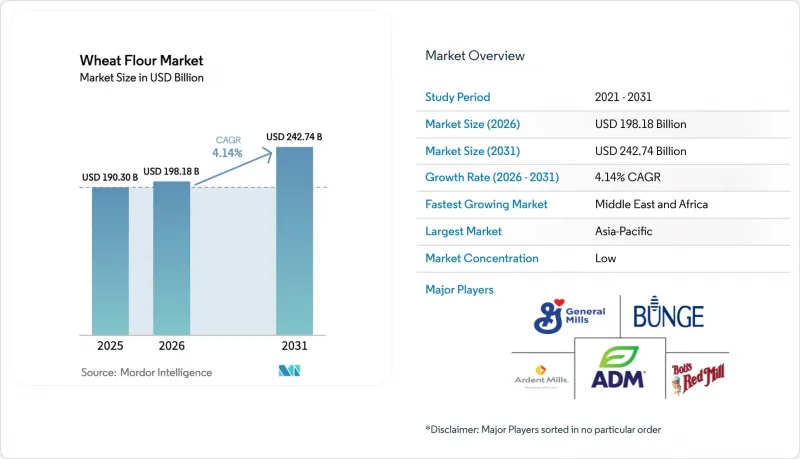
This report is Segmented by Type (All-Purpose Flour and Whole Wheat Flour), Category (Organic and Conventional), End User (Industrial Applications, Foodservice/HoReCa, and Household/Retail), and Geography (North America, Europe, Asia-Pacific, South America, and Middle East and Africa). The Market Forecasts are Provided in Terms of Value (USD).
Global Wheat Flour Market Trends and Insights
Rising demand for bakery and ready-to-eat foods
The global wheat flour market is experiencing growth due to increasing demand for bakery and ready-to-eat products, driven by urbanization, rising dual-income households, and the expansion of quick-service restaurants reliant on consistent flour quality. In 2024, U.S. per capita flour consumption accounted for 128.9 pounds , highlighting how consumers are shifting their preferences toward convenience foods, which require efficient, large-scale industrial flour processing. Ready-to-eat formats, including frozen dough, par-baked loaves, and shelf-stable flatbreads, are driving the adoption of specialized flour blends with controlled protein levels and additives tailored for automated production processes. In key markets such as China and India, large industrial bakeries are streamlining their supplier base, prioritizing millers capable of ensuring traceability and meeting stringent food safety standards, often requiring bulk delivery capabilities. This trend is intensifying competition, as smaller regional mills face challenges in meeting certification requirements and volume commitments, thereby strengthening the position of vertically integrated grain processors within the global supply chain.
Growing consumption of wheat-based snacks and convenience products
The global wheat flour market is experiencing growth driven by increasing consumption of wheat-based snacks and convenience foods. Changing consumer lifestyles and the rise of on-the-go eating habits are fueling demand for products such as pasta, noodles, crackers, pretzels, and baked chips across both developed and emerging markets. In the Asia-Pacific region, a strong preference for instant noodles and related products is sustaining demand for specialized wheat flour blends. In North America and Europe, the shift toward baked goods and clean-label snack options is driving the replacement of heavily modified ingredients with wheat flour. According to the United States Wheat Associates Report, global wheat consumption reached approximately 800 million metric tons in 2024 . This transition is also reshaping product specifications, as snack manufacturers seek flour with a lighter color, improved texture, and consistent processing performance. To meet these demands, millers are adopting advanced purification, separation, and air-classification technologies. Companies equipped with modern, multi-stage milling infrastructure and strong technical expertise are well-positioned to secure long-term supply contracts. Conversely, traditional mills with limited processing capabilities face increasing competitive pressure to meet the evolving quality standards of large-scale snack producers.
Price volatility and climate impact on wheat production
Fluctuating wheat prices and the escalating impact of climate change on wheat production are imposing significant constraints on the global wheat flour market. Extreme weather events, such as droughts and floods, are disrupting supply consistency and causing sharp fluctuations in raw material availability. These unpredictable price movements are placing considerable pressure on milling margins, particularly for small and mid-sized operators that lack structured procurement strategies, price-hedging mechanisms, or long-term sourcing agreements. In some cases, these challenges have led to temporary shutdowns during periods of elevated input costs. Additionally, the rising frequency of climate-related disruptions is undermining the reliability of traditional supply cycles, complicating production planning, inventory management, and stable pricing for downstream food manufacturers. As a result, sustained profitability increasingly relies on robust financial risk management, diversified sourcing strategies, and stronger integration across the grain value chain, creating a competitive disadvantage for less-capitalized players in the market.
Other drivers and restraints analyzed in the detailed report include:
- Increasing adoption of fortified wheat flour for nutritional benefits
- Technological advancements in flour milling and processing
- Growing consumer preference for gluten-free alternatives
For complete list of drivers and restraints, kindly check the Table Of Contents.
Segment Analysis
In 2025, all-purpose flour is set to command a dominant 57.74% share of the global wheat flour market. Its versatility spans industrial bakery production, home cooking, and foodservice applications. With a neutral taste, dependable gluten formation, and consistent processing performance, all-purpose flour is the go-to choice for a myriad of products, from breads and noodles to pasta and flatbreads. Meanwhile, whole-wheat flour is gaining traction, boasting a projected CAGR of 5.03% from 2026 to 2031. This surge is largely driven by health-conscious consumers and dietary fiber advocates, prompting food manufacturers and retailers to boost whole-grain content in their offerings. Many are proudly labeling these products as "clean-label" and "100% whole grain," especially in the packaged bread and tortilla segments.
Yet, whole-wheat flour's higher bran and germ content bring challenges. These include a shorter shelf life, a darker hue, and a denser texture, all of which can influence consumer acceptance and processing efficiency. To counteract these hurdles, millers are turning to cutting-edge methods like ultra-fine grinding and controlled heat treatment. These techniques aim to enhance texture, stability, and functionality, all while preserving the flour's nutritional benefits. Despite the rising popularity of whole-wheat variants, all-purpose flour remains indispensable in applications where refined characteristics are paramount, solidifying its status in large-scale industrial settings.
Complete Report Scope:
- By Type
- All-Purpose Flour
- Whole Wheat Flour
- By Category
- Organic
- Conventional
- By End User
- Industrial Applications
- Food and Beverage Processors
- Bakery and Confectionery
- Pasta and Noodles
- Snacks and RTE Foods
- Other Food Manufacturers
- Animal Feed
- Other Industrial Applications
- Food and Beverage Processors
- Foodservice/HoReCa
- Household/Retail
- Industrial Applications
- Geography
- North America
- United States
- Canada
- Mexico
- Rest of North America
- Europe
- Germany
- United Kingdom
- France
- Spain
- Italy
- Netherlands
- Sweden
- Poland
- Belgium
- Rest of Europe
- Asia-Pacific
- China
- India
- Japan
- Australia
- South Korea
- Indonesia
- Thailand
- Singapore
- Rest of Asia-Pacific
- South America
- Brazil
- Argentina
- Chile
- Peru
- Columbia
- Rest of South America
- Middle East and Africa
- Saudi Arabia
- United Arab Emirates
- South Africa
- Nigeria
- Egypt
- Morocco
- Turkey
- Rest of Middle East and Africa
- North America
Geography Analysis
In 2025, Asia-Pacific dominates the wheat flour market, holding a 43.42% share, driven by substantial wheat production and import reliance that supports the growth of the bakery, noodle, and convenience food industries. Rapid urbanization and increasing disposable incomes are shifting consumer preferences toward packaged and processed wheat-based products, creating opportunities for technologically advanced millers. Mature markets such as Japan and South Korea are experiencing value growth through premium and specialty flours. Despite periodic climate-related output fluctuations, Australia remains a critical wheat supplier in the region.
The Middle East and Africa are projected to grow at a CAGR of 6.88% during the forecast period (2026-2031), supported by strong population growth, urbanization, and government-backed bread consumption programs that ensure consistent demand for flour. High import dependency in several countries sustains milling and re-export activities, with Turkey serving as a major processing hub. However, operational efficiency in parts of Sub-Saharan Africa continues to be hindered by infrastructure and power constraints.
North America and Europe, as mature markets, exhibit stable consumption patterns, with growth primarily driven by demand for organic, whole-grain, and other value-added flours, alongside the recovery of the foodservice sector. In South America, increasing urbanization and evolving dietary trends are driving higher demand for bakery and pasta products. However, economic volatility introduces periodic uncertainties, while smaller markets in major cities are gradually expanding.
- Ardent Mills LLC
- General Mills Inc.
- Archer Daniels Midland Company
- Bunge Global SA
- Bob's Red Mill Natural Foods, Inc.
- Hodgson Mill, Inc.
- King Arthur Baking Company, Inc.
- The Mennel Milling Company
- Nisshin Seifun Group Inc.
- Manildra Milling Pvt. Ltd.
- Wilmar International Ltd.
- Grain Millers, Inc.
- Olam International Limited
- Interflour Group
- GoodMills Group GmbH
- P & H Milling Group
- PT Bogasari Flour Mills (Indofood)
- Bay State Milling Company
- Associated British Foods
- Kale Flour Milling
Additional Benefits:
- The market estimate (ME) sheet in Excel format
- 3 months of analyst support
TABLE OF CONTENTS
1 INTRODUCTION
- 1.1 Study Assumptions and Market Definition
- 1.2 Scope of the Study
2 RESEARCH METHODOLOGY
3 EXECUTIVE SUMMARY
4 MARKET LANDSCAPE
- 4.1 Market Overview
- 4.2 Market Drivers
- 4.2.1 Rising demand for bakery and ready-to-eat foods
- 4.2.2 Growing consumption of wheat-based snacks and convenience products
- 4.2.3 Increasing adoption of fortified wheat flour for nutritional benefits
- 4.2.4 Surging interest in home baking among consumers
- 4.2.5 Technological advancements in flour milling and processing
- 4.2.6 Expansion of foodservice, HORECA, and institutional catering sectors
- 4.3 Market Restraints
- 4.3.1 Price Volatility and Climate Impact on Wheat Production
- 4.3.2 Growing consumer preference for gluten-free alternatives
- 4.3.3 Rising competition from substitute flours
- 4.3.4 Storage challenges and limited shelf life of wheat flour
- 4.4 Supply Chain Analysis
- 4.5 Regulatory Outlook
- 4.6 Porter's Five Forces
- 4.6.1 Threat of New Entrants
- 4.6.2 Bargaining Power of Buyers/Consumers
- 4.6.3 Bargaining Power of Suppliers
- 4.6.4 Threat of Substitute Products
- 4.6.5 Intensity of Competitive Rivalry
5 MARKET SIZE AND GROWTH FORECASTS (VALUE)
- 5.1 By Type
- 5.1.1 All-Purpose Flour
- 5.1.2 Whole Wheat Flour
- 5.2 By Category
- 5.2.1 Organic
- 5.2.2 Conventional
- 5.3 By End User
- 5.3.1 Industrial Applications
- 5.3.1.1 Food and Beverage Processors
- 5.3.1.1.1 Bakery and Confectionery
- 5.3.1.1.2 Pasta and Noodles
- 5.3.1.1.3 Snacks and RTE Foods
- 5.3.1.1.4 Other Food Manufacturers
- 5.3.1.2 Animal Feed
- 5.3.1.3 Other Industrial Applications
- 5.3.1.1 Food and Beverage Processors
- 5.3.2 Foodservice/HoReCa
- 5.3.3 Household/Retail
- 5.3.1 Industrial Applications
- 5.4 Geography
- 5.4.1 North America
- 5.4.1.1 United States
- 5.4.1.2 Canada
- 5.4.1.3 Mexico
- 5.4.1.4 Rest of North America
- 5.4.2 Europe
- 5.4.2.1 Germany
- 5.4.2.2 United Kingdom
- 5.4.2.3 France
- 5.4.2.4 Spain
- 5.4.2.5 Italy
- 5.4.2.6 Netherlands
- 5.4.2.7 Sweden
- 5.4.2.8 Poland
- 5.4.2.9 Belgium
- 5.4.2.10 Rest of Europe
- 5.4.3 Asia-Pacific
- 5.4.3.1 China
- 5.4.3.2 India
- 5.4.3.3 Japan
- 5.4.3.4 Australia
- 5.4.3.5 South Korea
- 5.4.3.6 Indonesia
- 5.4.3.7 Thailand
- 5.4.3.8 Singapore
- 5.4.3.9 Rest of Asia-Pacific
- 5.4.4 South America
- 5.4.4.1 Brazil
- 5.4.4.2 Argentina
- 5.4.4.3 Chile
- 5.4.4.4 Peru
- 5.4.4.5 Columbia
- 5.4.4.6 Rest of South America
- 5.4.5 Middle East and Africa
- 5.4.5.1 Saudi Arabia
- 5.4.5.2 United Arab Emirates
- 5.4.5.3 South Africa
- 5.4.5.4 Nigeria
- 5.4.5.5 Egypt
- 5.4.5.6 Morocco
- 5.4.5.7 Turkey
- 5.4.5.8 Rest of Middle East and Africa
- 5.4.1 North America
6 COMPETITIVE LANDSCAPE
- 6.1 Market Concentration
- 6.2 Strategic Moves
- 6.3 Market Ranking Analysis
- 6.4 Company Profiles (includes Global level Overview, Market level overview, Core Segments, Financials as available, Strategic Information, Market Rank/Share for key companies, Products and Services, and Recent Developments)
- 6.4.1 Ardent Mills LLC
- 6.4.2 General Mills Inc.
- 6.4.3 Archer Daniels Midland Company
- 6.4.4 Bunge Global SA
- 6.4.5 Bob's Red Mill Natural Foods, Inc.
- 6.4.6 Hodgson Mill, Inc.
- 6.4.7 King Arthur Baking Company, Inc.
- 6.4.8 The Mennel Milling Company
- 6.4.9 Nisshin Seifun Group Inc.
- 6.4.10 Manildra Milling Pvt. Ltd.
- 6.4.11 Wilmar International Ltd.
- 6.4.12 Grain Millers, Inc.
- 6.4.13 Olam International Limited
- 6.4.14 Interflour Group
- 6.4.15 GoodMills Group GmbH
- 6.4.16 P & H Milling Group
- 6.4.17 PT Bogasari Flour Mills (Indofood)
- 6.4.18 Bay State Milling Company
- 6.4.19 Associated British Foods
- 6.4.20 Kale Flour Milling
7 MARKET OPPORTUNITIES AND FUTURE OUTLOOK

