PUBLISHER: Mordor Intelligence | PRODUCT CODE: 2125522

PUBLISHER: Mordor Intelligence | PRODUCT CODE: 2125522
GRC Cladding - Market Share Analysis, Industry Trends & Statistics, Growth Forecasts (2026 - 2031)
According to Mordor Intelligence, the GRC cladding market size is expected to grow from USD 33.93 billion in 2025 to USD 36.75 billion in 2026 and is forecast to reach USD 54.79 billion by 2031 at 8.32% CAGR over 2026-2031.
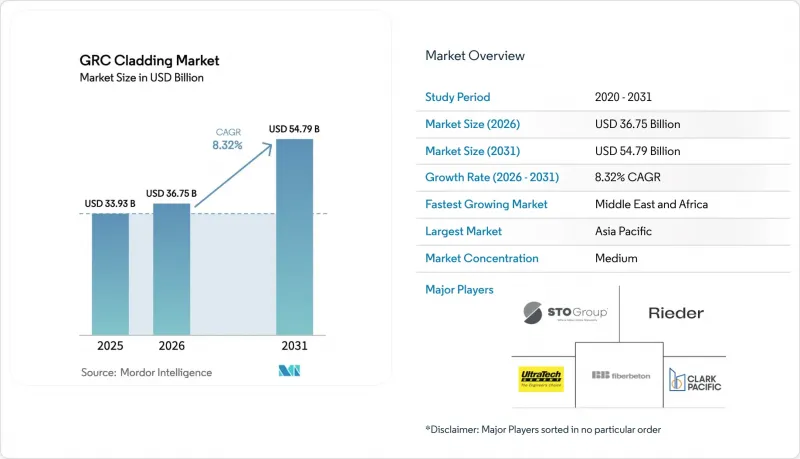
This report is Segmented by System Type (Rainscreen Cladding, Curtain Wall Systems and Others), by Application (Residential, Commercial and Others), by Installation (New Construction, Renovation & Retrofit), and by Geography (North America, South America, Europe, Asia-Pacific and More). The Market Forecasts are Provided in Terms of Value (USD).
Global GRC Cladding Market Trends and Insights
Rapid Urbanization & Smart-City Construction Boom
Surging city populations across China, India, and Southeast Asia stretch local infrastructure and energize demand for high-performance facades. India's construction GDP jumped 13.3% year-on-year in Q3 2024 as Smart Cities and Make in India initiatives funneled public spending into mixed-use towers and transit hubs. Municipal design codes increasingly reward energy-efficient envelopes, steering architects toward GRC assemblies that blend thermal mass, intricate form, and compatibility with building-integrated photovoltaics. China National Building Materials' 15.14% 2024 revenue rise signals a durable appetite for innovative cladding across the region's megaproject pipeline. Beyond tier-one cities, developers in India's secondary metros and Vietnam's emerging industrial zones specify GRC cladding market solutions to speed project delivery without sacrificing aesthetics.
Stricter Fire-Safety & Seismic Codes for Cladding
Post-Grenfell regulation reshaped facade procurement. Victoria's audit flagged more than 800 buildings for immediate remediation, fueling demand for non-combustible, test-certified panels. GRC passes NFPA 285 without extensive fire-stopping details, simplifying compliance for North American projects. Accredited UAE producers, guided by International Fire Consultants, now export to multiple jurisdictions, signaling global standardization. Governments from Australia to Canada plan staged bans on combustible facades, locking in a multi-year tailwind for the GRC cladding market.
Higher Upfront Cost Versus Conventional Concrete Panel
Sprayed GRC requires alkali-resistant glass fibers and skilled applicators, elevating material and labor premiums. Yet structural savings from lighter envelopes shrink the delta when the entire project economics are tallied. On geometrically complex facades curved or perforated GRC's moldability often undercuts stone or custom metal, pushing owners back to the GRC cladding market after value-engineering exercises.
Other drivers and restraints analyzed in the detailed report include:
- Superior Durability & Low Life-Cycle Cost
- Heritage Facade Retrofits Using Ultra-Thin GRC Skins
- Competition from Low-Cost Metal Composite Cladding
For complete list of drivers and restraints, kindly check the Table Of Contents.
Segment Analysis
Curtain walls captured 45.12% of the GRC cladding market size in 2025, reflecting their prevalence on high-rise commercial facades where architects pair lightweight panes with generous glazing for a daylight strategy. The segment's demanding tolerances and engineered anchors elevate barriers to entry, rewarding full-service manufacturers that offer design-assist and on-site technical crews. Rainscreen installations follow, leveraging GRC's vapor permeability to manage condensation in humid zones, while ultra-thin heritage skins and modular units form the fastest-growing "Others" category at a 9.12% CAGR. Design offices increasingly explore perforated panels that double as solar-shading devices, and early prototype projects embed thin-film PV directly onto GRC substrates to create energy-positive facades.
In the longer-term outlook, the GRC cladding market sees system convergence, where hybrid curtain wall-rainscreen assemblies meet seismic, thermal, and acoustic goals in a single package. Manufacturers invest in digital twins and CNC mold production to serve bespoke geometry at scale. Engineering consultancies favor GRC over heavier concrete in hoist-restricted urban sites, and GRCA technical bulletins standardize testing to accelerate approvals. Sustainability mandates push for demountable curtain wall frames, enabling future material separation and recycling, a design ethos well matched to GRC's cementitious recyclability.
Complete Report Scope:
- By System Type
- Rainscreen Cladding
- Curtain Wall Systems
- Others
- By Application
- Residential
- Commercial
- Others
- By Installation
- New Construction
- Renovation & Retrofit
- By Geography
- North America
- United States
- Canada
- Mexico
- South America
- Brazil
- Argentina
- Chile
- Rest of South America
- Europe
- Germany
- United Kingdom
- France
- Italy
- Spain
- Rest of Europe
- Asia-Pacific
- China
- India
- Japan
- South Korea
- Australia
- Rest of Asia-Pacific
- Middle East & Africa
- United Arab Emirates
- Saudi Arabia
- South Africa
- Nigeria
- Rest of Middle East and Africa
- North America
Geography Analysis
Asia-Pacific commanded 42.98% of 2025 revenue, underpinned by China's megacity pipeline and India's USD 1.4 trillion construction roadmap to 2025. Local producers such as CNBM scale output via automated spray lines and robotic trimming, shortening lead times for cross-border projects in ASEAN. Smart-city blueprints stipulate low-carbon facades and integrated renewables, dovetailing with evolving GRC panels that host PV laminates. Rising labor costs in coastal China push some fabrication toward Vietnam and Indonesia, broadening regional supply and intensifying price competition within the GRC cladding market.
The Middle East & Africa records the highest 9.71% CAGR as Saudi Arabia's NEOM, UAE's cultural museums, and Egypt's New Administrative Capital specify non-combustible facades resilient to 50 °C summers. Domestic champions in Oman and Qatar leverage GRCA membership to win public tenders, while European players partner locally to navigate import duties and heat-of-hydration challenges. New civil-defense codes promulgated in 2025 synchronize with NFPA 285, tightening envelope fire tests and elevating GRC's risk-mitigation appeal.
North America and Europe exhibit lower but steady growth, driven by regulation over volume. U.S. jurisdictions adopt NFPA 285-based exceptions for non-combustible systems, simplifying approval of GRC rainscreens over traditional cavity-barrier layouts. Europe's 2027 embodied-carbon ceiling accelerates low-clinker formulations as players seek Environmental Product Declarations to secure public-sector projects. Retrofit demand spikes in the UK, Ireland, and France, where combustible panels face legal removal deadlines, keeping order books robust across the mature yet lucrative GRC cladding market.
- UltraTech Cement Ltd
- Clark Pacific
- BB Fiberbeton
- ASAHI BUILDING-WALL CO. LTD
- Willis Construction Co. Inc.
- Loveld
- Fibrobeton
- GB Architectural Cladding Products Ltd
- Ibstock Telling
- BCM GRC Limited
- Sto Group
- Rieder Group
- GRC UK Ltd
- Panel Systems Ltd
- Permastone
- Pennine Stone Ltd
- Delta Panels
- GRC Arabia
- EuroGRC
- FCP Pre-fabricados
Additional Benefits:
- The market estimate (ME) sheet in Excel format
- 3 months of analyst support
TABLE OF CONTENTS
1 Introduction
- 1.1 Study Assumptions & Market Definition
- 1.2 Scope of the Study
2 Research Methodology
3 Executive Summary
4 Market Landscape
- 4.1 Market Overview
- 4.2 Market Drivers
- 4.2.1 Rapid urbanization & smart-city construction boom
- 4.2.2 High-rise demand for lightweight, high-strength facades
- 4.2.3 Stricter fire-safety & seismic codes for cladding
- 4.2.4 Superior durability & low life-cycle cost
- 4.2.5 Off-site modular construction uptake
- 4.2.6 Heritage facade retrofits using ultra-thin GRC skins
- 4.3 Market Restraints
- 4.3.1 Higher upfront cost versus conventional concrete panels
- 4.3.2 Competition from low-cost metal composite cladding
- 4.3.3 Cement & glass-fiber price volatility
- 4.3.4 Embodied carbon scrutiny of cementitious facades
- 4.4 Value / Supply-Chain Analysis
- 4.5 Regulatory Landscape
- 4.6 Technological Outlook
- 4.7 Industry Attractiveness - Porter's Five Forces Analysis
- 4.7.1 Threat of New Entrants
- 4.7.2 Bargaining Power of Buyers
- 4.7.3 Bargaining Power of Suppliers
- 4.7.4 Threat of Substitutes
- 4.7.5 Competitive Rivalry
5 Market Size & Growth Forecasts (Value, In USD Billion)
- 5.1 By System Type
- 5.1.1 Rainscreen Cladding
- 5.1.2 Curtain Wall Systems
- 5.1.3 Others
- 5.2 By Application
- 5.2.1 Residential
- 5.2.2 Commercial
- 5.2.3 Others
- 5.3 By Installation
- 5.3.1 New Construction
- 5.3.2 Renovation & Retrofit
- 5.4 By Geography
- 5.4.1 North America
- 5.4.1.1 United States
- 5.4.1.2 Canada
- 5.4.1.3 Mexico
- 5.4.2 South America
- 5.4.2.1 Brazil
- 5.4.2.2 Argentina
- 5.4.2.3 Chile
- 5.4.2.4 Rest of South America
- 5.4.3 Europe
- 5.4.3.1 Germany
- 5.4.3.2 United Kingdom
- 5.4.3.3 France
- 5.4.3.4 Italy
- 5.4.3.5 Spain
- 5.4.3.6 Rest of Europe
- 5.4.4 Asia-Pacific
- 5.4.4.1 China
- 5.4.4.2 India
- 5.4.4.3 Japan
- 5.4.4.4 South Korea
- 5.4.4.5 Australia
- 5.4.4.6 Rest of Asia-Pacific
- 5.4.5 Middle East & Africa
- 5.4.5.1 United Arab Emirates
- 5.4.5.2 Saudi Arabia
- 5.4.5.3 South Africa
- 5.4.5.4 Nigeria
- 5.4.5.5 Rest of Middle East and Africa
- 5.4.1 North America
6 Competitive Landscape
- 6.1 Market Concentration
- 6.2 Strategic Moves
- 6.3 Market Share Analysis
- 6.4 Company Profiles (includes Global level Overview, Market level overview, Core Segments, Financials as available, Strategic Information, Products & Services, Recent Developments)
- 6.4.1 UltraTech Cement Ltd
- 6.4.2 Clark Pacific
- 6.4.3 BB Fiberbeton
- 6.4.4 ASAHI BUILDING-WALL CO. LTD
- 6.4.5 Willis Construction Co. Inc.
- 6.4.6 Loveld
- 6.4.7 Fibrobeton
- 6.4.8 GB Architectural Cladding Products Ltd
- 6.4.9 Ibstock Telling
- 6.4.10 BCM GRC Limited
- 6.4.11 Sto Group
- 6.4.12 Rieder Group
- 6.4.13 GRC UK Ltd
- 6.4.14 Panel Systems Ltd
- 6.4.15 Permastone
- 6.4.16 Pennine Stone Ltd
- 6.4.17 Delta Panels
- 6.4.18 GRC Arabia
- 6.4.19 EuroGRC
- 6.4.20 FCP Pre-fabricados
7 Market Opportunities & Future Outlook
- 7.1 White-space & Unmet-Need Assessment

