PUBLISHER: Mordor Intelligence | PRODUCT CODE: 2125525

PUBLISHER: Mordor Intelligence | PRODUCT CODE: 2125525
Hernia Mesh Devices - Market Share Analysis, Industry Trends & Statistics, Growth Forecasts (2026 - 2031)
According to Mordor Intelligence, the hernia mesh devices market size reached USD 4.47 billion in 2026 and is expected to advance to USD 5.50 billion by 2031 at a 4.23% CAGR, reflecting measured growth that balances rising procedure volumes with persistent litigation headwinds.
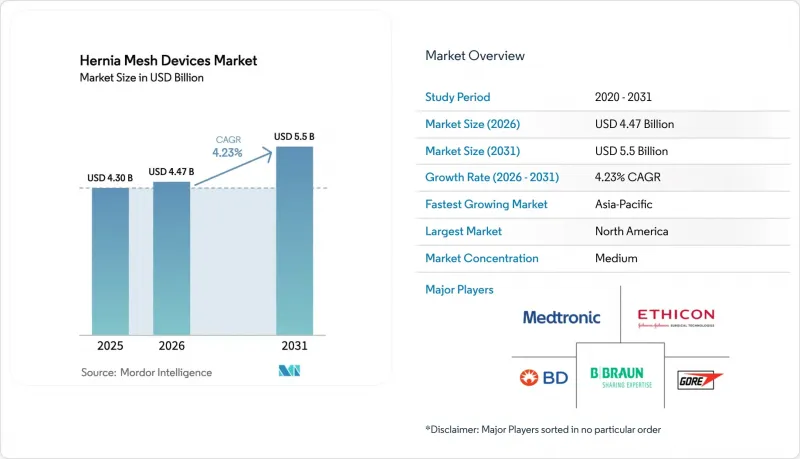
This report is Segmented by Hernia Type (Inguinal, Incisional/Ventral, and More), Mesh Type (Synthetic, Biologic, and Bio-Synthetic/Hybrid), Mesh Material (Non-Absorbable, and More), Surgical Repair Technique (Open, Laparoscopic, and Robotic-Assisted), End-User (Hospitals, and More), and Geography (North America, and More). The Market Forecasts are Provided in Terms of Value (USD).
Global Hernia Mesh Devices Market Trends and Insights
Rising Surgical Hernia Incidence in Obese and Aging Populations
Global obesity prevalence and a growing cohort aged 60 plus are raising procedure counts, particularly for ventral defects that are 2.42 times more common in obese patients than in normal-weight peers[1]. Meta-analysis data link obesity to a 1.27-fold higher inguinal recurrence, pressing surgeons to favor heavyweight polypropylene or reinforced composites in high-BMI cases. The World Health Organization projects that there will be 2.1 billion seniors by 2050, a demographic likely to present connective-tissue weakness and comorbidities that complicate mesh integration. Absorbable and hybrid meshes designed for impaired healing benefit from this trend, especially in complex ventral reconstructions that already exhibit a 6.54% CAGR within the Hernia mesh devices market. Post-bariatric patients and repeat laparotomy cases often result in larger, multi-territory defects, driving the consumption of premium barrier meshes that reduce infection risk while maintaining tensile support.
Shift Toward Minimally Invasive and Robotic Hernia Repairs
Robotic platforms have surpassed the adoption tipping point in U.S. hernia centers, with 54.9% of inguinal repairs utilizing robotic assistance during 2022-2023, compared to 45.1% using laparoscopic techniques, thereby reducing conversion rates to open surgery to 1.2%. Hospitals amortize da Vinci systems across multiple specialties, and surgeons typically reach proficiency after 16-20 robotic cases, which is half the number required for standard laparoscopy. Mesh design has followed suit, with low-profile products that roll through an 8 mm trocar and unfold without extra fixation; Gore's SYNECOR hybrid mesh delivers 2.5 times the tensile strength of Bard Soft Mesh and remains pliable for robotic manipulation. Operative time still runs 15-20 minutes longer than laparoscopy, prompting suppliers to add self-gripping features that eliminate the need for sutures. Ambulatory centers, now eligible for robotic hernia reimbursement under the 2025 CMS ASC list, are expanding access and increasing demand for pre-sterilized mesh kits, which reduce turnaround times.
Product Recalls and Litigation Over Chronic Pain & Adhesion Risks
More than USD 1 billion in 2024 settlements, including BD's resolution of 38,000 lawsuits, underscore the financial stakes tied to chronic pain and adhesion claims. Ethicon's Physiomesh remains burdened by 3,617 pending suits despite its 2016 withdrawal, while Getinge paid SEK 450 million to settle related actions in 2023. Hospitals now insist on indemnity clauses and 90-day complication tracking, forcing suppliers to restrain prices and emphasize long-term data, such as Gore's 13-year BIO-A follow-up, which records a 6.2% recurrence rate. Litigation chills radical innovation, steering R&D toward predicate-line extensions rather than novel materials that could trigger extensive surveillance mandates.
Other drivers and restraints analyzed in the detailed report include:
- Product Innovations in Lightweight Composite and Barrier Meshes
- Adoption of Integratable Biosensors in Smart Mesh Prototypes
- High Per-Procedure Cost of Biologic and Biosynthetic Meshes
For complete list of drivers and restraints, kindly check the Table Of Contents.
Segment Analysis
Ventral and incisional repairs, propelled by obesity and repeat laparotomies, are forecast to outstrip inguinal growth at 6.54% CAGR through 2031. Inguinal repairs retained 55.43% of the Hernia mesh devices market share in 2025; however, their annual growth lags, as BMI shows an inverse association with groin defects, evidenced by an odds ratio of 0.60.
The hernia mesh devices market increasingly sees ventral cases exceeding 10 cm that require component separation and large composite meshes. Robotic uptake favors inguinal work-54.9% of groin repairs used robotics in 2022-2023-but complex ventral reconstructions still rely on open techniques paired with biologic scaffolds such as OviTex, which underpinned TELA Bio's 29% sales jump. Post-bariatric cohorts and elderly women with femoral hernias sustain a varied but steady demand for mesh reinforcement across non-midline defects.
Synthetic meshes accounted for 85.11% of the revenue in 2025; however, biologics are expected to accelerate at a 6.42% CAGR as surgeons expand indications beyond frank contamination. In clean-contaminated ventral repairs, Phasix posted double-digit growth during fiscal 2024, demonstrating that a resorbable P4HB scaffold can capture a significant market share when infection risk is elevated.
The hernia mesh devices market size for hybrid designs such as SYNECOR is projected to widen as payers seek lower-priced alternatives with infection resistance. Ambulatory centers remain price sensitive, so biologic use stays below 5% of their volume, while hospitals apply them in up to 25% of complex abdominal wall cases. Lightweight synthetics face scrutiny after registry data showed higher failure in ventral repairs versus medium-weight constructs, reinforcing the need for balanced weight-to-strength ratios.
Complete Report Scope:
- By Hernia Type
- Inguinal Hernia
- Incisional / Ventral Hernia
- Femoral Hernia
- Other Hernia Types
- By Mesh Type
- Synthetic Mesh
- Biologic Mesh
- Bio-Synthetic / Hybrid Mesh
- By Mesh Material
- Non-Absorbable (Polypropylene, ePTFE, Polyester)
- Partially-Absorbable (PP + PGA/PLA)
- Fully-Absorbable (P4HB, PGA)
- By Surgical Repair Technique
- Open Repair
- Laparoscopic Repair
- Robotic-Assisted Repair
- By End-User
- Hospitals
- Ambulatory Surgical Centres
- Other End-Users
- Geography
- North America
- United States
- Canada
- Mexico
- Europe
- Germany
- United Kingdom
- France
- Italy
- Spain
- Rest Of Europe
- Asia-Pacific
- China
- Japan
- India
- South Korea
- Australia
- Rest Of Asia-Pacific
- Middle East And Africa
- GCC
- South Africa
- Rest Of Middle East And Africa
- South America
- Brazil
- Argentina
- Rest Of South America
- North America
Geography Analysis
North America accounted for 41.35% of 2025 revenue, driven by more than 1 million annual procedures, leading robotic penetration, and procurement models that reward low-complication meshes. The region's insurers and hospitals insist on long-term performance data after BD's USD 1 billion settlement, pushing suppliers toward meshes with decade-long track records. Robotic usage in inguinal repair surpassed 54% during 2022-2023, and ASC migration accelerates under CMS reimbursement, shifting routine volumes into lower-cost sites.
The Asia-Pacific region is expected to log the fastest growth rate of 5.67% CAGR, as Chinese insurance reforms expand surgical coverage and Indian device liberalization increases import flows. However, sterilization gaps and cold-chain limits keep biologic uptake low outside tier-one cities; polypropylene dominates lower-income segments. Singapore and Thailand leverage premium meshes, such as SYNECOR, to attract medical tourists, while TELA Bio's international expansion targets Australia and affluent clinics in Southeast Asia.
Europe's stringent Medical Device Regulation slows new product launches but cements quality expectations. EHS guidelines confine mesh use to tiny defects, tempering overall per-capita consumption. Litigation is less severe in Sweden than in the United States, but still notable; Getinge's SEK 450 million settlement highlights the growing regional risk. The Middle East & Africa, as well as South America, offer nascent growth, with Gulf states investing in tertiary robotics and Brazil's private network adding da Vinci systems. However, the public sectors remain budget-constrained and reliant on polypropylene.
- AbbVie Inc. (LifeCell)
- Advanced Medical Solutions Group
- B. Braun
- Beckton Dickinson
- Cook Group
- Cousin Surgery SAS
- Dipromed
- Duomed Group
- Ethicon Inc. (Johnson & Johnson)
- Getinge AB (Atrium Medical)
- Herniamesh Srl
- Integra LifeSciences Holdings Corp.
- Medtronic
- Novus Scientific AB
- Poly-Med Inc.
- TELA Bio Inc.
- Via Surgical Ltd.
- W. L. Gore & Associates
Additional Benefits:
- The market estimate (ME) sheet in Excel format
- 3 months of analyst support
TABLE OF CONTENTS
1 Introduction
- 1.1 Study Assumptions & Market Definition
- 1.2 Scope of the Study
2 Research Methodology
3 Executive Summary
4 Market Landscape
- 4.1 Market Overview
- 4.2 Market Drivers
- 4.2.1 Rising Surgical Hernia Incidence in Obese and Aging Populations
- 4.2.2 Shift Toward Minimally Invasive and Robotic Hernia Repairs
- 4.2.3 Product Innovations in Lightweight Composite and Barrier Meshes
- 4.2.4 Adoption of Integratable Biosensors in Smart Mesh Prototypes
- 4.2.5 Uptake of Value-Based Procurement Contracts Favoring Low Complication Meshes
- 4.2.6 Outsourcing of Custom 3D-Printed Meshes by Specialty Centers
- 4.3 Market Restraints
- 4.3.1 Product Recalls and Litigation Over Chronic Pain & Adhesion Risks
- 4.3.2 High Per-Procedure Cost of Biologic and Biosynthetic Meshes
- 4.3.3 Availability of Suture-Only Tissue Repairs for Small Defects
- 4.3.4 Slow Uptake in Emerging Markets Owing to Sterilization Infrastructure Gaps
- 4.4 Value / Supply-Chain Analysis
- 4.5 Regulatory Outlook
- 4.6 Technological Landscape
- 4.7 Porter's Five Forces Analysis
- 4.7.1 Threat Of New Entrants
- 4.7.2 Bargaining Power Of Buyers
- 4.7.3 Bargaining Power Of Suppliers
- 4.7.4 Threat Of Substitutes
- 4.7.5 Intensity Of Competitive Rivalry
5 Market Size & Growth Forecasts (Value, USD)
- 5.1 By Hernia Type
- 5.1.1 Inguinal Hernia
- 5.1.2 Incisional / Ventral Hernia
- 5.1.3 Femoral Hernia
- 5.1.4 Other Hernia Types
- 5.2 By Mesh Type
- 5.2.1 Synthetic Mesh
- 5.2.2 Biologic Mesh
- 5.2.3 Bio-Synthetic / Hybrid Mesh
- 5.3 By Mesh Material
- 5.3.1 Non-Absorbable (Polypropylene, ePTFE, Polyester)
- 5.3.2 Partially-Absorbable (PP + PGA/PLA)
- 5.3.3 Fully-Absorbable (P4HB, PGA)
- 5.4 By Surgical Repair Technique
- 5.4.1 Open Repair
- 5.4.2 Laparoscopic Repair
- 5.4.3 Robotic-Assisted Repair
- 5.5 By End-User
- 5.5.1 Hospitals
- 5.5.2 Ambulatory Surgical Centres
- 5.5.3 Other End-Users
- 5.6 Geography
- 5.6.1 North America
- 5.6.1.1 United States
- 5.6.1.2 Canada
- 5.6.1.3 Mexico
- 5.6.2 Europe
- 5.6.2.1 Germany
- 5.6.2.2 United Kingdom
- 5.6.2.3 France
- 5.6.2.4 Italy
- 5.6.2.5 Spain
- 5.6.2.6 Rest Of Europe
- 5.6.3 Asia-Pacific
- 5.6.3.1 China
- 5.6.3.2 Japan
- 5.6.3.3 India
- 5.6.3.4 South Korea
- 5.6.3.5 Australia
- 5.6.3.6 Rest Of Asia-Pacific
- 5.6.4 Middle East And Africa
- 5.6.4.1 GCC
- 5.6.4.2 South Africa
- 5.6.4.3 Rest Of Middle East And Africa
- 5.6.5 South America
- 5.6.5.1 Brazil
- 5.6.5.2 Argentina
- 5.6.5.3 Rest Of South America
- 5.6.1 North America
6 Competitive Landscape
- 6.1 Market Concentration
- 6.2 Market Share Analysis
- 6.3 Company Profiles (Includes Global Level Overview, Market Level Overview, Core Segments, Financials As Available, Strategic Information, Market Rank/Share For Key Companies, Products & Services, And Recent Developments)
- 6.3.1 AbbVie Inc. (LifeCell)
- 6.3.2 Advanced Medical Solutions Group plc
- 6.3.3 B. Braun SE
- 6.3.4 Becton, Dickinson And Company
- 6.3.5 Cook Medical LLC
- 6.3.6 Cousin Surgery SAS
- 6.3.7 Dipromed Srl
- 6.3.8 Duomed Group
- 6.3.9 Ethicon Inc. (Johnson & Johnson)
- 6.3.10 Getinge AB (Atrium Medical)
- 6.3.11 Herniamesh Srl
- 6.3.12 Integra LifeSciences Holdings Corp.
- 6.3.13 Medtronic plc
- 6.3.14 Novus Scientific AB
- 6.3.15 Poly-Med Inc.
- 6.3.16 TELA Bio Inc.
- 6.3.17 Via Surgical Ltd.
- 6.3.18 W. L. Gore & Associates Inc.
7 Market Opportunities & Future Outlook
- 7.1 White-Space & Unmet-Need Assessment

