PUBLISHER: Mordor Intelligence | PRODUCT CODE: 2125546

PUBLISHER: Mordor Intelligence | PRODUCT CODE: 2125546
Europe Machine Condition Monitoring - Market Share Analysis, Industry Trends & Statistics, Growth Forecasts (2026 - 2031)
According to Mordor Intelligence, Europe machine condition monitoring market size in 2026 is estimated at USD 1.13 billion, growing from 2025 value of USD 1.05 billion with 2031 projections showing USD 1.63 billion, growing at 7.60% CAGR over 2026-2031.
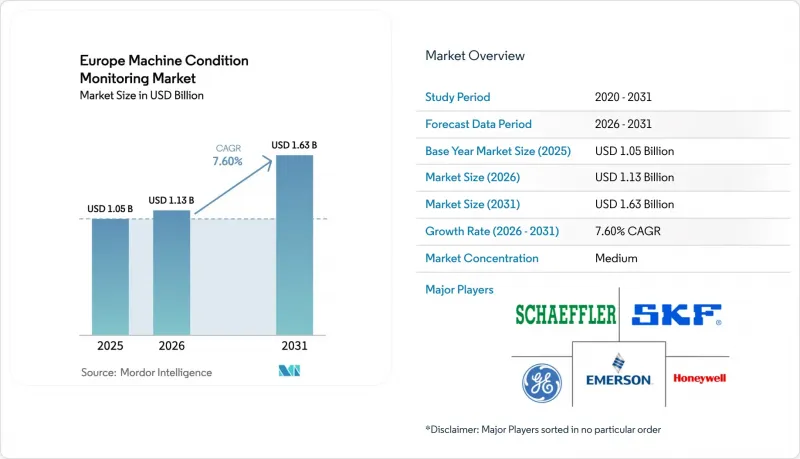
This report is Segmented by Type (Hardware, Software, and Services), Monitoring Technique (Online Condition Monitoring, and More), Deployment Mode (On-Premises and Cloud-Based), End-User Vertical (Oil and Gas, Power Generation, Process Manufacturing, Discrete Manufacturing, and More), and Country. The Market Forecasts are Provided in Terms of Value (USD).
Europe Machine Condition Monitoring Market Trends and Insights
Increasing Equipment Performance via Predictive Maintenance
German, French, and Dutch manufacturers now view reactive maintenance as a profit drain, with studies showing it can squander 70% of potential asset life. Germany's Manufacturing-X consortium, backed by EUR 133 million (USD 150.5 million), blends machine-health data and production metrics to cut unplanned downtime 25-30% and stretch asset life 15-20%. Schaeffler's online system across 58 drives at its European logistics hub delivered six-figure cost savings, validating ROI expectations. Integrating vibration and electrical-signature insights uncovers root-cause faults sooner, reallocating maintenance labor toward continuous-improvement tasks. The resulting gains elevate plant availability and make predictive approaches standard practice across mid-sized factories.
Industry 4.0 Adoption Across Manufacturing and Process Industries
Europe's transition toward data-centric production unifies plant-floor sensors with enterprise resource planning and manufacturing-execution applications. Strong 5G coverage in Germany, Italy, and Spain allows secure, high-speed data flow between machines and digital twins, unlocking continuous improvement loops. Siemens' Digital Drivetrain (released in 2024) exemplifies how an automation incumbent embeds embedded analytics directly into motor drive packages. Process operators integrate temperature, pressure, and vibration streams into a single pane of glass, exposing correlations between asset health and product yield that once remained invisible. Standardization efforts under Manufacturing-X lower integration barriers, accelerating multi-plant rollouts, and fueling the European machine condition monitoring market.
Cost Implications of Retrofits and Integration
Legacy pumps, turbines, and extruders often lack mounting points or digital interfaces for today's multi-axis accelerometers. Integrating wireless networks with 1990-era programmable-logic controllers can inflate project expense by 30-40% over sensor costs alone. Hazard-area certifications in petrochemical plants further double the spending on explosion-proof hardware, particularly across mature facilities in Italy, Spain, and Eastern Europe. Diverse national electrical codes, CE-marking nuances, and ATEX rules extend project timelines and dilute ROI calculations, slowing adoption in price-sensitive segments within the European machine condition monitoring market.
Other drivers and restraints analyzed in the detailed report include:
- Edge-AI Smart Sensors Enabling Real-Time Analytics
- Rising Regulatory Pressure on Asset Uptime in Critical Infrastructure
- Cybersecurity and Data-Ownership Concerns in Connected Assets
For complete list of drivers and restraints, kindly check the Table Of Contents.
Segment Analysis
Hardware retained a 61.10% revenue lead in 2025, supported by indispensable accelerometers, ultrasonic probes, and infrared cameras forming any monitoring program's front line. Vibration instruments dominate because rotating machinery remains pervasive, while thermography devices gain traction for high-voltage switchgear audits. The European machine condition monitoring market size for hardware reached USD 641.55 million in 2025. Services, however, exhibit an 8.65% CAGR as subscription models surge. Vendors now bundle sensor leasing, data hosting, and monthly health reports, accepted by CFOs eager for cost certainty. Software, although a smaller slice, supplies the analytics engine that converts signal streams to actionable work orders. Machine-learning modules automate fault classification, closing a skill gap for scarce vibration experts.
Because hardware acts as the beachhead for follow-on service revenues, vendors pursue razor-and-blade strategies, offering low-cost wireless kits that later anchor multi-site service contracts. Hybrid solutions integrating lubrication analysis and electrical-signature monitoring enrich context for root-cause troubleshooting, strengthening cross-sell opportunities. Thermography and ultrasonic skids safeguard electrical assets and compressed-air systems, respectively, broadening wallet share within mature blue-chip accounts.
Online installations accounted for 56.20% of 2025 revenue as critical-asset owners refuse to rely on periodic checks. High-speed turbines, compressors, and rail switches now stream data nonstop, enabling degradations to be caught hours, not weeks, before failure. The European machine condition monitoring market share for online solutions rests on maturing wireless mesh protocols and long-life batteries that cut cabling labor. Portable devices still appear across non-critical conveyors, chosen for their flexibility and low upfront cost.
Edge-AI sensors capture headlines with a 8.72% CAGR forecast. By shifting pattern matching into the device, these nodes forward only condensed fault indicators, slashing bandwidth fees and enabling private-LTE deployments deep inside refineries. Deutsche Bahn's KONUX rollout demonstrates how continuous rail-switch monitoring triggers preemptive field crews, shrinking network disruption minutes. Hybrid approaches emerge: technicians collect quick-route readings via Bluetooth handhelds, then upload to fleet dashboards for trend correlation, maximizing coverage while controlling spend.
Complete Report Scope:
- By Type
- Hardware
- Vibration Condition Monitoring Equipment
- Thermography Equipment
- Ultrasonic Detection Systems
- Lubricating Oil Analysis
- Current Signature Analysis
- Acoustic Emission Monitoring
- Software
- Services
- Hardware
- By Monitoring Technique
- Online Condition Monitoring
- Portable Condition Monitoring
- Edge AI-enabled Sensors
- By Deployment Mode
- On-Premises
- Cloud-Based Solutions
- By End-user Vertical
- Oil and Gas
- Power Generation
- Process Manufacturing
- Discrete Manufacturing
- Aerospace and Defense
- Automotive and Transportation
- Marine, Mining, and Metals
- Other End-user Verticals
- By Country
- United Kingdom
- Germany
- France
- Italy
- Spain
- Netherlands
- Rest of Europe
List of Companies Covered in this Report:
- SKF AB
- Schaeffler Technologies AG and Co. KG
- Emerson Electric Co.
- Honeywell International Inc.
- General Electric Company
- Siemens AG
- Bruel and Kjaer Vibro A/S
- Baker Hughes Company
- Meggitt PLC
- Pruftechnik Dieter Busch GmbH
- I-care NV
- SPM Instrument AB
- Spectris PLC
- PCE Instruments (PCE Holding GmbH)
- PCB Piezotronics Inc.
- Rockwell Automation Inc.
- Parker Hannifin Corporation
- Fluke Corporation
- Ametek Inc. (Spectro Scientific)
- ALS Limited
- National Instruments Corporation
- FLIR Systems Inc.
- ABB Ltd.
Additional Benefits:
- The market estimate (ME) sheet in Excel format
- 3 months of analyst support
TABLE OF CONTENTS
1 INTRODUCTION
- 1.1 Study Assumptions and Market Definition
- 1.2 Scope of the Study
2 RESEARCH METHODOLOGY
3 EXECUTIVE SUMMARY
4 MARKET LANDSCAPE
- 4.1 Market Overview
- 4.2 Market Drivers
- 4.2.1 Increasing equipment performance and productivity through predictive maintenance
- 4.2.2 Industry 4.0 adoption across manufacturing and process industries
- 4.2.3 Shift toward remote operations and worker safety post-COVID-19
- 4.2.4 Rising regulatory pressure on asset uptime in critical infrastructure
- 4.2.5 Edge AI-powered smart sensors enabling real-time analytics
- 4.2.6 Emergence of subscription-based condition monitoring platforms
- 4.3 Market Restraints
- 4.3.1 Cost implications associated with retrofits and system integration
- 4.3.2 European macroeconomic and geopolitical uncertainties
- 4.3.3 Cybersecurity and data ownership concerns in connected assets
- 4.3.4 Shortage of vibration analysts and reliability engineers
- 4.4 Industry Value Chain Analysis
- 4.5 Regulatory Landscape
- 4.6 Technological Outlook
- 4.7 Porter's Five Forces Analysis
- 4.7.1 Bargaining Power of Suppliers
- 4.7.2 Bargaining Power of Buyers
- 4.7.3 Threat of New Entrants
- 4.7.4 Threat of Substitutes
- 4.7.5 Intensity of Competitive Rivalry
- 4.8 Impact of Macroeconomic Factors
- 4.9 Investment Analysis
5 MARKET SIZE AND GROWTH FORECASTS (VALUES)
- 5.1 By Type
- 5.1.1 Hardware
- 5.1.1.1 Vibration Condition Monitoring Equipment
- 5.1.1.2 Thermography Equipment
- 5.1.1.3 Ultrasonic Detection Systems
- 5.1.1.4 Lubricating Oil Analysis
- 5.1.1.5 Current Signature Analysis
- 5.1.1.6 Acoustic Emission Monitoring
- 5.1.2 Software
- 5.1.3 Services
- 5.1.1 Hardware
- 5.2 By Monitoring Technique
- 5.2.1 Online Condition Monitoring
- 5.2.2 Portable Condition Monitoring
- 5.2.3 Edge AI-enabled Sensors
- 5.3 By Deployment Mode
- 5.3.1 On-Premises
- 5.3.2 Cloud-Based Solutions
- 5.4 By End-user Vertical
- 5.4.1 Oil and Gas
- 5.4.2 Power Generation
- 5.4.3 Process Manufacturing
- 5.4.4 Discrete Manufacturing
- 5.4.5 Aerospace and Defense
- 5.4.6 Automotive and Transportation
- 5.4.7 Marine, Mining, and Metals
- 5.4.8 Other End-user Verticals
- 5.5 By Country
- 5.5.1 United Kingdom
- 5.5.2 Germany
- 5.5.3 France
- 5.5.4 Italy
- 5.5.5 Spain
- 5.5.6 Netherlands
- 5.5.7 Rest of Europe
6 COMPETITIVE LANDSCAPE
- 6.1 Market Concentration
- 6.2 Strategic Moves
- 6.3 Market Share Analysis
- 6.4 Company Profiles (includes Global level Overview, Market level overview, Core Segments, Financials as available, Strategic Information, Market Rank/Share for key companies, Products and Services, and Recent Developments)
- 6.4.1 SKF AB
- 6.4.2 Schaeffler Technologies AG and Co. KG
- 6.4.3 Emerson Electric Co.
- 6.4.4 Honeywell International Inc.
- 6.4.5 General Electric Company
- 6.4.6 Siemens AG
- 6.4.7 Bruel and Kjaer Vibro A/S
- 6.4.8 Baker Hughes Company
- 6.4.9 Meggitt PLC
- 6.4.10 Pruftechnik Dieter Busch GmbH
- 6.4.11 I-care NV
- 6.4.12 SPM Instrument AB
- 6.4.13 Spectris PLC
- 6.4.14 PCE Instruments (PCE Holding GmbH)
- 6.4.15 PCB Piezotronics Inc.
- 6.4.16 Rockwell Automation Inc.
- 6.4.17 Parker Hannifin Corporation
- 6.4.18 Fluke Corporation
- 6.4.19 Ametek Inc. (Spectro Scientific)
- 6.4.20 ALS Limited
- 6.4.21 National Instruments Corporation
- 6.4.22 FLIR Systems Inc.
- 6.4.23 ABB Ltd.
7 MARKET OPPORTUNITIES AND FUTURE OUTLOOK
- 7.1 White-space and Unmet-Need Assessment

