PUBLISHER: Mordor Intelligence | PRODUCT CODE: 2125590

PUBLISHER: Mordor Intelligence | PRODUCT CODE: 2125590
UK Facade - Market Share Analysis, Industry Trends & Statistics, Growth Forecasts (2026 - 2031)
According to Mordor Intelligence, UK facade market size in 2026 is estimated at USD 10.99 billion, growing from 2025 value of USD 10.5 billion with 2031 projections showing USD 13.79 billion, growing at 4.63% CAGR over 2026-2031.
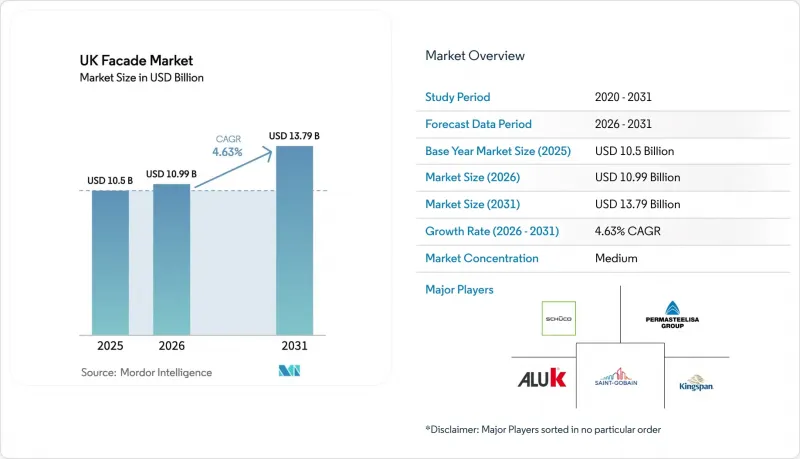
This report is Segmented by Type (Ventilated, Non-Ventilated, and Others), by Facade System Type (Rainscreen Cladding, and More), by Material (Glass, Metal, and More), by Installation (New Construction, Renovation & Retrofit), by End User (Commercial, Residential, and Others), and by Region (England, and More). The Market Forecasts are Provided in Terms of Value (USD).
UK Facade Market Trends and Insights
Post-Grenfell Recladding Surge
The Building Safety Act 2022 identified 5,052 residential blocks over 11 meters with unsafe cladding as of April 2025, with 2,477 already undergoing remediation . First-tier Tribunal rulings now deem even "medium" fire-risk ratings unacceptable, broadening liability exposure. Insurers are excluding combustible facades, effectively mandating A1-rated systems. VAT deductions on remediation work further lower upgrade costs. Established suppliers with certified, non-combustible portfolios are therefore capturing outsized demand.
Net-Zero 2050 Envelope Mandates
The Future Homes Standard, due in 2025, requires steep cuts in operational carbon, while London obliges whole-life carbon assessments for schemes above 1,000 m2. Research shows glass accounts for up to 60% of facade embodied carbon, prompting manufacturers to develop high-recycled-content glazing. Government recognition of data centers as nationally significant infrastructure is shortening planning timelines but tightening energy-performance criteria. Public-sector BREEAM "Excellent" thresholds now hinge on facade decarbonization, illustrated by Cardiff's Velindre Cancer Centre.
Aluminium & Glass Price Volatility
Energy-intensive aluminium smelting faces shifting supply dynamics and geopolitical trade risks that filter through to facade budgets. UK construction material indices recorded a 2.0% year-on-year decline as of June 2024, yet spot prices remain unstable, complicating cost planning for long-lead facade contracts. Flat-glass producers are investing in automation to curb unplanned downtime that can top GBP 1 million (USD 1.3501 million) per minute.
Other drivers and restraints analyzed in the detailed report include:
- Modular Off-Site Build Adoption
- Data-Center Build Boom
- Shortage of Certified Facade Labor
For complete list of drivers and restraints, kindly check the Table Of Contents.
Segment Analysis
Ventilated systems accounted for 45.32% of UK facade market share in 2025, and the segment is set to grow at a 7.65% CAGR through 2031. Their cavity design limits fire propagation and enhances thermal regulation, aligning with Building Safety Act compliance and net-zero targets two priorities that now shape nearly every tender in the UK facade market. The technology is evolving toward smart modules such as seele's ISOshade(R), which uses embedded sensors and AI-driven louvers to modulate solar gain without active energy consumption. Demand is also rising for ventilated retrofits on occupied residential towers, leveraging VAT relief and insurance incentives to replace combustible cladding. As insurers tighten underwriting, developers increasingly view ventilated systems as the baseline solution rather than an upgrade.
Rainscreen cladding captured 32.74% of UK facade market revenue in 2025, reflecting its versatility and proven A1-rated assemblies. However, unitised curtain walls are advancing at an 8.47% CAGR to 2031, driven by factory-controlled quality and faster installation that counters labor shortages in the UK facade market. Manufacturers are blurring lines between systems; hybrid unitised-rainscreen solutions promise the aesthetic freedom of rainscreens with the speed advantages of unitised panels. CWCT-certified mock-ups are now mandatory on most high-rise projects, favoring suppliers that can test entire unitised assemblies under worst-case load scenarios. As modular builders standardize bay sizes, unitised panels are becoming the default interface.
Complete Report Scope:
- By Type
- Ventilated
- Non-Ventilated
- Others
- By Facade System Type
- Rainscreen Cladding
- Curtain-Wall Systems
- Others
- By Material
- Glass
- Metal
- Plastic & Fibres
- Stone
- Others
- By Installation
- New Construction
- Renovation & Retrofit
- By End-User
- Commercial
- Residential
- Others
- By Region
- England
- Scotland
- Wales
- Northern Ireland
List of Companies Covered in this Report:
- Schuco UK
- Permasteelisa UK
- Kingspan Insulated Panels UK
- Saint-Gobain Glass UK
- Reynaers Aluminium UK
- Kawneer UK
- AluK (GB) Ltd
- Senior Architectural Systems
- Yuanda Europe (UK)
- McMullen Facades
- Etex EOS Facades
- Sotech UK
- Prism Architectural
- Technal UK
- Alucraft Systems
- Vision Built UK
- Sto Ltd
- Glassolutions (Saint-Gobain)
- Fineline Aluminium
- OAG (Optima Architectural Glazing)
Additional Benefits:
- The market estimate (ME) sheet in Excel format
- 3 months of analyst support
TABLE OF CONTENTS
1 Introduction
- 1.1 Study Assumptions & Market Definition
- 1.2 Scope of the Study
2 Research Methodology
3 Executive Summary
4 Market Landscape
- 4.1 Market Overview
- 4.2 Market Drivers
- 4.2.1 Post-Grenfell recladding surge
- 4.2.2 Net-zero 2050 envelope mandates
- 4.2.3 Modular off-site build adoption
- 4.2.4 Data-centre build boom
- 4.2.5 VAT relief energising BIPV facades
- 4.2.6 London "Retrofit First" policy
- 4.3 Market Restraints
- 4.3.1 Aluminium & glass price volatility
- 4.3.2 Shortage of certified facade labour
- 4.3.3 Insurance exclusions for combustible systems
- 4.3.4 Embodied-carbon caps (London Plan)
- 4.4 Brief on Different Structures Used in the Facades Industry
- 4.5 Pricing Analysis
- 4.6 Value / Supply-Chain Analysis
- 4.7 Regulatory Landscape
- 4.8 Technological Outlook
- 4.9 Porter's Five Forces
- 4.9.1 Bargaining Power of Suppliers
- 4.9.2 Bargaining Power of Consumers
- 4.9.3 Threat of New Entrants
- 4.9.4 Threat of Substitutes
- 4.9.5 Intensity of Competitive Rivalry
- 4.10 Consumer Behavior Analysis (Contractors, Architects, Developers, Individual Buyers, Facility & Property Managers/Building Owners)
- 4.11 Sustainability Trends
5 Market Size & Growth Forecasts (Value)
- 5.1 By Type
- 5.1.1 Ventilated
- 5.1.2 Non-Ventilated
- 5.1.3 Others
- 5.2 By Facade System Type
- 5.2.1 Rainscreen Cladding
- 5.2.2 Curtain-Wall Systems
- 5.2.3 Others
- 5.3 By Material
- 5.3.1 Glass
- 5.3.2 Metal
- 5.3.3 Plastic & Fibres
- 5.3.4 Stone
- 5.3.5 Others
- 5.4 By Installation
- 5.4.1 New Construction
- 5.4.2 Renovation & Retrofit
- 5.5 By End-User
- 5.5.1 Commercial
- 5.5.2 Residential
- 5.5.3 Others
- 5.6 By Region
- 5.6.1 England
- 5.6.2 Scotland
- 5.6.3 Wales
- 5.6.4 Northern Ireland
6 Competitive Landscape
- 6.1 Market Concentration
- 6.2 Strategic Moves
- 6.3 Market Share Analysis
- 6.4 Company Profiles (includes Global level Overview, Market level overview, Core Segments, Financials as available, Strategic Information, Market Rank/Share, Products & Services, Recent Developments)
- 6.4.1 Schuco UK
- 6.4.2 Permasteelisa UK
- 6.4.3 Kingspan Insulated Panels UK
- 6.4.4 Saint-Gobain Glass UK
- 6.4.5 Reynaers Aluminium UK
- 6.4.6 Kawneer UK
- 6.4.7 AluK (GB) Ltd
- 6.4.8 Senior Architectural Systems
- 6.4.9 Yuanda Europe (UK)
- 6.4.10 McMullen Facades
- 6.4.11 Etex EOS Facades
- 6.4.12 Sotech UK
- 6.4.13 Prism Architectural
- 6.4.14 Technal UK
- 6.4.15 Alucraft Systems
- 6.4.16 Vision Built UK
- 6.4.17 Sto Ltd
- 6.4.18 Glassolutions (Saint-Gobain)
- 6.4.19 Fineline Aluminium
- 6.4.20 OAG (Optima Architectural Glazing)
7 Market Opportunities & Future Outlook
- 7.1 White-Space & Unmet-Need Assessment

