PUBLISHER: Mordor Intelligence | PRODUCT CODE: 2125624

PUBLISHER: Mordor Intelligence | PRODUCT CODE: 2125624
Middle East Amusement Park - Market Share Analysis, Industry Trends & Statistics, Growth Forecasts (2026 - 2031)
According to Mordor Intelligence, the Middle East amusement park market size is expected to grow from USD 3.35 billion in 2025 to USD 3.68 billion in 2026 and is forecast to reach USD 5.84 billion by 2031 at 9.72% CAGR over 2026-2031.
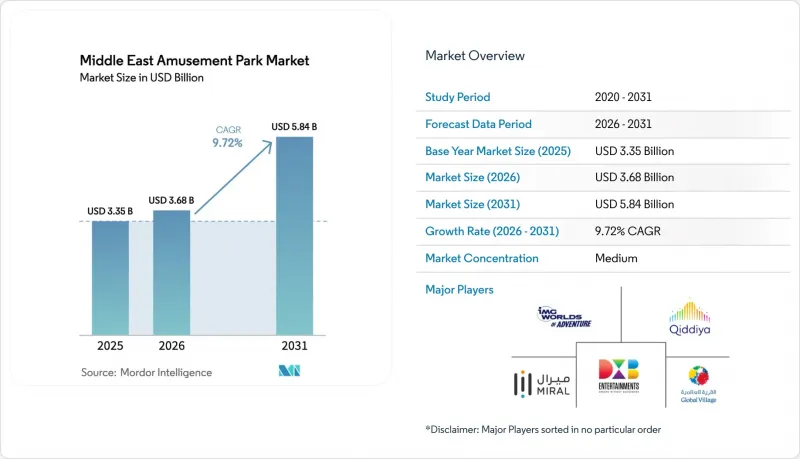
This report is Segmented by Rides (Mechanical Rides, Water Rides, Other Rides), Age (Up To 18 Years, 19-35 Years, 36-50 Years, 51-65 Years, More Than 65 Years), Revenue Source (Tickets, Food & Beverages, Merchandise, Hotels/Resorts, Others), and Geography (UAE, Saudi Arabia, Qatar, Kuwait, Oman, Rest of Middle East). The Market Forecasts are Provided in Terms of Value (USD).
Middle East Amusement Park Market Trends and Insights
Rapid Tourism-Led Footfall Growth in GCC
Dubai welcomed 18.7 million overnight visitors in 2024, up 9.1% year on year, giving regional parks a broader catchment and greater load factor. New air routes from China and Southeast Asia raised arrivals from those regions by 24.2% in 2024, diversifying visitor origin and insulating footfall from single-market shocks. Dubai International Airport handled 92.3 million passengers in 2024, offering unrivaled access to long-haul travelers. Tourism delivered AED 236 billion (USD 64.3 billion) to the UAE economy in 2024, equal to 12% of GDP, and governments continue to fund marketing to sustain this contribution. Rising visitor flows support premium pricing, longer stays, and bundled resort packages that boost yield per guest. Operators increasingly craft culturally adaptive shows and ride narratives to satisfy new visitor tastes. The outcome is a durable lift in attendance that feeds directly into top-line growth for the Middle East amusement park market.
Heavy Sovereign Wealth Investment into Integrated Leisure Districts
Saudi Arabia's Public Investment Fund alone targets a USD 70 billion slice of global park revenue, backing mega-projects such as Qiddiya and NEOM. Individual assets like Aquarabia and Land of Legends Qatar each carry about USD 3 billion in capital, creating multi-day entertainment districts instead of standalone parks. Large-scale funding enables shared infrastructure, centralized merchandising, and cohesive branding that lift marketing efficiency. Extended investment horizons allow time for destination brand building and gradual ramp-up of international visitation. Clustering of hotels, retail, and housing around attractions accelerates breakeven by spreading risk across complementary revenue streams. These integrated models also expand the Middle East amusement park market by positioning the region as a global leisure destination rather than a series of isolated parks. The depth of sovereign wallets assures continuous project financing even through oil price cycles.
High Water-Energy Intensity Amid Regional Sustainability Mandates
District cooling provider Empower recorded a 10% rise in consumption from hospitality and entertainment users in 2024, reflecting the resource-heavy nature of theme parks. Governments are phasing out utility subsidies and introducing carbon pricing that will raise operating costs. Water parks rely on desalinated supply, which has double the energy footprint of conventional sources. Operators invest in variable-speed pumps, heat-reflective materials, and closed-loop filtration to cut usage, but payback can stretch beyond five years. Peak summer days pose tough trade-offs between visitor comfort and sustainability compliance. Long-term, achieving national net-zero goals may require caps on new water attractions unless they incorporate on-site solar or waste-heat recovery. Resource intensity, therefore, trims profitability and tempers growth within the Middle East amusement park market.
Other drivers and restraints analyzed in the detailed report include:
- Post-COVID "Revenge Leisure" Spending Surge
- Regulatory Push for Family-Centric Entertainment to Diversify Oil Economies
- Fluctuating Disposable Income of Expatriate Population
For complete list of drivers and restraints, kindly check the Table Of Contents.
Segment Analysis
Mechanical rides claimed 49.88% of the Middle East amusement park market share in 2025, underscoring their strong cross-age appeal and established supplier networks. Water rides, however, are on track for an 11.58% CAGR to 2031, outpacing other categories as indoor wave pools and cooled slides lengthen the profitable season. Yas Waterworld's upgrades and Aquaventure's premium cabanas illustrate how water venues draw high-spend visitors and repeat traffic. AI queue management tools boost throughput during peak hours, pushing daily capacity higher without major expansions. Mechanical rides still enjoy lower operating costs, but face higher content refresh demands to stay relevant. Hybrid XR coasters that blend screens and motion control are emerging as a bridge between classic attractions and fully digital experiences. Water-ride growth enlarges the Middle East amusement park market size for operators that can master energy-efficient cooling and rapid ride-turnaround maintenance. Climate-controlled domes further reduce weather risk, making water concepts bankable assets in project finance models.
The "other rides" category spans VR arenas, esports lounges, and interactive dark rides, each offering modular footprints ideal for malls and cruise-line partnerships. Smaller assets need less capex and can be rethemed quickly in response to pop-culture trends, giving operators a hedge against the long design-build cycles of coasters. Revenue per square meter often exceeds that of traditional steel attractions once sponsorships and branded IP licensing are layered in. Supply chains for headsets and software updates remain a constraint, yet falling hardware costs should narrow the gap. Cross-sell bundles that attach VR tokens to gate tickets help drive trial. Successful operators position the mix as a portfolio, balancing high-volume crowd-pleasers with high-margin pay-per-play add-ons that lift overall yield in the Middle East amusement park market.
Complete Report Scope:
- By Rides
- Mechanical Rides
- Water Rides
- Other Rides
- By Age
- Upto 18 Years
- 19-35 Years
- 36-50 Years
- 51-65 Years
- More than 65 Years
- By Revenue Source
- Tickets
- Food & Beverages
- Merchandise
- Hotels / Resorts
- Others
- By Geography
- UAE
- Saudi Arabia
- Qatar
- Kuwait
- Oman
- Rest of Middle East
List of Companies Covered in this Report:
- DXB Entertainments (Dubai Parks & Resorts)
- Miral Asset Management (Ferrari World, Warner Bros World, SeaWorld Abu Dhabi)
- IMG Worlds of Adventure
- Global Village Dubai
- Majid Al Futtaim (Magic Planet, VOX indoor parks)
- Qiddiya Investment Co. (Six Flags Qiddiya)
- Al Hokair Group (Sparky's, Snowy Forest)
- Al Othaim Leisure & Tourism (FabyLand, Snow City)
- Landmark Leisure (Fun City, Fun Ville)
- Loopagoon Water Park
- Yas Waterworld
- Aquaventure Atlantis
- Motiongate Dubai
- Bollywood Parks Dubai
- Wild Wadi Waterpark
- KidZania (Dubai & Abu Dhabi)
- Kidzmondo Doha
- Al Montazah Parks (Sharjah)
- Jazeera Adventure World (Iran)
- Land of Legends (Turkey)
Additional Benefits:
- The market estimate (ME) sheet in Excel format
- 3 months of analyst support
TABLE OF CONTENTS
1 Introduction
- 1.1 Study Assumptions & Market Definition
- 1.2 Scope of the Study
2 Research Methodology
3 Executive Summary
4 Market Landscape
- 4.1 Market Overview
- 4.2 Market Drivers
- 4.2.1 Rapid tourism-led footfall growth in GCC
- 4.2.2 Heavy sovereign wealth investment into integrated leisure districts
- 4.2.3 Post-COVID "revenge leisure" spending surge
- 4.2.4 Regulatory push for family-centric entertainment to diversify oil economies
- 4.2.5 AI-driven queue & capacity optimization boosting per-capita spend (under-reported)
- 4.2.6 Indoor micro-theme-park format inside malls driving off-season traffic (under-reported)
- 4.3 Market Restraints
- 4.3.1 High water-energy intensity amid regional sustainability mandates
- 4.3.2 Fluctuating disposable income of expatriate population
- 4.3.3 Visa & geopolitical uncertainty dampening cross-border tourism flows (under-reported)
- 4.3.4 Scarcity of skilled ride-maintenance technicians (under-reported)
- 4.4 Value / Supply-Chain Analysis
- 4.5 Regulatory Landscape
- 4.6 Technological Outlook
- 4.7 Porter's Five Forces
- 4.7.1 Threat of New Entrants
- 4.7.2 Bargaining Power of Suppliers
- 4.7.3 Bargaining Power of Buyers
- 4.7.4 Threat of Substitutes
- 4.7.5 Competitive Rivalry
5 Market Size & Growth Forecasts
- 5.1 By Rides
- 5.1.1 Mechanical Rides
- 5.1.2 Water Rides
- 5.1.3 Other Rides
- 5.2 By Age
- 5.2.1 Upto 18 Years
- 5.2.2 19-35 Years
- 5.2.3 36-50 Years
- 5.2.4 51-65 Years
- 5.2.5 More than 65 Years
- 5.3 By Revenue Source
- 5.3.1 Tickets
- 5.3.2 Food & Beverages
- 5.3.3 Merchandise
- 5.3.4 Hotels / Resorts
- 5.3.5 Others
- 5.4 By Geography
- 5.4.1 UAE
- 5.4.2 Saudi Arabia
- 5.4.3 Qatar
- 5.4.4 Kuwait
- 5.4.5 Oman
- 5.4.6 Rest of Middle East
6 Competitive Landscape
- 6.1 Market Concentration
- 6.2 Strategic Moves
- 6.3 Market Share Analysis
- 6.4 Company Profiles (includes Global level Overview, Market level overview, Core Segments, Financials as available, Strategic Information, Market Rank/Share for key companies, Products & Services, and Recent Developments)
- 6.4.1 DXB Entertainments (Dubai Parks & Resorts)
- 6.4.2 Miral Asset Management (Ferrari World, Warner Bros World, SeaWorld Abu Dhabi)
- 6.4.3 IMG Worlds of Adventure
- 6.4.4 Global Village Dubai
- 6.4.5 Majid Al Futtaim (Magic Planet, VOX indoor parks)
- 6.4.6 Qiddiya Investment Co. (Six Flags Qiddiya)
- 6.4.7 Al Hokair Group (Sparky's, Snowy Forest)
- 6.4.8 Al Othaim Leisure & Tourism (FabyLand, Snow City)
- 6.4.9 Landmark Leisure (Fun City, Fun Ville)
- 6.4.10 Loopagoon Water Park
- 6.4.11 Yas Waterworld
- 6.4.12 Aquaventure Atlantis
- 6.4.13 Motiongate Dubai
- 6.4.14 Bollywood Parks Dubai
- 6.4.15 Wild Wadi Waterpark
- 6.4.16 KidZania (Dubai & Abu Dhabi)
- 6.4.17 Kidzmondo Doha
- 6.4.18 Al Montazah Parks (Sharjah)
- 6.4.19 Jazeera Adventure World (Iran)
- 6.4.20 Land of Legends (Turkey)
7 Market Opportunities & Future Outlook
- 7.1 "Park-to-Desert" hybrid resorts bundling safari & thrill rides for multi-day GCC staycations
- 7.2 Subscription-based unlimited entry passes leveraging digital ID & facial recognition to flatten seasonality

