PUBLISHER: Mordor Intelligence | PRODUCT CODE: 2125633

PUBLISHER: Mordor Intelligence | PRODUCT CODE: 2125633
United States Credit Agency - Market Share Analysis, Industry Trends & Statistics, Growth Forecasts (2026 - 2031)
According to Mordor Intelligence, the u.S. credit agency market size was valued at USD 18.77 billion in 2025 and estimated to grow from USD 19.86 billion in 2026 to reach USD 26.34 billion by 2031, at a CAGR of 5.82% during the forecast period (2026-2031).
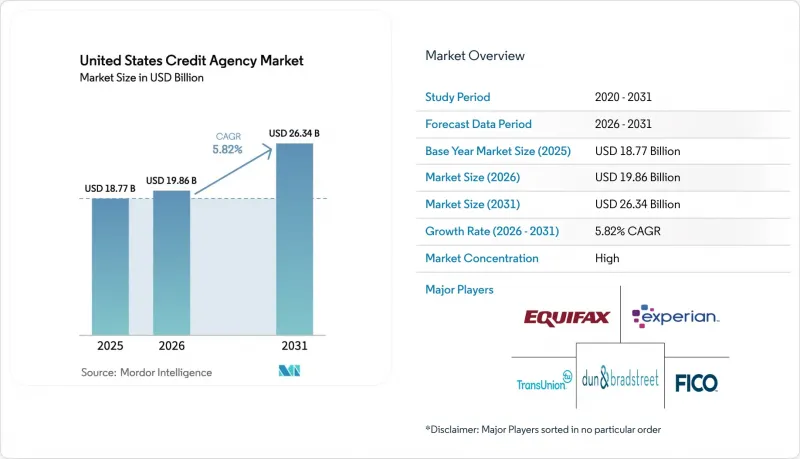
This report Segments the Industry Into by Service Type (Credit Reporting Services, Credit Scoring & Analytics, and More), by End User (Direct-To-Consumer, Government and Public Sector, and More), by Client Type (Individual and Commercial), and by Geography (Northeast, Midwest, and More). The Market Forecasts are Provided in Terms of Value (USD).
United States Credit Agency Market Trends and Insights
AI-Driven Alternative-Data Scoring Adoption
Machine-learning engines ingest rent, utilities, and mobile-usage records to score thin-file borrowers, supplying lenders with broader coverage while satisfying CFPB goals for fairness. Citigroup estimates AI could lift global banking profits by USD 170 billion by 2028, with credit underwriting gains supplying much of that upside . Agencies are strategically leveraging previously untapped data assets to unlock new revenue opportunities and enhance their market positioning. They are also introducing comprehensive model-risk reports that provide in-depth analysis of bias control mechanisms, ensuring compliance with evolving regulatory standards. By prioritizing transparency in their operations, these agencies are strengthening their ability to mitigate regulatory risks and maintain credibility in the market. Moreover, this approach solidifies their role as essential facilitators of responsible AI implementation within the lending industry.
Rising BNPL and Fintech Lending Volumes
Apple began furnishing Pay Later trades to Experian in March 2024, signaling a shift from off-book installments to fully reported credit obligations . CFPB research shows almost one in five BNPL users missed a payment in 2024, creating lender demand for bureau-grade oversight and loss forecasting. Agencies package BNPL attributes into specialty scores that track pay-in-four utilization and rollovers, then resell that insight to card issuers fighting share erosion. Direct-to-consumer dashboards let borrowers monitor BNPL history, generating subscription fees while easing dispute workloads. Early evidence suggests reported BNPL data raises average FICO by 10-12 points for punctual users, expanding access to mainstream credit lines.
Intensifying Data-Privacy Legislation (US State Patchwork)
California's Consumer Privacy Rights Act expansion, New York's proposed Digital Fairness Bill, and Illinois's Biometric Information Privacy Act each impose distinct consent, retention, and deletion rules. Agencies must run parallel workflows that check data provenance at state borders, inflating cloud-storage and compliance-audit spending. Delays in reconciling opt-out requests can trigger statutory fines as high as USD 7,500 per violation, eroding profit margins. Some bureaus respond by geofencing sensitive products or baking privacy surcharges into contracts. While privacy rules curb data breadth, they simultaneously heighten lender demand for vetted, FCRA-compliant sources, partially offsetting lost volume.
Other drivers and restraints analyzed in the detailed report include:
- Regulatory Push for Inclusive Credit Models
- Expansion of Small-Business Credit Data Products
- Mortgage-Rate Volatility Dampening Pull-Through Volumes
For complete list of drivers and restraints, kindly check the Table Of Contents.
Segment Analysis
Credit Reporting Services captured 57.05% of the U.S. credit agency market, reinforcing its position as the primary data provider for lenders. The Credit Scoring & Analytics segment is projected to expand at a 6.69% CAGR, surpassing the growth rate of traditional reporting services. This growth reflects a notable increase in the analytics-driven segment of the U.S. credit agency market. Key factors driving this expansion include regulatory requirements for AI transparency, the proliferation of Buy Now Pay Later (BNPL) offerings, and heightened demand for real-time credit approvals. Furthermore, Subscription-based Monitoring & Identity Protection services mitigate risks associated with lending cycles. These services experience demand surges during data breach events, ensuring steady revenue streams.
As scoring models mature, bureaus bolt on behavioural features such as spending volatility, pay cheque cadence, and geospatial fraud indicators, fortifying predictive power. Agencies that pilot federated-learning techniques retain consumer privacy while training networks, preserving legal compliance. Proprietary algorithmic lift underpins premium prices, yet pending CFPB algorithm-transparency moves threaten to erode that moat. To hedge, bureaus prioritise unique data ownership-public-record liens, payroll feeds, and verified cash-flow series. Cloud delivery lowers compute cost per inquiry by roughly 25% and enables pay-as-you-go bundles that attract fintech upstarts.
Complete Report Scope:
- By Service Type
- Credit Reporting Services
- Credit Scoring & Analytics
- Credit Monitoring & Identity Protection
- By End User
- Direct-to-Consumer
- Government and Public Sector
- Healthcare
- Financial Services
- Software and Professional Services
- Media and Technology
- Automotive
- Telecom and Utilities
- Retail and E-Commerce
- Other Verticals
- By Client Type
- Individual
- Commercial
- By Geography
- Northeast
- Midwest
- South
- West
List of Companies Covered in this Report:
- Equifax Inc.
- Experian PLC
- TransUnion
- Dun & Bradstreet Holdings
- Fair Isaac Corp. (FICO)
- LexisNexis Risk Solutions
- Innovis Data Solutions
- MicroBilt Corp.
- CoreLogic
- Moody's Analytics
- S&P Global Market Intelligence
- PRBC (PayRentBuildCredit)
- Nova Credit
- Clarity Services (Experian)
- ID Analytics (Symantec)
- Teletrack (Equifax)
- Early Warning Services
- Kroll Bond Rating Agency
- LenddoEFL
- Zest AI
- Petal / Prism Data
Additional Benefits:
- The market estimate (ME) sheet in Excel format
- 3 months of analyst support
TABLE OF CONTENTS
1 Introduction
- 1.1 Study Assumptions & Market Definition
- 1.2 Scope of the Study
2 Research Methodology
3 Executive Summary
4 Market Landscape
- 4.1 Market Overview
- 4.2 Market Drivers
- 4.2.1 AI-driven alternative-data scoring adoption
- 4.2.2 Rising BNPL & fintech lending volumes
- 4.2.3 Regulatory push for inclusive credit models (CFPB, FHFA)
- 4.2.4 Expansion of small-business credit data products
- 4.2.5 Data-broker deprecation boosting first-party bureau demand
- 4.2.6 Cloud-native bureau platforms enable real-time decisioning
- 4.3 Market Restraints
- 4.3.1 Intensifying data-privacy legislation (US state patchwork)
- 4.3.2 Mortgage-rate volatility dampening pull-through volumes
- 4.3.3 CFPB plan to open-source credit scoring algorithms
- 4.3.4 Concentrated tri-bureau pricing scrutiny & legal actions
- 4.4 Value / Supply-Chain Analysis
- 4.5 Regulatory Landscape
- 4.6 Technological Outlook
- 4.7 Porter's Five Forces
- 4.7.1 Threat of New Entrants
- 4.7.2 Bargaining Power of Buyers
- 4.7.3 Bargaining Power of Suppliers
- 4.7.4 Threat of Substitutes
- 4.7.5 Competitive Rivalry
5 Market Size & Growth Forecasts (Value, USD Bn)
- 5.1 By Service Type
- 5.1.1 Credit Reporting Services
- 5.1.2 Credit Scoring & Analytics
- 5.1.3 Credit Monitoring & Identity Protection
- 5.2 By End User
- 5.2.1 Direct-to-Consumer
- 5.2.2 Government and Public Sector
- 5.2.3 Healthcare
- 5.2.4 Financial Services
- 5.2.5 Software and Professional Services
- 5.2.6 Media and Technology
- 5.2.7 Automotive
- 5.2.8 Telecom and Utilities
- 5.2.9 Retail and E-Commerce
- 5.2.10 Other Verticals
- 5.3 By Client Type
- 5.3.1 Individual
- 5.3.2 Commercial
- 5.4 By Geography
- 5.4.1 Northeast
- 5.4.2 Midwest
- 5.4.3 South
- 5.4.4 West
6 Competitive Landscape
- 6.1 Market Concentration
- 6.2 Strategic Moves
- 6.3 Market Share Analysis
- 6.4 Company Profiles (includes Global level Overview, Market level overview, Core Segments, Financials as available, Strategic Information, Market Rank/Share for key companies, Products & Services, and Recent Developments)
- 6.4.1 Equifax Inc.
- 6.4.2 Experian PLC
- 6.4.3 TransUnion
- 6.4.4 Dun & Bradstreet Holdings
- 6.4.5 Fair Isaac Corp. (FICO)
- 6.4.6 LexisNexis Risk Solutions
- 6.4.7 Innovis Data Solutions
- 6.4.8 MicroBilt Corp.
- 6.4.9 CoreLogic
- 6.4.10 Moody's Analytics
- 6.4.11 S&P Global Market Intelligence
- 6.4.12 PRBC (PayRentBuildCredit)
- 6.4.13 Nova Credit
- 6.4.14 Clarity Services (Experian)
- 6.4.15 ID Analytics (Symantec)
- 6.4.16 Teletrack (Equifax)
- 6.4.17 Early Warning Services
- 6.4.18 Kroll Bond Rating Agency
- 6.4.19 LenddoEFL
- 6.4.20 Zest AI
- 6.4.21 Petal / Prism Data
7 Market Opportunities & Future Outlook
- 7.1 White-space & Unmet-need Assessment

