PUBLISHER: Mordor Intelligence | PRODUCT CODE: 2125659

PUBLISHER: Mordor Intelligence | PRODUCT CODE: 2125659
GCC Packaging - Market Share Analysis, Industry Trends & Statistics, Growth Forecasts (2026 - 2031)
According to Mordor Intelligence, the GCC packaging market size is expected to increase from USD 15.99 billion in 2025 to USD 16.68 billion in 2026 and reach USD 20.45 billion by 2031, growing at a CAGR of 4.16% over 2026-2031.
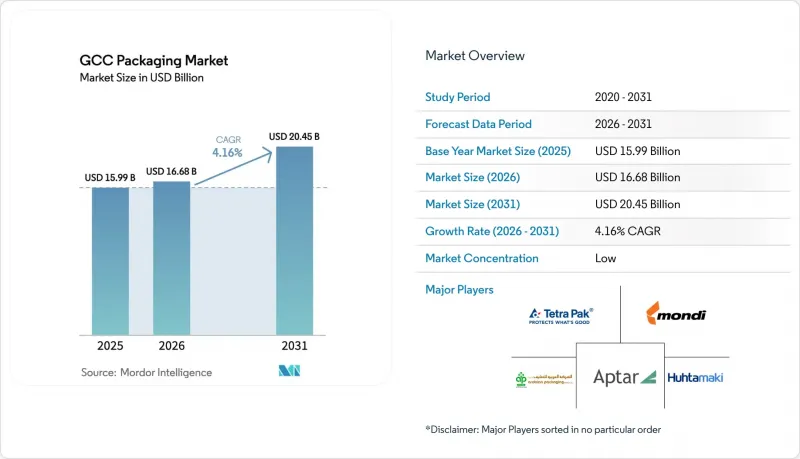
This report is Segmented by Material (Plastic, Metal, Glass, Paper and Paperboard, and Bioplastics), Packaging Type (Rigid, Flexible, and Semi-Rigid), End-User Industry (Food, Beverage, Pharmaceutical, Personal and Homecare, and Industrial), Packaging Technology (Thermoforming, Blow Molding, Injection Molding, and Vacuum Forming), and Geography. Market Forecasts are Provided in Value (USD).
GCC Packaging Market Trends and Insights
Rapid Growth in E-commerce Fulfilment Packaging
Double-digit growth in home delivery is reshaping secondary and tertiary packaging needs across the GCC packaging market. Online orders typically require corrugated outers, cushioning void fill, and tamper-evident seals, formats that carry greater material intensity than in-store retail. Retail sales are projected to hit USD 390 billion by 2028, with omnichannel share continuing to climb, a shift that magnifies demand for printable graphics that enhance the unboxing experience and for carrier-optimized pack dimensions that lower last-mile costs. Saudi Arabia's large-scale investments in logistics zones and fulfilment robotics will compress delivery lead times, encouraging frequent but smaller basket sizes, further elevating packaging unit requirements. Converters that add digital printing, right-sized corrugation, and biodegradable cushioning stand to capture premium margins as brand owners seek cost-effective differentiation. E-commerce therefore injects sustained incremental volume into the GCC packaging market and accelerates innovation in structural design.
Government Bans on Single-Use Plastics Spurring Alternative Materials
Implementation of the UAE's Executive Council Resolution No. 124 of 2023 eliminated single-use plastic bags, cups, plates, and cutlery beginning June 2024, triggering wholesale substrate swaps toward moulded fiber, coated paper, and certified-compostable biopolymers. The policy horizon has widened, with Saudi Arabia and Oman unveiling phased bans that prompt regional fast-food chains and retailers to redesign disposable service ware well before the 2028 compliance deadlines. However, GCC paper and board capacity is constrained by water scarcity and high energy costs, creating short-term shortages that inflate import bills and extend lead times. Emirates Biotech aims to address supply gaps through its 160,000-tonne-per-annum polylactic-acid complex, slated for mechanical completion in 2028, thereby positioning the UAE as a renewable-polymer hub. Brand owners now routinely request ISO 14855 or ASTM D6400 certification, and failure to comply risks shelf delisting, making alternative-material agility a competitive prerequisite across the GCC packaging market.
Persistent Volatility in Polymer Feedstock Prices
Crude-oil fluctuations, scheduled cracker turnarounds, and shifting Asian demand drove a SAR 60 per tonne rise in polypropylene while polyethylene dropped SAR 37 per tonne during 2024-2025, compressing gross margins for converters locked into quarterly price caps. Although recent capacity additions aim to smooth regional supply, global freight swings and arbitrage windows still transmit sharp resin price gyrations into the GCC packaging market. Smaller family-owned converters lack the hedging instruments that multinational peers wield, forcing them either to hold costly buffer stocks or accept spot-exposure risk. Emerging recycled-content mandates further destabilize price planning, because recycled PET and HDPE command premiums over virgin material in the Gulf due to tight local collection volumes. Without more transparent futures mechanisms or contract indexation, resin volatility will continue to temper near-term investment appetites.
Other drivers and restraints analyzed in the detailed report include:
- Food Security Investments Driving Cold-Chain Packaging Demand
- GCC Petrochemical Capacity Providing Low-Cost Resin Advantage
- Limited Post-Consumer Recycling Infrastructure
For complete list of drivers and restraints, kindly check the Table Of Contents.
Segment Analysis
Plastic controlled 66.04% of the GCC packaging market in 2025, and the segment's absolute tonnage continues to climb even as light-weighting trims gram-per-pack intensity. The dominance reflects resin availability, integrated feedstock economics, and established conversion assets. Within this hierarchy, polyethylene grades feed most films and liners, polypropylene secures closures and rigid tubs, and PET leads beverage bottles, together underpinning a multi-billion-dollar plastics economy inside the broader GCC packaging market size benchmark.
Bioplastics, although holding a single-digit share, are forecast to expand at a 4.98% CAGR as policy bans and multinational sustainability scorecards sharpen substrate choices. Emirates Biotech's coming PLA complex will anchor regional biopolymer supply, encouraging converters to retrofit extrusion and thermoforming lines for compostable goods. Glass remains niche in pharmaceuticals and premium beverages because of weight and breakage liability, while metal persists in canned drinks and aerosols, buoyed by near-perfect recycling loops. Paper and board growth is moderated by desalinated-water input costs, a structural issue that limits capex for new mills despite rising e-commerce corrugate demand. Overall, material substitution dynamics promise gradual diversification of the GCC packaging market, yet plastics will retain center stage through 2031.
Rigid packaging captured 48.19% of spending in 2025, upheld by bottles, jars, and industrial drums that satisfy barrier, stacking, and regulatory demands. However, flexible structures are logging a 4.56% CAGR through 2031 as pouches, sachets, and stretch wraps unlock cost, freight, and shelf-space advantages across food, personal-care, and e-commerce channels. Vacuum pouches extend protein shelf lives, while stand-up spouted pouches replace HDPE bottles in detergents, each substitution elevating the GCC packaging market's innovation cycle.
E-commerce imposes extra corrugated outers, but brand owners increasingly pair them with lightweight mailer films and molded-fiber inserts to minimize dimensional weight. Semi-rigid blister packs and tubes straddle both camps, finding traction in pharmaceutical dosing compliance and premium cosmetics presentation. SIG's aluminium-free full-barrier carton further blurs lines by delivering 12-month oxygen protection at a fraction of aluminium's carbon load, a pivotal lever as corporate climate targets tighten. The convergence of lightweighting economics and sustainability imperatives will keep flexible formats siphoning share from rigid incumbents inside the GCC packaging market.
Complete Report Scope:
- By Material
- Plastic
- LDPE
- HDPE
- PET
- PP
- PS
- PVC
- Other Plastics
- Metal
- Aluminum
- Steel / Tinplate
- Glass
- Flint (Clear)
- Amber
- Green
- Paper and Paperboard
- Corrugated Board
- Folding Cartons
- Liquid Packaging Board
- Molded Fiber
- Bioplastics
- PLA
- PHA
- Starch-based
- Bio-PET / Bio-PE
- Plastic
- By Packaging Type
- Rigid
- Bottles and Jars
- Cans and Drums
- Trays and Containers
- Caps and Closures
- Flexible
- Pouches
- Bags and Sacks
- Films and Wraps
- Sachets and Stick Packs
- Lidding
- Semi-rigid
- Blister Packs
- Tubes
- Clamshells
- Cups and Bowls
- Rigid
- By End-user Industry
- Food
- Processed Food
- Fresh Produce
- Bakery and Confectionery
- Meat, Poultry and Seafood
- Ready Meals
- Beverage
- Bottled Water
- Carbonated Soft Drinks
- Dairy Beverages
- Juices and Nectars
- Alcoholic Beverages
- Pharmaceutical
- Prescription Drugs
- OTC Medicines
- Nutraceuticals
- Personal and Homecare
- Personal Care
- Home Care and Cleaning
- Cosmetics
- Industrial
- Chemicals and Lubricants
- Building and Construction
- Automotive Components
- Food
- By Packaging Technology
- Thermoforming
- Blow Molding
- Extrusion Blow Molding
- Injection Stretch Blow Molding
- Injection Blow Molding
- Injection Molding
- Vacuum Forming
- By Country
- United Arab Emirates
- Saudi Arabia
- Qatar
- Kuwait
- Oman
- Bahrain
List of Companies Covered in this Report:
- Tetra Pak International SA
- Mondi plc
- Najmuddin Packaging and Refilling Industry LLC
- AptarGroup Inc.
- Can-Pack SA
- Rotopacking Materials Industry Co. LLC
- Gulf East Paper and Plastic Industries LLC
- Arabian Packaging LLC
- Amber Packaging Industries LLC
- Huhtamaki Oyj
- Corys Packaging LLC
- Integrated Plastics Packaging LLC
- Emirates Printing Press LLC
- Hotpack Packaging Industries LLC
- Napco National CJSC
- Express Pack Print LLC
- Green Packaging Boxes Industries LLC
- Tarboosh Packaging Company LLC
- Unipack Containers and Carton Products LLC
- Al Rumanah Packaging LLC
- Al Ghurair Packaging LLC
- SIG Combibloc Group AG
Additional Benefits:
- The market estimate (ME) sheet in Excel format
- 3 months of analyst support
TABLE OF CONTENTS
1 INTRODUCTION
- 1.1 Study Assumptions and Market Definition
- 1.2 Scope of the Study
2 RESEARCH METHODOLOGY
3 EXECUTIVE SUMMARY
4 MARKET LANDSCAPE
- 4.1 Market Overview
- 4.2 Market Drivers
- 4.2.1 Rapid Growth in E-commerce Fulfilment Packaging
- 4.2.2 Government Bans on Single-use Plastics Spurring Alternative Materials
- 4.2.3 Food Security Investments Driving Cold-chain Packaging Demand
- 4.2.4 GCC Petrochemical Capacity Providing Low-cost Resin Advantage
- 4.2.5 Mega-events Catalysing Retail Packaging Upgrades
- 4.2.6 AI-driven Packaging Automation Adoption at Converters
- 4.3 Market Restraints
- 4.3.1 Persistent Volatility in Polymer Feedstock Prices
- 4.3.2 Limited Post-consumer Recycling Infrastructure
- 4.3.3 Water Scarcity Increasing Paper and Board Processing Costs
- 4.3.4 Skills Gap for Industry 4.0 Packaging Operations
- 4.4 Industry Value-Chain Analysis
- 4.5 Impact of Macroeconomic Factors
- 4.6 Regulatory Landscape
- 4.7 Technological Outlook
- 4.8 Porter's Five Forces Analysis
- 4.8.1 Threat of New Entrants
- 4.8.2 Bargaining Power of Consumers
- 4.8.3 Bargaining Power of Suppliers
- 4.8.4 Threat of Substitute Products
- 4.8.5 Intensity of Competitive Rivalry
5 MARKET SIZE AND GROWTH FORECASTS (VALUE)
- 5.1 By Material
- 5.1.1 Plastic
- 5.1.1.1 LDPE
- 5.1.1.2 HDPE
- 5.1.1.3 PET
- 5.1.1.4 PP
- 5.1.1.5 PS
- 5.1.1.6 PVC
- 5.1.1.7 Other Plastics
- 5.1.2 Metal
- 5.1.2.1 Aluminum
- 5.1.2.2 Steel / Tinplate
- 5.1.3 Glass
- 5.1.3.1 Flint (Clear)
- 5.1.3.2 Amber
- 5.1.3.3 Green
- 5.1.4 Paper and Paperboard
- 5.1.4.1 Corrugated Board
- 5.1.4.2 Folding Cartons
- 5.1.4.3 Liquid Packaging Board
- 5.1.4.4 Molded Fiber
- 5.1.5 Bioplastics
- 5.1.5.1 PLA
- 5.1.5.2 PHA
- 5.1.5.3 Starch-based
- 5.1.5.4 Bio-PET / Bio-PE
- 5.1.1 Plastic
- 5.2 By Packaging Type
- 5.2.1 Rigid
- 5.2.1.1 Bottles and Jars
- 5.2.1.2 Cans and Drums
- 5.2.1.3 Trays and Containers
- 5.2.1.4 Caps and Closures
- 5.2.2 Flexible
- 5.2.2.1 Pouches
- 5.2.2.2 Bags and Sacks
- 5.2.2.3 Films and Wraps
- 5.2.2.4 Sachets and Stick Packs
- 5.2.2.5 Lidding
- 5.2.3 Semi-rigid
- 5.2.3.1 Blister Packs
- 5.2.3.2 Tubes
- 5.2.3.3 Clamshells
- 5.2.3.4 Cups and Bowls
- 5.2.1 Rigid
- 5.3 By End-user Industry
- 5.3.1 Food
- 5.3.1.1 Processed Food
- 5.3.1.2 Fresh Produce
- 5.3.1.3 Bakery and Confectionery
- 5.3.1.4 Meat, Poultry and Seafood
- 5.3.1.5 Ready Meals
- 5.3.2 Beverage
- 5.3.2.1 Bottled Water
- 5.3.2.2 Carbonated Soft Drinks
- 5.3.2.3 Dairy Beverages
- 5.3.2.4 Juices and Nectars
- 5.3.2.5 Alcoholic Beverages
- 5.3.3 Pharmaceutical
- 5.3.3.1 Prescription Drugs
- 5.3.3.2 OTC Medicines
- 5.3.3.3 Nutraceuticals
- 5.3.4 Personal and Homecare
- 5.3.4.1 Personal Care
- 5.3.4.2 Home Care and Cleaning
- 5.3.4.3 Cosmetics
- 5.3.5 Industrial
- 5.3.5.1 Chemicals and Lubricants
- 5.3.5.2 Building and Construction
- 5.3.5.3 Automotive Components
- 5.3.1 Food
- 5.4 By Packaging Technology
- 5.4.1 Thermoforming
- 5.4.2 Blow Molding
- 5.4.2.1 Extrusion Blow Molding
- 5.4.2.2 Injection Stretch Blow Molding
- 5.4.2.3 Injection Blow Molding
- 5.4.3 Injection Molding
- 5.4.4 Vacuum Forming
- 5.5 By Country
- 5.5.1 United Arab Emirates
- 5.5.2 Saudi Arabia
- 5.5.3 Qatar
- 5.5.4 Kuwait
- 5.5.5 Oman
- 5.5.6 Bahrain
6 COMPETITIVE LANDSCAPE
- 6.1 Market Concentration
- 6.2 Strategic Moves
- 6.3 Market Share Analysis
- 6.4 Company Profiles (includes Global Level Overview, Market Level Overview, Core Segments, Financials as available, Strategic Information, Market Rank/Share, Products and Services, Recent Developments)
- 6.4.1 Tetra Pak International SA
- 6.4.2 Mondi plc
- 6.4.3 Najmuddin Packaging and Refilling Industry LLC
- 6.4.4 AptarGroup Inc.
- 6.4.5 Can-Pack SA
- 6.4.6 Rotopacking Materials Industry Co. LLC
- 6.4.7 Gulf East Paper and Plastic Industries LLC
- 6.4.8 Arabian Packaging LLC
- 6.4.9 Amber Packaging Industries LLC
- 6.4.10 Huhtamaki Oyj
- 6.4.11 Corys Packaging LLC
- 6.4.12 Integrated Plastics Packaging LLC
- 6.4.13 Emirates Printing Press LLC
- 6.4.14 Hotpack Packaging Industries LLC
- 6.4.15 Napco National CJSC
- 6.4.16 Express Pack Print LLC
- 6.4.17 Green Packaging Boxes Industries LLC
- 6.4.18 Tarboosh Packaging Company LLC
- 6.4.19 Unipack Containers and Carton Products LLC
- 6.4.20 Al Rumanah Packaging LLC
- 6.4.21 Al Ghurair Packaging LLC
- 6.4.22 SIG Combibloc Group AG
7 MARKET OPPORTUNITIES AND FUTURE OUTLOOK
- 7.1 White-space and Unmet-need Assessment

