PUBLISHER: Mordor Intelligence | PRODUCT CODE: 2125676

PUBLISHER: Mordor Intelligence | PRODUCT CODE: 2125676
Plastic Pallets - Market Share Analysis, Industry Trends & Statistics, Growth Forecasts (2026 - 2031)
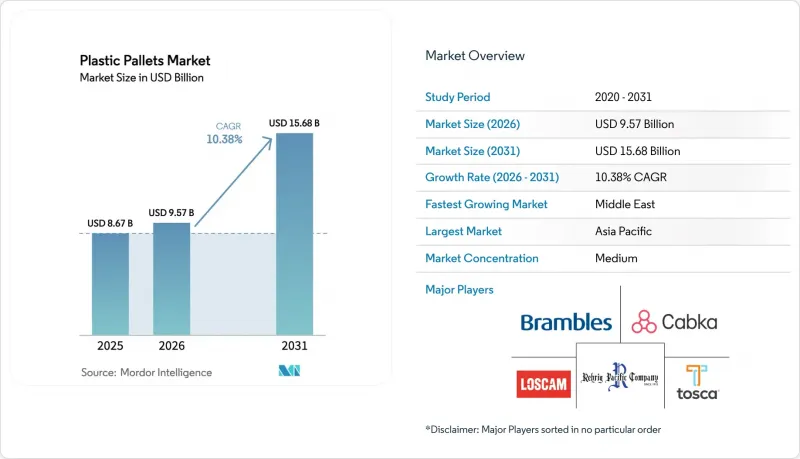
According to Mordor Intelligence, the plastic pallets market size is projected to expand from USD 8.67 billion in 2025 and USD 9.57 billion in 2026 to USD 15.68 billion by 2031, registering a CAGR of 10.38% between 2026 to 2031.
This report is Segmented by Material Type (High-Density Polyethylene, Polypropylene, Recycled Materials), Pallet Type (Nestable, Rackable, and More), End-User Industry (Chemical, Pharmaceutical and Healthcare, Logistics and Warehousing, Automotive, and More), Load Capacity (Light-Duty Pallets, Medium-Duty Pallets, High-Duty Pallets), and Geography. The Market Forecasts are Provided in Terms of Value (USD).
Global Plastic Pallets Market Trends and Insights
Adoption of Hygienic Plastic Pallets in Pharmaceutical Cold Chains
Pharmaceutical distributors now view pallets as qualified equipment rather than disposable dunnage. Health Canada's GUI-0069 and USP Chapter 1079 formalize cleanability and traceability requirements, driving buyers to non-porous, reusable platforms. Cold-chain pools that document wash-cycle microbiology are therefore displacing spot-market wood. As more biologics move through strict temperature lanes, suppliers that can validate pallet performance under shock, vibration, and cleaning chemicals are securing multi-year contracts. This shift tilts procurement criteria from unit price to total cost of quality and strengthens barriers to entry for unverified wooden alternatives.
Mandates for ISPM-15 Compliance in Asia Export Hubs
International Standards for Phytosanitary Measures 15 requires exporters to heat-treat or fumigate wood packaging, while plastic pallets are exempt from the rule entirely. Enforcement at U.S. and EU ports creates costly delays for non-compliant loads. Export-oriented manufacturers in China, Vietnam, and India are therefore moving to plastic despite a higher ticket price because it shortens customs clearance and mitigates re-export risks. The practical effect is a trade-velocity premium that positions plastic as a logistics insurance policy for just-in-time supply chains.
High Upfront Capital Cost Barrier for SMEs in Emerging Southeast Asia
Plastic pallets cost three to five times as much as comparable wood units, a burden for small exporters operating on slim margins. Because pooling coverage is patchy in the region, many firms must self-purchase, tying up scarce working capital. Without the backing of pooling consortia or subsidies from development banks for reusable packaging, wood will continue to dominate, even with its higher lifecycle costs, hindering its adoption among numerous micro-exporters.
Other drivers and restraints analyzed in the detailed report include:
- Pooling Models Reducing Total Cost of Ownership for 3PLs in Europe
- Retail Automation Requiring Dimensionally Stable Pallets in the United States
- Limited Reverse Logistics Infrastructure in Africa and South America
For complete list of drivers and restraints, kindly check the Table Of Contents.
Segment Analysis
High-density polyethylene accounted for 47.33% of the plastic pallets market share in 2025, while recycled-content variants are forecast to expand at a 10.96% CAGR through 2031. Virgin HDPE remains the first choice for food and pharmaceutical shippers that must meet FDA and EU migration limits, yet tightening circular-economy rules in Europe are making recycled feedstock a competitive necessity. Vertically integrated molders have started locking in post-consumer resin streams to protect margins from crude-linked swings in virgin resin prices, and those contracts are already oversubscribed. A Korean longevity study showed virgin HDPE pallets lasting 9.6 years in high-rotation pools, three times longer than polypropylene, which reinforces HDPE's value proposition despite its higher input cost.
Recycled blends now dominate automotive and general retail lanes, where hygiene barriers are lower, and sustainability scorecards govern sourcing. Demand spikes ahead of the EU's 10% recycled-content deadline for 2030, creating a seller's market for food-grade recyclate. Processors that can certify decontamination to FDA 21 CFR Part 177 standards command premium pricing and priority in contract renewals. As recycled supply tightens, the plastic pallets market for virgin HDPE is expected to hold steady rather than contract, as brand owners fund parallel supply chains to ring-fence risk.
Rackable platforms secured 39.53% of the plastic pallets market share in 2025 by maximizing vertical storage density in automated warehouses. Nestable and stackable designs retained strong positions in export corridors that prize container cube and backhaul efficiency, yet their share is plateauing as retailers prioritize automation compatibility. Display and custom formats are on track for an 11.23% CAGR through 2031, because discounters and big-box stores now roll fully merchandised pallets straight to the sales floor, eliminating manual shelf stocking.
Second-generation display units incorporate in-mold graphics, color coding, and embedded RFID, letting stores cut labor while improving shrink control. Custom anti-static versions are proliferating in lithium-battery supply chains, where a single spark can trigger thermal runaway. As fulfillment centers retrofit with high-speed conveyors, procurement managers are specifying rackable or stackable SKUs built to +-2 mm tolerances, sidelining wood and low-precision compression molds. This specification shift cements an architectural divide between automation-ready pallets and commodity export skids.
Complete Report Scope:
- By Material Type
- High-Density Polyethylene
- Polypropylene
- Recycled Materials
- By Pallet Type
- Nestable
- Rackable
- Stackable
- Display / Custom
- By End-User Industry
- Food and Beverage
- Chemical
- Pharmaceutical and Healthcare
- Retail and E-Commerce
- Logistics and Warehousing
- Automotive
- Other End-User Industries
- By Load Capacity
- Light-Duty Pallets
- Medium-Duty Pallets
- High-Duty Pallets
- By Geography
- North America
- United States
- Canada
- Mexico
- South America
- Brazil
- Argentina
- Rest of South America
- Europe
- United Kingdom
- Germany
- France
- Italy
- Rest of Europe
- Asia Pacific
- China
- Japan
- India
- South Korea
- Rest of Asia Pacific
- Middle East and Africa
- Middle East
- United Arab Emirates
- Saudi Arabia
- Rest of Middle East
- Africa
- South Africa
- Egypt
- Rest of Africa
- Middle East
- North America
Geography Analysis
Asia-Pacific accounted for 38.91% of the global value in 2025, making it the largest plastic pallets market. Export manufacturers in China, India, and ASEAN favor plastic units that bypass ISPM-15 treatment, cutting customs delays and re-export risks. India's plastics sector is targeting USD 44.59 billion by 2030, and domestic demand is driving higher pallet purchases for both export and inland moves. China remains the single biggest producer and exporter of plastic packaging, and the resulting logistics flows sustain high pallet rotation that rewards durable HDPE designs. Together, these dynamics push the regional plastic pallets market size steadily upward through 2031.
North America and Europe form a mature second tier. U.S. retailers are equipping new fulfillment centers with AS/RS equipment that accepts only precision-molded units, ensuring steady replacement cycles and vibrant pooling activity. The EU Packaging and Packaging Waste Regulation locks in reuse targets that guarantee multi-trip demand and accelerate take-back programs. Pooling operators maintain dense retrieval networks across both regions, reducing empty miles and supporting 30-40% cost savings for shippers. Stable reverse-logistics infrastructure keeps pallet loss rates low and underpins predictable asset lifetimes.
The Middle East is forecast to log the fastest regional CAGR at 11.41% through 2031 as Saudi Vision 2030 builds megaproject warehouses and UAE pharmaceutical imports swell cold-chain lanes. South America shows mixed progress because Brazil and Argentina support limited pooling corridors, while Andean markets lack the warehouse density needed for economical retrieval. Most of Africa remains constrained by fragmented road systems that strand pallets at endpoints, blocking reuse economics. Until cross-border trade agreements streamline paperwork and road conditions improve, wooden platforms will dominate in those territories. Regional growth prospects, therefore, bifurcate along lines of infrastructure maturity.
- Brambles Limited
- CABKA Group GmbH
- Orbis Corporation
- Schoeller Allibert Group BV
- Rehrig Pacific Company
- Tosca Services, LLC
- Loscam International Holdings
- Craemer Holding GmbH
- Gamma-Wopla NV / Smart-Flow NV
- Q-Pall BV
- Plasgad Plastic Products ACS Ltd.
- NAECO S.L.
- Polymer Solutions International Inc.
- RPP Containers
- IPS Plastics Pallets
- Shandong Huaxiang Plastic Co., Ltd.
- Beijing Jingliang United Plastic Products Co., Ltd.
- TranPak Inc.
- Allied Plastics, Inc.
- Falkenhahn AG
- Buckhorn Inc.
- iGPS Logistics LLC
Additional Benefits:
- The market estimate (ME) sheet in Excel format
- 3 months of analyst support
TABLE OF CONTENTS
1 INTRODUCTION
- 1.1 Study Assumptions and Market Definition
- 1.2 Scope of the Study
2 RESEARCH METHODOLOGY
3 EXECUTIVE SUMMARY
4 MARKET LANDSCAPE
- 4.1 Market Overview
- 4.2 Market Drivers
- 4.2.1 Adoption of Hygienic Plastic Pallets in Pharmaceutical Cold Chains across North America and Europe
- 4.2.2 Mandates for ISPM-15 Compliance Driving Shift from Wood to Plastic in Asia Export Hubs
- 4.2.3 Pooling Models Reducing Total Cost of Ownership for 3PLs in Europe
- 4.2.4 Retail Automation, AS/RS and Conveyor Systems Requiring Dimensionally Stable Pallets in the United States
- 4.2.5 Circular Economy Targets Pushing Demand for Recyclate-Based HDPE Pallets in the European Union
- 4.2.6 Battery and Chemical Lithium Supply Chains Preferring Anti-Static Plastic Pallets in China
- 4.3 Market Restraints
- 4.3.1 High Upfront Capital Cost Barrier for Small and Medium Enterprises in Emerging Southeast Asia
- 4.3.2 Limited Reverse Logistics Infrastructure for Bulk Return of Pallets in Africa and South America
- 4.3.3 Price Volatility of Virgin Polyolefin Resins Linked to Crude-Oil Swings
- 4.3.4 Perception of Lower Load Capacity Versus Hardwood Pallets Among Heavy-Duty Users in Construction
- 4.4 Impact of Macroeconomic Factors on the Market
- 4.5 Industry Value Chain Analysis
- 4.6 Technological Outlook
- 4.7 Sustainability and Recycling/Reusability of Plastic Pallets
- 4.8 Regulatory Framework and Standards
- 4.9 Porter's Five Forces Analysis
- 4.9.1 Bargaining Power of Suppliers
- 4.9.2 Bargaining Power of Buyers
- 4.9.3 Threat of New Entrants
- 4.9.4 Threat of Substitutes
- 4.9.5 Intensity of Competitive Rivalry
5 MARKET SIZE AND GROWTH FORECASTS (VALUE)
- 5.1 By Material Type
- 5.1.1 High-Density Polyethylene
- 5.1.2 Polypropylene
- 5.1.3 Recycled Materials
- 5.2 By Pallet Type
- 5.2.1 Nestable
- 5.2.2 Rackable
- 5.2.3 Stackable
- 5.2.4 Display / Custom
- 5.3 By End-User Industry
- 5.3.1 Food and Beverage
- 5.3.2 Chemical
- 5.3.3 Pharmaceutical and Healthcare
- 5.3.4 Retail and E-Commerce
- 5.3.5 Logistics and Warehousing
- 5.3.6 Automotive
- 5.3.7 Other End-User Industries
- 5.4 By Load Capacity
- 5.4.1 Light-Duty Pallets
- 5.4.2 Medium-Duty Pallets
- 5.4.3 High-Duty Pallets
- 5.5 By Geography
- 5.5.1 North America
- 5.5.1.1 United States
- 5.5.1.2 Canada
- 5.5.1.3 Mexico
- 5.5.2 South America
- 5.5.2.1 Brazil
- 5.5.2.2 Argentina
- 5.5.2.3 Rest of South America
- 5.5.3 Europe
- 5.5.3.1 United Kingdom
- 5.5.3.2 Germany
- 5.5.3.3 France
- 5.5.3.4 Italy
- 5.5.3.5 Rest of Europe
- 5.5.4 Asia Pacific
- 5.5.4.1 China
- 5.5.4.2 Japan
- 5.5.4.3 India
- 5.5.4.4 South Korea
- 5.5.4.5 Rest of Asia Pacific
- 5.5.5 Middle East and Africa
- 5.5.5.1 Middle East
- 5.5.5.1.1 United Arab Emirates
- 5.5.5.1.2 Saudi Arabia
- 5.5.5.1.3 Rest of Middle East
- 5.5.5.2 Africa
- 5.5.5.2.1 South Africa
- 5.5.5.2.2 Egypt
- 5.5.5.2.3 Rest of Africa
- 5.5.5.1 Middle East
- 5.5.1 North America
6 COMPETITIVE LANDSCAPE
- 6.1 Market Concentration
- 6.2 Strategic Moves
- 6.3 Market Share Analysis
- 6.4 Company Profiles (includes Global Level Overview, Market Level Overview, Core Segments, Financials as available, Strategic Information, Market Rank/Share, Products and Services, Recent Developments)
- 6.4.1 Brambles Limited
- 6.4.2 CABKA Group GmbH
- 6.4.3 Orbis Corporation
- 6.4.4 Schoeller Allibert Group BV
- 6.4.5 Rehrig Pacific Company
- 6.4.6 Tosca Services, LLC
- 6.4.7 Loscam International Holdings
- 6.4.8 Craemer Holding GmbH
- 6.4.9 Gamma-Wopla NV / Smart-Flow NV
- 6.4.10 Q-Pall BV
- 6.4.11 Plasgad Plastic Products ACS Ltd.
- 6.4.12 NAECO S.L.
- 6.4.13 Polymer Solutions International Inc.
- 6.4.14 RPP Containers
- 6.4.15 IPS Plastics Pallets
- 6.4.16 Shandong Huaxiang Plastic Co., Ltd.
- 6.4.17 Beijing Jingliang United Plastic Products Co., Ltd.
- 6.4.18 TranPak Inc.
- 6.4.19 Allied Plastics, Inc.
- 6.4.20 Falkenhahn AG
- 6.4.21 Buckhorn Inc.
- 6.4.22 iGPS Logistics LLC
7 MARKET OPPORTUNITIES AND FUTURE OUTLOOK
- 7.1 White-space and Unmet-Need Assessment

