PUBLISHER: Mordor Intelligence | PRODUCT CODE: 2125679

PUBLISHER: Mordor Intelligence | PRODUCT CODE: 2125679
GCC Paper Bags - Market Share Analysis, Industry Trends & Statistics, Growth Forecasts (2026 - 2031)
According to Mordor Intelligence, the GCC paper bags market size was valued at USD 469.53 million in 2025 and is estimated to grow from USD 505.28 million in 2026 to reach USD 742.73 million by 2031, at a CAGR of 8.01% during the forecast period (2026-2031).
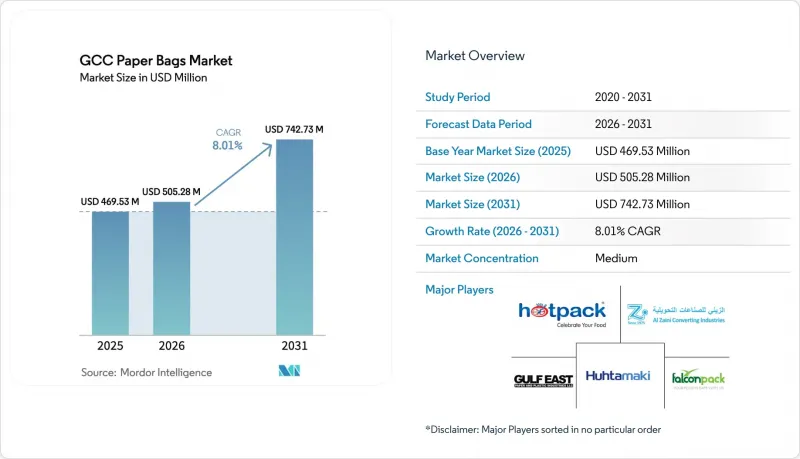
This report is Segmented by Bag Type (Flat Bottom, Pasted Valve, Pinched Bottom Open Mouth, Pasted Open Mouth, and Sewn Open Mouth), Material Type (Brown Kraft, Bleached/White Kraft, Coated Kraft, and Recycled Brown Kraft), Ply Thickness (1-Ply, 2-Ply, and More), End User (Retail, Agriculture and Animal Feed, Food Service, and More), and Country. The Market Forecasts are Provided in Terms of Value (USD).
GCC Paper Bags Market Trends and Insights
Sustainable-Packaging Regulations Spur Paper Adoption
The United Arab Emirates enforced a federal ban on single-use plastic bags in January 2024, compelling retailers and food-service chains to shift procurement to paper carriers. Dubai's Resolution 124 of 2023 added local penalties that further accelerated conversion timelines. Oman tightened the regional regime through Decision 8/2024, which blocks imports of single-use plastic bags from September 2024 Because implementation windows were short, converters with existing multi-wall capacity captured sudden order spikes while plastic-film specialists lost shelf space.
E-Commerce Parcel Growth Fuels Protective Paper Mailers
Parcel volumes handled by regional fulfillment centers are rising double-digit annually as smartphone adoption, digital payments, and last-mile footprint expand. Online platforms are piloting fully recyclable padded mailers that combine kraft outer layers with cushioning inserts, replacing traditional plastic bubble envelopes. Retrofit programs for automatic mailer-loading equipment are progressing, and several logistics providers are testing humidity-controlled depots to protect paper parcels. Brand owners view curbside recyclability as a marketing edge, increasing willingness to pay a premium for advanced barrier coatings. The result is a virtuous cycle in which higher-value mailer formats elevate both revenue and margin per unit for converters engaged in the GCC paper bags market.
Volatile Wood-Pulp Prices and Import Dependence
Regional converters still import the bulk of virgin fiber, tying their cost base to global commodity cycles. Recent mill closures in North America tightened supply, pushing spot kraft prices to multi-year highs just as converters quoted fixed-price tenders for supermarket chains. Freight surcharges from Asia added further pressure, and not all customers accept quarterly price escalators. Smaller converters with limited inventory buffers face working-capital strain, occasionally resorting to short-weighting or delayed deliveries that erode buyer trust. Unless upstream pulp self-sufficiency accelerates, margin volatility will continue to cap near-term profitability in the GCC paper bags market.
Other drivers and restraints analyzed in the detailed report include:
- Vision 2030 Manufacturing Diversification Incentives
- Food-Delivery Boom Boosts Takeaway Paper Bags
- Competition from Reusable PP and Cotton Tote Bags
For complete list of drivers and restraints, kindly check the Table Of Contents.
Segment Analysis
Pasted valve formats, holding 35.72% of GCC paper bags market share in 2025, stayed dominant because cement producers require dust-tight seals compatible with rotary packers. Construction mega-projects such as NEOM and The Red Sea Project consume millions of 50-kilogram units monthly, anchoring baseline volumes. Downstream, the sewn open mouth segment is forecast to post a 9.31% CAGR, propelled by animal-feed and grain processors that value tamper-evident stitching for traceability audits. Flat bottom variants, which stand upright on retail shelves, are carving out niche demand from premium coffee roasters and specialty pet food. Pinched bottom open mouth bags serve dry commodities like flour and sugar, offering a compromise between cost and burst strength. The proliferation of bag-type SKUs encourages converters to invest in modular lines that switch quickly among sealing options, improving asset utilization.
Second-generation equipment imported from Europe allows one plant to alternate between pasted valve and pinch-bottom designs within a single shift, smoothing order peaks. Digital die-cutting combined with inline flexographic presses accelerates custom branding for mid-volume jobs, a feature appreciated by e-commerce sellers launching limited-edition merchandise. In parallel, quality inspectors deploy machine-vision cameras to verify glue application and stitch density, reducing rejection rates. These productivity gains help cushion raw-material price shocks. Market awareness campaigns by packaging institutes also underline the dust-emission benefits of valve bags, persuading regulators to include minimum performance thresholds in new cement-logistics guidelines. All told, evolutionary improvements in bag-type engineering underpin diversified revenue streams for participants in the GCC paper bags market.
Brown kraft retained 46.79% market share in 2025 as its unbleached fibers offer the lowest delivered-cost profile and adequate printability for mass retail. Nevertheless, coated kraft is projected to clock a 9.57% CAGR up to 2031, thanks to proprietary barrier layers that repel grease, moisture, and even oxygen. Quick-service restaurants now specify water-based dispersion coatings, avoiding polyethylene laminations that complicate recycling. Bleached kraft, bright and smooth, remains the substrate of choice for cosmetics gift packs and luxury apparel, but price premiums constrain adoption in grocery carry-outs. Recycled brown kraft sourced from new containerboard machines offsets virgin fiber exposure, soothing ESG scrutiny from corporate buyers.
Converters fine-tune basis weights between 70 g m-2 and 120 g m-2 to balance stiffness with foldability in high-speed form-fill-seal systems. Extrusion coaters recently installed in Jeddah can apply dual-layer barriers in one pass, shaving energy consumption by double-digit percentages. Meanwhile, pilot trials for date-palm fiber pulping show early promise, although variability in lignin content complicates bleaching sequences. Intellectual-property filings on bio-based resins further suggest that functional performance and circularity are no longer mutually exclusive. These material-type breakthroughs keep the GCC paper bags market in the spotlight for brand owners chasing both legislative compliance and differentiated shelf presence.
Complete Report Scope:
- By Bag Type
- Flat Bottom
- Pasted Valve
- Pinched Bottom Open Mouth
- Pasted Open Mouth
- Sewn Open Mouth
- By Material Type
- Brown Kraft
- Bleached/White Kraft
- Coated Kraft
- Recycled Brown Kraft
- By Ply Thickness
- 1-Ply
- 2-Ply
- 3-Ply
- 4-Ply
- By End User
- Retail
- Agriculture and Animal Feed
- Food Service
- Cosmetics and Personal Care
- E-Commerce
- Other End Users
- By Country
- Saudi Arabia
- Oman
- United Arab Emirates
- Qatar
- Rest of GCC
List of Companies Covered in this Report:
- Huhtamaki Flexibles UAE
- Gulf East Paper & Plastic Industries LLC
- Hotpack Packaging Industries LLC
- Falcon Pack Industries LLC
- Al Zaini Converting Industries
- Mondi plc
- BreezPack FZ-LLC
- Middle East Paper Company (MEPCO)
- Segezha Group PJSC
- Novolex Holdings LLC
- Gascogne SA
- Unipack Containers and Carton Products LLC
- Union Paper Mills LLC
- Smurfit Westrock
- Klabin S.A.
- Ronpak Inc.
- Detpak Manufacturing LLC
- Star Paper Mill Paper Industry LLC
- International Paper Company
- Billerud AB
- Printpack Packaging Industries LLC
Additional Benefits:
- The market estimate (ME) sheet in Excel format
- 3 months of analyst support
TABLE OF CONTENTS
1 INTRODUCTION
- 1.1 Study Assumptions and Market Definition
- 1.2 Scope of the Study
2 RESEARCH METHODOLOGY
3 EXECUTIVE SUMMARY
4 MARKET LANDSCAPE
- 4.1 Market Overview
- 4.2 Market Drivers
- 4.2.1 Sustainable-Packaging Regulations Spur Paper Adoption
- 4.2.2 E-Commerce Parcel Growth Fuels Protective Paper Mailers
- 4.2.3 Vision 2030 Manufacturing Diversification Incentives
- 4.2.4 Food-Delivery Boom Boosts Takeaway Paper Bags
- 4.2.5 Date-Palm Fibre-Based Kraft Pulp Pilot Projects
- 4.2.6 Regional Recycled-Containerboard Capacity Expansions
- 4.3 Market Restraints
- 4.3.1 Volatile Wood-Pulp Prices and Import Dependence
- 4.3.2 Competition from Reusable PP and Cotton Tote Bags
- 4.3.3 Weak GCC Paper-Recycling Logistics Network
- 4.3.4 Gulf Humidity Challenges Bag Integrity in Wet Uses
- 4.4 Industry Value Chain Analysis
- 4.5 Regulatory Landscape
- 4.6 Technological Outlook
- 4.7 Impact of Macroeconomic Factors on the Market
- 4.8 Porter's Five Forces Analysis
- 4.8.1 Threat of New Entrants
- 4.8.2 Bargaining Power of Buyers
- 4.8.3 Bargaining Power of Suppliers
- 4.8.4 Threat of Substitutes
- 4.8.5 Intensity of Competitive Rivalry
5 MARKET SIZE AND GROWTH FORECASTS (VALUE)
- 5.1 By Bag Type
- 5.1.1 Flat Bottom
- 5.1.2 Pasted Valve
- 5.1.3 Pinched Bottom Open Mouth
- 5.1.4 Pasted Open Mouth
- 5.1.5 Sewn Open Mouth
- 5.2 By Material Type
- 5.2.1 Brown Kraft
- 5.2.2 Bleached/White Kraft
- 5.2.3 Coated Kraft
- 5.2.4 Recycled Brown Kraft
- 5.3 By Ply Thickness
- 5.3.1 1-Ply
- 5.3.2 2-Ply
- 5.3.3 3-Ply
- 5.3.4 4-Ply
- 5.4 By End User
- 5.4.1 Retail
- 5.4.2 Agriculture and Animal Feed
- 5.4.3 Food Service
- 5.4.4 Cosmetics and Personal Care
- 5.4.5 E-Commerce
- 5.4.6 Other End Users
- 5.5 By Country
- 5.5.1 Saudi Arabia
- 5.5.2 Oman
- 5.5.3 United Arab Emirates
- 5.5.4 Qatar
- 5.5.5 Rest of GCC
6 COMPETITIVE LANDSCAPE
- 6.1 Market Concentration
- 6.2 Strategic Moves
- 6.3 Market Share Analysis
- 6.4 Company Profiles (Includes Global Level Overview, Market Level Overview, Core Segments, Financials as Available, Strategic Information, Market Rank/Share, Products and Services, and Recent Developments)
- 6.4.1 Huhtamaki Flexibles UAE
- 6.4.2 Gulf East Paper & Plastic Industries LLC
- 6.4.3 Hotpack Packaging Industries LLC
- 6.4.4 Falcon Pack Industries LLC
- 6.4.5 Al Zaini Converting Industries
- 6.4.6 Mondi plc
- 6.4.7 BreezPack FZ-LLC
- 6.4.8 Middle East Paper Company (MEPCO)
- 6.4.9 Segezha Group PJSC
- 6.4.10 Novolex Holdings LLC
- 6.4.11 Gascogne SA
- 6.4.12 Unipack Containers and Carton Products LLC
- 6.4.13 Union Paper Mills LLC
- 6.4.14 Smurfit Westrock
- 6.4.15 Klabin S.A.
- 6.4.16 Ronpak Inc.
- 6.4.17 Detpak Manufacturing LLC
- 6.4.18 Star Paper Mill Paper Industry LLC
- 6.4.19 International Paper Company
- 6.4.20 Billerud AB
- 6.4.21 Printpack Packaging Industries LLC
7 MARKET OPPORTUNITIES AND FUTURE OUTLOOK
- 7.1 White-Space and Unmet-Need Assessment

