PUBLISHER: Mordor Intelligence | PRODUCT CODE: 2125702

PUBLISHER: Mordor Intelligence | PRODUCT CODE: 2125702
Adjustable Bed Bases - Market Share Analysis, Industry Trends & Statistics, Growth Forecasts (2026 - 2031)
According to Mordor Intelligence, the adjustable bed bases market size is expected to grow from USD 4.44 billion in 2025 to USD 4.69 billion in 2026 and is forecast to reach USD 6.14 billion by 2031 at 5.56% CAGR over 2026-2031.
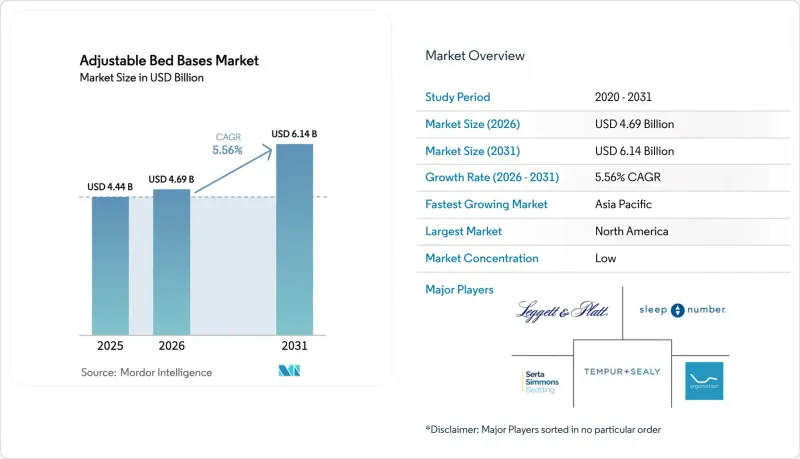
This report is Segmented by Bed Type (Manual Adjustable Bed Bases, and More), by Frame Material (Wood, Metal, and More), by Size (Queen, King, Twin, and More), by End User (Residential, and Commercial), by Distribution Channel (B2C/Retail Channels, and B2B/Project ), and by Geography (North America, South America, Europe, Asia-Pacific, and More). The Market Forecasts are Provided in Terms of Value (USD).
Global Adjustable Bed Bases Market Trends and Insights
Aging Population and Mobility Challenges Elevating Demand for Adjustable Sleep Systems Globally
Adults aged 65 and above are projected to represent 16% of the global population by 2030, and many now view adjustability as an essential aid to maintain independence. Designs increasingly target arthritis relief and easier breathing, with nine in ten older users reporting better rest quality after switching. Medicare and comparable programs reimburse adjustable bases prescribed for specific ailments, lowering out-of-pocket costs and expanding access. Manufacturers, therefore, prioritize motor strength, emergency power backup, and low-height profiles to meet both comfort and mobility needs.
Consumer Prioritization of Sleep Wellness and Ergonomic Comfort Across Price Tiers
Sleep has shifted from a luxury discussion to a measurable wellness metric. Entry-level motorized bases under USD 900 are now commonplace, widening adoption among middle-income households. Smart bases add sleep-stage sensing, automatic micro-adjustments, and app-controlled ecosystem links, turning the bed into a platform for subscription-based analytics. Brands are piloting "sleep-as-a-service" bundles that package cloud software with periodic firmware upgrades, creating new annuity revenue streams. Integration with voice assistants and circadian lighting further embeds adjustable bases within connected-home routines, reinforcing daily user engagement beyond nighttime use.
High Price Sensitivity Versus Traditional Foundations Hindering Mass Adoption
The significant price differential between adjustable bases and conventional bed foundations continues to constrain market penetration, with adjustable bases typically commanding substantial premiums over traditional foundations. The twin category, despite strong senior and single-user needs, sees the steepest premium, slowing unit velocity. Manufacturers are shifting to tiered portfolios that offer essential lift functions at entry prices while reserving mass customization and IoT integration for flagship lines.
Other drivers and restraints analyzed in the detailed report include:
- Premiumization of Hospitality Sector: Enhancing Guest Experience with Motorized Bases
- E-Commerce and Flat-Pack Logistics Expanding Global Reach for Adjustable Bed Bases
- Global Supply-Chain Volatility Raising Production and Shipping Costs
For complete list of drivers and restraints, kindly check the Table Of Contents.
Segment Analysis
Electric/Powered models dominated value with a 69.35% share in 2025, anchoring the adjustable bed bases market through proven reliability and accessible pricing. Demand is buoyed by programmable presets, massage modules, and smartphone connectivity that deliver perceived luxury at mid-level costs. The adjustable bed bases market size tied to Smart bases is advancing at a 6.39% CAGR alongside wider IoT adoption. Smart platforms leverage AI algorithms to raise or lower sections based on heart-rate variability, translating biomedical data into granular position adjustments.
A growing cohort of technology firms is entering the category, partnering with bedding manufacturers to embed firmware over-the-air upgrades and cloud analytics. Price premiums remain viable as early adopters pay for advanced biofeedback loops and integration with broader wellness dashboards. Manual models retain niches in regions with unreliable grids, offering simple crank mechanisms at the lowest cost of ownership. Nonetheless, software-driven differentiation is reshaping competitive dynamics, making proprietary algorithms and user-experience design central to brand equity.
Metal frames accounted for 59.40% of the 2025 share, favored for strength under frequent articulation cycles and compatibility with high-torque motors. Commercial buyers in hospitality and healthcare prize the corrosion resistance and serviceability of powder-coated steel, maintaining this leadership. A 6.09% CAGR supports the adjustable bed bases market for composite and alternative frames as brands pivot toward eco-friendly solutions. Recycled aluminum alloys and fiber-reinforced wood hybrids reduce weight by up to 20%, lowering freight emissions and easing assembly.
Environmental preferences shape purchasing criteria in Europe and parts of North America, where corporate sustainability targets carry procurement weight. Manufacturers experiment with bio-resin finishes and FSC-certified timber in visible components to align with green building standards. Weight reduction also suits e-commerce logistics, enabling flat-pack cartons that stay within parcel weight limits. Consumer marketing increasingly highlights cradle-to-grave recyclability and low-VOC coatings, signaling that sustainability is transitioning from a niche advantage to a mainstream expectation.
Complete Report Scope:
- By Bed Type
- Manual Adjustable Bed Bases
- Electric/Powered Adjustable Bed Bases
- Smart Adjustable Bed Bases
- By Frame Material
- Wood
- Metal
- Other Materials
- By Size
- Queen
- King
- Twin
- Full
- Other Size
- By End User
- Residential
- Commercial
- By Distribution Channel
- B2C/Retail Channels
- Home Centers/Home Improvement Stores
- Specialty Stores
- Online
- Other Distribution Channels
- B2B/Project (direct from the manufacturers)
- B2C/Retail Channels
- By Geography
- North America
- Canada
- United States
- Mexico
- South America
- Brazil
- Peru
- Chile
- Argentina
- Rest of South America
- Europe
- United Kingdom
- Germany
- France
- Spain
- Italy
- BENELUX (Belgium, Netherlands, and Luxembourg)
- NORDICS (Denmark, Finland, Iceland, Norway, and Sweden)
- Rest of Europe
- Asia-Pacific
- India
- China
- Japan
- Australia
- South Korea
- South East Asia (Singapore, Malaysia, Thailand, Indonesia, Vietnam, and Philippines)
- Rest of Asia-Pacific
- Middle East And Africa
- United Arab of Emirates
- Saudi Arabia
- South Africa
- Nigeria
- Rest of Middle East And Africa
- North America
Geography Analysis
North America retained leadership with 44.55% of global revenue in 2025, underpinned by widespread sleep-health awareness and established reimbursement pathways for medically indicated beds. The United States accounts for roughly 85% of regional sales and sets technology benchmarks that ripple worldwide. Smart feature attach rates are highest here, buoying average selling prices and reinforcing premium positioning. Favorable demographics-namely, the large Baby Boomer cohort-and the prevalence of sleep apnea and acid reflux conditions sustain consistent demand.
Asia-Pacific delivers the fastest 6.67% regional CAGR for 2026-2031, reflecting rapid urbanization, rising middle-class incomes, and maturing e-commerce infrastructure. Japan leads adoption due to its aging population and enthusiasm for home automation, whereas China provides the largest addressable base. In major Chinese cities, adjustable bases command growing interest as high-rise living amplifies space constraints that favor twin and split configurations. Local brands tailor cost-optimized models with pared-down feature sets to meet price expectations without sacrificing core adjustability.
Europe contributes steady growth driven by Northern markets that blend wellness culture with environmental standards. Regulatory encouragement for recyclable materials and circular design informs procurement, especially in healthcare systems that factor lifecycle cost into purchasing. The United Kingdom and Germany headline adoption, while France and the Nordics close the gap through heightened awareness campaigns. Design-centric consumer preferences favor minimalistic aesthetics integrated seamlessly into modern interiors, prompting European manufacturers to emphasize sculpted wood veneers and concealed actuators.
- Leggett & Platt, Inc.
- Ergomotion, Inc.
- Tempur Sealy International, Inc.
- Sleep Number Corporation
- Serta Simmons Bedding, LLC
- Reverie (Dreamwell, LLC)
- Rize Home (Glaizer's Inc.)
- Invacare Corporation
- Drive DeVilbiss Healthcare
- Flexabed
- Southerland Sleep
- Okimat (DewertOkin Technology Group)
- Sealy Australia (A.H. Beard)
- Amerisleep
- Saatva
- Puffy
- Helix
- DreamCloud
- Nolah
- Lucid
- Glideaway (Customatic Technologies)
- Mantua Manufacturing Co. (Structures Adjustable Bases)
Additional Benefits:
- The market estimate (ME) sheet in Excel format
- 3 months of analyst support
TABLE OF CONTENTS
1 Introduction
- 1.1 Study Assumptions & Market Definition
- 1.2 Scope of the Study
2 Research Methodology
3 Executive Summary
4 Market Landscape
- 4.1 Market Overview
- 4.2 Market Drivers
- 4.2.1 Aging Population and Mobility Challenges Elevating Demand for Adjustable Sleep Systems Globally
- 4.2.2 Consumer Prioritization of Sleep Wellness and Ergonomic Comfort Across Price Tiers
- 4.2.3 Shift of Healthcare & Post-Acute Recovery to Home Setting Increasing Need for Medical-Grade Bases
- 4.2.4 Premiumization of Hospitality Sector Enhancing Guest Experience with Motorized Bases
- 4.2.5 E-Commerce and Flat-Pack Logistics Expanding Global Reach for Adjustable Bed Bases
- 4.3 Market Restraints
- 4.3.1 High Price Sensitivity Versus Traditional Foundations Hindering Mass Adoption
- 4.3.2 Global Supply-Chain Volatility Raising Production and Shipping Costs
- 4.3.3 Limited Consumer Awareness in Emerging Markets Curtailing Growth Potential
- 4.4 Industry Value Chain Analysis
- 4.5 Porter's Five Forces Analysis
- 4.5.1 Threat of New Entrants
- 4.5.2 Bargaining Power of Suppliers
- 4.5.3 Bargaining Power of Buyers
- 4.5.4 Threat of Substitutes
- 4.5.5 Competitive Rivalry
- 4.6 Insights into the Latest Trends and Innovations in the Market
- 4.7 Insights on Recent Developments (New Product Launches, Strategic Initiatives, Investments, Partnerships, JVs, Expansion, M&As, etc.) in the Market
5 Market Size & Growth Forecasts
- 5.1 By Bed Type
- 5.1.1 Manual Adjustable Bed Bases
- 5.1.2 Electric/Powered Adjustable Bed Bases
- 5.1.3 Smart Adjustable Bed Bases
- 5.2 By Frame Material
- 5.2.1 Wood
- 5.2.2 Metal
- 5.2.3 Other Materials
- 5.3 By Size
- 5.3.1 Queen
- 5.3.2 King
- 5.3.3 Twin
- 5.3.4 Full
- 5.3.5 Other Size
- 5.4 By End User
- 5.4.1 Residential
- 5.4.2 Commercial
- 5.5 By Distribution Channel
- 5.5.1 B2C/Retail Channels
- 5.5.1.1 Home Centers/Home Improvement Stores
- 5.5.1.2 Specialty Stores
- 5.5.1.3 Online
- 5.5.1.4 Other Distribution Channels
- 5.5.2 B2B/Project (direct from the manufacturers)
- 5.5.1 B2C/Retail Channels
- 5.6 By Geography
- 5.6.1 North America
- 5.6.1.1 Canada
- 5.6.1.2 United States
- 5.6.1.3 Mexico
- 5.6.2 South America
- 5.6.2.1 Brazil
- 5.6.2.2 Peru
- 5.6.2.3 Chile
- 5.6.2.4 Argentina
- 5.6.2.5 Rest of South America
- 5.6.3 Europe
- 5.6.3.1 United Kingdom
- 5.6.3.2 Germany
- 5.6.3.3 France
- 5.6.3.4 Spain
- 5.6.3.5 Italy
- 5.6.3.6 BENELUX (Belgium, Netherlands, and Luxembourg)
- 5.6.3.7 NORDICS (Denmark, Finland, Iceland, Norway, and Sweden)
- 5.6.3.8 Rest of Europe
- 5.6.4 Asia-Pacific
- 5.6.4.1 India
- 5.6.4.2 China
- 5.6.4.3 Japan
- 5.6.4.4 Australia
- 5.6.4.5 South Korea
- 5.6.4.6 South East Asia (Singapore, Malaysia, Thailand, Indonesia, Vietnam, and Philippines)
- 5.6.4.7 Rest of Asia-Pacific
- 5.6.5 Middle East And Africa
- 5.6.5.1 United Arab of Emirates
- 5.6.5.2 Saudi Arabia
- 5.6.5.3 South Africa
- 5.6.5.4 Nigeria
- 5.6.5.5 Rest of Middle East And Africa
- 5.6.1 North America
6 Competitive Landscape
- 6.1 Market Concentration
- 6.2 Strategic Moves
- 6.3 Market Share Analysis
- 6.4 Company Profiles {(includes Global level Overview, Market level overview, Core Segments, Financials as available, Strategic Information, Market Rank/Share for key companies, Products & Services, and Recent Developments)}
- 6.4.1 Leggett & Platt, Inc.
- 6.4.2 Ergomotion, Inc.
- 6.4.3 Tempur Sealy International, Inc.
- 6.4.4 Sleep Number Corporation
- 6.4.5 Serta Simmons Bedding, LLC
- 6.4.6 Reverie (Dreamwell, LLC)
- 6.4.7 Rize Home (Glaizer's Inc.)
- 6.4.8 Invacare Corporation
- 6.4.9 Drive DeVilbiss Healthcare
- 6.4.10 Flexabed
- 6.4.11 Southerland Sleep
- 6.4.12 Okimat (DewertOkin Technology Group)
- 6.4.13 Sealy Australia (A.H. Beard)
- 6.4.14 Amerisleep
- 6.4.15 Saatva
- 6.4.16 Puffy
- 6.4.17 Helix
- 6.4.18 DreamCloud
- 6.4.19 Nolah
- 6.4.20 Lucid
- 6.4.21 Glideaway (Customatic Technologies)
- 6.4.22 Mantua Manufacturing Co. (Structures Adjustable Bases)
7 Market Opportunities & Future Outlook
- 7.1 Smart-Home & IoT Integration Driving Feature Differentiation and Upselling

